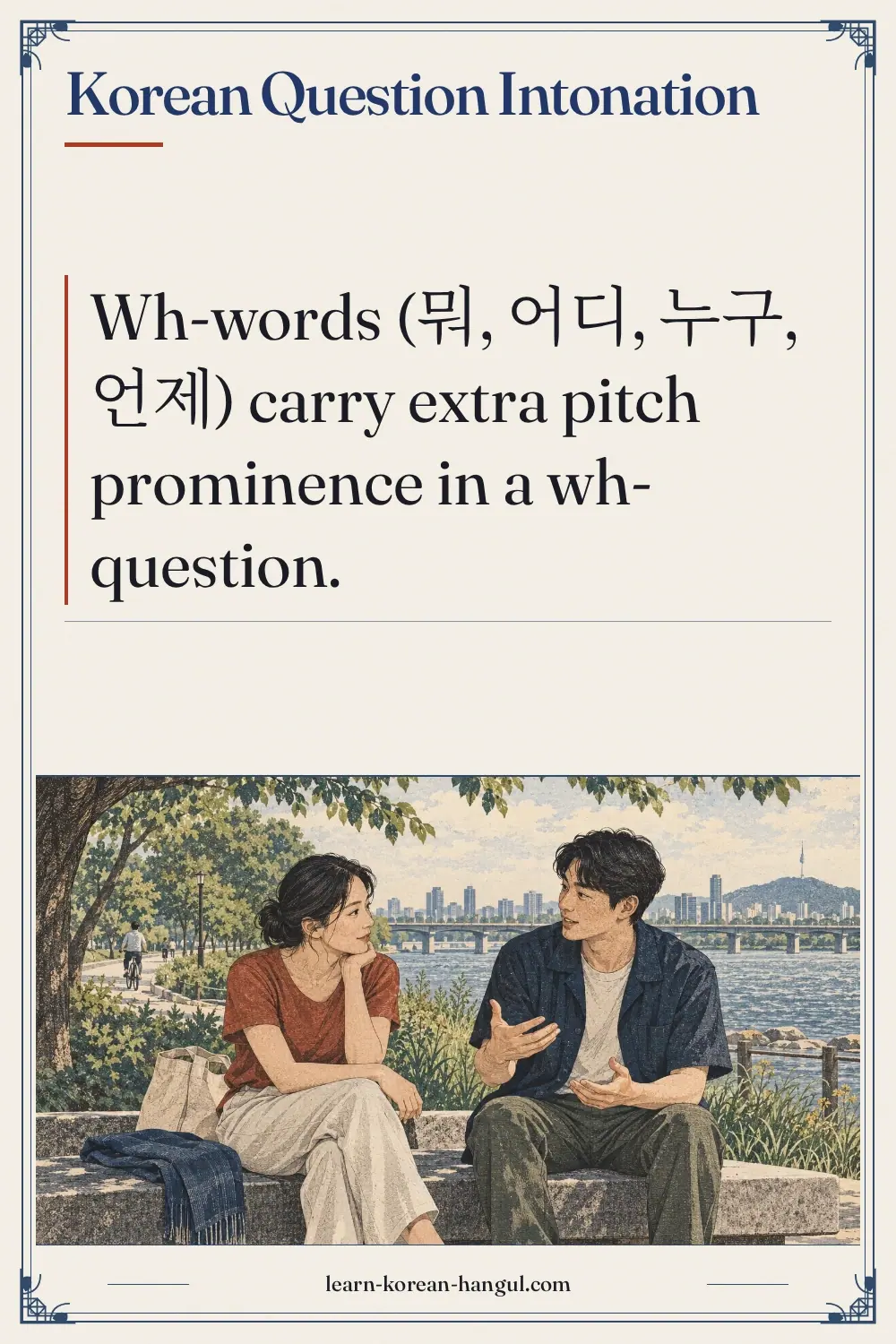
Korean question intonation usually raises the pitch at the end of a yes/no question that ends in -요, as in 괜찮아요? ↗ ("Are you OK?"), while wh-questions such as 뭐 해요? ("What are you doing?") put the prominence on the question word. The same words said with a falling end, 괜찮아요. ↘, are a statement.
What you'll learn
- Say 괜찮아요, 이거 맞아요, 뭐 해요 and 어디 가요 with the right pitch pattern.
- Turn a statement into a yes/no question by changing only the pitch.
- Tell a wh-question from a yes/no question by ear.
- Choose polite and casual question forms.
Prerequisites: you can read Hangul and you know the polite -요 ending. Review Korean stress first if you can. Estimated time: 25 minutes.
What Is Korean Question Intonation?
Korean question intonation is the pattern of pitch, the rise and fall of the voice, that tells a listener a sentence is a question. In Korean, a statement and a yes/no question can have exactly the same words. 괜찮아요. means "I'm fine." and 괜찮아요? means "Are you OK?" Only the pitch at the end changes.
This differs from English, which also changes word order or adds "do": "You are fine" becomes "Are you fine?" Korean keeps the order of 괜찮아요 and relies on pitch for the polite -요 style. The written form adds a question mark, but speech has no punctuation, so the voice has to carry the signal.
Pitch, rhythm and stress together are called prosody. The glossary entries on prosody and pitch accent define these terms. In this lesson, "rise" and "fall" mean what your ear hears at the end of a sentence. The next section looks at why this is hard for English speakers.
Why English Speakers Struggle with Question Pitch
English speakers struggle with Korean question pitch for three reasons, and none of them is that English lacks rising questions. English yes/no questions also rise. The first problem is placement. English spreads the rise over the last stressed word, while Korean puts it on the last syllable, often 요.
The second problem is wh-questions. English wh-questions usually fall at the end, as in "What are you doing?" ↘. A learner carries that fall into Korean 뭐 해요? and, in some contexts, that fits. A learner who uses uptalk, the English habit of rising at the end of statements, can make a Korean statement sound like a question.
The third problem is silence. English adds "do", "are" or "is" in front, so a listener hears a question coming. Korean 괜찮아요? gives no such warning. The listener learns it only at the last syllable. The next section starts with the pattern for yes/no questions.
How Do Yes/No Questions Sound?
Yes/no questions with -요 usually rise on the final syllable. The earlier syllables stay near the pitch of a normal statement, and the last syllable lifts. The rise is short and clear. Say 괜찮아요? as 괜찮아 at a steady level, then 요 higher.
Here is the pattern in four steps.
- Say the statement 괜찮아요 [괜차나요] with a falling end.
- Keep 괜찮아 the same.
- Start 요 at a higher pitch and let it rise a little.
- Add a small pause after it, as if you are waiting for an answer.
Other everyday yes/no questions use the same pattern: 이거 맞아요? (Is this right?), 좋아요? (Do you like it?), 있어요? (Is there?) and 먹어요? (Are you eating?). The rise is on 요 in each. The grammar behind yes/no questions is in yes-no questions. The wh-question pattern is different, so the next section covers it.
How Do Wh-Questions Sound?
In wh-questions, the question word carries extra pitch prominence, and the words after it are usually said lower and more compressed. A wh-question uses a word such as 뭐 (what), 어디 (where), 누구 (who) or 언제 (when). Because the question word already marks the sentence as a question, the end does not need a strong rise.
| Question | Spoken | Meaning | Pitch pattern |
|---|---|---|---|
| 뭐 해요? | [뭐 해요] | What are you doing? | high on 뭐, then lower |
| 어디 가요? | [어디 가요] | Where are you going? | high on 어디, then lower |
| 누구예요? | [누구예요] | Who is it? | high on 누구, then lower |
| 언제 와요? | [언제 와요] | When are you coming? | high on 언제, then lower |
The honest limit is that real speech varies. In friendly conversation, many speakers also end a wh-question with a gentle rise, which sounds warm. In neutral or firm speech, the end stays low or falls. Research on Korean describes this as variable, so treat the table as a safe default.
Pitch also tells listeners which kind of question they hear. 뭐 and 어디 can mean "something" and "somewhere" as well as "what" and "where". 어디 가요? with a high 어디 and a low end asks "Where are you going?" With 어디 kept low and a rise on 요, the same words ask "Are you going somewhere?", and the answer is 네 or 아니요. Next, compare statements and questions side by side.
How Does a Statement Differ from a Question?
A statement ends with a fall and a yes/no question ends with a rise on the same words. The table gives 14 minimal sentence pairs in which only the pitch differs. ↘ marks a fall, and ↗ marks a rise.
| Statement ↘ | Question ↗ | Meaning |
|---|---|---|
| 괜찮아요. | 괜찮아요? | I'm fine. / Are you OK? |
| 맞아요. | 맞아요? | That's right. / Is that right? |
| 가요. | 가요? | I'm going. / Are you going? |
| 먹어요. | 먹어요? | I eat. / Are you eating? |
| 좋아요. | 좋아요? | It's good. / Is it good? |
| 있어요. | 있어요? | There is. / Is there? |
| 없어요. | 없어요? | There isn't. / Isn't there? |
| 비싸요. | 비싸요? | It's expensive. / Is it expensive? |
| 알아요. | 알아요? | I know. / Do you know? |
| 지금 가요. | 지금 가요? | I'm going now. / Are you going now? |
| 커피 마셔요. | 커피 마셔요? | I drink coffee. / Do you drink coffee? |
| 이거 맞아요. | 이거 맞아요? | This is right. / Is this right? |
| 학생이에요. | 학생이에요? | I'm a student. / Are you a student? |
| 한국 사람이에요. | 한국 사람이에요? | I'm Korean. / Are you Korean? |
Read the table left to right. Say each pair aloud with only the last syllable changed. If a friend listens with their eyes closed, they should be able to tell which version you said. In writing, only the mark differs. The next section covers question signals other than pitch.
Question Markers besides Pitch
Many Korean question endings mark a question without needing a rise. These endings change the verb itself, so pitch matters less.
| Ending | Example | Meaning | Register |
|---|---|---|---|
| -ㅂ니까/-습니까 | 어디 가십니까? | Where are you going? | formal |
| -(으)ㄹ까요 | 같이 갈까요? | Shall we go together? | polite |
| -나요/-(으)ㄴ가요 | 괜찮나요? | Is it OK? (softer) | polite |
| -지요/-죠 | 맞죠? | Right? (checking) | polite |
Formal questions in -ㅂ니까 are usually said with a falling or only slightly rising end, because the ending already says "question". See formal question -ㅂ니까/습니까 and soft questions with -나요/-(으)ㄴ가요 for the grammar.
A frequent error is adding an extra question word or ending to show a question, when pitch alone is enough. Repeating the subject or adding an English-style helper word is not needed. Another error is the opposite: leaving out the rise in 괜찮아요? and making the listener guess from context. The next section covers casual and polite forms.
Polite and Casual Question Forms
Polite questions end in -요 and casual questions drop it. Both use the same rise. 괜찮아요? is polite and 괜찮아? is casual. Casual speech (반말, banmal) is for close friends, younger people and children. Using it with strangers or elders is rude.
| Polite | Casual | Meaning |
|---|---|---|
| 괜찮아요? | 괜찮아? | Are you OK? |
| 뭐 해요? | 뭐 해? | What are you doing? |
| 어디 가요? | 어디 가? | Where are you going? |
| 이거 맞아요? | 이거 맞아? | Is this right? |
When in doubt, use the polite form. The grammar of the polite style is in 해요체 polite speech, casual forms are in how to make banmal, and the choice between them is in when to use polite speech. The next section covers short echo questions.
What about Short Replies and Echo Questions?
Short echo questions repeat or ask about what someone just said, and they rise strongly. They are among the most common questions in daily speech, and they depend almost entirely on pitch.
| Echo question | Spoken | Meaning | Use |
|---|---|---|---|
| 네? | [네] | Pardon? / Really? | you did not hear or are surprised |
| 뭐요? | [뭐요] | What? | you did not hear the last word |
| 진짜요? | [진짜요] | Really? | you want confirmation |
The same word 네 means "yes" with a falling end and "pardon?" with a rise. Tone of voice and face change the meaning, so a rise that is too big can sound rude. Keep the rise small and add a polite smile when you ask a stranger to repeat. The next section follows one full question.
Worked Example: 괜찮아요?
The question 괜찮아요? shows the whole yes/no pattern. Follow these steps.
- Read the spoken form. 괜찮아요 is [괜차나요]. The ㅎ is silent before the vowel, and ㄴ links.
- Say the statement. 괜찮아요 ↘ with a fall at the end.
- Find the last syllable. It is 요.
- Lift 요. Keep 괜차나 level, then start 요 higher with a short rise.
- Check the pause. Wait for an answer for a moment.
- Compare. Play both clips and listen for the last syllable only.
You will know it worked when a listener with closed eyes hears a question. If it sounds like a statement, the rise is too small. If it sounds like surprise or doubt, the rise is too big. A small, quick lift is normal.
Common Learner Mistakes
Mistake 1: rising on every syllable. Learners often assume a question rises throughout. Actually the earlier syllables stay level, and only the last syllable rises. Fix: say 괜차나 flat first.
Mistake 2: treating wh-questions like yes/no questions. Learners often put a strong rise on 뭐 해요?. Actually the main prominence is on 뭐. A strong final rise adds an emotional tone, such as surprise. Fix: lift 뭐 and let 해요 fall.
Mistake 3: adding extra words. Learners often add an English-like question word before the sentence, such as "do" or a repeated subject. Actually pitch alone is enough in -요 questions. Fix: keep the statement order.
Mistake 4: ignoring the question mark. Learners often think the ? tells the listener enough. Actually speech has no marks. Fix: practise the pitch aloud.
Mistake 5: reading a statement with uptalk. Learners who rise at the end of every sentence in English carry the habit into Korean. Actually a rising statement sounds like a question or like hesitation. Fix: finish statements with a clear fall.
The practice set follows.
Key Terms Used in This Lesson
Three terms appear in the lesson, and each has a glossary entry.
- Prosody: the rhythm, stress and pitch of speech. See prosody.
- Pitch accent: use of pitch to mark words. Standard Seoul Korean does not use it the way Japanese does, although some regional dialects, such as Gyeongsang, do. See pitch accent.
- Accentual phrase: a small group of words said under one pitch pattern. See accentual phrase.
Practice: Say the Right Pitch
For each item, say it aloud and mark whether the end rises or falls.
- 괜찮아요? (Are you OK?)
- 괜찮아요. (I'm fine.)
- 뭐 해요? (What are you doing?)
- 이거 맞아요? (Is this right?)
- 어디 가요? (Where are you going?)
Answers.
- Rise on 요. A yes/no question.
- Fall on 요. A statement.
- Prominence on 뭐, then lower. A wh-question, with no strong final rise needed.
- Rise on 요. A yes/no question.
- Prominence on 어디, then lower. A wh-question.
If you got four or five right, move on. If you got fewer, repeat the 14-pair table.
Where to Go Next
The next lesson is Korean sentence-final intonation, which covers other endings and attitudes. For the grammar of questions, see Korean grammar, and for question phrases in conversation, see small talk. The section hub is Korean Intonation and Rhythm.
This lesson does not teach every question ending, rhetorical questions, or regional pitch patterns. Speakers outside Seoul use different contours, and some regions use rising endings more freely. In short, Korean question intonation means a short rise on the last syllable of a yes/no question, extra prominence on the question word in a wh-question, and a fall for statements.
Frequently Asked Questions
How do you ask a question in Korean? Keep the sentence as a statement and change the pitch or the ending. In the polite style, say the -요 sentence with a rise on 요: 괜찮아요? With a question word, add 뭐, 어디, 누구 or 언제 and lift it. Formal and soft endings such as -ㅂ니까 and -나요 also mark a question.
Does Korean rise at the end? In yes/no questions with -요, yes: the last syllable rises. In statements, no: the end falls. In wh-questions, the end often stays low, but friendly speech may rise gently. Formal -ㅂ니까 questions are typically falling or slightly rising. Listen to the clips and imitate them.
Do wh-questions rise? Not usually. The question word carries the prominence, and the end often falls or rises and then falls (a rise-fall). In warm, friendly speech many speakers add a soft rise at the end. Research describes this as variable, so use the falling pattern as a safe default and listen to local speakers.
How do I sound polite? Use the -요 ending, keep the rise small and add a pause. A large rise can sound surprised or pushy. Casual speech drops -요, so use it only with close friends or younger people. If you are unsure, choose the polite form, because it is safe with strangers and elders.