What you'll learn
- Form -았다, -었다 and -했다 on verbs, adjectives and 이다.
- Merge vowel-final stems correctly, as in 가+았다 to 갔다.
- Tell the plain past from the polite -았어요 and the formal -았습니다.
- Recognise the plain past in indirect speech, such as 비가 왔다고 했어요.
Before you start: you should know the past tense -았/었- with the polite ending -아요/어요. Time: about 30 minutes. This site places the pattern at level B1, which is an editorial estimate. The official TOPIK information is published at topik.go.kr.
What Does the Plain past -았다/었다 Mean?
The plain past -았다/었다 states that something happened, without any polite ending and without speaking to anyone in particular. It is the form you see when Korean describes the past in print: a diary entry, a news article, a story or a textbook example. The English meaning is the same as any simple past: "watched", "rained", "was".
The pattern is the past infix -았/었- followed by the plain statement ending -다. The infix carries the tense, and the -다 carries the style. Because this style does not address a listener, it neither shows respect nor shows closeness. It is the "neutral" past.
| Style | Form | Where you see it |
|---|---|---|
| Plain (해라체) | 봤다 | Diaries, news, novels, essays |
| Casual (해체) | 봤어 | Friends |
| Polite (해요체) | 봤어요 | Everyday speech |
| Formal (하십시오체) | 봤습니다 | Meetings, announcements |
A First Example
Listen to each sentence at normal speed, then slowly.
1. 어제 영화를 봤다. (eoje yeonghwareul bwatda.) "I watched a movie yesterday."
Pronunciation: [어제 영화를 봗따]. The ㅆ of 봤 is read as [ㄷ], and the ㄷ of 다 becomes tense.
2. 밤새 비가 왔다. (bamsae biga watda.) "It rained all night."
Pronunciation: [밤새 비가 왇따]. The same ending sound appears: ㅆ is read as [ㄷ] and 다 is tense.
Neither sentence is addressed to a listener. The first reads like a diary line, and the second like a line from a story.
How Does the Plain past -았다/었다 Work?
The rule is the one for the past tense -았/었-: look at the last vowel of the stem. Then end with 다.
- After ㅏ or ㅗ, add 았다.
- After any other vowel, add 었다.
- For 하다 verbs, use 했다.
- For 이다, use 이었다 after a consonant and 였다 after a vowel.
Pattern Table
| Dictionary form | Stem | Last vowel | Plain past | Spoken |
|---|---|---|---|---|
| 먹다 (to eat) | 먹 | ㅓ | 먹었다 | [머걷따] |
| 읽다 (to read) | 읽 | ㅣ | 읽었다 | [일걷따] |
| 가다 (to go) | 가 | ㅏ | 갔다 | [갇따] |
| 오다 (to come) | 오 | ㅗ | 왔다 | [왇따] |
| 보다 (to see) | 보 | ㅗ | 봤다 | [봗따] |
| 마시다 (to drink) | 마시 | ㅣ | 마셨다 | [마셛따] |
| 배우다 (to learn) | 배우 | ㅜ | 배웠다 | [배웓따] |
| 하다 (to do) | 하 | ㅏ (하다 verb) | 했다 | [핻따] |
| 학생이다 (to be a student) | 학생이 | 이 | 학생이었다 | [학쌩이얻따] |
The RR forms are meogeotda, ilgeotda, gatda, watda, bwatda, masyeotda, baewotda and haetda. Notice that RR writes the final ㅆ as t before 다, because that is how it sounds.
Vowel-Final Stems Merge with the Infix
When a stem ends in a vowel, the stem and the infix fuse into one syllable that carries the ㅆ. The merger is the same as in the polite past, so 가 + 았다 gives 갔다 and 보 + 았다 gives 봤다. The lesson on past tense -았/었- shows all the mergers in detail.
Adjectives and Irregular Verbs
Adjectives take the same endings. 크다 becomes 컸다, 예쁘다 becomes 예뻤다, and 춥다 becomes 추웠다. The irregular groups behave as they do in the polite past.
| Dictionary form | Irregular type | Plain past | Spoken |
|---|---|---|---|
| 듣다 (to hear) | ㄷ-irregular | 들었다 | [드럳따] |
| 돕다 (to help) | ㅂ-irregular | 도왔다 | [도왇따] |
| 모르다 (not to know) | 르-irregular | 몰랐다 | [몰랃따] |
| 낫다 (to recover) | ㅅ-irregular | 나았다 | [나앋따] |
| 크다 (to be big) | ㅡ-drop | 컸다 | [컫따] |
| 예쁘다 (to be pretty) | ㅡ-drop | 예뻤다 | [예뻗따] |
The conjugation procedure and the irregular groups are taught in past tense irregular verbs.
Worked Example: Building a Sentence in the Plain Past
Goal: write a diary line meaning "I met a friend today."
- Choose the verb. 만나다 (to meet). The stem is 만나.
- Look at the last vowel. 나 ends in ㅏ, so the infix is 았.
- Merge. 나 + 았 becomes 났: 만났.
- Add the plain ending. 만났 + 다 = 만났다.
- Add the rest. 오늘 (today) 친구를 (a friend, with the object particle).
Result: 오늘 친구를 만났다. (oneul chingureul mannatda.) "I met a friend today."
Pronunciation: [오늘 친구를 만낟따]. The ㅆ of 났 is read as [ㄷ], and the ㄷ of 다 is tense, so 만났다 sounds like [만낟따].
Reference Examples
| Style | Form | Where you see it |
|---|---|---|
| Plain (해라체) | 봤다 | Diaries, news, novels, essays |
| Casual (해체) | 봤어 | Friends |
| Polite (해요체) | 봤어요 | Everyday speech |
| Formal (하십시오체) | 봤습니다 | Meetings, announcements |
| Dictionary form | Stem | Last vowel | Plain past | Spoken |
|---|---|---|---|---|
| 먹다 (to eat) | 먹 | ㅓ | 먹었다 | [머걷따] |
| 읽다 (to read) | 읽 | ㅣ | 읽었다 | [일걷따] |
| 가다 (to go) | 가 | ㅏ | 갔다 | [갇따] |
| 오다 (to come) | 오 | ㅗ | 왔다 | [왇따] |
| 보다 (to see) | 보 | ㅗ | 봤다 | [봗따] |
| 마시다 (to drink) | 마시 | ㅣ | 마셨다 | [마셛따] |
| 배우다 (to learn) | 배우 | ㅜ | 배웠다 | [배웓따] |
| 하다 (to do) | 하 | ㅏ (하다 verb) | 했다 | [핻따] |
| 학생이다 (to be a student) | 학생이 | 이 | 학생이었다 | [학쌩이얻따] |
| Dictionary form | Irregular type | Plain past | Spoken |
|---|---|---|---|
| 듣다 (to hear) | ㄷ-irregular | 들었다 | [드럳따] |
| 돕다 (to help) | ㅂ-irregular | 도왔다 | [도왇따] |
| 모르다 (not to know) | 르-irregular | 몰랐다 | [몰랃따] |
| 낫다 (to recover) | ㅅ-irregular | 나았다 | [나앋따] |
| 크다 (to be big) | ㅡ-drop | 컸다 | [컫따] |
| 예쁘다 (to be pretty) | ㅡ-drop | 예뻤다 | [예뻗따] |
| Style | Form | Speaker and listener | Typical place |
|---|---|---|---|
| Plain 해라체 | 봤다 | No listener; or a child | Diary, news, novel |
| Polite 해요체 | 봤어요 | Equals and elders | Daily conversation |
| Formal 하십시오체 | 봤습니다 | Public or business | Meetings, announcements |
Sentence
How Is -았다/-었다 Different from Similar Forms?
The three past statement endings differ only in the last part. The infix is the same.
| Style | Form | Speaker and listener | Typical place |
|---|---|---|---|
| Plain 해라체 | 봤다 | No listener; or a child | Diary, news, novel |
| Polite 해요체 | 봤어요 | Equals and elders | Daily conversation |
| Formal 하십시오체 | 봤습니다 | Public or business | Meetings, announcements |
A sentence in each style, for the same event, makes the difference visible.
- 영화를 봤다. (yeonghwareul bwatda.) Plain, no listener.
- 영화를 봤어요. (yeonghwareul bwasseoyo.) Polite, in conversation. Pronunciation: [영화를 봐써요].
- 영화를 봤습니다. (yeonghwareul bwatseumnida.) Formal, in a meeting. Pronunciation: [영화를 봗씀니다].
The difference between plain and polite is not only an ending, but a social choice. A plain past said to a teacher sounds blunt, because the ending shows no respect. The plain past is also not casual banmal. Banmal ends in -아/어 (봤어), and it is for friends. For all three, see Korean plain style 해라체.
When Do You Use It, and When Not?
Writing about the past. Use 았다/었다 in a diary, an essay, a report, a story or a blog post in plain style. A news article states events in the same form: 경찰은 사고 원인을 조사했다 (gyeongchareun sago woinineul josahaetda) "The police investigated the cause of the accident." Pronunciation: [경차른 사고 워니늘 조사핻따].
Speaking to yourself. Plain past forms are common as exclamations. 늦었다! (neujeotda!) "Oh no, I'm late!" Pronunciation: [느젇따]. And 드디어 끝났다! (deudieo kkeunnatda!) "It's finally over!" Pronunciation: [드디어 끈낟따].
Indirect speech. The quoting endings use the plain form. When you report a past event, 았다/었다 sits inside the quote: 비가 왔다고 했어요 (biga watdago haesseoyo) "He said it rained." Pronunciation: [비가 왇따고 해써요]. The same form works in a noun clause: 비가 왔다는 소식 (biga watdaneun sosik) "the news that it rained", pronounced [비가 왇따는 소식].
When not to use it. Do not use the plain past with someone you must respect, in a polite email, or in a spoken interview. In those places, switch to 봤어요 or 봤습니다. Do not mix the plain past and the polite past in one text either.
What Mistakes Do Learners Make?
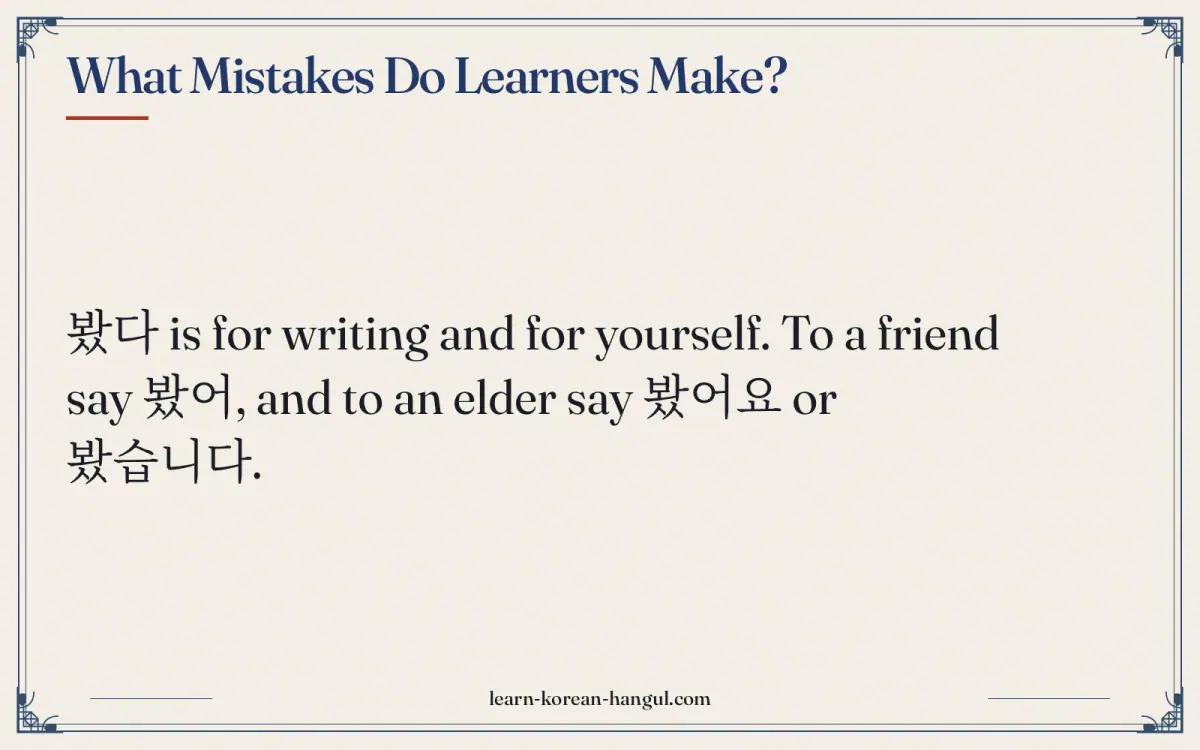
- Using 았다 in a polite conversation. Telling an older person 어제 영화를 봤다 sounds blunt. Use 봤어요 or 봤습니다.
- Adding -요 to the plain form. 봤다요 is not a standard form. The polite form is 봤어요.
- Using 았 after ㅓ. 먹았다 is wrong, and 먹었다 is right. Check the last vowel of the stem.
- Not merging. 가았다 and 보았다 are not used in speech. Write 갔다 and 봤다. (보았다 does exist in formal writing, but 봤다 is the normal form.)
- Writing 하었다. The past of 하다 is 했다, and the formal-writing variant is 하였다.
- Dropping 이다. For nouns, the plain past is 학생이었다 or 의사였다, not 학생이다 or 의사다, which are present.
- Using -ㄴ다 on a past event. 어제 갔다 is right, and 어제 간다 mixes the present with a past time word.
Reading Practice: a Short Diary
A diary is the clearest place to see the plain past at work. Read the entry below. Every sentence ends in -다, the subject "I" is left out, and there is no politeness marker anywhere.
오늘은 토요일이었다. 아침에 늦게 일어났다. 점심에는 친구를 만났다. 우리는 카페에서 커피를 마셨다. 저녁에는 숙제를 했다. 일찍 잤다.
(oneureun toyoirieotda. achime neutge ireonatda. jeomsimeneun chingureul mannatda. urineun kapeeseo keopireul masyeotda. jeonyeogeneun sukjereul haetda. iljjik jatda.)
"Today was Saturday. I got up late in the morning. I met a friend at lunch. We drank coffee at a café. In the evening I did my homework. I went to bed early."
The spoken forms are [오느른 토요이리얻따], [아치메 늗께 이러낟따], [점시메는 친구를 만낟따], [우리는 카페에서 커피를 마셛따], [저녀게는 숙쩨를 핻따] and [일찍 잗따].
Use the entry as a checklist.
- 토요일이었다 is a noun plus 이었다, because 토요일 ends in a consonant.
- 일어났다, 만났다 and 잤다 are merged forms: 나 + 았다 and 자 + 았다.
- 마셨다 comes from 마시 + 었다, which merges into 셨다.
- 했다 is the past of 하다, even inside the noun phrase 숙제를 했다.
- The same entry in polite speech would end every sentence with 어요, for example 일찍 잤어요.
Try reading the entry aloud, then change each ending to -어요 to hear how the style changes. This simple exercise trains both forms at once.
Practice and Answers
Try all four items before you read the answers. Each answer has audio.
Practice · 6
What is the plain past of 먹다 for a diary entry?
Show answer
먹었다
The last vowel of 먹 is ㅓ, so the infix is 었: 먹었다.
What is the usual plain past of 보다?
Show answer
봤다
보 + 았다 merges into 봤다.
What is the plain past of the noun phrase 학생이다 (to be a student)?
Show answer
학생이었다
After a consonant, 이다 takes 이었다; 학생이다 is the present.
Which sentence suits a diary?
Show answer
오늘 친구를 만났다.
A diary uses the plain statement ending -다 with no listener.
You are telling your teacher what you did yesterday. Which form fits?
Show answer
어제 영화를 봤어요.
With a teacher, use the polite 봤어요. The plain 봤다 sounds blunt, and 봤다요 is not a standard form.
What is the past of 하다 in plain style?
Show answer
했다
하다 becomes 했다 (하였다 in formal writing); 하었다 is wrong.
- Choose the form. A diary entry: 오늘 김치찌개를 먹었다 or 오늘 김치찌개를 먹았다?
- Fix the error. In a polite talk with a teacher: 선생님, 어제 영화를 봤다.
- Translate. "It rained all night."
- Write your own. Write one diary line about yesterday using the plain past.
Answer Key
- 오늘 김치찌개를 먹었다. (oneul gimchijjigaereul meogeotda.) Pronunciation: [오늘 김치찌개를 머걷따]. The last vowel of 먹 is ㅓ, so the infix is 었.
- 선생님, 어제 영화를 봤어요. (seonsaengnim, eoje yeonghwareul bwasseoyo.) Pronunciation: [선생님 어제 영화를 봐써요]. With a teacher, replace the plain ending with the polite 어요.
- 밤새 비가 왔다. (bamsae biga watda.) Pronunciation: [밤새 비가 왇따]. 오 + 았다 merges to 왔다.
- Sample answer: 어제 도서관에서 책을 읽었다. (eoje doseogwaneseo chaegeul ilgeotda.) "Yesterday I read a book at the library." Pronunciation: [어제 도서과네서 채글 일걷따]. Any past sentence ending in a correct 았다/었다 is right.
If a sentence went wrong, check three things: the last vowel of the stem, whether vowel-final stems merged, and whether the listener allows a plain ending.
Next Lessons and Where to Go from Here
The matching lesson for the present is plain present -는다/ㄴ다. For the polite and formal forms, review past tense -았/었-. To make a past statement about a noun, study 이었어요/였어요 past of 이다. The set overview, Korean past tense, lists every lesson in order.
This page uses Revised Romanization only as a learning aid. The Hangul is the reference. To remember the idea in one line: the plain past adds 았다 or 었다 by the last vowel (했다 for 하다), and it belongs in writing, not in polite talk.
Frequently Asked Questions
What Is the Plain past -았다/었다?
It is the non-polite past form of Korean. It is made of the past infix -았/었- plus the plain statement ending -다, and it is used in narration, news, diaries, essays and reported statements. 어제 영화를 봤다 means "I watched a movie yesterday".
How Do I Form -았다/-었다?
Add 았다 after the vowels ㅏ and ㅗ, 었다 after other vowels, and 했다 to 하다 verbs. Vowel-final stems merge: 가 + 았다 becomes 갔다 and 보 + 았다 becomes 봤다. For 이다, use 이었다 after a consonant and 였다 after a vowel.
What Is the Most Common Mistake with -았다/-었다?
The most common mistake is using the plain past in polite conversation, which sounds blunt to an older person. Say 봤어요 or 봤습니다 instead of 봤다. Another is using 았 after ㅓ, as in 먹았다, when 먹었다 is right.
How Is -았다/-었다 Different from -았어요 and -았습니다?
The infix is the same, and only the last ending changes. -았다/었다 is the plain style for writing, -았어요 is polite everyday speech, and -았습니다 is formal speech. The plain style does not address a listener and shows no respect.
Do I Use -았다/-었다 in Speech, Writing or Both?
Mostly writing: diaries, news, stories and essays. In speech it appears as an exclamation to yourself, such as 늦었다!, or to young children. With adults you must respect, use -았어요 or -았습니다 instead.
Why Does 비가 왔다고 했어요 Contain -았다?
Indirect speech is built on the plain form of what was said. The quoted event 비가 왔다 ("it rained") keeps its plain past, then 고 했어요 reports it. The same form works as a modifier: 비가 왔다는 소식 means "the news that it rained".