
The Korean present tense is one set of verb endings that covers actions happening now, habits, general facts, current states and near-future plans. 먹어요 can mean "I eat", "I'm eating" or "I'll eat". This hub lists the three present-tense lessons in learning order and helps you pick the right one for the sentence you want to say.
What Is the Korean Present Tense?
The Korean present tense is the verb form for actions and states that are current, habitual, generally true or already planned. It is built by adding an ending to the verb stem, the part left when you remove 다 from the dictionary form. The ending changes with the speech level, but the meaning stays the same.
| Speech level | 먹다 (to eat) | 가다 (to go) | 좋다 (to be good) | Where it is used |
|---|---|---|---|---|
| Polite (해요체) | 먹어요 | 가요 | 좋아요 | everyday talk with adults |
| Formal (합쇼체) | 먹습니다 | 갑니다 | 좋습니다 | news, presentations |
| Casual (해체) | 먹어 | 가 | 좋아 | close friends |
| Plain written (해라체) | 먹는다 | 간다 | 좋다 | books, diaries, newspapers |
Two facts surprise most English speakers. First, Korean has no separate present continuous: 먹어요 already covers "I'm eating". Second, adjectives conjugate like verbs, so 좋아요 means "is good" with no separate word for "is". The rules for building the polite forms from any stem are drilled in korean present tense conjugation; this hub is about meaning and use. The next section shows where to start.
Where Should You Start with the Korean Present Tense?

Start with the polite present, then adjectives, then the plain written form. That order follows how often you will need each form in conversation.
- Korean present tense uses (A1). Learn the -아요/어요 present and its five jobs: now, habit, fact, state and plan. After it, you can describe your routine and your plans in polite Korean.
- Adjective present tense in korean (A1). Learn how adjectives such as 좋다 and 바쁘다 take the same endings to describe how things are. After it, you can say how you feel and what something is like.
- Plain present -는다/ㄴ다 (B1). Learn the plain present used in writing and diaries. After it, you can read and write diary entries, essays and news-style sentences.
A typical study time is one sitting of 20 to 30 minutes per lesson, plus practice. The next section summarizes each lesson in more detail.
Browse the Present Tense Lessons

Each published lesson below has audio examples, a pattern table, common mistakes and practice with answers.
Korean Present Tense Uses
The lesson on korean present tense uses teaches the polite -아요/어요 present and when it means now, a habit, a fact, a state or a plan. It contrasts the simple present with -고 있어요 and -(으)ㄹ 거예요. Example: 저는 매일 커피를 마셔요. (jeoneun maeil keopireul masyeoyo) = "I drink coffee every day."
Adjective Present Tense in Korean
The lesson on adjective present tense in korean covers descriptive verbs, the Korean word class that does the work of English adjectives. It explains why 날씨가 좋아요 needs no word for "is" and why adjectives cannot take -고 있어요. Example: 오늘은 날씨가 좋아요. = "The weather is nice today."
Plain Present -는다/ㄴ다
The plain present -는다/ㄴ다 lesson teaches the present used in writing and diaries. Example: 나는 매일 일기를 쓴다. = "I write in my diary every day."
With the lessons mapped, the next section helps you choose one for a specific sentence.
Which Lesson Fits Your Sentence?
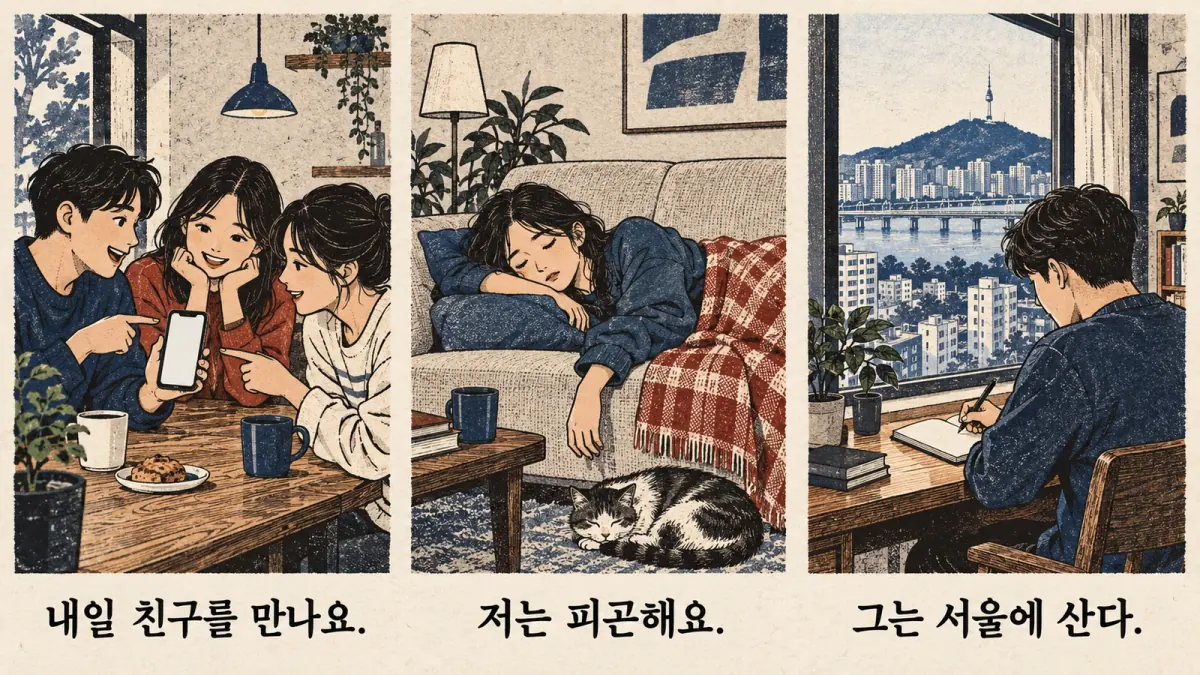
Choose the lesson by the kind of sentence you want to make. The table answers the five questions learners ask most often.
| If you want to... | Example | Open this lesson |
|---|---|---|
| Talk about your routine or plans politely | 내일 친구를 만나요. | Korean present tense uses |
| Say how something is or how you feel | 저는 피곤해요. | Adjective present tense in korean |
| Read or write a diary, essay or news text | 그는 서울에 산다. | Plain present -는다/ㄴ다 |
| Stress that an action is happening right now | 지금 먹고 있어요. | Progressive |
| Build the polite form of any new verb | 마시다 → 마셔요 | Korean present tense conjugation |
If you are not sure, start with the first row. The polite present is the form you will use in most conversations. The next section lists the first mistake to avoid.
What Mistakes Should You Avoid First?
The most common first mistake is looking for separate forms for "I eat" and "I am eating". In Korean, 먹어요 covers both; -고 있어요 is an optional way to stress the action in progress.
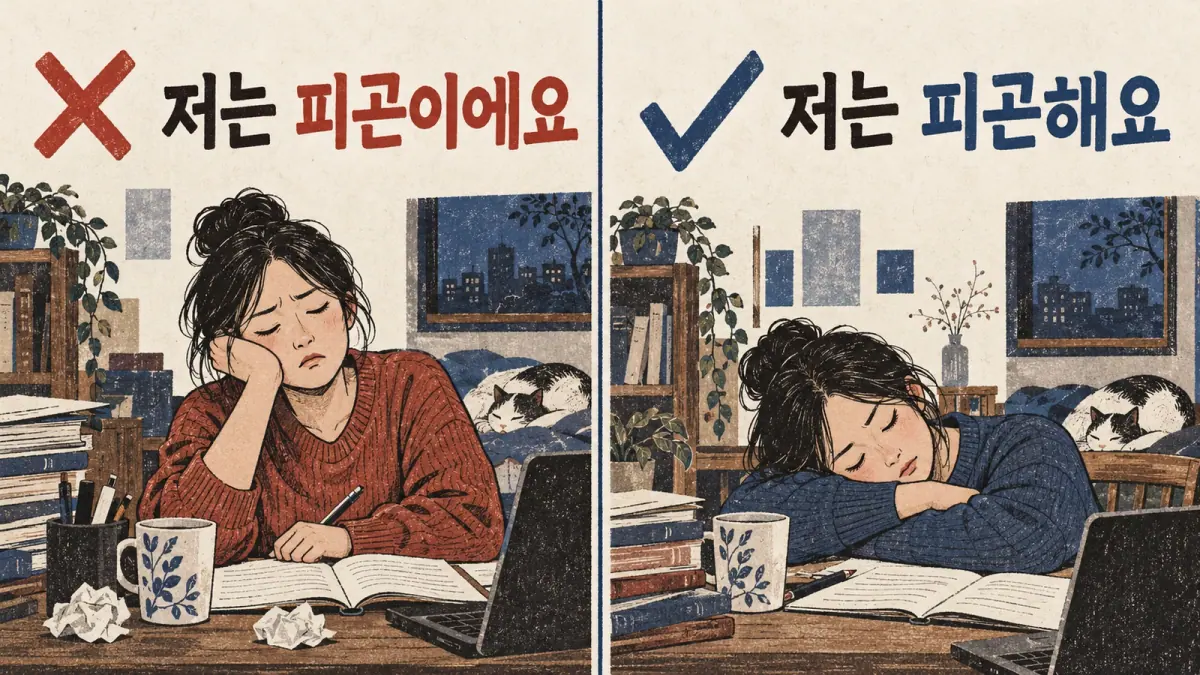
Two more early mistakes are worth knowing. Learners often add 이에요 to adjectives, as in 저는 피곤이에요; the correct form is 저는 피곤해요. Learners also keep the present with 어제 (yesterday), but a finished event always needs the korean past tense. Plans, however, can stay in the present: 내일 가요 means "I'm going tomorrow", while predictions usually move to the korean future tense.
How Do You Practise the Present Tense?
Practise by building forms, then checking yourself, then reviewing. The site's tools cover each step.
- Build forms: type any verb into the korean verb conjugator to see its present forms at every speech level.
- Check yourself: the korean tenses quiz mixes present, past and future items with feedback after each answer.
- Review: the beginner korean grammar flashcards include the present endings with audio.
What this hub covers and doesn't. This hub covers the meaning and use of present forms. Irregular verbs, honorific -(으)세요 and the progressive have their own sections, and every tense is listed on the korean tenses hub. Korean examples on these pages are model-checked and waiting for review by a human Korean reviewer.
In short, the Korean present tense is one flexible form for now, habits, facts, states and plans; start with the polite -아요/어요 lesson and add the others as you need them.
Frequently Asked Questions
Does Korean have a separate present continuous? No separate tense, but there is an optional pattern. The simple present 먹어요 covers both "I eat" and "I'm eating". When you want to stress that an action is in progress right now, add -고 있어요: 지금 먹고 있어요. Many learners overuse it at first; the simple present is usually enough.
How do adjectives work in the present? Korean adjectives are descriptive verbs, so they take the same present endings as action verbs: 좋다 becomes 좋아요 and 바쁘다 becomes 바빠요. The form already includes "is", so 날씨가 좋아요 means "The weather is nice". Adjectives cannot take -고 있어요, and in the plain written style they stay in the dictionary form.
Which present tense lesson should I read first? Read the lesson on Korean present tense uses first. It teaches the polite -아요/어요 form, which you will use in most conversations, and its five meanings. Then read the adjective lesson, because describing things uses the same endings. Leave the plain written present -는다/ㄴ다 until you start reading books or writing a diary.
What level is the Korean present tense? The polite present and adjectives in the present are A1, the first level of the CEFR scale and the start of TOPIK I preparation. Most beginner textbooks teach -아요/어요 in the first few chapters. The plain written present -는다/ㄴ다 is usually taught around B1, when learners begin reading longer texts.