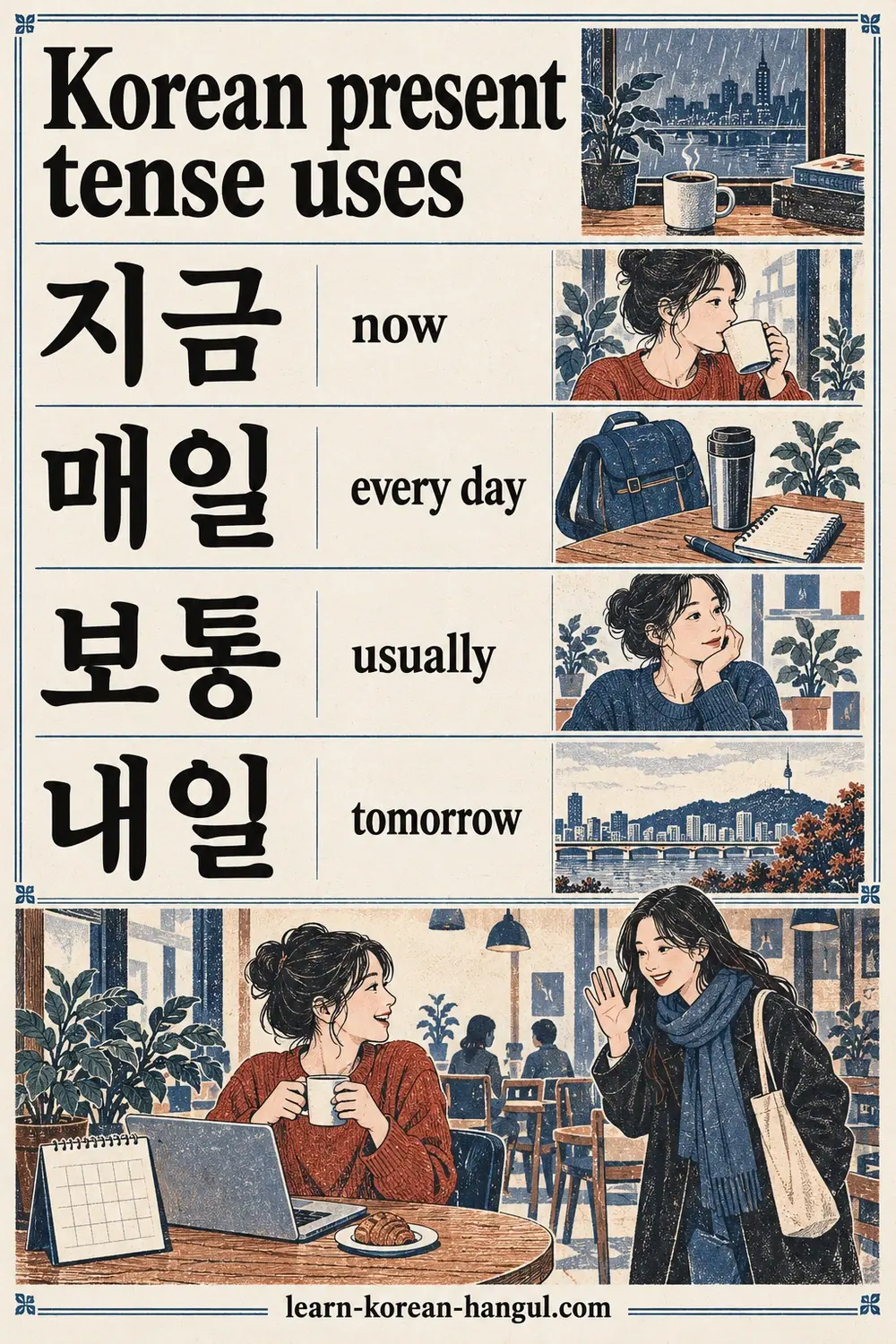
Korean present tense uses are the jobs that one polite verb form, -아요/어요, does in everyday Korean: actions happening now, habits, general facts, current states and near-future plans. 마셔요 can mean "I drink", "I'm drinking" or "I'll drink", depending on context and time words. After this lesson you can choose the present confidently and know when another form fits better.
What you'll learn
- Identify which of the five uses a present-tense sentence has.
- Build a present-tense sentence such as 저는 매일 커피를 마셔요 from a dictionary form.
- Distinguish the simple present from -고 있어요 and -(으)ㄹ 거예요.
- Fix the errors 저는 피곤이에요 and 어제 친구를 만나요.
Before you start: you can read Hangul and know that the verb comes last in Korean. Estimated time: 20 minutes.
What Are the Korean Present Tense Uses?

The Korean present tense uses fall into five groups, all expressed by the same polite ending -아요/어요. The ending is attached to a verb or adjective stem: the part left when you remove 다 from the dictionary form.
| Use | Signal words | Example | Meaning |
|---|---|---|---|
| Action now | 지금 (now) | 지금 비가 와요. | It's raining now. |
| Habit or routine | 매일 (every day), 보통 (usually) | 저는 매일 커피를 마셔요. | I drink coffee every day. |
| General fact | none needed | 물은 100도에서 끓어요. | Water boils at 100 degrees. |
| Current state | 요즘 (these days) | 저는 서울에 살아요. | I live in Seoul. |
| Near-future plan | 내일 (tomorrow), 다음 주 (next week) | 내일 친구를 만나요. | I'm meeting a friend tomorrow. |
English needs at least three tenses to cover that table: "I drink", "I'm drinking" and "I'm meeting". Korean uses one. The term for this form in Korean grammar is 현재 시제 (present tense), and the polite style it belongs to is called 해요체 (haeyo-che).
A First Example
The two sentences below show the same ending doing two different jobs: a habit and a plan.
- 저는 매일 커피를 마셔요. (jeoneun maeil keopireul masyeoyo) = "I drink coffee every day." Word by word: 저는 (I, topic) + 매일 (every day) + 커피를 (coffee, object) + 마셔요 (drink).
- 내일 친구를 만나요. (naeil chingureul mannayo) = "I'm meeting a friend tomorrow." Word by word: 내일 (tomorrow) + 친구를 (friend, object) + 만나요 (meet).
In the first sentence, 매일 makes 마셔요 a habit. In the second, 내일 makes 만나요 a plan. The verb ending is identical in kind; the time word does the work. The next section explains why Korean can afford this.
Why Does One Korean Form Cover so Much?

One Korean form covers so much because Korean marks the past clearly and leaves the rest to context. The present form is the default: it means "not past", and time words narrow it down.
English grammar forces a choice between "I eat" and "I am eating" in every sentence. Korean grammar does not. If the difference matters, Korean adds a word, such as 지금 (now), or uses a special pattern, such as -고 있어요 for an action in progress. If it does not matter, the plain present is enough.
That design makes the present the most useful form for a beginner. With one ending per verb, you can talk about your routine, your plans and what is going on around you. With that purpose clear, the next section shows how the form is built.
How Is the -아요/어요 Present Formed?
The -아요/어요 present is formed in three steps: remove 다, check the last vowel of the stem, and add the matching ending. Only the vowel decides between 아요 and 어요.
- Remove 다 from the dictionary form: 마시다 → 마시.
- Check the last vowel of the stem. If it is ㅏ or ㅗ, add 아요. For any other vowel, add 어요.
- For 하다 verbs, use 해요: 공부하다 → 공부해요.
- Merge vowels where they meet, as in 마시 + 어요 → 마셔요.
| Dictionary form | Meaning | Stem | Rule | Present (polite) |
|---|---|---|---|---|
| 살다 | to live | 살 | ㅏ → 아요 | 살아요 |
| 좋다 | to be good | 좋 | ㅗ → 아요 | 좋아요 [조아요] |
| 가다 | to go | 가 | ㅏ + 아요 merge | 가요 |
| 오다 | to come | 오 | ㅗ + 아요 merge | 와요 |
| 먹다 | to eat | 먹 | other → 어요 | 먹어요 [머거요] |
| 마시다 | to drink | 마시 | ㅣ + 어요 merge | 마셔요 |
| 배우다 | to learn | 배우 | ㅜ + 어요 merge | 배워요 |
| 공부하다 | to study | 공부하 | 하다 → 해요 | 공부해요 |
This table is a summary. The full recipe, with every vowel merge and the irregular verbs, is on the page on how to conjugate korean verbs in present tense. The drill set for building forms from any stem is in korean present tense conjugation. With the form in hand, the next section builds one sentence.
Worked Example, Step by Step

This worked example builds 저는 매일 커피를 마셔요 ("I drink coffee every day"). You are telling a new coworker about your morning routine.
- Set the topic. You are talking about yourself, so start with 저는.
- Add the time word. The sentence is a habit, so add 매일 (every day). Time words usually come early in the sentence.
- Add the object. Coffee is what you drink. 커피 ends in a vowel, so it takes 를: 커피를.
- Take the verb. To drink is 마시다. Remove 다 to get the stem 마시.
- Choose the ending. The last vowel is ㅣ, which is not ㅏ or ㅗ, so add 어요: 마시 + 어요.
- Merge the vowels. 시 + 어 merges into 셔, giving 마셔요.
- Put the verb last. Korean ends with the verb: 저는 매일 커피를 마셔요. The lesson on the korean sov sentence pattern explains why.
You'll know it worked when you can change the time word and the meaning shifts while the verb stays the same. Replace 매일 with 지금 and the sentence means "I'm drinking coffee now". Replace it with 이따가 (later today) and it becomes a plan. The next section looks at each use in detail.
The Five Uses in Detail
Each of the five Korean present tense uses below follows the same order: what it means, the words that signal it, and an example with audio.
Use 1: Actions Happening Now
The present describes an action in progress at the moment of speaking. The signal word is 지금 (now), though context often makes it unnecessary.
지금 뭐 해요? 숙제해요. = "What are you doing now? I'm doing homework."
Use 2: Habits and Routines
The present describes something you do regularly. Signal words include 매일 (every day), 보통 (usually), 자주 (often) and 주말마다 (every weekend).
저는 주말마다 등산해요. = "I go hiking every weekend."
Use 3: General Facts
The present states facts that are always true, often without any time word. Science, definitions and descriptions of how things work all use it.
물은 100도에서 끓어요. (mureun baekdoeseo kkeureoyo) [무른 백또에서 끄러요] = "Water boils at 100 degrees."
Use 4: Current States and Situations
The present describes how things are now, including where you live, what you do these days and how something is. Adjectives always use this form for a present state: 날씨가 좋아요 (The weather is nice). Adjectives have their own lesson, adjective present tense in korean.
요즘 한국어를 배워요. = "These days I'm learning Korean."
Use 5: near-Future Plans and Schedules
The present describes a fixed plan or a timetable, as long as a time word shows the future. Signal words include 내일 (tomorrow), 다음 주에 (next week) and a clock time.
영화가 일곱 시에 시작해요. (yeonghwaga ilgop sie sijakaeyo) [영화가 일곱 씨에 시자캐요] = "The movie starts at seven."
One Form for Statements, Questions and Suggestions
The same -아요/어요 form also works as a question, a suggestion or a soft request. Intonation and context tell them apart. 같이 가요. with falling intonation means "Let's go together"; 같이 가요? with rising intonation means "Shall we go together?" or "Are you coming with us?" Knowing that one form does many jobs raises the question of when a different form is better, which the next section answers.
How Is the Present Different from -고 있어요 and -(으)ㄹ 거예요?
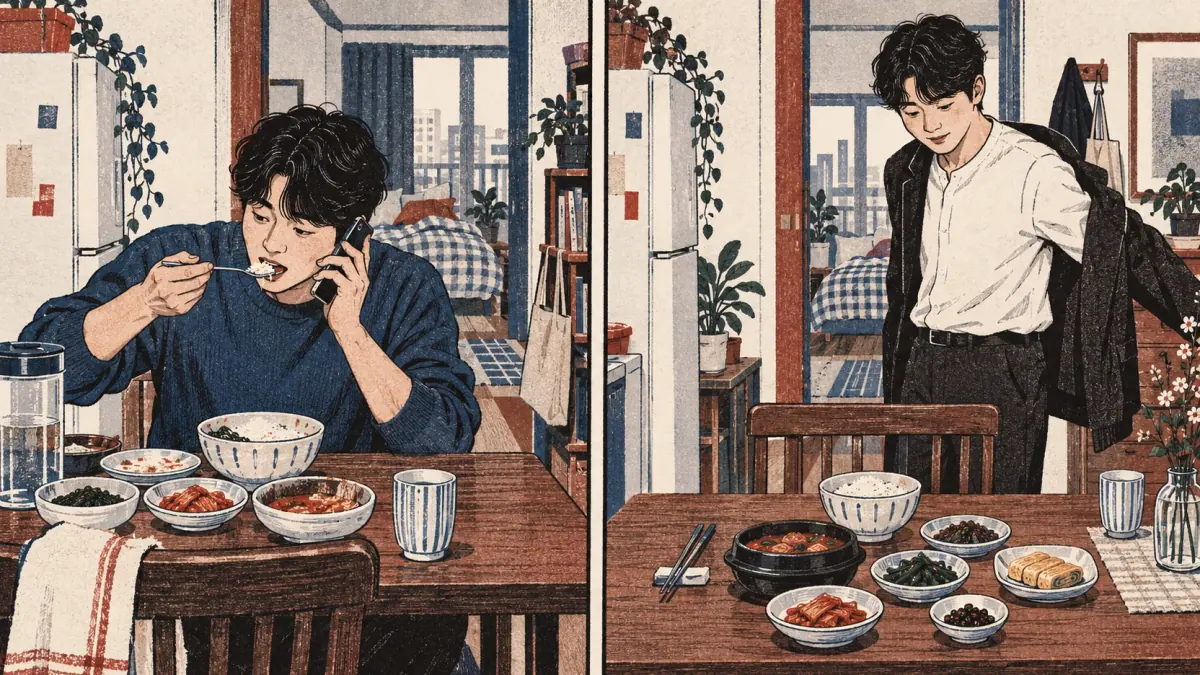
The simple present covers "now", "habit" and "plan" in one form, while -고 있어요 stresses an action in progress and -(으)ㄹ 거예요 stresses a future intention or prediction. Use the simple present by default and switch only when you need the extra meaning.
| Form | Example | Meaning | Best for |
|---|---|---|---|
| -아요/어요 (present) | 밥을 먹어요. | I eat / I'm eating / I'll eat. | default; habits, facts, fixed plans |
| -고 있어요 (progressive) | 밥을 먹고 있어요. | I'm eating (right now). | stressing an action in progress |
| -(으)ㄹ 거예요 (future) | 밥을 먹을 거예요. | I'm going to eat. | intentions and predictions |
| -았/었어요 (past) | 밥을 먹었어요. | I ate. | finished actions |
The progressive is taught in progressive -고 있다, and the future in future tense -(으)ㄹ 거예요. The past form, which is the one Korean always marks, is in past tense -았/었-.
A practical rule of thumb: when someone asks 지금 뭐 해요? (What are you doing now?), both 숙제해요 and 숙제하고 있어요 are correct. The second sounds more like "I'm in the middle of it". The next section covers the places where the present is the wrong choice.
When Should You Not Use the Present?

Do not use the present for predictions, finished events or promises, and switch to other endings in formal writing. In each case, a different form is clearer.
- Predictions and guesses. For something you expect but have not planned, use -(으)ㄹ 거예요: 내일 비가 올 거예요 (It will probably rain tomorrow).
- Finished events. A time word such as 어제 (yesterday) never makes the present into a past. Say 어제 친구를 만났어요, not 어제 친구를 만나요.
- Promises to the listener. "I'll call you" is usually 전화할게요, using the ending -(으)ㄹ게요, rather than the present.
- Formal and written styles. The present also has other speech levels. Formal speech uses 마십니다, and written Korean in books and newspapers uses the plain present 마신다, taught in plain present -는다/ㄴ다.
The -아요/어요 present itself is spoken and informal-polite: right for colleagues, shopkeepers, classmates and most adults you talk to. With the limits mapped, the next section covers the mistakes learners make most.
What Mistakes Do Learners Make with the Present?
Learners make five predictable mistakes with the Korean present. Each one follows the pattern "learners often assume X; actually Y, because Z".
- Looking for a separate continuous form. Learners often assume they need a special form for "I am eating". Actually 먹어요 already covers it, because Korean does not split simple and continuous present. Add -고 있어요 only for emphasis.
- Using a future ending for every plan. Learners often put 거예요 on every future sentence. Actually a fixed plan with a time word sounds natural in the present: 내일 친구를 만나요.
- Translating "I am" with 이에요 before adjectives. Learners say 저는 피곤이에요 for "I'm tired". Actually adjectives conjugate themselves: 저는 피곤해요. The ending 이에요 is only for nouns.
- Skipping the vowel merge. Learners write 가아요. Actually the form is 가요, because when a stem ending in ㅏ meets 아요 the second ㅏ drops (한글 맞춤법, Article 34). With 마시다 the long form 마시어요 is not wrong, but 마셔요 is the normal spoken and written form.
- Keeping the present with 어제. Learners say 어제 영화를 봐요. Actually the past must be marked: 어제 영화를 봤어요.
A self-check that catches most errors: if the event is finished, use the past; if it is a guess, use 거예요; for everything else, the present is a safe first choice. The practice set tests this.
Practice and Answers
These four exercises check the outcomes listed at the top of the lesson. Try each one before you read the answers.
Reference Examples
| Use | Signal words | Example | Meaning |
|---|---|---|---|
| Action now | 지금 (now) | 지금 비가 와요. | It's raining now. |
| Habit or routine | 매일 (every day), 보통 (usually) | 저는 매일 커피를 마셔요. | I drink coffee every day. |
| General fact | none needed | 물은 100도에서 끓어요. | Water boils at 100 degrees. |
| Current state | 요즘 (these days) | 저는 서울에 살아요. | I live in Seoul. |
| Near-future plan | 내일 (tomorrow), 다음 주 (next week) | 내일 친구를 만나요. | I'm meeting a friend tomorrow. |
| Dictionary form | Meaning | Stem | Rule | Present (polite) |
|---|---|---|---|---|
| 살다 | to live | 살 | ㅏ → 아요 | 살아요 |
| 좋다 | to be good | 좋 | ㅗ → 아요 | 좋아요 [조아요] |
| 가다 | to go | 가 | ㅏ + 아요 merge | 가요 |
| 오다 | to come | 오 | ㅗ + 아요 merge | 와요 |
| 먹다 | to eat | 먹 | other → 어요 | 먹어요 [머거요] |
| 마시다 | to drink | 마시 | ㅣ + 어요 merge | 마셔요 |
| 배우다 | to learn | 배우 | ㅜ + 어요 merge | 배워요 |
| 공부하다 | to study | 공부하 | 하다 → 해요 | 공부해요 |
| Form | Example | Meaning | Best for |
|---|---|---|---|
| -아요/어요 (present) | 밥을 먹어요. | I eat / I'm eating / I'll eat. | default; habits, facts, fixed plans |
| -고 있어요 (progressive) | 밥을 먹고 있어요. | I'm eating (right now). | stressing an action in progress |
| -(으)ㄹ 거예요 (future) | 밥을 먹을 거예요. | I'm going to eat. | intentions and predictions |
| -았/었어요 (past) | 밥을 먹었어요. | I ate. | finished actions |
Practice · 8
Which use of the present is 다음 주에 부산에 가요?
Show answer
near-future plan
The time word 다음 주에 (next week) turns the present into a plan: "I'm going to Busan next week."
Which use of the present is 저는 보통 일곱 시에 일어나요?
Show answer
habit or routine
보통 (usually) signals a habit: "I usually get up at seven."
Which sentence is correct?
Show answer
어제 친구를 만났어요.
A finished event must be marked with the past. A time word such as 어제 never turns the present into a past.
Why is 저는 행복이에요 wrong for "I'm happy"?
Show answer
행복 is a noun; the adjective 행복하다 gives 행복해요
Adjectives conjugate themselves. 이에요 is only for nouns.
What is the polite present of 가다?
Show answer
가요
The stem 가 ends in ㅏ, so it takes 아요, and the two ㅏ sounds merge into 가요.
What is the polite present of 마시다?
Show answer
마셔요
The last vowel ㅣ is not ㅏ or ㅗ, so the ending is 어요, and 시 + 어 merges into 셔.
Which form fits a prediction such as "It will probably rain tomorrow"?
Show answer
-(으)ㄹ 거예요
The present fits fixed plans, but guesses and predictions take -(으)ㄹ 거예요: 내일 비가 올 거예요.
Someone asks 지금 뭐 해요? Is 숙제해요 a correct answer?
Show answer
Yes; the simple present covers actions happening now
Korean does not split simple and continuous present. 숙제하고 있어요 is also correct and only adds "in the middle of it".
Exercise 1: Name the use. Which of the five uses is each sentence?
- 저는 보통 일곱 시에 일어나요.
- 다음 주에 부산에 가요.
- 지금 음악을 들어요.
Exercise 2: Fix the error. Each sentence has one mistake.
- 저는 행복이에요. (I'm happy.)
- 어제 친구를 만나요.
Exercise 3: Translate. "I study Korean every day." (study = 공부하다, Korean = 한국어)
Exercise 4: Write your own. Write one sentence about a plan for this weekend. Use 이번 주말에 (this weekend) and a present-tense verb.
Answer Key
- Exercise 1: 1 habit or routine (보통, "I usually get up at seven"). 2 near-future plan (다음 주에, "I'm going to Busan next week"). 3 action now (지금, "I'm listening to music now"); 들어요 comes from the irregular verb 듣다.
- Exercise 2: 1 저는 행복해요. 행복 is a noun; the adjective is 행복하다, so its present is 행복해요. 2 어제 친구를 만났어요. A finished event needs the past.
- Exercise 3: 저는 매일 한국어를 공부해요. (jeoneun maeil hangugeoreul gongbuhaeyo) 공부하다 is a 하다 verb, so it becomes 공부해요.
- Exercise 4: One model answer: 이번 주말에 영화를 봐요. = "I'm watching a movie this weekend." 보다 has the vowel ㅗ, so 보 + 아요 merges to 봐요.
If you missed Exercise 1, reread the five uses. If you missed Exercise 2, reread mistakes 3 and 5. The next section shows where to go next.
Next Lessons and Where to Go from Here
The next lesson is plain present -는다/ㄴ다, the written form of the present used in books, news and diaries. To compare all present-tense lessons and choose the right one for a sentence, return to the hub on the korean present tense.
What this lesson does not cover. This lesson does not cover irregular verbs, the honorific present -(으)세요, or the progressive -고 있다 in depth. Irregular stems are in the conjugation recipe linked above, and the progressive has its own lesson.
In short, Korean present tense uses come down to one form with five jobs, now, habit, fact, state and plan, while the past and predictions need their own endings.
Frequently Asked Questions
Does Korean have a present continuous tense? Korean has a progressive pattern, -고 있어요, but no separate present continuous tense. The simple present 먹어요 already covers "I'm eating" when the context or the word 지금 makes that clear. Use 먹고 있어요 when you want to stress that the action is in progress right now, such as answering a phone call.
Can I use the present tense to talk about the future? Yes, for plans and schedules. With a future time word, the present describes something arranged: 내일 친구를 만나요 (I'm meeting a friend tomorrow), 기차가 세 시에 출발해요 (The train leaves at three). For guesses and predictions, such as the weather, use -(으)ㄹ 거예요 instead: 내일 비가 올 거예요.
Is -아요/어요 polite enough for strangers? Yes, for most everyday situations. -아요/어요, called 해요체, is the standard polite style for shops, restaurants, colleagues and people you have just met. Very formal settings, such as presentations, news and military or business announcements, use -ㅂ니다/습니다 instead. With close friends, drop the 요 to get the casual style.
Why does 마시다 become 마셔요 and not 마시어요? The stem 마시 ends in the vowel ㅣ, and the ending 어요 starts with the vowel ㅓ. When ㅣ and ㅓ meet, Korean merges them into ㅕ, so 마시 + 어요 becomes 마셔요. The unmerged 마시어요 can appear in careful writing, but in speech and everyday writing 마셔요 is the normal form.
Do adjectives use the same present tense? Yes. Korean adjectives, also called descriptive verbs, take the same -아요/어요 ending: 좋다 becomes 좋아요 (is good) and 바쁘다 becomes 바빠요 (is busy). They describe a current state, so they cover the fourth use on this page. There is no separate word for "is"; the adjective form already includes it.