Which Type of Hanja App Should You Choose?
Choose by your goal. The short verdict is below, and the rest of the page explains why.
| If you want to... | Choose | Why |
|---|---|---|
| Memorise 100 characters | A flashcard tool with spaced repetition | It schedules review for you |
| Look up characters you meet | A dictionary with handwriting input | You can draw or search by reading |
| Learn to write | A writing practice app | It animates stroke order |
| Follow a path with no planning | A course-style app | Lessons come in a set order |
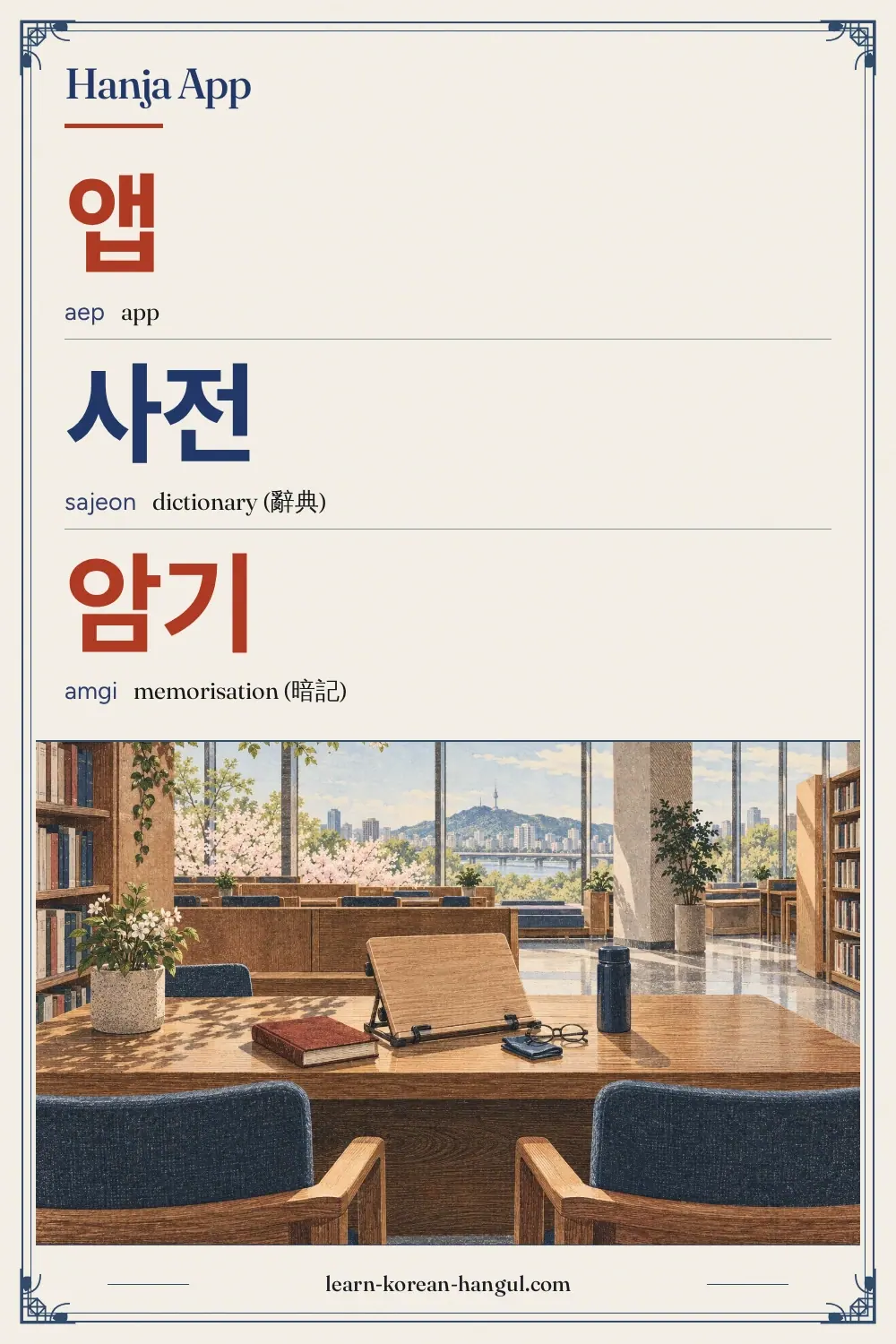
If you can pick only one, pick the flashcard tool. It works for reading, which is the goal of most learners, and it lets you add the Korean reading yourself. Add a dictionary later for look-ups. The words for the main app features are worth knowing: 앱 (app), 사전 (dictionary) and 단어장 (wordbook).
What Criteria Matter?
Five criteria separate a useful hanja app from a poor one. Test each yourself, because store descriptions and screenshots do not show them. The table includes a ten-minute test for each.
| Criterion | Why it matters | 10-minute test |
|---|---|---|
| Korean readings | Many character apps show only Chinese or Japanese readings | Search 學 and look for 학 and 배울 학 |
| Spaced repetition | Schedules review so you remember longer | Add 3 cards and see when the app plans to show them again |
| Handwriting practice | Needed only if you want to write | Open a character and look for stroke order and a draw mode |
| Offline use | Lets you study without internet on trains or flights | Switch on airplane mode and open a deck |
| Cost | Prices and limits change | Find out what the free version stops you from doing |
The first criterion is the one most people miss. An app built for Chinese or Japanese learners will usually show Mandarin pinyin or Japanese kana, not 학 or 배울 학. That would teach you the wrong reading. Always search a character you know, such as 學, and look for the Korean reading before you invest time.
Which App Type Is Best for Korean Readings?
A dictionary app or a flashcard tool you fill yourself is best for Korean readings. The reason is control. In a dictionary made for Koreans or Korean learners, each character comes with its 음훈, such as 배울 학. In a flashcard tool you write the Korean reading on the card yourself, so the data is always right. A fixed course may or may not include Korean readings, so check the first lessons.
The table compares the four types.
| App type | What it does | Strong for | Weak for |
|---|---|---|---|
| Flashcard tool with spaced repetition | Shows cards on a schedule | Memorising readings and meanings | Looking up unknown characters |
| Dictionary with handwriting input | Lets you draw a character to find it | Looking up characters you meet | Long-term memory |
| Writing practice | Animates strokes and checks your drawing | Learning to write | Vocabulary context |
| Course-style | Lessons in a fixed order | Beginners who want a path | Flexibility |
Look at each row's weak column. No type does everything, so many learners combine two: a flashcard tool for memory and a dictionary for look-ups. The word for search is 검색 (geomsaek), and it is the button you will use most in a dictionary.
Which Type Is Best for Memorisation?
A flashcard tool with spaced repetition is best for memorisation. Spaced repetition shows a card soon after you learn it and again after longer gaps, and the tool does the scheduling. The word for review is 복습 (bokseup) and for memorisation 암기 (amgi). Look for four features: the ability to add your own fields (character, reading, meaning, example word), a review queue, a "hard" button for items you miss and a count of today's reviews.
A good hanja card has the character on the front and, on the back, the reading, the meaning word and one example word. For 學 that is 학, 배울 학 and 학교. The example word links the character to something you know. If your tool allows audio, add the word, because hearing 학교 helps the reading stick.
Which Type Is Best for Writing?
A writing practice app is best for writing. It shows the stroke order as an animation, lets you draw the character and corrects wrong strokes. Check that it uses the traditional forms Korea uses, such as 學, and not simplified forms. Writing is optional, so use these apps only if you need it. See how to write hanja for the rules these apps teach. The Korean word for handwriting is 필기 (pilgi).
A dictionary with handwriting input is a different tool: it lets you draw a character you cannot read, and returns candidates. It is excellent for a character you see on a sign or in a document, but it does not teach order. If your phone keyboard has a hanja conversion option, type the Hangul reading, such as 학, and open the candidate list: it shows the possible hanja and often a meaning hint. That is a free look-up tool you already own.
Which Should You Pick?
Pick by learner type. Each profile has a first choice and a second.
Beginner
Start with paper cards or a simple flashcard tool. You need 10 to 20 minutes a day and a deck of 100 basic hanja. Read how to learn hanja and use its four-week plan. Add a dictionary only when you start meeting characters in the wild.
TOPIK Candidate
Use a flashcard tool, with your own deck built from the 20 characters on the TOPIK hanja page and the word families you meet in reading passages. A dictionary helps with unknown words in practice tests. Skip writing practice, since TOPIK does not test it.
Chinese or Japanese Speaker
You already know most shapes, so you need a tool that attaches Korean readings. A flashcard tool where you type the Korean reading is ideal. Avoid apps that show only your own language's reading. A dictionary that lists Korean readings next to the Chinese or Japanese ones is a good partner.
Name-Curious Learner
You want to find the characters behind a name. A dictionary with search by reading and by handwriting is the best fit. See hanja in Korean names for how to match a name to its characters.
How Do You Set up 25 Characters a Week?
Set up a deck of 100 characters and add 25 each week. The arithmetic is simple: 25 a week for 4 weeks is 100. On six study days that is four or five new cards a day, with a review queue on top. A week looks like this.
| Day | Task | Time |
|---|---|---|
| Day 1 to 6 | Add 4 or 5 new cards, review the queue | 15 to 20 minutes |
| Day 7 | Review only, or rest | 10 minutes |
For the cards, take the character list from the basic hanja page, and write each reading in the Korean form given there. If your app supports tags, tag each card with its theme: numbers, family, school. Tags let you study one theme at a time.
Over four weeks, six study days at 15 to 20 minutes is 4 × 6 × 15 to 20 = 360 to 480 minutes, or 6 to 8 hours. If an app promises you will learn faster than that, check what "learn" means. Remembering a card in a flashcard session is different from reading the character in a real text.
How Do You Run a Ten-Minute Trial?
Run the trial on a fresh install, before you spend money or time. Set a timer for ten minutes and follow the steps in order. Score each as pass or fail.
| Minute | Step | Pass if |
|---|---|---|
| 0 to 2 | Search 學 | The app shows 학 as the Korean reading |
| 2 to 4 | Search 校 and 生 | You find 교 and 생, and a meaning for each |
| 4 to 6 | Add three cards of your own | You can type the Korean reading and one example word |
| 6 to 8 | Check the review schedule | The app shows when each card will return |
| 8 to 9 | Switch on airplane mode | The deck still opens |
| 9 to 10 | Find the price page | You can see what the free version cannot do |
Four passes out of six is a good start, and the first one matters most. If the app fails the Korean-reading step, stop there. You can always return to it after you have added your own readings by hand.
Here is a sample card for the second character in the trial, so you know what to aim for. On the front put 校. On the back put 교, the meaning hook "school", and one word: 학교. Add a second card for the word itself, with 學校 on the front and 학교 on the back. Two cards per character may seem like double work, but it trains both directions: from the character to the word, and from the word to the characters. This matches the three recall tests on the how to learn hanja page.
What Are the Red Flags?
Three signs suggest an app is a poor choice. First, it shows readings only in another language and gives no way to add your own. Second, it uses simplified forms only, which are not the forms Korea uses. Third, it makes claims about speed, such as "learn all hanja in a week". Memory does not work like that, and the claim does not tell you how well you will remember a month later. Be wary too of any page that lists a ranking without saying when and how the apps were tested.
What Are the Limits of Apps?
Apps help with memory but not with understanding. They show a character and a reading, but they do not teach how a word is built or when a reading changes. Three limits to keep in mind:
- Coverage of Korean readings varies. Some apps list one reading and miss the variants, such as 金 as 금 and 김.
- Sound changes are not shown. The reading 학 is shown, not the spoken [학꾜] of 학교. You still need to hear the word.
- Prices and features change. An app that is free this year may limit its free version next year.
Because of this, pair any app with the word-family method. For a wider list of tools, see Korean learning apps, and for vocabulary decks see Korean vocabulary flashcards.
Two terms from app stores are worth reading in Hangul: 무료 (muryo) for free and 유료 (yuryo) for paid, and 오프라인 (opeurain) for offline.
A Note on How This Page Was Prepared
This page covers types of app and criteria. It does not rank products. Apps change quickly, and an accurate review needs a date and a test on a real device. Anki is mentioned in the FAQ only as an example of a flashcard tool you can fill yourself. If you find a product that fits the criteria, test it and use the ten-minute checks before you commit.
Practice: Cards and Quiz
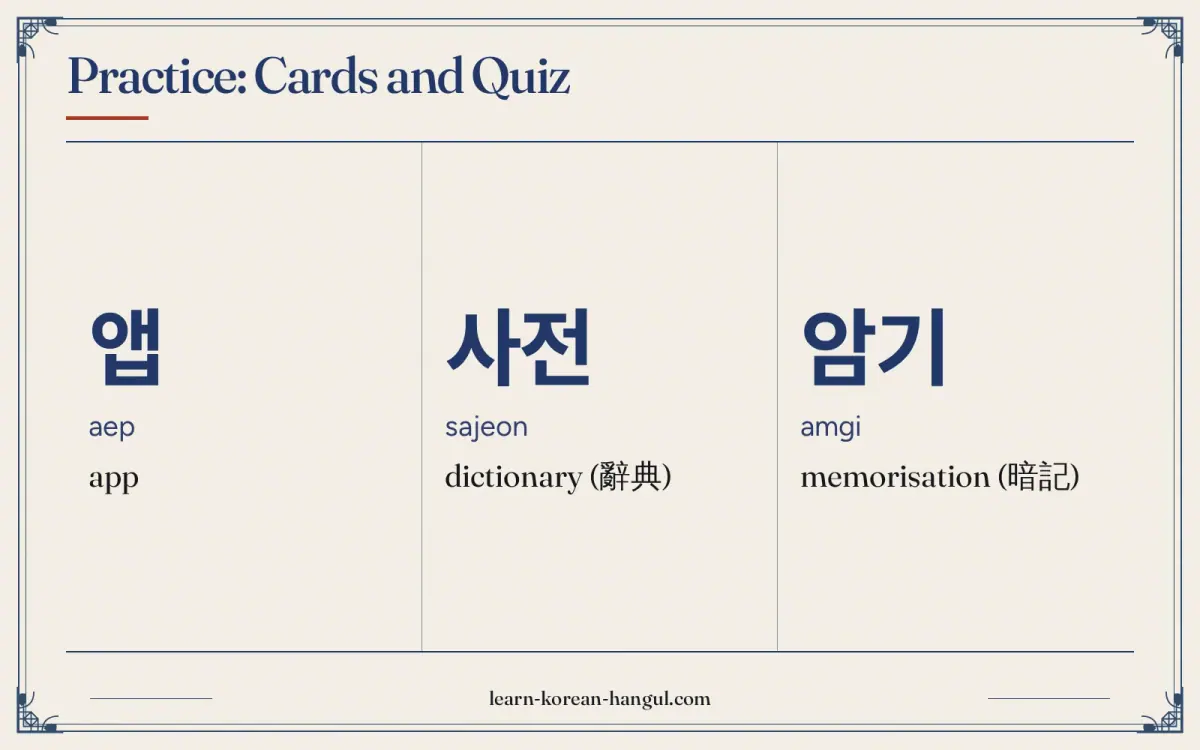
These ten cards teach the words you will meet in an app store listing.
| Korean | RR | Meaning | Note |
|---|---|---|---|
| 앱 | aep | app | Short for 애플리케이션. Said [앱]. |
| 사전 | sajeon | dictionary (辭典) | A 한자 사전 lists characters with readings and meanings. |
| 암기 | amgi | memorisation (暗記) | What flashcards are for. |
| 복습 | bokseup | review (復習) | Said [복씁]. The step spaced repetition schedules for you. |
| 무료 | muryo | free of charge (無料) | 無 means "without" and 料 means "fee". |
| 유료 | yuryo | paid, for a fee (有料) | The opposite of 무료. 有 means have. |
| 오프라인 | opeurain | offline | Means the app works without internet. |
| 필기 | pilgi | handwriting, note-taking (筆記) | A handwriting mode is 필기 입력. |
| 단어장 | daneojang | wordbook, vocabulary list (單語帳) | Said [다너짱]. Many apps call a deck a 단어장. |
| 검색 | geomsaek | search (檢索) | Said [검색]. The key feature of a dictionary app. |
Practice · 10
- 01앱
Show answer
aep
app
- 02사전
Show answer
sajeon
dictionary (辭典)
- 03암기
Show answer
amgi
memorisation (暗記)
- 04복습
Show answer
bokseup
review (復習)
- 05무료
Show answer
muryo
free of charge (無料)
- 06유료
Show answer
yuryo
paid, for a fee (有料)
- 07오프라인
Show answer
opeurain
offline
- 08필기
Show answer
pilgi
handwriting, note-taking (筆記)
- 09단어장
Show answer
daneojang
wordbook, vocabulary list (單語帳)
- 10검색
Show answer
geomsaek
search (檢索)
Check your understanding with six questions.
Practice · 6
Which criterion checks that an app shows Korean readings, not only Chinese or Japanese ones?
Show answer
Korean-reading support
A character app built for Chinese or Japanese may omit the Korean reading. Always check it first.
Which app type is best for memorising characters over time?
Show answer
A spaced-repetition flashcard tool
Spaced repetition schedules review at growing gaps, which fits memorisation best.
What does 무료 mean?
Show answer
free of charge
무료 (無料) means free of charge. 유료 (有料) means paid.
If you want to learn to write characters, which feature should you look for?
Show answer
Stroke-order animation and handwriting practice
Writing needs stroke order and practice. A dictionary with handwriting input helps look up characters but may not teach order.
At 25 characters a week, how many weeks to finish 100?
Show answer
4
100 divided by 25 is 4 weeks.
Which is the best test of an app in ten minutes?
Show answer
Add three characters and check the Korean reading, a review schedule and offline use
A short hands-on trial of the criteria tells you more than a rating.
Frequently Asked Questions
Is there a free hanja app?
Free options exist in each type, but features, limits and prices change often, and we do not list prices. Many flashcard tools are free to use with your own cards, and some dictionary apps are free with ads. Check the current store page and test the free version against the five criteria before you pay.
Can I use Chinese-character apps for Korean hanja?
Sometimes, with care. The characters are the same family, but Chinese apps show Mandarin readings and often simplified forms, and Japanese apps show kanji readings. If an app has no Korean reading and uses simplified forms, it will teach the wrong thing for Korean. Use it only if you can add the Korean reading yourself.
Do I need handwriting practice?
Only if you want to write. For reading, recognition is enough. If you do want to write, pick an app with stroke-order animation, or use paper alongside it. See how to write hanja for the stroke rules and a ten-character practice set.
Should I use Anki?
Anki is a well-known flashcard program that lets you build your own cards with spaced repetition, so it fits a hanja deck well. It takes a little setup, and prices and features differ by platform, so check the current details. Any tool that schedules reviews and lets you add your own fields can do the same job.
Do I need an app at all?
No. Paper cards and the flashcards on this site work. An app helps with scheduling and convenience. If you already study every day, add hanja cards to the tool you use.