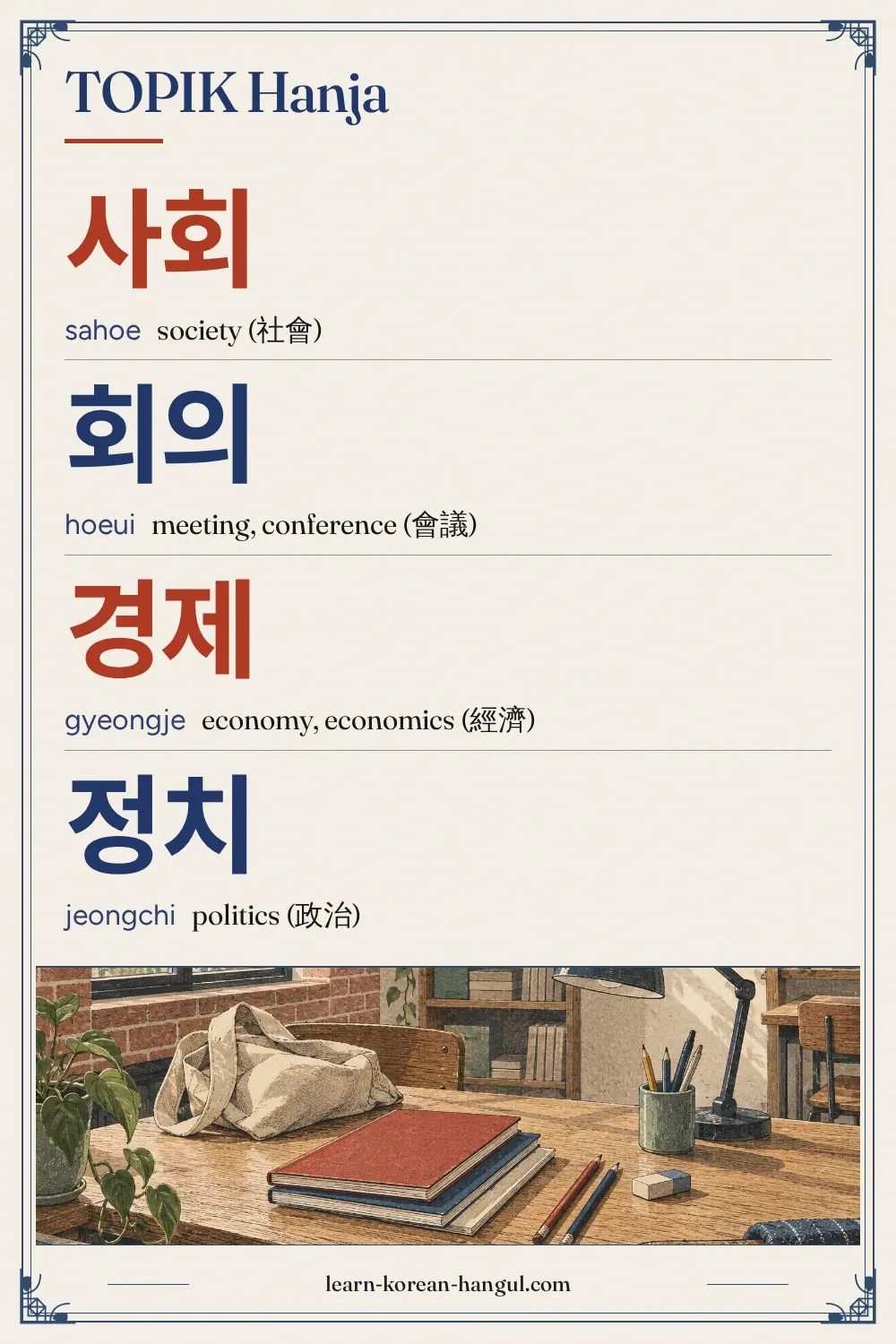
TOPIK Hanja: the Essentials
TOPIK hanja is the set of Chinese characters behind the Sino-Korean words that fill the Test of Proficiency in Korean (한국어능력시험), especially TOPIK II. The exam never asks you to read or write a character. What it does ask is that you understand words such as 경제 (economy), 환경 (environment) and 발전 (development) in listening and reading, and those words are built from hanja.
The verdict depends on your target:
| Your target | Do you need hanja? | Best use of your time |
|---|---|---|
| TOPIK I (levels 1 to 2) | No | listening and reading practice, core word lists |
| TOPIK II, levels 3 to 4 | Optional, useful | 20 high-yield characters as a vocabulary shortcut |
| TOPIK II, levels 5 to 6 | Optional, very useful | word families for abstract and academic words |
| No exam, conversation only | No | everyday vocabulary in Hangul |
The rest of this page answers the questions learners ask in the order they usually ask them, starting with whether the exam tests characters at all.
Is Hanja Tested on TOPIK?
No. TOPIK has no section, question type or answer option that tests hanja, and the papers are printed in Hangul. TOPIK I tests listening and reading; TOPIK II tests listening, writing and reading. The TOPIK exam format page lists every section and question type. NIIED, the body that runs the test, publishes the official guide on topik.go.kr, and that guide is the place to confirm the current specification before your exam.
Hanja do appear on the exam in one hidden way: inside words. When a reading passage says 정부가 새로운 정책을 발표했다 ("The government announced a new policy"), the key words 정부, 정책 and 발표 are all Sino-Korean. You read them in Hangul, but if you know 政 "govern" and 發 "send out", the meanings come faster. That is the whole case for TOPIK hanja: a vocabulary shortcut, not a test requirement. The next question is why that shortcut works.
Why Do Hanja Help with TOPIK Vocabulary?
Hanja help because TOPIK II vocabulary shifts from everyday native Korean words to abstract Sino-Korean words, and those words are made from a limited set of recurring syllables. At TOPIK I, you learn 먹다, 집 and 날씨, which are native Korean and must be learned one by one. At TOPIK II, texts discuss 사회 (society), 경제 (economy) and 문화 (culture), and each syllable carries a meaning that repeats across many other words.
Take the syllable 사 in its 社 sense. It appears in 사회 (society), 회사 (company) and 사장 (company president). The syllable 회 (會) appears in 사회, 회사, 회의 (meeting) and 기회 (opportunity). Learn two characters and you have a handle on five words. A word list treats those five as five separate items; the character route treats them as combinations of two.
There is a second benefit. TOPIK II reading includes questions where you must infer the meaning of an unfamiliar word from context. Knowing the characters gives you a second clue: an unseen word such as 출산율 contains 出 "out", 産 "produce" and 率 "rate", so it is the birth rate. The next section shows how often this happens in practice.
How Do Hanja Show up in TOPIK Vocabulary?
Hanja show up as recurring syllables in two- and three-syllable words, and as suffixes that turn one word into several. Three patterns are worth knowing before you study any list.
- Compound nouns. Two characters form one word: 經 + 濟 = 경제 (economy), 發 + 展 = 발전 (development). Put them together and you get the news phrase 경제 발전, "economic development".
- Suffixes. A small set of characters attach to many nouns: -적 (的) makes "-ic, -al" words such as 경제적 (economic) and 사회적 (social); -성 (性) makes "-ness" words such as 가능성 [가능썽] (possibility); -화 (化) makes "-ization" words such as 세계화 (globalisation); -자 (者) makes "person who" words such as 소비자 (consumer).
- Reversed pairs. The same two characters in a different order give a different word: 社會 사회 (society) and 會社 회사 (company).
Here is a worked example. In 사회적 문제 ("a social problem") you can read every syllable: 社 society + 會 meet + 的 "-al" + 問 ask + 題 topic. A learner who knows those five characters can decode the phrase on first sight. Brackets on this page show pronunciation where it differs from the spelling, such as 발전 [발쩐], where the ㅈ after ㄹ is tense in Sino-Korean words. The next section ranks which characters to learn at each level.
Which Hanja Help Most at Each Level?
The most useful hanja change with your level: basic concrete characters for TOPIK I, social and economic characters for levels 3 to 4, and abstract, academic characters for levels 5 to 6. The table is an editorial guide built from the topics each level covers, not an official list.
| TOPIK level | What the vocabulary is like | Characters that help | Example words |
|---|---|---|---|
| 1 to 2 (TOPIK I) | concrete daily life, many native words | numbers, weekdays, 學 校 人 | 학교 [학꾜], 월요일 [워료일], 한국인 [한구긴] |
| 3 to 4 (TOPIK II) | society, work, news, culture | the 20 on this page: 社 會 經 政 文 化 and others | 사회, 경제, 문화, 발전 [발쩐] |
| 5 to 6 (TOPIK II) | argument, policy, academic texts | 論 (논할 론), 認 (알 인), 識 (알 식), 制 (절제할 제), 價 (값 가), 値 (값 치), 意 (뜻 의), 法 (법 법) | 논리 [놀리], 인식, 제도, 가치, 의견, 방법 |
For TOPIK I, characters are a curiosity rather than a tool; the basic hanja section covers the concrete ones if you are interested. For levels 3 to 4, the 20 characters below are the best return on time. For levels 5 to 6, move on to the hanja word families and add characters as you meet them in reading. What each level requires in practice is described on TOPIK levels. The next section lists the 20.
Which 20 Hanja Pay Back Fastest for TOPIK II?
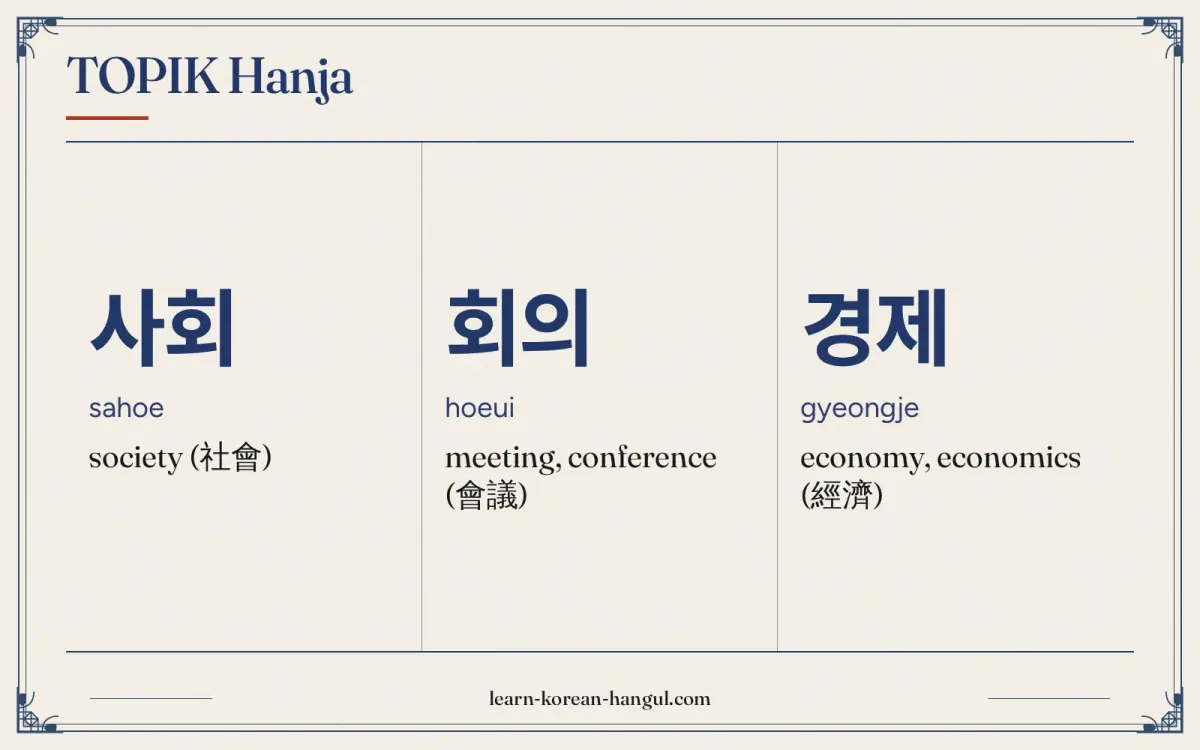
These 20 characters pay back fastest because each one builds at least three common TOPIK II words, and together they cover the big reading topics: society, economy, politics, culture, education, industry and development. The selection is editorial. Each row gives the character, its 음훈 (the native meaning word and the Korean reading, as dictionaries list it) and three words.
| # | Hanja | 음훈 | Three common words |
|---|---|---|---|
| 1 | 社 | 모일 사 | 사회 (society), 회사 (company), 사장 (company president) |
| 2 | 會 | 모일 회 | 회의 (meeting), 기회 (opportunity), 회원 (member) |
| 3 | 經 | 지날 경 | 경제 (economy), 경험 (experience), 경영 (management) |
| 4 | 政 | 정사 정 | 정치 (politics), 정부 (government), 정책 (policy) |
| 5 | 文 | 글월 문 | 문화 (culture), 문학 (literature), 논문 (thesis, paper) |
| 6 | 化 | 될 화 | 변화 (change), 세계화 (globalisation), 강화 (strengthening) |
| 7 | 敎 | 가르칠 교 | 교육 (education), 교사 (teacher), 종교 (religion) |
| 8 | 育 | 기를 육 | 교육 (education), 체육 (P.E.), 육아 [유가] (childcare) |
| 9 | 産 | 낳을 산 | 생산 (production), 산업 [사넙] (industry), 출산 [출싼] (childbirth) |
| 10 | 業 | 업 업 | 직업 [지겁] (job), 기업 (enterprise), 졸업 [조럽] (graduation) |
| 11 | 發 | 필 발 | 발표 (presentation), 발생 [발쌩] (occurrence), 개발 (development) |
| 12 | 展 | 펼 전 | 발전 [발쩐] (development), 전시 (exhibition), 전망 (outlook) |
| 13 | 現 | 나타날 현 | 현재 (present), 현대 (modern times), 표현 (expression) |
| 14 | 實 | 열매 실 | 사실 (fact), 현실 (reality), 실제 [실쩨] (actual) |
| 15 | 問 | 물을 문 | 질문 (question), 문제 (problem), 방문 (visit) |
| 16 | 題 | 제목 제 | 문제 (problem), 주제 (topic), 숙제 [숙쩨] (homework) |
| 17 | 性 | 성품 성 | 성격 [성껵] (personality), 가능성 [가능썽] (possibility), 여성 (woman) |
| 18 | 的 | 과녁 적 | 목적 [목쩍] (purpose), 경제적 (economic), 사회적 (social) |
| 19 | 者 | 놈 자 | 기자 (reporter), 학자 [학짜] (scholar), 소비자 (consumer) |
| 20 | 關 | 관계할 관 | 관심 (interest), 관계 (relationship), 관련 [괄련] (connection) |
Twenty characters times three words gives 60 entries. 교육 and 문제 each appear twice, under both of their characters, so the table holds 58 different words. Look at the pairs that share a word: 敎 + 育 = 교육 and 問 + 題 = 문제. Learning characters in such pairs halves the effort, because one word anchors two characters.
How Do Two "Development" Words Differ?
The table has two words that English translates as "development", and the characters explain the difference. 발전 (發展, "start + unfold") is growth or progress, as in 경제 발전 (economic development). 개발 (開發, "open + start") is developing something new, such as a product, a technology or land, as in 제품 개발 (product development). The same trick separates 현재 (present time) from 현대 (modern era): 在 "exist" versus 代 "generation".
The 20 as Flashcards
The deck below has one key word for each character, with audio. The table shows the same cards.
| # | Korean | RR | Meaning | Character and note |
|---|---|---|---|---|
| 1 | 사회 | sahoe | society (社會) | 社 (모일 사). 社 "gather; society" + 會 "meet". Reverse the two and you get 회사, company. |
| 2 | 회의 | hoeui | meeting, conference (會議) | 會 (모일 회). 會 "meet" + 議 "discuss". Also in 기회 (opportunity) and 회원 (member). |
| 3 | 경제 | gyeongje | economy, economics (經濟) | 經 (지날 경). 經 "manage, pass through" + 濟 "relieve". Also in 경험 (experience). |
| 4 | 정치 | jeongchi | politics (政治) | 政 (정사 정). 政 "govern" + 治 "rule". Also in 정부 (government) and 정책 (policy). |
| 5 | 문화 | munhwa | culture (文化) | 文 (글월 문). 文 "writing" + 化 "become". Also in 문학 (literature) and 논문 (thesis). |
| 6 | 변화 | byeonhwa | change (變化) | 化 (될 화). 化 "become, -ization" is the last syllable. Also in 세계화 (globalisation). |
| 7 | 교육 | gyoyuk | education (敎育) | 敎 (가르칠 교). 敎 "teach" + 育 "raise". Also in 교사 (teacher) and 종교 (religion). |
| 8 | 체육 | cheyuk | physical education, P.E. (體育) | 育 (기를 육). 體 "body" + 育 "raise". Also in 육아 (childcare), said [유가]. |
| 9 | 생산 | saengsan | production (生産) | 産 (낳을 산). 生 "live" + 産 "produce". Also in 산업 (industry), said [사넙]. |
| 10 | 직업 | jigeop | job, occupation (職業) | 業 (업 업). 職 "post" + 業 "work". Said [지겁]. Also in 기업 (enterprise). |
| 11 | 발표 | balpyo | presentation, announcement (發表) | 發 (필 발). 發 "send out, start" + 表 "show". Also in 개발 (development of a product). |
| 12 | 발전 | baljeon | development, progress (發展) | 展 (펼 전). 發 "start" + 展 "unfold". Said [발쩐]. Also in 전시 (exhibition). |
| 13 | 현재 | hyeonjae | present, current time (現在) | 現 (나타날 현). 現 "appear, now" + 在 "exist". Also in 현대 (modern times). |
| 14 | 사실 | sasil | fact (事實) | 實 (열매 실). 事 "matter" + 實 "real". Also in 현실 (reality) and 실제 (actual), said [실쩨]. |
| 15 | 질문 | jilmun | question, query (質問) | 問 (물을 문). 質 "inquire" + 問 "ask". Not the same 문 as 文 "writing". |
| 16 | 문제 | munje | problem, exam question (問題) | 題 (제목 제). 問 "ask" + 題 "topic". Also in 주제 (topic) and 숙제 (homework). |
| 17 | 성격 | seonggyeok | personality, character (性格) | 性 (성품 성). 性 "nature" + 格 "pattern". Said [성껵]. As a suffix: 가능성 (possibility). |
| 18 | 목적 | mokjeok | purpose, objective (目的) | 的 (과녁 적). 目 "eye" + 的 "target". Said [목쩍]. As a suffix -적 makes 경제적 (economic). |
| 19 | 기자 | gija | reporter, journalist (記者) | 者 (놈 자). 記 "record" + 者 "person who". Also in 소비자 (consumer). |
| 20 | 관심 | gwansim | interest (in something) (關心) | 關 (관계할 관). 關 "concern" + 心 "heart". Also in 관계 (relationship) and 관련 (connection), said [괄련]. |
Practice · 20
- 01사회
Show answer
sahoe
society (社會)
- 02회의
Show answer
hoeui
meeting, conference (會議)
- 03경제
Show answer
gyeongje
economy, economics (經濟)
- 04정치
Show answer
jeongchi
politics (政治)
- 05문화
Show answer
munhwa
culture (文化)
- 06변화
Show answer
byeonhwa
change (變化)
- 07교육
Show answer
gyoyuk
education (敎育)
- 08체육
Show answer
cheyuk
physical education, P.E. (體育)
- 09생산
Show answer
saengsan
production (生産)
- 10직업
Show answer
jigeop
job, occupation (職業)
- 11발표
Show answer
balpyo
presentation, announcement (發表)
- 12발전
Show answer
baljeon
development, progress (發展)
- 13현재
Show answer
hyeonjae
present, current time (現在)
- 14사실
Show answer
sasil
fact (事實)
- 15질문
Show answer
jilmun
question, query (質問)
- 16문제
Show answer
munje
problem, exam question (問題)
- 17성격
Show answer
seonggyeok
personality, character (性格)
- 18목적
Show answer
mokjeok
purpose, objective (目的)
- 19기자
Show answer
gija
reporter, journalist (記者)
- 20관심
Show answer
gwansim
interest (in something) (關心)
Review the deck once a day while you follow the plan in the next section.
How Do You Add Hanja to a TOPIK Study Plan?
Add hanja as a two-week, 10-minute daily add-on, not as a separate course. Fourteen days of 10 minutes is 140 minutes in total, a little over two hours. The plan fits into any two weeks of the 12-week TOPIK study plan, ideally in the first half, so the words have time to settle before mock tests.
- Days 1 to 10: two characters a day. Learn the character, its 음훈 and its three words from the table. By day 10 you have all 20. You will know a day has worked when you can say the three words from the character alone.
- Days 11 to 12: decode. Cover the meanings and decode the words from their characters. Then take the quiz at the end of this page. The common mistake here is guessing from the sound only; say the character's meaning aloud first.
- Days 13 to 14: read. Take one TOPIK II-style reading text and underline every word that contains one of the 20 syllables in its character sense. Check each one with a dictionary. The TOPIK reading page explains the question types to practise with.
After the two weeks, keep the deck in your daily review and add one new character whenever a syllable keeps appearing in your reading. That habit matters more than any list. The next question is whether the top levels need more.
Do You Need Hanja for TOPIK Level 5 or 6?
You do not need hanja for level 5 or 6, but at those levels they help most. Level 5 and 6 reading uses editorials, academic summaries and policy texts, and almost every key noun is Sino-Korean: 인식 (awareness), 제도 (system), 가치 (value), 논리 [놀리] (logic). The TOPIK II writing task 54, the long essay, also rewards precise abstract nouns.
A candidate who knows a few hundred productive characters can often guess an unfamiliar word's field, and sometimes its meaning, from the syllables. That is a common rule of thumb, not a measured result. The trade-off is time: by level 5 you already need a large vocabulary, so learn new characters only through words you meet in reading, never from a frequency list on its own. The hanja word families pages are built for exactly this. The next section covers the opposite case: when to leave hanja alone.
When Should You Skip Hanja?
Skip hanja when your exam is close, when you are aiming at TOPIK I, or when you already know the characters from Chinese or Japanese. In those cases the time is better spent on listening, reading speed or the Korean readings of words you already understand.
| Situation | Hanja route | Word-list route |
|---|---|---|
| TOPIK I target | little benefit | better: learn whole words with audio |
| TOPIK II exam in under 4 weeks | too slow to pay back | better: mock tests and topik vocabulary lists |
| TOPIK II, 3 months or more away | good: 20 characters in 2 weeks | works, but more memorising |
| You read Chinese or Japanese | skip character study; learn Korean readings | better: map known words to Korean sounds |
| You enjoy characters | good motivation | fine as a backup |
The word-list route always works; hanja are a speed-up for some learners, not a gate. For levels 3 to 6, the TOPIK 2 vocabulary list groups exam words by topic, and the topik vocabulary page gives 100 core exam words with audio. This page shows the hanja behind those words; the lists are where you learn the words themselves.
What Mistakes Do Learners Make with TOPIK Hanja?
The most common mistake is assuming that the same Korean syllable always means the same character. Five mistakes cost the most time:
- Same sound, same character. 문 is 問 "ask" in 문제 but 文 "writing" in 문화 and 門 "gate" in 대문. 전 is 展 in 발전, 電 in 전화 and 前 in 오전. Always learn the word, then the character.
- Characters without words. A character you cannot place in two words is not yet useful for TOPIK.
- Learning to write. Handwriting is not tested and takes far longer than recognition.
- Over-decoding. Meanings drift: 인사 (人事) means "greeting" in daily life and "personnel" in companies. Check the dictionary before trusting a literal reading.
- Ignoring pronunciation. Characters do not show sound changes, so 발전 is said [발쩐] and 산업 [사넙]. Listen to the audio for each word.
Check Yourself: Decode Six TOPIK Words
Each question asks you to decode a word from its characters. The answers are checked as you go.
Practice · 6
경제 is 經 "manage" + 濟 "relieve". What does 경제 mean?
Show answer
economy
경제 (經濟) is the economy: managing and providing for a society. Culture is 문화, religion is 종교 and exhibition is 전시.
문화 is 文 "writing" + 化 "become". What does 문화 mean?
Show answer
culture
문화 (文化) is culture, literally becoming refined through writing. Homework is 숙제, a reporter is 기자 and the government is 정부.
산업 is 産 "produce" + 業 "work". What does 산업 mean?
Show answer
industry
산업 (産業), said [사넙], is industry: the work of producing things. A meeting is 회의, a visit is 방문 and personality is 성격.
性 (성) makes "-ness" nouns. Which word means "possibility"?
Show answer
가능성
가능성 (可能性), said [가능썽], is possibility. 가능하다 is the adjective "be possible", 관심 is interest and 현재 is the present.
Which character makes "-ic, -al" words such as 경제적 (economic) and 사회적 (social)?
Show answer
的 (적)
的 (적) turns a noun into an "-ic, -al" word: 경제적, 사회적. 者 means "person who", 問 means "ask" and 業 means "work".
The 문 in 문제 (problem) is which character?
Show answer
問 "ask"
문제 is 問題, "ask + topic": a question to be solved. 文 is the 문 of 문화, 門 is the 문 of 대문, and 水 is read 수, not 문.
The Bottom Line
TOPIK hanja are never tested directly: the exam is written in Hangul and you can reach level 6 without them. From level 3 upward, though, 20 characters such as 社, 經, 化 and 的 explain 58 common words met in TOPIK II, and two weeks at 10 minutes a day is enough to learn them. Skip hanja if you are aiming at TOPIK I or your exam is less than a month away. If you want a certificate for characters themselves, the Korean hanja proficiency tests are a separate, optional route. For the bigger picture, see the TOPIK hub, the TOPIK I section and the hanja hub, or read Hangul vs Hanja for why Korean is written in Hangul at all.
Frequently Asked Questions
Can I pass TOPIK without hanja?
Yes. TOPIK is written entirely in Hangul and has no character questions, so every level, including level 6, can be reached without learning a single hanja. Characters are a shortcut for learning Sino-Korean vocabulary, not a requirement. Many successful candidates learn the same words from lists and reading alone.
Does TOPIK I need any hanja?
No. TOPIK I (levels 1 and 2) uses everyday vocabulary about family, shopping, weather and plans, and much of it is native Korean or simple Sino-Korean words you learn as whole words. Spend TOPIK I preparation time on listening and reading practice. Start hanja, if at all, after you pass level 2.
Is a hanja proficiency test a substitute for TOPIK?
No. Korean hanja proficiency tests measure knowledge of characters and are taken mostly by Korean students. TOPIK measures Korean language ability and is the test universities, employers and visa routes ask for. A hanja certificate does not replace a TOPIK level, so take one only if you have a separate reason.
Do Chinese and Japanese speakers have an advantage on TOPIK?
In vocabulary, often yes: many Sino-Korean words such as 경제 (經濟) and 문화 (文化) match words they already know. They still have to learn the Korean readings, grammar and listening, and some shared words differ in meaning. The advantage is real for reading but small for writing and listening.