
Hanja in Korean Names: the Essentials
Every Korean name is two things at once: a sound written in Hangul, and, usually, a set of characters. The Hangul is what people say, write on a phone and read on a name tag. The hanja is the layer behind it, kept in family records, genealogy books and some formal documents. Both layers matter, but they do different jobs.
| Layer | What it is | Where you see it |
|---|---|---|
| Hangul name | The sound of the name | Everywhere in daily life |
| Hanja name | The characters behind each syllable | Family register, family tree, seals, formal papers |
| Meaning | What the characters say | Only if you know the hanja |
Here is a worked example. The name 김민준 has three syllables. 김 is the surname, 金. 민 and 준 are the given name. The family might choose 敏 (quick) and 俊 (excellent), or 民 (people) and 俊. Both are 김민준 in Hangul, and the meaning differs. The words for name that you will meet are 성 (seong, surname), 이름 (ireum, name) and 성명 (seongmyeong, full name on a form).
What Are Common Surname Hanja?
The most common Korean surnames each have one standard hanja, which makes them the easiest part of a name to read. The ten below follow the surname table on our Korean last names page. Learn the first six and you can read the family names of a large share of Koreans.
| Hangul | Hanja | RR | Meaning of the character | Note |
|---|---|---|---|---|
| 김 | 金 | Gim | gold, metal | Read 금 in most other words |
| 이 | 李 | I | plum tree | Original reading 리 |
| 박 | 朴 | Bak | plain, simple | Final ㄱ, said [박] |
| 최 | 崔 | Choe | lofty, high | Usually said with the diphthong [we], like 췌; the standard allows this |
| 정 | 鄭 | Jeong | ancient state name | Mostly a surname |
| 강 | 姜 | Gang | surname character | Mostly a surname |
| 조 | 趙 | Jo | ancient state name | Also a common name syllable |
| 윤 | 尹 | Yun | govern, rule | Old official title |
| 장 | 張 | Jang | stretch, draw a bow | Also in 확장 and 장력 |
| 임 | 林 | Im | forest | Original reading 림 |
Notice that many of these characters have ordinary meanings. 金 is gold or metal, and 林 is a forest. Others, like 鄭 and 趙, began as the names of ancient states and are used mostly as surnames, so a learner will seldom meet them elsewhere. A surname does not describe the person. It identifies the family line.
A practical tip: on an old business card, a signboard or a family tree, the surname is often the only part printed in characters, and it comes first. If you can read the six top surnames, you can tell at a glance which of them you are looking at, even when the given name is in a script you cannot yet read. Start with 金, 李 and 朴, which together cover a very large share of people.
Surnames are also tied to a clan origin place, called the 본관 (bongwan), written in hanja before the surname, as in 金海金氏 (김해 김씨, the Gimhae Kim clan) or 密陽朴氏 (밀양 박씨, the Miryang Bak clan). Two families with the same surname but different 본관 are different lines.
For the clan system and romanisation of surnames, see Korean last names.
How Are Given Names Built from Hanja?
Most Korean given names have two syllables, and each syllable is either a hanja or a native Korean word. Parents choose characters for their meaning, their sound and how the whole name feels when said aloud. The table below shows how a few names might be built. These are illustrations, because each family chooses its own characters.
| Name | Possible hanja | Meaning of the parts |
|---|---|---|
| 민준 | 敏俊 | quick + excellent |
| 민준 | 民俊 | people + excellent |
| 지수 | 智秀 | wisdom + excellent |
| 지수 | 志洙 | will + river bank |
| 서연 | 瑞妍 | auspicious + beautiful |
| 현우 | 賢宇 | wise + universe |
Notice that two people named 지수 may have different characters. Even a single syllable like 준 can come from 俊 (excellent), 準 (standard) or 峻 (lofty). A name built from native words, such as 하늘 (sky), has no hanja, and the trend of using native Korean words for given names has grown since the later twentieth century. Both kinds are normal names.
Some parents consider the number of strokes in the characters, a naming custom based on stroke counts. Others ask a naming specialist, and others choose by family tradition. The act of choosing a name is called 작명 (jangmyeong). These are customs, not rules. For more on how names are chosen, see Korean name meaning.
Why Does One Sound Have Many Hanja?
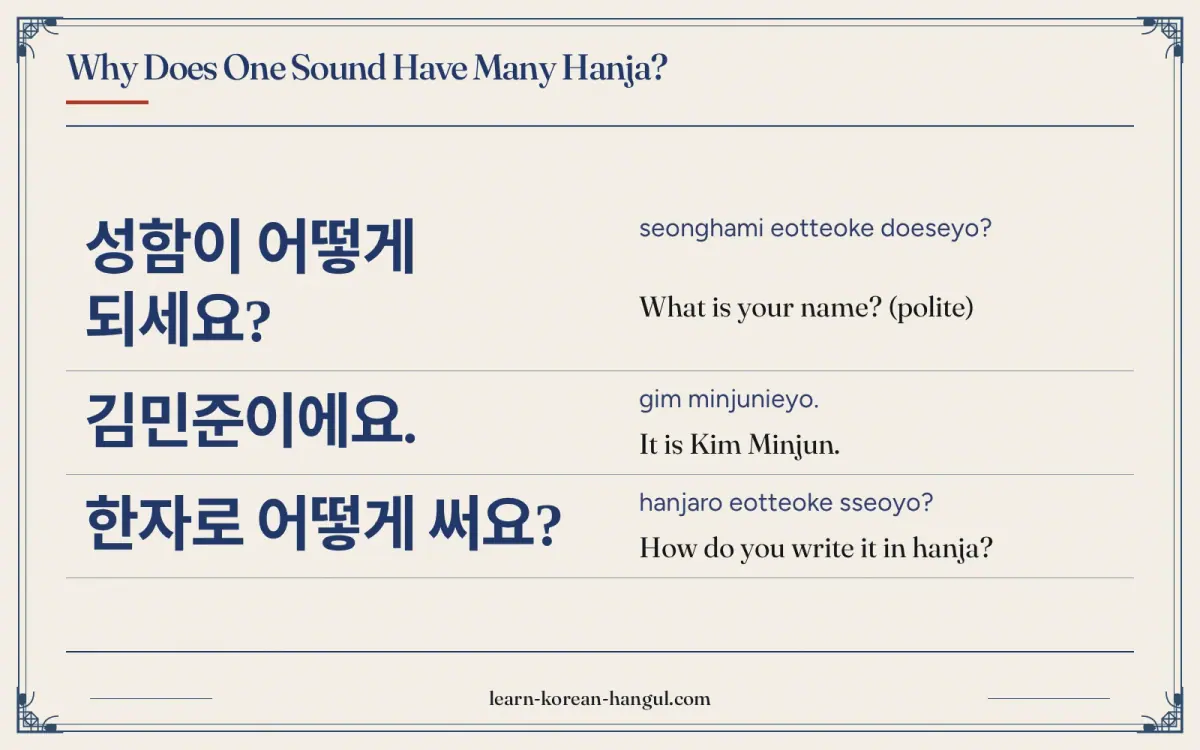
One sound has many hanja because Korean has far fewer syllables than Chinese has characters. A syllable like 지 is read for more than a dozen common characters, each with its own meaning. When a name is written in Hangul, all of that meaning collapses into the same letters. The table shows seven common syllables and some characters that share them.
| Hangul syllable | Example hanja | Meaning of each |
|---|---|---|
| 지 | 智, 志, 知, 池 | wisdom, will, know, pond |
| 서 | 書, 瑞, 序 | writing, auspicious, order |
| 연 | 妍, 淵, 然 | beautiful, deep pool, so |
| 현 | 賢, 玄, 炫 | wise, dark, shine |
| 우 | 宇, 雨, 友, 佑 | universe, rain, friend, help |
| 민 | 民, 敏, 珉 | people, quick, jade-like stone |
| 준 | 俊, 準, 峻 | excellent, standard, lofty |
This is why asking "what does your name mean?" often gets the answer "it depends on the hanja", or a quick explanation: "민 as in 민첩할 민". Koreans explain which character they mean by naming its 음훈, the meaning word and the sound together, such as 민첩할 민 for 敏. It is a normal way to spell a name aloud, and a good use of the 음훈 method you may already know from basic hanja.
Here is how that exchange sounds in a conversation.
성함이 어떻게 되세요?
seonghami eotteoke doeseyo?
What is your name? (polite)
김민준이에요.
gim minjunieyo.
It is Kim Minjun.
한자로 어떻게 써요?
hanjaro eotteoke sseoyo?
How do you write it in hanja?
민첩할 민, 준걸 준이에요.
mincheopal min, jun-geol junieyo.
It is 민 as in 'quick' and 준 as in 'outstanding'.
The first line is said [성하미 어떠케 되세요], with the ㅁ of 성함이 linking to the vowel. The second is said [김민주니에요]. The fourth gives each given-name character by its meaning word and sound, which is how people spell a name by speech. A common surname such as 김 rarely needs spelling out.
How Are Names Registered?
Names are recorded in the 가족관계등록부 (family relations register), the civil record that replaced the older household register in 2008. The register stores the Hangul name, and a hanja form can be recorded alongside it. Papers made from the register, such as the 가족관계증명서 (certificate of family relations), may show the hanja in brackets next to the Hangul.
Two rules matter for hanja. First, a hanja used in a registered name must come from a list of characters permitted for personal names, which the courts set and have extended more than once. The permitted list is longer than the 1,800 school list. Second, the details, such as which documents show hanja, can change. Check the current rules on the court system's website or ask the local office before you rely on this.
Other records also keep the hanja. A family genealogy book, called 족보 (jokbo), lists each member with his or her characters and clan. Name seals (도장) may be cut with hanja or Hangul.
What Is a Generation Name (돌림자)?
A 돌림자 (dollimja) is a syllable shared by one generation of a clan, so brothers and cousins carry the same character in their names. A clan keeps a list of generation characters called the 항렬 (hangnyeol), and each new generation takes the next on the list. If the generation character is 민, cousins might be named 민준, 민수 and 민호 when they are of the same generation. The shared syllable is often the first or the second of the given name.
Some clans choose generation characters in a cycle of the five elements, wood, fire, earth, metal and water. Then one generation uses characters with the 木 radical, the next with 火, then 土, 金 and 水. This is a convention some families follow, not a legal rule, and fewer families use it now than in the past. If you meet siblings or cousins with a matching syllable, that is probably the reason.
How to Look up a Name in Hanja
You can look up the hanja of a Korean name in four steps. The method works best if you know the family, because only the family knows which characters it chose.
- Write the syllables. Split the name by syllable: 김 / 민 / 준.
- Ask the family or check the record. A family member, a genealogy book or a certificate of family relations shows the characters. This is the only reliable source.
- Search a hanja dictionary for each syllable. Search by reading, such as 민 or 준. You will get a list of candidates with the 음훈 for each.
- Match the meaning. Choose the candidates that fit what the family says, such as "quick" for 민. If nobody can say, you can list the likely options, but do not state one as fact.
The Korean hanja lookup page explains how to search by radical, stroke count or sound. You can also use the dictionary of the National Institute of Korean Language to read a character. For radicals, see hanja radicals.
What about Names in Other Languages?
A Korean name is not read the same in Chinese or Japanese. The characters may match, but each language reads them with its own sounds. 金敏俊 is Jīn Mǐnjùn in Mandarin and Kim Min-jun in Korean. The surnames are good examples: 金 Jīn, 李 Lǐ, 朴 Piáo, 崔 Cuī, 鄭 Zhèng and 姜 Jiāng in Mandarin. In a Chinese-language document a Korean person's name is often written in characters, and a reader says it in Mandarin.
For a person who has a Korean name, this means that three people can have one set of characters and three different spoken names. For the learner who wants a Korean name, it is good to know that the hanja gives the meaning, and the Hangul gives the sound used in Korea.
Many foreigners who study Korean receive or choose a Korean name. If you do, you can use Hangul only. If you want hanja, choose characters whose meanings you like, check that they are accepted for names and ask a Korean friend whether the combination sounds natural. See Korean names for the wider guide to Korean naming.
Try It: the Placeholder Name 홍길동
Korean sample forms use a stock name the way English forms use "John Doe": 홍길동 (Hong Gildong, said [홍길똥]). It is also the name of a hero in a classic Joseon-era story. The name is written 洪吉童 in hanja, and it makes a perfect practice case.
| Syllable | Hanja | 음훈 | Meaning |
|---|---|---|---|
| 홍 | 洪 | 넓을 홍 | wide, vast |
| 길 | 吉 | 길할 길 | lucky |
| 동 | 童 | 아이 동 | child |
Read across the table and you can say the name's meaning: roughly "vast, lucky child". Notice how the same method works for any name. You split it into syllables, find the character for each, and read the 음훈. You will see this name on bank forms, application forms and school sample sheets, so it is a good first name to recognise.
How Do the Sound Rules Touch Names?
Two sound rules show up in names, and both explain why a character has more than one reading. The first is the initial-sound rule, 두음법칙 (dueum beopchik). In standard South Korean spelling, a word that begins with ㄹ changes it, or drops it, in some cases. That is why the original reading of 李 is 리 but the surname is written 이, and why 林 (림) is written 임 and 羅 (라) is written 나. In the North, the original ㄹ is kept, so the same surname appears as 리. The second rule is the change of sound inside a name. Many Korean names are said with liaison or tensing, so 김민준이에요 is said [김민주니에요], and a name followed by a particle can sound different from the written form.
Here is the point for hanja. A character can have one reading in the middle of a name and another at the front. 女 is 여 at the start (여자) and 녀 after another syllable (자녀). 金 is 김 for a surname and 금 in most words. If you meet a name and the reading looks odd, check whether one of these rules is at work before you decide the character is different. The page on how Korean names are pronounced covers the spoken changes.
What Can Go Wrong with Hanja in Names?
Four problems come up often, and they are easy to avoid once you know them.
- Assuming the Hangul shows the meaning. It shows only the sound. Always say "depends on the hanja".
- Choosing a character for sound alone. A character may have an unwanted second meaning. Check a dictionary and ask a native speaker.
- Mixing up similar characters. 己, 已 and 巳 look alike but are different characters, and a wrong shape can make an unwanted name. Copy hanja from a reliable record.
- Treating the register as unchangeable. Naming rules and the permitted character list have changed before. Check the current rules.
Practice: Cards and Quiz
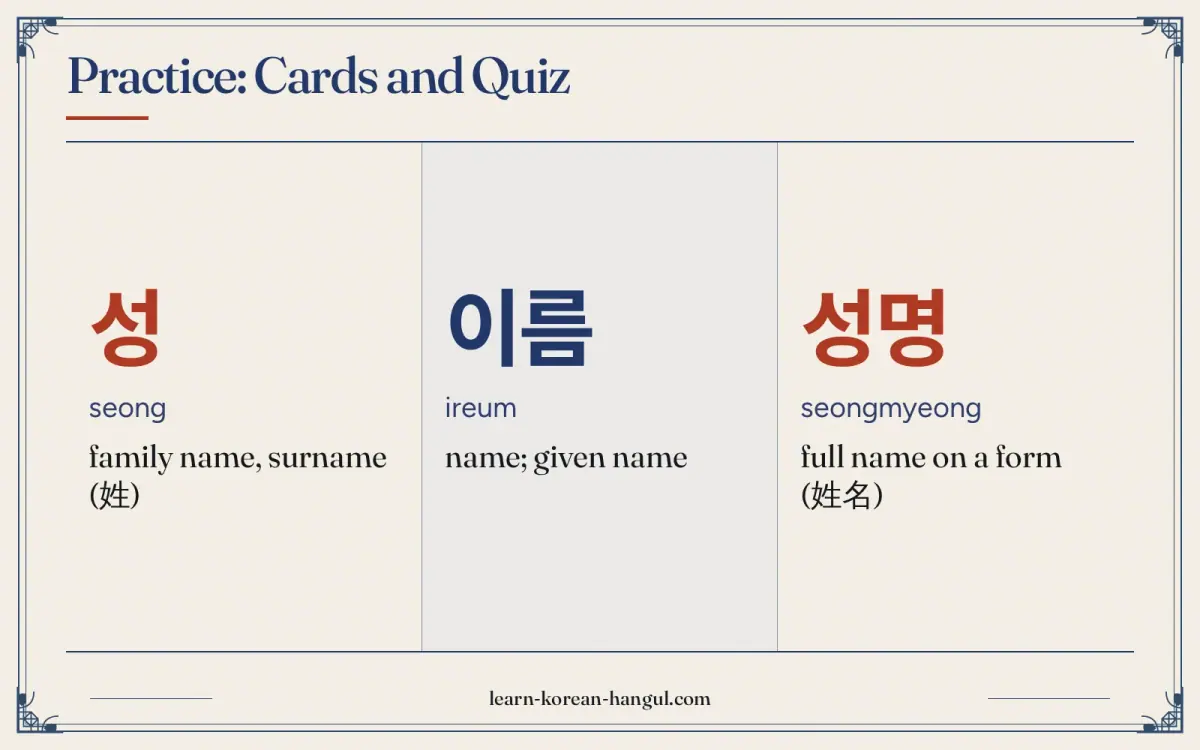
The cards cover the key terms for names. The Korean word for each is written in Hangul with its hanja where it has one.
| Korean | RR | Meaning | Note |
|---|---|---|---|
| 성 | seong | family name, surname (姓) | The surname is the first part of a Korean name: 김 in 김민준. |
| 이름 | ireum | name; given name | A native word. It can mean the whole name or only the given name. |
| 성명 | seongmyeong | full name on a form (姓名) | 姓 family name + 名 name. The label on many forms. |
| 성함 | seongham | name, honorific form (姓銜) | Used for another person's name: 성함이 어떻게 되세요? |
| 본관 | bongwan | clan origin place (本貫) | The place the family line is traced to, such as 김해 in 김해 김씨. |
| 족보 | jokbo | family genealogy book (族譜) | Said [족뽀]. It lists names with their hanja. |
| 돌림자 | dollimja | generation name syllable | Said [돌림짜]. A syllable shared by one generation of a clan. |
| 항렬 | hangnyeol | generation rank in a clan (行列) | Said [항녈]. The 돌림자 follows the 항렬. |
| 작명 | jangmyeong | choosing a name (作名) | Said [장명]. Some parents pay a naming specialist, a 작명가. |
| 가족관계증명서 | gajokgwangyejeungmyeongseo | certificate of family relations (家族關係證明書) | Said [가족꽌계증명서]. Lists names, with hanja in brackets. |
Practice · 10
- 01성
Show answer
seong
family name, surname (姓)
- 02이름
Show answer
ireum
name; given name
- 03성명
Show answer
seongmyeong
full name on a form (姓名)
- 04성함
Show answer
seongham
name, honorific form (姓銜)
- 05본관
Show answer
bongwan
clan origin place (本貫)
- 06족보
Show answer
jokbo
family genealogy book (族譜)
- 07돌림자
Show answer
dollimja
generation name syllable
- 08항렬
Show answer
hangnyeol
generation rank in a clan (行列)
- 09작명
Show answer
jangmyeong
choosing a name (作名)
- 10가족관계증명서
Show answer
gajokgwangyejeungmyeongseo
certificate of family relations (家族關係證明書)
Check your understanding.
Practice · 6
The surname 김 is written 金. What does 金 mean as an ordinary word?
Show answer
Gold or metal
金 means gold or metal. As a surname it is read 김, and in most other words it is read 금.
Which statement about the Hangul name 지수 is correct?
Show answer
It can be written with different hanja in different families
A Hangul name gives only the sound. Many hanja share the reading, so different families can choose different characters.
What is a 돌림자?
Show answer
A syllable shared by a generation of a clan
A 돌림자 is a shared syllable, usually from the clan's 항렬 list, given to one generation.
Which of these Korean names has no hanja behind it?
Show answer
하늘
하늘 means sky and is a native Korean word. Many Korean names are made of hanja, but native names exist.
Which hanja can be used in a registered name?
Show answer
Characters on a permitted list set by the courts
Registered name hanja must come from a list kept by the court system, which is longer than the 1,800 school list.
The surname 李 is read 이 in the South. What is the original reading?
Show answer
리
The original reading is 리. Under the initial-sound rule the South writes 이.
Frequently Asked Questions
Does every Korean name have hanja?
No. Most older and many current names do, and the hanja form is kept in family records, but some names are native Korean words such as 하늘 (sky) or 보람 (a worthwhile result) and have no hanja. A person may also not know which characters their name uses. Ask the family or check the family relations register.
Can I find the hanja for my name?
Often, yes, if you have a Korean name. The best source is your own family record or a family member. If you only have the Hangul, a hanja dictionary will list candidates for each syllable, but it cannot tell you which one your parents chose. For a name you chose yourself, you may pick the characters you like.
Why are there so many hanja for one sound?
Korean has far fewer syllables than Chinese has characters. Many characters were borrowed with different meanings but ended up with the same Korean reading, so one sound such as 지 stands for 智, 志, 知 and many more. This is why Hangul alone does not show the meaning of a name.
Are Korean names the same in Chinese?
No. The characters may be the same, but the Chinese reading is different. 金敏俊 is read Jīn Mǐnjùn in Mandarin and 김민준 in Korean. The reverse also holds: Chinese names are read in Korean either with the Chinese pronunciation written in Hangul, which is usual for living people, or with the Sino-Korean readings, which are usual for historical figures.
Should a learner pick a hanja name?
Only if you want one. A Korean name in Hangul works everywhere in daily life, and many learners do not use hanja at all. If you choose hanja, pick characters that are on the name list for registration, check each meaning in a dictionary and ask a Korean friend whether the combination sounds natural.