
How to Learn Hanja
Learn hanja by starting with words, because a character with no word attached is quickly forgotten. A Korean word you know, such as 학교 (hakgyo, school), already carries two characters. Split the word, learn what each character means, then look for other words that use the same character. After that, review on a schedule so the memory lasts.
Before you start
- You can read Hangul and know a few hundred Korean words.
- You have 15 to 20 minutes a day, six days a week.
- You have a flashcard tool that lets you add your own cards, or paper cards.
- You accept that the goal is recognition. Writing by hand is a separate, optional skill.
If you are not sure that hanja are worth your time, read Hangul vs Hanja first. If you are ready, the five steps below are the whole method.
Step 1: Pick a Word You Know
Choose a Korean word you already use, and let that word lead. Words you know give you a free hook: the sound, the meaning and the situation where you heard it. Good first words are 학교 (school), 학생 (student), 생일 (birthday), 외국 (foreign country) and 시간 (time). Avoid rare words at the start, because they have no hook.
Checkpoint: you can say the word and its meaning without looking. If you cannot, pick an easier word.
Step 2: Split It into Characters
Most Sino-Korean words have two characters, and each character is one syllable. Write the word, split it by syllable and look up each character. Keep three facts for each: the shape, the Korean reading and the meaning word, known as the 음훈 (eumhun). 學 is 배울 학: "learn" is the meaning word and 학 is the reading. Here are eight worked examples.
| Word | Characters | Meaning of the parts | Meaning of the word |
|---|---|---|---|
| 학교 | 學 + 校 | study + school | school |
| 학생 | 學 + 生 | study + born, person | student |
| 대학 | 大 + 學 | big + study | university |
| 선생 | 先 + 生 | earlier + born | teacher |
| 생일 | 生 + 日 | born + day | birthday |
| 외국 | 外 + 國 | outside + country | foreign country |
| 인구 | 人 + 口 | person + mouth | population |
| 시간 | 時 + 間 | time + between | time, hour |
Do not worry about the exact English gloss of each part. The point is a short meaning hook. 先生 literally means "born earlier", which is why it is the word for teacher.
Checkpoint: for any two-syllable Sino-Korean word on your list, you can name both characters and their meaning hooks.
Step 3: Study the Character's Word Family
A character is worth learning because of the words it builds, so study each one together with its family. Take 學. Once you know it means "study", a whole group of words falls into place.
| Word | Characters | Meaning |
|---|---|---|
| 학교 | 學 + 校 | school |
| 학생 | 學 + 生 | student |
| 대학 | 大 + 學 | university |
| 방학 | 放 + 學 | school vacation |
| 입학 | 入 + 學 | entering a school |
| 학원 | 學 + 院 | private academy |
| 학년 | 學 + 年 | school year |
Say these aloud and note the sound changes. 학교 is said [학꾜], 학생 [학쌩], 입학 [이팍] and 학원 [하권]. The sounds change in speech, but the character stays the same. Each word is a new place to meet the same character, which is what makes it stick.
The site's hanja word families section does this for the most productive characters. Use it once you have the first dozen.
Checkpoint: for each new character, you can list three words that contain it.
Step 4: Add Radicals as Hints
Radicals are small parts inside a character that often hint at its meaning, and they are a helpful extra, not a requirement. Learn only the common ones, and learn them when they appear in a character you are studying. Here are six common ones, each with one example character; four of the examples (校, 語, 時 and the radical 心 itself) are in the first 100.
| Radical | Meaning hint | Example | Reading |
|---|---|---|---|
| 氵 (water) | water, liquid | 海 sea | 해 |
| 木 | tree, wood | 校 school | 교 |
| 言 | speech | 語 language | 어 |
| 心 or 忄 | heart, feeling | 情 feeling | 정 |
| 日 | sun, time | 時 time | 시 |
| 亻 (person) | person | 休 rest | 휴 |
Use these as memory hooks, not as rules. A radical gives a hint about the field, not the full meaning. The 木 in 校 is a handy visual anchor, but it does not tell you the meaning "school", so you will not guess the word from the radical alone. For more detail, see hanja radicals.
Checkpoint: you can name the radical in five characters you have already learned.
Step 5: Review with Spaced Repetition
Spaced repetition means seeing an item soon after you learn it, and again after longer and longer gaps. A common starting pattern is the next day, then 3 days, a week, two weeks and a month later. If you use a flashcard app, it schedules reviews for you; the guide to choosing a hanja app explains what to look for. If you use paper, sort cards into boxes by how well you know them. For more on flashcard decks on this site, see Korean vocabulary flashcards.
Test recall in three directions, because each one trains something different.
- Character to reading: see 學, say 학.
- Character to meaning: see 學, say "study".
- Word to characters: see 학교, say 學校.
If you can do all three, you know the character well enough to read it inside a word. If you can only do the first, you can read but not understand; go back to Step 2.
Checkpoint: you pass all three recall tests for last week's characters.
The Four-Week Plan
A four-week plan gives 25 new characters a week for the 100 basic hanja. It matches the 10 themes on the basic hanja page, spread across four weeks so each week finishes cleanly. Check the sum: 25 characters a week for 4 weeks is 100. Six study days a week gives about four new characters a day.
| Week | Characters | New characters |
|---|---|---|
| Week 1 | Numbers (10), nature and weekdays (10), five size characters (百 千 萬 大 小) | 25 |
| Week 2 | Five size characters (多 少 長 高 重), people and family (10), school and learning (10) | 25 |
| Week 3 | Body and mind (10), directions and places (10), five time characters (年 時 間 今 前) | 25 |
| Week 4 | Five time characters (後 午 夜 新 古), country and society (10), actions and abstract words (10) | 25 |
| Total | The 100 basic hanja | 100 |
A daily session of 15 to 20 minutes can look like this:
- 3 minutes: review yesterday's cards.
- 9 to 10 minutes: learn four new characters (Steps 1 to 4).
- 3 to 4 minutes: recall test, in three directions.
- 2 minutes: add the new cards to your deck.
That adds up to 17 to 19 minutes. The total study time is 4 weeks × 6 days × 15 to 20 minutes, or 6 to 8 hours. On the seventh day, rest or review only. If 25 a week is too heavy, use the same order at 10 a week and finish in ten weeks; the order matters more than the speed. After the 100, continue with the word families and, if you want to write them, how to write hanja.
What Mistakes Slow Learners Down?
Most problems come from five habits. Fix them early.
- Learning shapes before words. A shape without a word has no hook. Always start from a word you know.
- Ignoring sound changes. The reading 학 is steady, but the spoken forms change: 학교 [학꾜], 입학 [이팍]. Learn the reading, then hear the change.
- Treating every homophone as the same character. 전 can be 電, 前, 全 or 展. Group words by character, not by sound.
- Skipping review. New characters feel good and old characters quietly fade. Review first, add second.
- Over-investing in radicals or writing. Both are useful, but neither is a good first step.
How Many Hanja Can I Learn in a Month?
At the plan's pace you can meet 100 characters in four weeks, but "learn" should mean you can recognise them in words after review. How much you keep varies by person, so use your own recall tests as the guide and slow down if last week's cards keep failing. If you only have 10 minutes a day, aim for 10 to 12 new characters a week and you will finish the 100 in about 8 to 10 weeks.
How Do I Stop Forgetting Hanja Readings?
Tie each reading to a word you say, and review it on schedule. 學 is 학 because of 학교; 生 is 생 because of 생일. If a reading keeps slipping, make a card with a word, not only the character, and say the word aloud. Listening to the word helps, because the sound and the character become linked.
Practice: Cards and Quiz
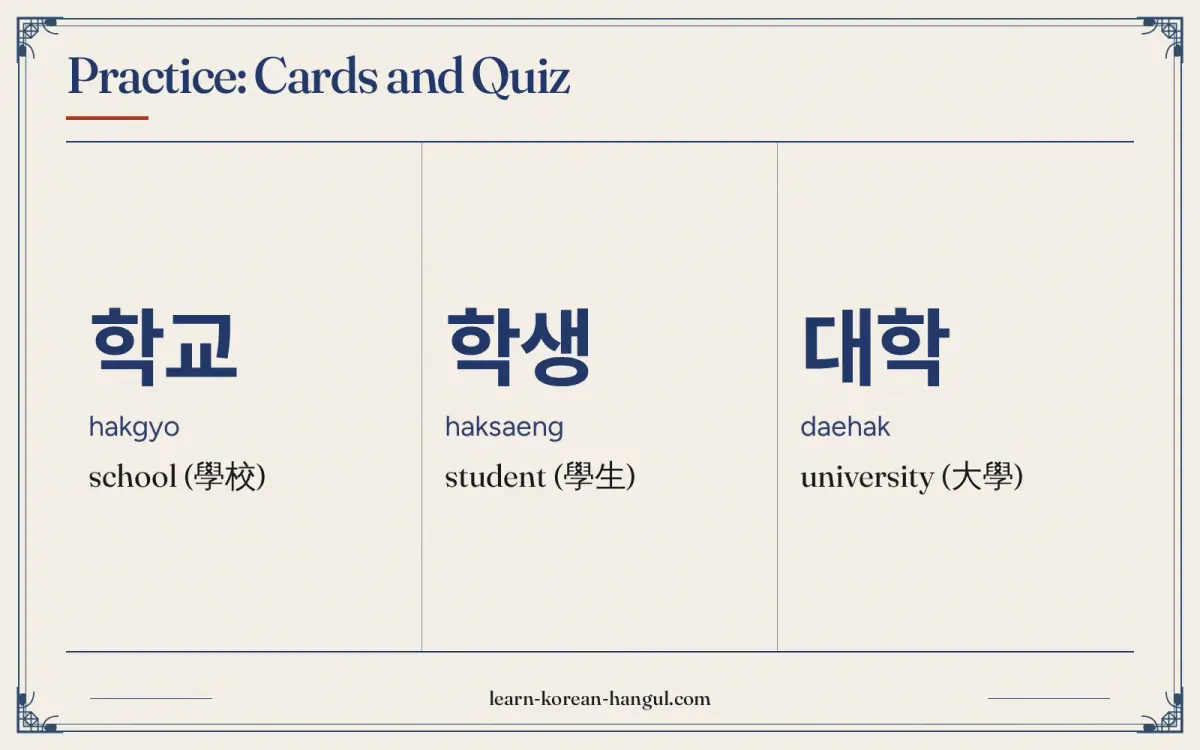
These ten cards use the words from the method. Each shows the characters, so the card is a word-family card, not a shape card.
| Korean | RR | Meaning | Note |
|---|---|---|---|
| 학교 | hakgyo | school (學校) | 學 배울 학 + 校 학교 교. Said [학꾜]. |
| 학생 | haksaeng | student (學生) | 學 + 生 날 생. Said [학쌩]. |
| 대학 | daehak | university (大學) | 大 큰 대 + 學. A 대학교 is a full university. |
| 방학 | banghak | school vacation (放學) | 放 놓을 방 + 學. School is "let go" for a while. |
| 선생 | seonsaeng | teacher (先生) | 先 먼저 선 + 生. Literally "born earlier". Usually said 선생님. |
| 생일 | saengil | birthday (生日) | 生 + 日 날 일. "Day of birth". |
| 인구 | ingu | population (人口) | 人 사람 인 + 口 입 구. "People mouths". |
| 외국 | oeguk | foreign country (外國) | 外 바깥 외 + 國 나라 국. "Outside country". |
| 시간 | sigan | time, hour (時間) | 時 때 시 + 間 사이 간. "Time between". |
| 입학 | iphak | entering a school (入學) | 入 들 입 + 學. Said [이팍]; RR keeps the h in this noun. |
Practice · 10
- 01학교
Show answer
hakgyo
school (學校)
- 02학생
Show answer
haksaeng
student (學生)
- 03대학
Show answer
daehak
university (大學)
- 04방학
Show answer
banghak
school vacation (放學)
- 05선생
Show answer
seonsaeng
teacher (先生)
- 06생일
Show answer
saengil
birthday (生日)
- 07인구
Show answer
ingu
population (人口)
- 08외국
Show answer
oeguk
foreign country (外國)
- 09시간
Show answer
sigan
time, hour (時間)
- 10입학
Show answer
iphak
entering a school (入學)
Now check recall with six questions.
Practice · 6
What is the best first step in the word-family method?
Show answer
Pick a Korean word you already know
Start from a word you know, then look at the characters behind it. That keeps every character tied to a meaning.
Split 학생 into characters. Which pair is right?
Show answer
學 + 生
학생 is 學 (study) + 生 (born, person). 大 + 學 is 대학, 先 + 生 is 선생 and 學 + 校 is 학교.
Which word shares the character 學 with 학교?
Show answer
방학
방학 (放學) contains 學. 하늘 and 바다 are native words, and 사과 is a different word.
The 日 in 생일 is read 일. What does it mean?
Show answer
day, sun
日 means sun or day. 생일 is the day of birth.
Which review habit fits spaced repetition?
Show answer
Review soon after learning, then at longer gaps
Spaced repetition revisits an item soon and then at growing gaps, which is more efficient than a single long session.
외국 is 外 + 國. What does it mean?
Show answer
foreign country
外 means outside and 國 means country, so 외국 is a foreign country.
Frequently Asked Questions
Do I need to write hanja by hand?
No. If your goal is to read, recognition is enough: see 學 and think 학, "study". Writing can help some people remember shapes, and it is needed for hanja tests. It takes much longer, so add it later if you need it. The page on how to write hanja gives the stroke-order rules when you are ready.
How many hanja can I learn per day?
About four new characters a day is a realistic pace for a 15 to 20 minute session, which gives 25 a week on six study days. If that feels heavy, drop to two a day, or 10 to 12 a week. Reviewing old characters matters more than adding new ones, so never skip the review step.
Which app is best?
It depends on what you need. The useful features are Korean readings, spaced repetition, handwriting practice, offline use and low cost. Our page on choosing a hanja app lists the criteria and how to test an app in ten minutes. Any flashcard tool works if you can add your own cards.
Should I learn Chinese first?
No. You do not need Chinese to learn hanja for Korean. Learn the Korean readings through Korean words. If you already read Chinese or Japanese, you will recognise many characters, but you still need to learn the Korean readings and check the meaning of compound words.
Should I learn radicals first?
No. Radicals help as hints later, but learning all 214 first delays real progress. Pick up the common ones as they appear in your characters, and use the radical hints only when a shape is hard to remember.