Hanja History: the Essentials
The short version has five milestones. Read them in order and you have the whole story.
- Early centuries: Chinese characters arrive and classical Chinese becomes the written language of Korean states.
- Silla and after: scholars invent idu, hyangchal and gugyeol to write Korean with hanja and to read Chinese in Korean order.
- 1446: King Sejong promulgates Hunminjeongeum, the alphabet now called Hangul.
- 1500s to 1800s: hanja stay official, while Hangul spreads among women, commoners and in literature.
- 1894 to the present: Hangul becomes the official and everyday script, and hanja shrink to an optional extra.
Hanja never "left" in a single year. They faded over about a century, and some uses never disappeared. The sections below take each stage in turn. If you only want the current picture, read whether Korean uses hanja today.
When Did Chinese Characters Reach Korea?
Chinese characters reached Korea in the first centuries CE at the latest, and probably earlier. China's Han dynasty set up commanderies in the north of the peninsula in 108 BCE, so people there had contact with writing early on. The first dated Korean inscriptions in classical Chinese come from the Three Kingdoms period. The Gwanggaeto Stele, put up in 414 CE for the Goguryeo king, is a large stone covered in classical Chinese. Historical records say that the kingdom of Baekje compiled a history called Seogi in 375. Silla used the Chinese script too, as stone inscriptions show.
The language written was not Korean. It was 한문 (hanmun, 漢文), classical Chinese, a literary language with its own grammar. Educated Koreans learned to read it as scholars did elsewhere in East Asia. Korean readers read it aloud with Korean sounds, and each character got a Korean reading. Those readings came from a medieval stage of Chinese, which is why Sino-Korean readings still keep final consonants such as the ㄱ of 학 and the ㄹ of 일 that Mandarin has lost.
This arrangement explains something important. Hanja are read with Korean sounds because Koreans, not Chinese speakers, learned them. A word built from these readings, such as 학교, is called 한자어 (hanjaeo), a Sino-Korean word. Many such words were borrowed from Chinese, and many others were coined in Korea.
What Were Idu, Hyangchal and Gugyeol?
Idu, hyangchal and gugyeol were three ways to adapt Chinese characters to Korean before Hangul. Each used hanja for their sound or their meaning, and each solved a different problem.
| System | Hangul | Who used it | What it did |
|---|---|---|---|
| Idu | 이두 (吏讀) | Clerks and officials | Wrote Korean grammar words and names in official documents |
| Hyangchal | 향찰 (鄕札) | Poets in the Silla period | Wrote whole Korean poems, using hanja for sound and meaning |
| Gugyeol | 구결 (口訣) | Readers of Chinese texts | Added small grammar marks so Chinese could be read in Korean order |
Idu
Idu wrote Korean sentences with Chinese characters arranged in Korean word order. A character could be used for its meaning, as a native Korean word, or for its sound, as a syllable. The result was readable to Korean clerks but looked odd to Chinese readers. Idu appears in documents from the Silla period, and the tradition credits the scholar Seol Chong with arranging it, though this is a later attribution. It stayed in use in official documents into the Joseon period.
Scholars reconstruct particles such as 乙 for the object marker 을, 隱 for the topic marker 은/는 and 伊 for the subject marker 이. This is a simplification, because the same character could carry several readings, but it shows the principle: a hanja is a piece of grammar. The reconstructed readings come from modern scholarship, so treat them as a guide, not a certainty.
Hyangchal
Hyangchal was a more complete system, known mainly from about two dozen Silla and early Goryeo poems called 향가 (hyangga). In hyangchal the main nouns and verb stems were written with characters used for their meaning, while endings were written with characters used for their sound. Only a small set of poems survive, so much of how it was read remains uncertain and is still debated.
Gugyeol
Gugyeol did something different. Students did not write Korean with it. They used it to read Chinese. Small marks or simplified characters were added beside the Chinese words to show Korean particles and endings, so the reader could turn a Chinese sentence into Korean word order. It is a reading aid, much like Japanese kunten marks. Gugyeol lived on in scholarly reading for centuries.
All three systems share a lesson: before Hangul, writing Korean meant bending Chinese characters to fit. That is the problem Hangul later solved.
What Changed in 1446?
In 1446, King Sejong's court promulgated the Hunminjeongeum (訓民正音), a new alphabet made for Korean sounds. The name means roughly "the correct sounds for teaching the people". It is the script now called Hangul. Records say the alphabet was completed in late 1443 and published in 1446. The Hunminjeongeum Haerye, the explanatory text with the design of the letters, survives, and UNESCO placed it on the Memory of the World Register in 1997.
Sejong's preface gives the reason in plain words. Korean speech differed from Chinese, characters did not fit it, and many ordinary people could not express what they wished to say in writing. The alphabet had 28 letters at the start. Four of them are no longer used, and the remaining 24 are the letters in use today. You can read about the design on the how Hangul was created page and the wider story on the history of Hangul pages.
South Korea celebrates Hangul Day on 9 October, a national holiday. North Korea marks its own Hangul day on January 15.
One point matters for the history of hanja. The creation of Hangul did not abolish hanja. Hangul was added to the toolbox, and for centuries both lived side by side.
How Did Hanja and Hangul Coexist in Joseon?
In the Joseon period (1392 to the early twentieth century) the two scripts had different jobs. Classical Chinese stayed the language of state, the civil service examinations, law, history and scholarship. Hangul was used for things that needed the common tongue. Early projects included songs of dynasty founders (Yongbieocheonga, 1447) and Buddhist texts translated into Korean. Over time women wrote letters and poetry in Hangul, and storytellers and novelists wrote fiction in it.
| Group | Main script |
|---|---|
| Officials and scholars | Classical Chinese (hanmun) |
| Clerks | Idu and Chinese |
| Women of all classes | Often Hangul |
| Commoners | Spoken Korean, and Hangul where they could read |
| Fiction and song | Hangul, with hanja words mixed in |
The civil service examination (과거, gwageo) shows why classical Chinese had such power. Candidates for government posts were tested on Chinese classics and on writing in classical Chinese, so success in public life required a deep knowledge of characters. Families with the means to educate their sons in this way formed the scholar-official class, called 양반 (yangban). Hangul never became an examination language in this period, which kept hanja at the centre of public life even while Hangul spread in homes, markets and private letters.
Officials of the time often called Hangul 언문 (eonmun), "vernacular writing". Historians disagree on whether it also carried a slighting tone; either way, the word is dated today.
This arrangement is called a diglossia: two forms of writing for different purposes. Many scholars wrote in Chinese and spoke Korean, and a letter to a family member might be in Hangul. It was the norm for centuries. A wide range of Sino-Korean words entered everyday speech through this long contact, which is the subject of the final section.
What Happened in the Twentieth Century?
The twentieth century moved hanja from the centre of writing to its edge. Four steps are worth knowing.
- 1894 and the Gabo reforms. A royal edict gave Hangul a place in official documents, often mixed with hanja. In 1896 the Dongnip Sinmun (The Independent) was founded as a newspaper written in Hangul, with an English edition.
- Mixed script. From the 1890s on, writers such as Yu Gil-jun used a mixed script, 국한문혼용 (gukhanmunhonyong): hanja for content words and Hangul for grammar endings, a style that was dominant in print for much of the century. During the period of Japanese rule (1910 to 1945), Korean publishing still used mixed script widely, and in 1933 the Joseon Language Society published a unified Hangul spelling that became the base of modern standard spelling.
- 1948 and Hangul-only policy. After liberation, South Korea passed a law making Hangul the script for official documents, with exceptions. Later governments pushed Hangul-only writing further in the late 1960s and 1970s, and a school list of 1,800 basic hanja was fixed in 1972.
- 2005 and the Framework Act on the Korean Language. The Act sets Hangul as the script for official documents and allows hanja or foreign scripts in brackets when needed.
The policy swung back and forth in debate, with arguments on both sides. Supporters of Hangul-only writing said it was easier and more democratic. Supporters of mixed script said hanja prevent confusion between homophones and help students read old texts. Both views still appear in debates today. No single date ended hanja use. Newspapers moved to Hangul gradually in the later twentieth century, and schools adjusted hanja teaching with each curriculum revision.
Details of these policies changed more than once, so use this as a summary and check a history source before you cite any year.
How Did the Move to Hangul Change Reading and Writing?
Moving to Hangul changed more than the letters. It changed how text looked and how it was read. Classical Chinese text was written without spaces between words, because each character was already a unit. Hangul text mixes native words, particles and endings that do not fit that pattern, so spaces between words (띄어쓰기, ttuieosseugi) became useful. Word spacing is usually linked to late nineteenth-century Hangul printing, including texts prepared by Western missionaries and the Dongnip Sinmun, and it became standard in modern Korean. If you have ever wondered why Korean puts spaces where Chinese and old Korean documents did not, this is part of the answer.
The shift also changed what readers could skip. In mixed script a reader saw hanja for the content words, so homophones were obvious at a glance. In Hangul-only text a reader relies on context. This is why dictionaries, legal texts and some textbooks still put hanja in brackets for a rare term, and why schools kept a basic list of characters. It is also why Sino-Korean words feel "invisible" to a learner: the characters are gone, but the word-building is still there.
For a learner, three points are worth keeping from this history.
- Hangul is complete. You never need hanja to pronounce a Korean word, only to understand its parts.
- Sound is regular, meaning is not. The Korean reading of a character is steady, but the meaning of a word built from it must be checked.
- Older texts differ. Spelling, spacing and vocabulary in pre-modern Korean documents are different from the modern standard, so older works usually need a specialist edition or translation.
How Does This History Shape Korean Vocabulary Today?
The long use of Chinese texts left Korean with a very large layer of Sino-Korean vocabulary. Not everything in that layer came straight from China. The layers are different.
| Layer | Example | How it entered |
|---|---|---|
| Old borrowings | 학교 (hakgyo, school) | Taken from Chinese texts and education long ago |
| Coined in Korea | 시댁 (sidaek, husband's family) | Built in Korea from hanja parts |
| Modern terms via Japan | 철학 (cheolhak, philosophy) | Coined in Japan in the nineteenth century and adopted |
| Recent loanwords | 인터넷 (inteonet, internet) | Taken from English and written directly in Hangul |
Three things follow for a learner. First, abstract vocabulary is mostly Sino-Korean: 사회 (society), 경제 (economy), 문화 (culture). Second, native Korean words fill the base of daily life, such as numbers 하나, 둘, 셋 and many verbs. Third, the same hanja syllable turns up in many words, so a few characters unlock hundreds of words. The Sino-Korean vocabulary page lists such words, and basic hanja teaches the core characters.
The history also explains why Korean can drop hanja entirely and still work. Hangul was designed for Korean sounds, so it writes Sino-Korean words as well as native ones. Words that sound the same are told apart by context, as in 사과 (apple) and 사과 (apology), the same way English tells "bank" apart.
The Timeline at a Glance
This table gathers the milestones into one place. Dates are summaries, so check a history source for exact years.
| Year | What happened |
|---|---|
| Before 1446 | Chinese characters and classical Chinese are the written language of government and learning; adapted systems record Korean. |
| 1446 | Hunminjeongeum, the Korean alphabet, is promulgated by King Sejong. |
| 1500s to 1800s | Classical Chinese stays official; Hangul spreads among women, commoners and in translations and fiction. |
| 1894 | The Gabo reforms give Hangul a place in official documents. |
| 1948 | A law makes Hangul the script of official documents, with exceptions. |
| 1970s | Government policy pushes Hangul-only writing; the 1,800 school list is set in 1972. |
| 2005 | The Framework Act on the Korean Language sets Hangul as the script for official documents, with brackets allowed. |
Practice: Cards and Quiz
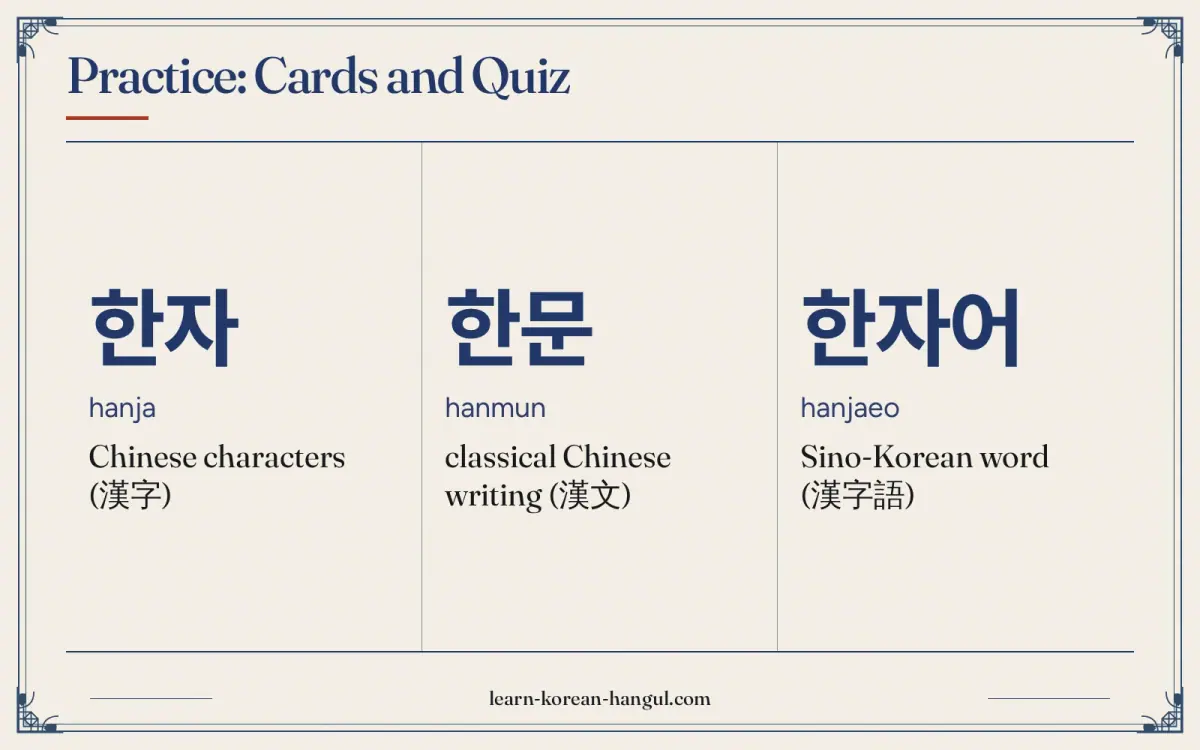
The cards below use words from the history. Learn the terms before the dates.
| Korean | RR | Meaning | Note |
|---|---|---|---|
| 한자 | hanja | Chinese characters (漢字) | Characters read with Korean sounds. |
| 한문 | hanmun | classical Chinese writing (漢文) | The language of official and scholarly texts for most of Korean history. |
| 한자어 | hanjaeo | Sino-Korean word (漢字語) | A word built from hanja syllables, such as 학교. |
| 이두 | idu | idu, hanja used to write Korean grammar (吏讀) | Used by clerks in official documents for centuries. |
| 구결 | gugyeol | gugyeol, grammar marks on Chinese texts (口訣) | Small marks that let readers read Chinese in Korean order. |
| 향찰 | hyangchal | hyangchal, hanja used to write Korean poems (鄕札) | Silla-period system known from a small set of poems. |
| 훈민정음 | hunminjeongeum | the original name of Hangul (訓民正音) | Roughly "the correct sounds for teaching the people". |
| 한글 | hangeul | Hangul, the Korean alphabet | The name Hangul came into use in the early twentieth century. |
| 세종대왕 | sejongdaewang | King Sejong the Great (世宗大王) | Fourth king of Joseon, associated with the creation of Hangul. |
| 언문 | eonmun | eonmun, an old term for Hangul (諺文) | A common-script label in Joseon; it is dated today. |
Practice · 10
- 01한자
Show answer
hanja
Chinese characters (漢字)
- 02한문
Show answer
hanmun
classical Chinese writing (漢文)
- 03한자어
Show answer
hanjaeo
Sino-Korean word (漢字語)
- 04이두
Show answer
idu
idu, hanja used to write Korean grammar (吏讀)
- 05구결
Show answer
gugyeol
gugyeol, grammar marks on Chinese texts (口訣)
- 06향찰
Show answer
hyangchal
hyangchal, hanja used to write Korean poems (鄕札)
- 07훈민정음
Show answer
hunminjeongeum
the original name of Hangul (訓民正音)
- 08한글
Show answer
hangeul
Hangul, the Korean alphabet
- 09세종대왕
Show answer
sejongdaewang
King Sejong the Great (世宗大王)
- 10언문
Show answer
eonmun
eonmun, an old term for Hangul (諺文)
Check yourself with six questions.
Practice · 6
Which writing system was used by clerks to write Korean grammar with hanja?
Show answer
Idu
Idu used hanja by sound and by meaning to record Korean word endings in official documents.
In which year was Hangul promulgated as Hunminjeongeum?
Show answer
1446
The Hunminjeongeum was promulgated in 1446 under King Sejong.
What is gugyeol?
Show answer
Grammar marks added to Chinese texts so they could be read in Korean order
Gugyeol marks showed Korean grammar on classical Chinese texts.
Who mostly read and wrote classical Chinese in Joseon Korea?
Show answer
Educated officials and scholars
Classical Chinese was the language of government and scholarship, so officials and scholars used it most. Hangul was used widely by women and commoners.
What did the 1948 Hangul law do?
Show answer
Made Hangul the script of official documents, with exceptions
The 1948 law on Hangul-only use set Hangul for official documents. The 1,800 school list is from the early 1970s.
Why does Korean have so many Sino-Korean words?
Show answer
Centuries of official and scholarly writing used Chinese vocabulary
Official and scholarly writing in classical Chinese brought a large layer of Chinese-based vocabulary into Korean. Grammar and native words remained Korean.
The Bottom Line
Hanja came to Korea with Chinese texts, were adapted by idu, hyangchal and gugyeol, and then shared the stage with Hangul after 1446. Hangul became the everyday script in the twentieth century, but a thousand years of Chinese reading left Korean with a deep Sino-Korean vocabulary. For a learner, the practical result is simple: read in Hangul, and learn hanja only when you want the word-building pattern behind the vocabulary. The next step is how to learn hanja with a word-family method.
Frequently Asked Questions
When did Koreans start using hanja?
Chinese characters reached the Korean peninsula in the first centuries CE at the latest, and probably earlier through contact with China. Stone inscriptions such as the Gwanggaeto Stele of 414 CE are in classical Chinese, and the Three Kingdoms kept written records in Chinese by about the fourth century. The exact first use is not known, because early texts are scarce.
Why was Hangul created?
King Sejong's preface to the Hunminjeongeum says that Chinese characters did not fit Korean speech and that ordinary people had no easy way to write what they wanted to say. The alphabet was designed to be learned quickly. The preface is the main source for the stated reason, and historians debate the political and scholarly motives behind it.
Did Hangul replace hanja immediately?
No. Hangul was published in 1446, but classical Chinese stayed the language of government, the civil service exams and scholarship until the late nineteenth century. Hangul grew in use among women, commoners and in translation and poetry. It became the official base script only after 1894 and the main everyday script in the twentieth century.
Why is Korean vocabulary so Chinese-derived?
Because for many centuries Korea's written culture, law, religion and learning used Chinese texts, and the terms in those texts entered Korean speech. Later, new terms for modern ideas were also built from Chinese characters, some of them in Japan. Korean grammar and basic everyday words stayed native, so Chinese-derived words fill the abstract and technical layers of vocabulary.
Did North Korea stop using hanja?
North Korea writes ordinary text in Hangul only. Sources describe its schooling in hanja differently at different periods, so there is no single simple statement. For a learner of South Korean Korean, the useful point is that both Koreas write everyday text in the same alphabet.