
Key facts
- Hanja are hidden in the vocabulary itself: a very large share of Korean words are Sino-Korean, even when written in Hangul.
Does Korean Use Hanja Today?
Yes, but only in a few places, and almost never as the main script. A Korean person reading a menu, a text message, a novel, a subway sign or a news article is reading Hangul. Hanja show up in the margins of the writing system: in names, in short headline forms, on traditional plaques and ceremonial items, in brackets inside dictionaries and textbooks, and in school lessons on the 한문 subject.
So the honest answer has two parts. As a script, hanja are rare and optional. As vocabulary, they are everywhere, because Sino-Korean words (한자어, hanjaeo) are built from hanja syllables and are written in Hangul. The word 학교 (hakgyo, school) is spelled in Hangul on every sign, but behind it sit 學 (study) and 校 (school). You can listen to the word for hanja itself.
The table sorts the places by how often an ordinary learner meets them.
| Where | What you see | How often you meet it |
|---|---|---|
| Everyday text, menus, apps, signs | Hangul only | Constantly |
| Dictionaries and textbooks | Hanja in brackets after a word | Often in study materials |
| Names on formal records | Hangul name, with hanja form on the register | Occasionally |
| Newspaper headlines | A few one-character abbreviations such as 美 and 中 | Depends on the paper |
| Palace, temple and shop plaques | Names written in hanja for a traditional look | In tourist and heritage areas |
| Funeral and ceremony items | Words such as 謹弔 on wreaths | At ceremonies |
| School 한문 lessons and hanja tests | Characters taught and written by hand | In classrooms and exam halls |
The next section looks at each place in turn.
Where Do Hanja Appear?
Hanja appear in six main places, and each has its own reason for surviving. Here they are one by one, starting with the one most learners care about.
Names
Most Korean names have a hanja form even though people write and say them in Hangul. A name such as 김민준 has three syllables, and each syllable can be backed by a character: 金 for 김, and other characters for 민 and 준 that the parents chose for their meaning. The same Hangul syllable can map to many different characters, so two people called 김민준 may have different hanja and different intended meanings.
The hanja form is kept in the 가족관계등록부 (gajokgwangyedeungnokbu, family relations register), the civil record that has replaced the old household register since 2008. It can also appear on formal documents, family trees and name seals. In daily life nobody needs it. The pages on hanja in Korean names and on Korean last names explain the details.
The word for a full name on a form is 성명 (seongmyeong), written 姓名 in characters. Listen to it.
Newspaper Headlines
Some newspapers use single hanja as short forms for countries and other common nouns in headlines. The characters are read with the Korean name of the country, and they save space in a narrow headline. The next section lists the common ones. Article text itself is in Hangul, and many outlets have dropped hanja from headlines too.
Signs and Plaques
Traditional buildings often keep their name plaques in hanja. Palace gates and halls, temple buildings, old academies and some tea houses and traditional medicine clinics use characters because the style looks classical. Modern shop signs, road signs and station names are in Hangul and Latin letters. Signs in Chinese, which you may see in tourist areas, are written for Chinese readers and are not hanja in the Korean sense, since they usually use the simplified characters of mainland China.
Dictionaries and Textbooks
When a Sino-Korean word has a homophone, a dictionary or school book may put the hanja in brackets to show which word is meant. The standard example is 사과: 사과(沙果) is an apple and 사과(謝過) is an apology. Hangul alone cannot tell them apart, but context almost always does in conversation. The brackets matter more in study texts and reference works.
Legal and Academic Writing
Law, medicine, philosophy and the sciences use many Sino-Korean terms. Modern laws and papers are written in Hangul. Where a term could be misread, a writer may add the hanja in brackets on the first mention. Learners who read academic Korean find it useful to recognise the characters, because the meaning of a long term can often be read off its parts. The Sino-Korean vocabulary page lists such words by topic.
Ceremonies, Calligraphy and Idioms
Funeral wreaths carry 謹弔 (근조, geunjo, respectful condolence) on the ribbon, and ancestral rites use written tablets in characters. Calligraphy keeps hanja as an art form. Four-character idioms (사자성어, sajaseongeo) such as 일석이조 (ilseogijo, 一石二鳥, "one stone, two birds") are learned with their characters and often appear in hanja in quotes and essays.
Do Newspapers Still Use Hanja?
A few do, in small doses, and the practice varies by paper and by year. The typical use is a one-character abbreviation in a headline. Because each character stands for a whole word, headline writers can fit more meaning into a short space. The characters are not read aloud as Chinese. They are read with the Korean word they abbreviate.
| Character | Korean word it stands for | RR | Meaning |
|---|---|---|---|
| 韓 | 한국 | hanguk | Korea |
| 美 | 미국 | miguk | United States |
| 中 | 중국 | jungguk | China |
| 日 | 일본 | ilbon | Japan |
| 北 | 북한 | bukhan | North Korea |
Two of these abbreviations are combined in headlines to name a relationship. 韓日 is 한일 (hanil, Korea and Japan), said [하닐], and 美中 is 미중 (mijung, the US and China). The same pattern gives 한미 (hanmi, Korea and the US). Other abbreviations of the same kind exist for other countries, for example 英 for 영국 (the UK) and 獨 for 독일 (Germany).
Reading these costs nothing to a learner who knows the country names in Hangul: each character is the first syllable of the Hangul word. Many papers now print 한일 and 미중 in Hangul instead, so hanja are a style choice, not a requirement. The word for newspaper itself is 신문 (sinmun, 新聞).
Do Schools Teach Hanja?
Yes. Hanja are taught in secondary school under the subject name 한문 (hanmun), which literally means "Chinese writing" (漢文). The subject covers the characters themselves and short passages of classical Chinese read in the Korean way. The Ministry of Education keeps a list of 1,800 basic hanja for education: 900 for middle school and 900 for high school. The list was first set in the early 1970s and is the standard reference for how many characters a school student can be expected to meet.
How much teaching happens has changed with each national curriculum. The time given to 한문, whether it is required or optional, and whether elementary schools teach any characters have all been adjusted several times, and the subject has often been debated. Because of that, treat any statement such as "all students study hanja" or "nobody studies hanja" as too simple. Check the current national curriculum on the Ministry of Education site (moe.go.kr) if you need the present rules. Outside school, many students and adults also take private hanja certificate exams; see Korean hanja proficiency tests.
One useful number for learners is the size of the list, not the hours. Even if a student knows only a few hundred of the 1,800, those characters appear in thousands of everyday words, which is why basic hanja and word-family study give such good value.
How Common Are Hanja Compared with the Past?
Hanja were once the writing of the elite, and they are now a small part of daily writing. For well over a thousand years before Hangul, Korea wrote official and scholarly texts in classical Chinese. Hangul was published in 1446 but took centuries to become the main script. The mixed script of Hangul grammar words and hanja content words, called 국한문혼용 (gukhanmunhonyong), dominated print through much of the twentieth century. After that, Hangul-only writing spread. The full story is on the hanja history page.
| Period | What happened to hanja |
|---|---|
| Before 1446 | Classical Chinese and adapted systems were used for writing. |
| 1446 | Hangul was promulgated as the Korean alphabet. |
| 1894 | The Gabo reforms gave Hangul a place in official documents, mixed with hanja. |
| 1948 | A law set Hangul as the script for official documents, with exceptions. |
| 1970s | Government policy pushed Hangul-only writing; the 1,800 school list was fixed. |
| Today | Hangul is the everyday script; hanja are optional extras. |
These dates are a summary, and details of the policies changed more than once, so check a history source before you quote them.
What Does This Mean for You as a Learner?
It means you can start with Hangul and ignore the characters for a long time, then add them later if your goals need them. How soon depends on what you read.
- Beginner. Skip hanja for now. Learn Hangul and core words first, and read Hangul vs Hanja if you want the comparison. What is hanja? explains the basics, and Should I learn hanja? helps you decide when to start.
- TOPIK candidate. Hanja are not tested directly, but they make abstract vocabulary guessable. See TOPIK hanja.
- Speaker of Chinese or Japanese. You already know many of the characters; you need only the Korean sounds. The page on hanja, kanji and hanzi compares them.
- Traveller. Expect Hangul and English on signs; hanja appear on heritage sites and plaques.
- Curious about names. Look at hanja in Korean names.
Notice that the characters help with vocabulary even in Hangul. When you see 대학 (university) and 대통령 (president), the shared 대 might be 大 (big, great) in both. That is a reasoning habit you can build without writing a single stroke. The word for a Sino-Korean word is 한자어, and the flashcards below include it.
Three Common Myths
Three beliefs about hanja come up often among learners, and each is partly wrong.
- "Koreans write in Chinese characters." They do not. Everyday Korean is written in Hangul. Hanja are an extra layer used in a few places.
- "Hangul comes from Chinese characters." It does not. Hangul is an alphabet whose consonant shapes were designed to show the mouth shapes that make the sounds. It was made as a new system. See how Hangul was created.
- "If you know hanja you can read Korean." No. Hanja give the meaning of Sino-Korean words only. Native Korean words, particles and verb endings have no hanja, so you still need the grammar.
Practice: Flashcards and Quiz
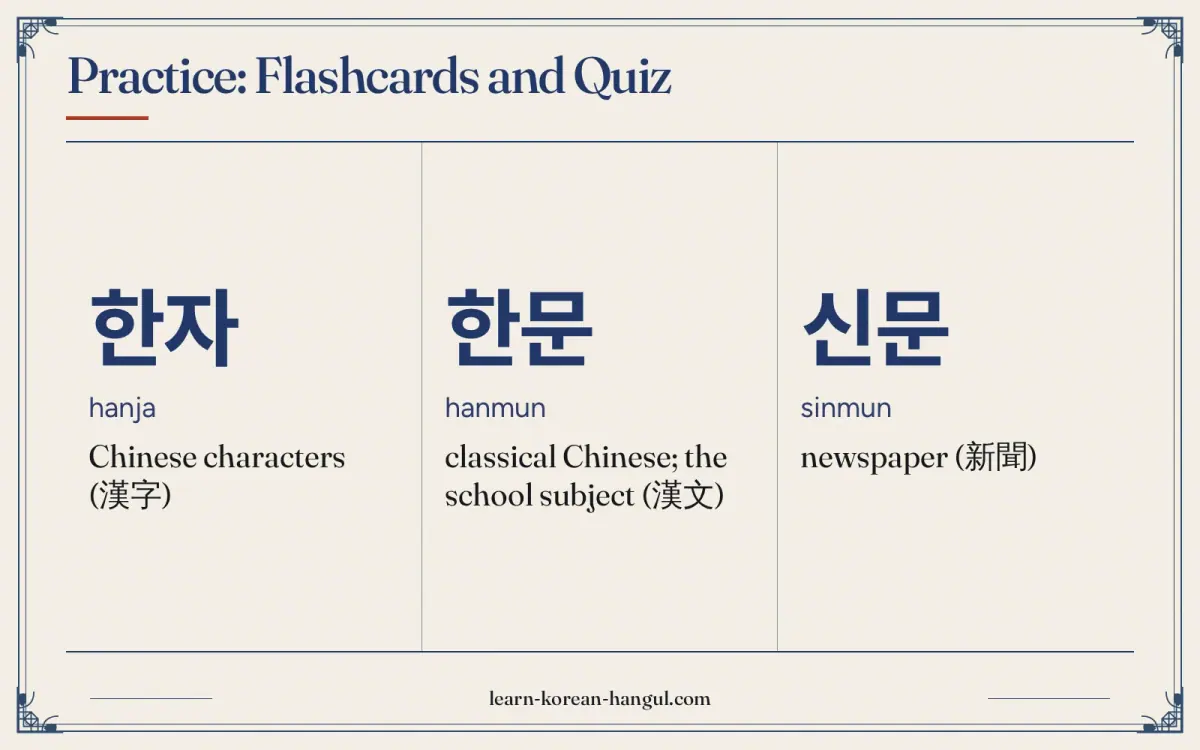
These ten cards use words from this page. Each shows the Hangul word, a Revised Romanization guide, the meaning and a note about the characters behind it.
| Korean | RR | Meaning | Note |
|---|---|---|---|
| 한자 | hanja | Chinese characters (漢字) | The word itself is written with two characters. In a Korean sentence, 한자 means hanja. |
| 한문 | hanmun | classical Chinese; the school subject (漢文) | Students meet this word as a subject name in secondary school. |
| 신문 | sinmun | newspaper (新聞) | Written 新聞 in the old mixed script. Today the Hangul spelling is normal. |
| 한일 | hanil | Korea and Japan (韓日) | Said [하닐]. In headlines it can be 韓日 or 한일. |
| 미중 | mijung | the US and China (美中) | Short for 미국 and 중국. 美 is read 미 and 中 is read 중. |
| 사과 | sagwa | apple (沙果) or apology (謝過) | Two different words with one spelling. Hanja in brackets can tell them apart. |
| 근조 | geunjo | condolence (謹弔) | Seen as 謹弔 on funeral wreaths and ribbons. |
| 성명 | seongmyeong | full name (姓名) | The label for the name box on many forms. |
| 대한민국 | daehanminguk | Republic of Korea (大韓民國) | Four characters, four syllables. Common on official papers. |
| 한자어 | hanjaeo | Sino-Korean word (漢字語) | A Korean word built from hanja syllables, usually written in Hangul. |
Practice · 10
- 01한자
Show answer
hanja
Chinese characters (漢字)
- 02한문
Show answer
hanmun
classical Chinese; the school subject (漢文)
- 03신문
Show answer
sinmun
newspaper (新聞)
- 04한일
Show answer
hanil
Korea and Japan (韓日)
- 05미중
Show answer
mijung
the US and China (美中)
- 06사과
Show answer
sagwa
apple (沙果) or apology (謝過)
- 07근조
Show answer
geunjo
condolence (謹弔)
- 08성명
Show answer
seongmyeong
full name (姓名)
- 09대한민국
Show answer
daehanminguk
Republic of Korea (大韓民國)
- 10한자어
Show answer
hanjaeo
Sino-Korean word (漢字語)
Check what you learned with six questions.
Practice · 6
Which script do Koreans use for everyday writing such as messages, menus and signs?
Show answer
Hangul
Everyday Korean is written in Hangul. Hanja appear in a few places, and kana is the Japanese syllabary.
In a headline, 美中 stands for which pair of countries?
Show answer
The US and China
美 is the short form of 미국 (the US) and 中 of 중국 (China). Korea is 韓 and Japan is 日.
What is 한문 as a school subject?
Show answer
A subject on classical Chinese and basic hanja
한문 covers classical Chinese texts and the basic hanja. It is not a Hangul class.
Why might a dictionary write 사과 (沙果) and 사과 (謝過)?
Show answer
To show two different words that are spelled the same
Hanja in brackets separate homophones. 사과 means apple in one case and apology in the other.
Which statement about names is most accurate?
Show answer
Names are written in Hangul, and many also have a registered hanja form
Hangul is the everyday and legal spelling. Many names also have hanja that give the meaning, and the same Hangul sound can have different hanja.
Which of these is the best way to describe how most Korean adults use hanja today?
Show answer
They read some common characters, but seldom write them by hand
Most adults recognise common characters in names, headlines and signs, but handwriting hanja is rare outside special uses such as tests and calligraphy.
Frequently Asked Questions
Do Koreans read hanja?
Many do, to different degrees. Adults who went through school in the last decades usually recognise common characters such as 大, 國 and 學, especially inside names and headlines. Few can read long texts written only in hanja, and younger people tend to know fewer. Reading ability varies with age, schooling and profession, and no reliable single figure exists.
Do Korean newspapers use hanja?
Some do, in small amounts. A few papers still use single characters for countries in headlines, such as 美 for 미국 and 中 for 중국, to save space. Article text is in Hangul, and many outlets write headlines fully in Hangul too. Practice differs by paper, so open a current front page to see it.
Do Koreans write hanja by hand?
Rarely. People write hanja by hand mostly for tests, calligraphy, formal occasions and sometimes to give their own name in characters. For everyday notes, messages and forms, Hangul is used. Typing hanja is also less common than typing Hangul, and phones convert Hangul to hanja only on request.
Is hanja on the Korean ID card?
The Hangul name is the standard form on Korean ID documents. A hanja name can be recorded in the family relations register, and some documents let you add it in brackets next to the Hangul name. The rules depend on the document and can change, so ask the issuing office before you rely on this.
Is hanja still taught in Korean schools?
Yes. It is taught under the subject name 한문 (hanmun) in secondary school, which uses the Ministry of Education list of 1,800 basic hanja: 900 for middle school and 900 for high school. How many hours it gets, and whether it is required, has changed with each curriculum, so check the current national curriculum.