
Hanja vs Kanji vs Hanzi: the Essentials
Here is the short verdict. Hanja, kanji and hanzi are the same family of characters with a shared ancestor, but each country adapted them. They differ in four ways: how they are read, which shapes are used, how many are in everyday use, and what job they do in the writing system. Of the four, the reading is the one that matters most to a Korean learner.
| Question | Short answer |
|---|---|
| Are they the same characters? | Mostly the same ancestors, with differing shapes in China and Japan |
| Are the readings the same? | No. Each language reads them with its own sounds |
| Can I read Korean with kanji or hanzi? | Only the Sino-Korean words, and only after learning the Korean readings |
| Which does Korea use today? | Hanja in small amounts, mostly traditional forms |
The word 한자 (hanja) is spelled 漢字 in Korea, Japan and China. Listen to it in Korean.
Why Do the Three Names Exist?
The three names exist because each language reads 漢字 in its own way and gave the same two characters its own name. 漢 refers to the Han dynasty, the Chinese dynasty that gave its name to the majority ethnic group and to the script, and 字 means "character". In Korean the compound is read 한자 (hanja), in Japanese kanji, and in Mandarin hànzì. Vietnam once used the same characters too, as Hán tự, but now writes in a Latin-based alphabet.
Two other Korean terms are worth knowing. 한문 (hanmun, 漢文) means classical Chinese texts and the school subject that teaches them. 한자어 (hanjaeo) means a Sino-Korean word, a word built from hanja syllables, whether or not the characters are shown. Learners often mix up the three terms, so keep the contrast in mind: 한자 are the characters, 한문 is the classical writing, and 한자어 are the words.
How Do They Compare Overall?
The table below compares the three on six features. Read across a row to see how one feature changes from country to country.
| Feature | Hanja (한자, Korea) | Kanji (漢字, Japan) | Hanzi (汉字 or 漢字, China) |
|---|---|---|---|
| Role in writing | Optional extra beside Hangul | Required, mixed with kana | The only script |
| Character forms | Mostly traditional | Mix of simplified and traditional | Simplified in mainland China; traditional in Taiwan, Hong Kong and Macau |
| Usual readings | One Sino-Korean reading | Two or more: on'yomi and kun'yomi | One main reading, with tones |
| Everyday standard list | 1,800 basic characters for schools | 2,136 jōyō kanji | Several thousand |
| Learned in school | Secondary school, 한문 subject | From elementary school | From the first year |
| Example: 學 | 學 (학, hak) | 学 (gaku, manabu) | 学 (xué) |
Two numbers need a caution. The 1,800 list is the Ministry of Education's school list, not a count of characters Koreans know. The 2,136 list is Japan's official jōyō kanji list, in force since 2010. Check each ministry's site for current lists. Chinese education also uses lists of commonly used characters, in the range of a few thousand, and big dictionaries list tens of thousands of rare ones.
How Do Readings Differ?
The same character is read differently in each language, because each language borrowed the character with a sound that fit its own speech. Korean readings come from an older stage of Chinese, usually with one syllable per character. Japanese has an on'yomi (音読み, a Chinese-based sound) and a kun'yomi (訓読み, a native Japanese word). Mandarin has one syllable with a tone.
| Character | Meaning | Korean | Japanese | Mandarin |
|---|---|---|---|---|
| 學 | study | 학 (hak) | gaku, manabu | xué |
| 日 | sun, day | 일 (il) | nichi, hi | rì |
| 國 | country | 국 (guk) | koku, kuni | guó |
| 東 | east | 동 (dong) | tō, higashi | dōng |
| 三 | three | 삼 (sam) | san, mittsu | sān |
| 生 | life, be born | 생 (saeng) | sei, umareru | shēng |
| 發 | emit, start | 발 (bal) | hatsu | fā |
| 本 | root, book | 본 (bon) | hon, moto | běn |
Three patterns stand out. First, Korean keeps final consonants. 學 ends in ㄱ in Korean (hak) and in -ku in Japanese (gaku), but Mandarin xué has no final consonant. Korean and Japanese both preserve a trace of final sounds that Mandarin lost. Second, Korean ㅁ often matches Japanese n: 삼 (sam) and san. Third, a Korean final ㄹ often matches Japanese -tsu or -chi: 발 (bal) and hatsu, 일 (il) and ichi. These are tendencies and not laws, so always check the word.
Cantonese and Hokkien speakers may notice that their varieties keep final stops too, so 國 in Cantonese (gwok) sounds closer to Korean 국 than Mandarin guó does. Korean readings also include sound changes inside words. 學校 is written 학교 but said [학꾜], with a tense ㄱ after the final ㄱ. Listen to a few Korean words and compare them with the table.
How Do Character Forms Differ?
Forms differ because China and Japan simplified many characters in the twentieth century, while Korea kept the traditional shapes. Mainland China's simplification came in the 1950s and 1960s. Japan reformed its characters after the Second World War and published shinjitai (新字体, new character forms). Some simplified shapes ended up the same in both countries, and some differ.
| Meaning | Korea (traditional) | Japan (shinjitai) | Mainland China (simplified) |
|---|---|---|---|
| study | 學 | 学 | 学 |
| country | 國 | 国 | 国 |
| body | 體 | 体 | 体 |
| emit, start | 發 | 発 | 发 |
| pair, versus | 對 | 対 | 对 |
| wide | 廣 | 広 | 广 |
| iron | 鐵 | 鉄 | 铁 |
| read | 讀 | 読 | 读 |
Korean hanja are not always identical to the traditional forms used in Taiwan. The Korean standard has a few form differences of its own, for example 敎 (teach) in Korean school lists where Taiwan prints 教. The basic hanja pages on this site use the Korean forms. If you have learned simplified characters, the table is a small bridge: for many characters the traditional form is easy to recognise once you see it. If you know Japanese kanji, the forms are halfway between the two.
How Much Are They Used Today?
Hanja are the least used in Korea of the three. In Korea, Hangul carries everyday writing and hanja are optional extras in names, some headlines and academic terms. The page on whether Korean uses hanja lists the places. In Japan, kanji are required: a Japanese sentence uses kanji for content words and kana for grammar, so a reader cannot skip them. In China, hanzi are the script itself, with no alphabet underneath.
This difference decides the learning goal. A Japanese learner must learn thousands of kanji to read at all. A Chinese learner reads only hanzi. A Korean learner must read Hangul and may add hanja later to learn vocabulary faster. Korea's choice to write mostly in Hangul is the main reason Korean can be learned without characters, while Japanese and Chinese cannot.
What Can Learners Transfer?
Transfer depends on which language you already read. Here is what each group can carry over, and what to relearn.
If You Know Japanese Kanji
You already know the shapes and meanings of many characters, and you can often predict the Korean reading from the Japanese on'yomi using the patterns above. Take 發 (hatsu): the -tsu points to a final ㄹ, and 발 is correct. Take 學 (gaku): -ku points to final ㄱ, and 학 is correct. Take 生 (sei): the -ei often points to ㅇ, and 생 (saeng) is correct. Expect exceptions, and expect initial consonants to shift: Japanese h often matches Korean ㅂ or ㅍ (本 hon and 본 bon; 八 hachi and 팔 pal), and Japanese long vowels do not map one to one onto Korean vowels.
Beware of kanji that Japan made or reshaped. A character such as 働 (hataraku, "work") was created in Japan and is not used in Korean in that form. Korean writes 勞動 (노동, nodong) for "labour". Use the Korean forms from the basic hanja pages.
If You Know Chinese Hanzi
You can read most meaning at once, especially if you read traditional characters. Korean readings are easier to learn because they follow regular correspondences: Mandarin initial r- often matches Korean ㅇ (人 rén, 인 in; 日 rì, 일 il), and some Mandarin syllables that end in a vowel match a Korean syllable with a final ㄱ, ㄹ or ㅂ, because Korean kept old final stops that Mandarin lost (十 shí, 십 sip; 國 guó, 국 guk). The compound meaning can differ, so check each word in a Korean dictionary.
If You Know Neither
Start with words, not shapes. Learn 학교 and 학생, notice that both contain 學, and let the character come second. The how to learn hanja page gives a word-family method. For a first look, the Sino-Korean vocabulary list shows Sino-Korean words by topic.
The three country names above all use hanja syllables. They are good first words because you can compare 韓國, 日本 and 中國 with the Japanese and Chinese names.
Why Can the Same Characters Mean Different Things?
Shared characters can hide different meanings, because each language chose its own compounds. Here is a trap list of five.
| Characters | Korean | Japanese | Mandarin |
|---|---|---|---|
| 愛人 | 애인 (aein), a partner | aijin, a lover or mistress | àiren, a spouse |
| 汽車 | 기차 (gicha), a train | kisha, a train | qìchē, a car |
| 約束 | 약속 (yaksok), a promise or appointment | yakusoku, a promise | yuēshù, to restrain |
| 工夫 | 공부 (gongbu), study | kufū, an idea or device | gōngfu, time or skill |
| 勉強 | 공부 (gongbu) is the word for study | benkyō, study | miǎnqiǎng, reluctant or forced |
The last row is the clearest warning. The Japanese word for study, 勉強, is not the Korean word for study: Koreans say 공부. A Japanese learner who writes 勉強 in a Korean sentence will probably not be understood. Always confirm that a compound exists in Korean with the same meaning before you rely on it.
Some modern Sino-Korean words were coined in Japan in the nineteenth century to translate Western ideas. 철학 (cheolhak, 哲學, philosophy) is a well-known example. These words were adopted into Korean and Chinese, which is why many abstract terms look alike in all three languages.
Does Korea Have Its Own Hanja?
Yes, a few. A Korean-made character is called a 국자 (gukja, 國字). The best-known is 畓 (답), made from 水 and 田 to mean a rice paddy: it appears in 전답 (jeondap, fields and rice paddies). Another is 媤 (시), used in 시댁 (sidaek, husband's family home). A third, 乭 (돌), appears in old personal names. Korea has far fewer of these than Japan has kokuji, and you will only meet them in specific words.
Practice: Cards and Quiz
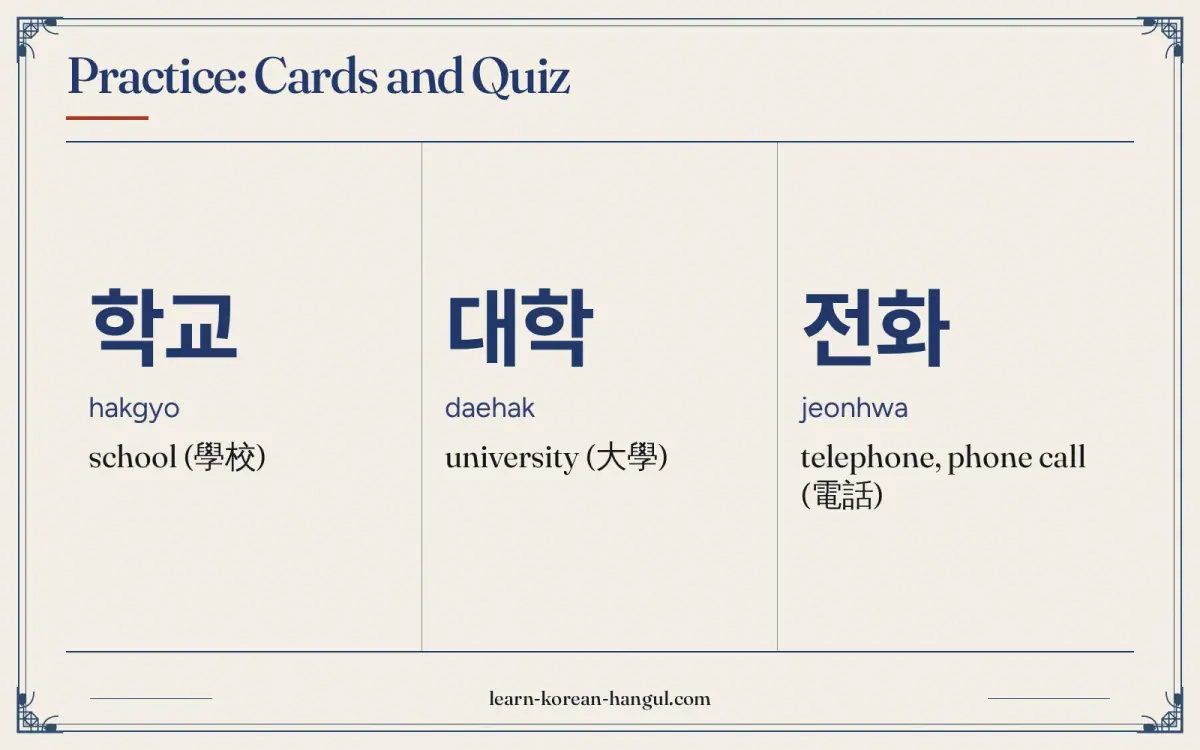
These ten cards compare Korean words with their Japanese and Mandarin counterparts.
| Korean | RR | Meaning | Note |
|---|---|---|---|
| 학교 | hakgyo | school (學校) | Japanese gakkō, Mandarin xuéxiào. Same two characters, three readings. |
| 대학 | daehak | university (大學) | Japanese daigaku, Mandarin dàxué. Said [대학] with a plain ㅎ in the second syllable. |
| 전화 | jeonhwa | telephone, phone call (電話) | Japanese denwa, Mandarin diànhuà. Mandarin 电话 is the simplified form. |
| 한국 | hanguk | Korea (韓國) | Japanese kankoku, Mandarin Hánguó. Japan and China use 韓国 and 韩国. |
| 일본 | ilbon | Japan (日本) | Japanese nihon or nippon, Mandarin Rìběn. The Korean reading is il-bon. |
| 중국 | jungguk | China (中國) | Japanese chūgoku, Mandarin Zhōngguó. 國 keeps its final ㄱ in Korean. |
| 애인 | aein | partner, boyfriend or girlfriend (愛人) | A false friend: in Mandarin 爱人 àiren usually means spouse. |
| 기차 | gicha | train (汽車) | A false friend: in Mandarin 汽车 qìchē means car. |
| 약속 | yaksok | promise, appointment (約束) | Said [약쏙]. In Mandarin 约束 yuēshù means to restrain. |
| 공부 | gongbu | study (工夫) | In Mandarin 工夫 gōngfu is time or skill; in Japanese kufū is a clever idea. |
Practice · 10
- 01학교
Show answer
hakgyo
school (學校)
- 02대학
Show answer
daehak
university (大學)
- 03전화
Show answer
jeonhwa
telephone, phone call (電話)
- 04한국
Show answer
hanguk
Korea (韓國)
- 05일본
Show answer
ilbon
Japan (日本)
- 06중국
Show answer
jungguk
China (中國)
- 07애인
Show answer
aein
partner, boyfriend or girlfriend (愛人)
- 08기차
Show answer
gicha
train (汽車)
- 09약속
Show answer
yaksok
promise, appointment (約束)
- 10공부
Show answer
gongbu
study (工夫)
Test what you have learned.
Practice · 6
What do hanja, kanji and hanzi have in common?
Show answer
They all trace back to Han Chinese characters (漢字)
All three names refer to Han characters and share a historical source. The sounds and some forms differ in each language.
Which form does Korea mainly use for 'study'?
Show answer
學
Korea keeps the traditional form 學. 学 is the simplified or Japanese form, used in mainland China and Japan.
The Korean reading of 國 (country) is 국. Which Japanese reading follows the same pattern of a final stop?
Show answer
koku
The on'yomi koku has a -ku that matches Korean final ㄱ. Mandarin guó has lost that final stop.
In Mandarin, 汽车 (qìchē) means what?
Show answer
car
In Mandarin 汽车 is a car. The same characters in Korean 기차 and Japanese kisha mean train. It is a classic false friend.
Which of these is a Korean-made character (국자)?
Show answer
畓
畓 (답) was made in Korea for a rice paddy. 學, 國 and 金 are Chinese-origin characters used in Korea.
A Japanese speaker sees 發 (hatsu in Japanese). Which Korean reading fits the usual pattern?
Show answer
발
The Japanese -tsu usually matches a Korean final ㄹ, so hatsu corresponds to 발. This is a pattern, not a law, so check each word.
The Bottom Line
Hanja, kanji and hanzi share ancestors but are different tools. If you know kanji or hanzi, you have a real head start on Sino-Korean vocabulary, as long as you learn the Korean readings and check each compound. If you know neither, you can safely ignore the characters until you reach abstract vocabulary. Read Hangul vs Hanja next for the Korean side, or compare how Korean sits with Chinese on the Korean vs Chinese page.
Frequently Asked Questions
Is hanja the same as Chinese?
No. Hanja are Chinese in origin, but they are read with Korean sounds, used in Korean grammar and mostly written in traditional forms. A Korean reader reads 學校 as 학교 (hakgyo), not as Mandarin xuéxiào. Korean also has its own coined words and a few Korean-made characters, so hanja are part of Korean, not a foreign script.
Can a Chinese speaker read hanja?
Often, in part. A Chinese reader who knows traditional characters can guess the meaning of many hanja words, and a simplified-character reader can learn the traditional forms quickly. The meaning of a compound can differ, though, and the Korean reading must be learned. Korean sentences are still Korean grammar, so reading hanja words does not mean reading Korean.
Is Korean easier if I know kanji?
It helps with vocabulary. A learner who knows kanji can recognise the meaning of many Sino-Korean words and can predict the Korean reading from the Japanese on'yomi in many cases. Grammar is a separate task, although Korean and Japanese word order is similar. Treat kanji knowledge as a head start on words, not on the whole language.
What is a Korean-made hanja?
A Korean-made character, called a 국자 (gukja), is a character created in Korea rather than borrowed from China. Examples are 畓 (답), a rice paddy, and 媤 (시), used in 시댁 for a husband's family. There are few of them, and they appear mostly in place names, family terms and old documents.
Do Koreans and Japanese read the same characters the same way?
No. The characters often look alike, but the readings differ. Japanese gives most characters two or more readings, an on'yomi from Chinese and a kun'yomi from native words, while Korean usually gives one Sino-Korean reading. 學 is gaku or manabu in Japanese and 학 (hak) in Korean.