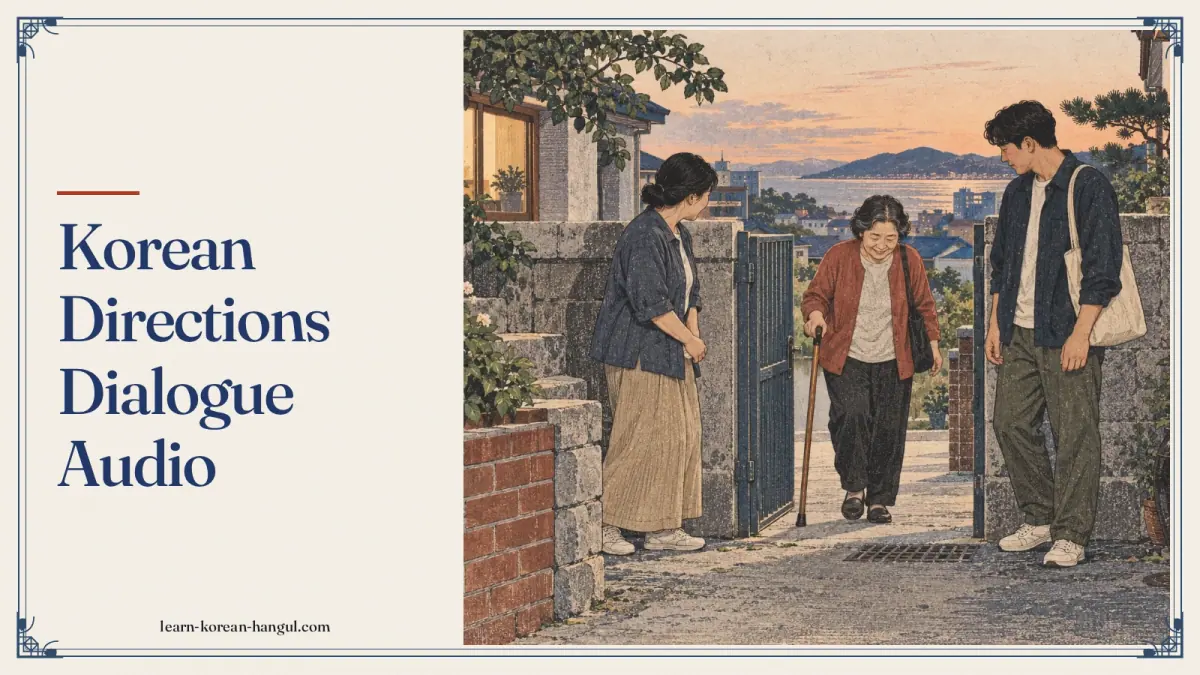
실례합니다, 지하철역이 어디예요? / 지하철역이요? 이 길로 쭉 가시다가 오른쪽으로 가세요. / 오른쪽이요? 왼쪽이 아니에요? / 네, 오른쪽이에요. 왼쪽에는 병원이 있어요. / 거기서 얼마나 걸려요? / 걸어서 오 분쯤 걸려요. / 가깝네요. 그럼 걸어서 갈게요. / 네, 가시다가 약국이 보이면 그 옆이에요. / 정말 감사합니다. / 아니에요. 조심히 가세요.
What you'll learn
- Draw the route after hearing the dialogue: straight, right, pharmacy, station.
- Tell 오른쪽 (right) from 왼쪽 (left) by ear.
- Understand 가시다가 and 걸어서 오 분쯤 걸려요.
- Hear the sound changes in 지하철역이 and 약국이.
Before you start: you need to read Hangul and know the basic numbers. Time: about 20 minutes. Level: A2. The transcript stays hidden until you have listened once.
Key facts
- 쭉 가시다가 means "go straight and then" (keep going, then do something else).
What Is Korean Directions Dialogue Audio?
Korean directions dialogue audio is a short clip of one person asking the way and another person giving a route, with questions that check whether you caught each turn. Here the setting is a street near a subway station, and the answer comes in three parts: a direction, a landmark and a time.
The listening goal is practical. Real directions arrive as one fast string, such as 쭉 가시다가 약국이 보이면 그 옆이에요, and you must keep the order of the steps. The phrases themselves are listed in Korean directions phrases, and the signs you will meet on arrival are in Korean subway signs.
First, see what makes directions hard to follow by ear.
What Makes This Dialogue Hard to Follow by Ear?
Directions pack several actions into one sentence. Korean puts the verb last and joins the steps with endings, so the key word often comes at the end of a long chain. English speakers wait for "turn right" and miss that 오른쪽으로 came before the verb.
| What you see | What you hear | Where learners slip |
|---|---|---|
| 지하철역이 | [지하철려기] | A ㄴ sound appears before 역 and turns into ㄹ |
| 오른쪽으로 | [오른쪼그로] | The final ㄱ of 쪽 moves to the next block |
| 가깝네요 | [가깜네요] | ㅂ before ㄴ is said as ㅁ |
| 약국이 | [약꾸기] | The second ㄱ is tense, and the final ㄱ links to 이 |
The first row combines ㄴ-insertion (an added ㄴ) with ㄹ assimilation. The second and fourth rows are liaison (연음), and the third is nasalization. All are covered by the standard pronunciation rules (표준 발음법) of the National Institute of Korean Language (국립국어원). The first row is explained further in Korean liaison and n-insertion.
Next is the routine.
How Does the Dialogue Practice Work?
Two listens come before any reading.
- Listen once at normal speed. Do not pause. Sketch a line with an arrow for each turn.
- Listen again slowly. Replay any line you missed up to three times.
- Open the transcript. Compare it with your sketch.
- Replay the marked lines. Then play the whole dialogue once more.
You will know it worked when your drawing matches the route without help. The usual mistake is to swap right and left, because the two words look and sound alike to a beginner. If a clip is too fast even when slow, understand spoken Korean shows how to find your bottleneck.
Begin with the gist.
First Listen: the Gist
Play the audio once. Answer in English.
- What is the traveller looking for?
- Does the traveller decide to walk or take a vehicle?
Gist means the overall outcome. Replay the clip if you are not sure, then move on.
The second listen focuses on the route.
Second Listen: the Details
Play the slow version and answer.
- In which direction does the passer-by tell the traveller to turn?
- What building is on the left?
- How long does the walk take?
- What landmark is next to the station?
실례합니다, 지하철역이 어디예요? / 지하철역이요? 이 길로 쭉 가시다가 오른쪽으로 가세요. / 오른쪽이요? 왼쪽이 아니에요? / 네, 오른쪽이에요. 왼쪽에는 병원이 있어요. / 거기서 얼마나 걸려요? / 걸어서 오 분쯤 걸려요. / 가깝네요. 그럼 걸어서 갈게요. / 네, 가시다가 약국이 보이면 그 옆이에요. / 정말 감사합니다. / 아니에요. 조심히 가세요.
If question 3 was hard, check line 3: the traveller asks again because left and right are easy to mix up.
Transcript, Translation and Key
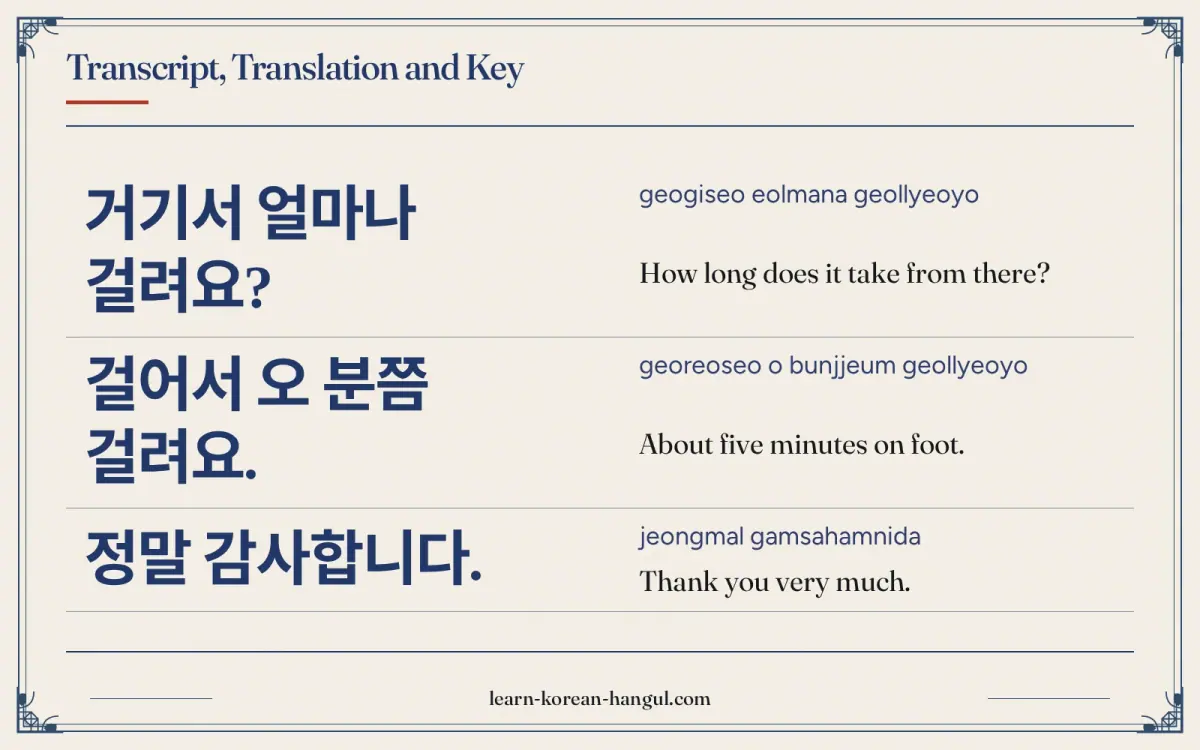
Read the transcript after both listens. Each line has its own clip.
Asking the Way to the Subway Station
Traveller
실례합니다, 지하철역이 어디예요?
sillyehamnida, jihacheollyeogi eodiyeyo
Excuse me, where is the subway station?
Passer-By
지하철역이요? 이 길로 쭉 가시다가 오른쪽으로 가세요.
jihacheollyeogiyo? i gillo jjuk gasidaga oreunjjogeuro gaseyo
The subway station? Go straight along this road and then turn right.
Traveller
오른쪽이요? 왼쪽이 아니에요?
oreunjjogiyo? oenjjogi anieyo
The right? Is it not the left?
Passer-By
네, 오른쪽이에요. 왼쪽에는 병원이 있어요.
ne, oreunjjogieyo. oenjjogeneun byeongwoni isseoyo
Yes, it is the right. On the left there is a hospital.
Traveller
거기서 얼마나 걸려요?
geogiseo eolmana geollyeoyo
How long does it take from there?
Passer-By
걸어서 오 분쯤 걸려요.
georeoseo o bunjjeum geollyeoyo
About five minutes on foot.
Traveller
가깝네요. 그럼 걸어서 갈게요.
gakkamneyo. geureom georeoseo galgeyo
That is close. Then I will walk.
Passer-By
네, 가시다가 약국이 보이면 그 옆이에요.
ne, gasidaga yakgugi boimyeon geu yeopieyo
Yes, if you see a pharmacy as you go, it is next to that.
Traveller
정말 감사합니다.
jeongmal gamsahamnida
Thank you very much.
Passer-By
아니에요. 조심히 가세요.
anieyo. josimhi gaseyo
Not at all. Take care.
Answer key
- The subway station (지하철역).
- Walk. The traveller says 걸어서 갈게요, "I will walk".
- Right (오른쪽).
- A hospital (병원), on the left.
- About five minutes (오 분쯤).
- A pharmacy (약국); the station is next to it, according to the passer-by's last landmark line.
Here is the route as a text map, using only what the dialogue says.
| Step | Korean | Meaning |
|---|---|---|
| 1 | 이 길로 쭉 | straight along this road |
| 2 | 오른쪽으로 | turn right (the hospital is on the left) |
| 3 | 오 분쯤 | about five minutes on foot |
| 4 | 약국 옆 | next to the pharmacy |
Line-by-Line Notes
- Line 1, 실례합니다. A formal opener meaning "excuse me". The question after it uses the ordinary polite ending.
- Line 2, 이 길로. 로 marks the route you move along: "along this road".
- Line 3, 오른쪽이요? The 요 on a noun repeats and checks what you heard, politely.
- Line 6, 오 분쯤. 쯤 means "about" and follows a number, so 오 분쯤 is "about five minutes".
- Line 8, 보이면. From 보이다 (to come into view) plus -(으)면 "if" or "when".
The sound changes in these lines are next.
Which Sound Changes Are Hidden in the Dialogue?
Four written forms sound different from their spelling, and 실례합니다 has one more. Play each one alone.
In 지하철역이, the word 역 starts with a y-sound after a consonant, so a ㄴ is added, and the ㄴ then becomes ㄹ after the ㄹ of 철. The written ㄱ of 역 links to 이, giving [지하철려기]. In 가깝네요 and 실례합니다, the final ㅂ is followed by ㄴ and is said as ㅁ, so you hear [가깜네요] and [실례함니다]. These rules are regular, so they help even with new words.
Next, the question at the centre of the dialogue gets a worked example.
Worked Example: 실례합니다, 지하철역이 어디예요?
This is the question you will use most when you are lost.
실례합니다, 지하철역이 어디예요?
sillyehamnida, jihacheollyeogi eodiyeyo
Excuse me, where is the subway station?
- Get attention. 실례합니다 means "excuse me" and is the usual opener to a stranger. 저기요 is lighter and also works.
- Name the place. 지하철역 is "subway station", and 이 marks it as the topic of the question.
- Ask where. 어디 is "where". 예요 closes it politely. A question with 어디 does not end with a sharp rise; the pitch usually falls, or rises and falls a little.
Now hear the reply, which chains two steps with -다가.
쭉 가시다가 오른쪽으로 가세요.
jjuk gasidaga oreunjjogeuro gaseyo
Go straight and then turn right.
- Read -다가. 가다 (to go) plus -다가 means "go on going and then do something else". The first action stops when the second begins.
- Spot the honorific. The -시- in 가시다가 shows respect to the person who will walk, and 가세요 is the polite request form of 가다.
The time is a separate piece of information.
걸어서 오 분쯤 걸려요.
georeoseo o bunjjeum geollyeoyo
It takes about five minutes on foot.
- Read the verbs. 걸어서 is from 걷다 (to walk), which changes ㄷ to ㄹ before a vowel. 걸려요 is from 걸리다 (to take time). They look alike, but they are two different verbs.
The two directions are worth a quick drill.
Learners often mix the pair, so the next section lists the usual slips.
What Mistakes Do Learners Make Here?
Learners often assume that the direction word is the only thing they must hear. Actually, the order and the connectors matter just as much, because they tell you what happens first. Four slips are common.
- Swapping 오른쪽 and 왼쪽. The first starts with an [o] sound and the second with a [we] sound. Listen for that first vowel before the rest.
- Hearing 가시다가 as a command to stop. 가시다가 means "keep going, and then". The next verb tells you what to do after you have walked.
- Using 미안합니다 to stop a stranger. That is an apology. Use 실례합니다 or 저기요.
- Mixing 걷다 and 걸리다. 걸어서 is "by walking" and 걸려요 is "it takes (time)". The dialogue uses both in one line.
Test these in the practice set below.
Practice and Answer Key
- How do you say "turn right" using 오른쪽?
- What does 쭉 mean in 쭉 가시다가?
- Write the sentence "It takes about ten minutes on foot".
- Which opener is more formal: 실례합니다 or 저기요?
Answers
- 오른쪽으로 가세요.
- "Straight on, without turning".
- 걸어서 십 분쯤 걸려요.
- 실례합니다.
Where to Go Next
Play the dialogue again tomorrow, hide the transcript and redraw the route. When it feels easy, continue with Korean taxi dialogue audio, which moves from walking to riding. Time words are explained in telling time in Korean. All dialogues are listed in Korean audio dialogues.
What this page does not cover. It does not cover street addresses, bus routes or map apps.
Return to this Korean directions dialogue audio when you want to check that you still hear the turn before the verb.
Frequently Asked Questions
What does -다가 mean?
-다가 joins two actions and means "go on doing X, and then switch to Y". In 쭉 가시다가 오른쪽으로 가세요, the walking along the road stops when the turn begins. It is the natural connector for step-by-step directions. It can also show an action that is interrupted, but in this dialogue it only links two steps.
How do I say 'about five minutes'?
Say 오 분쯤 (o bunjjeum). 오 is five in the Sino-Korean numbers used for minutes, 분 means minutes, and 쯤 means "about". For the walking time, add 걸어서 and 걸려요: 걸어서 오 분쯤 걸려요. You can swap 쯤 for 정도 with the same meaning.
What is the difference between 오른쪽 and 왼쪽?
오른쪽 (oreunjjok) means right and 왼쪽 (oenjjok) means left. Both end in 쪽, which means "side", and the first syllable tells them apart. Add 으로 to say "to the right": 오른쪽으로 가세요. The ㄱ of 쪽 links to the next syllable, so you hear [오른쪼그로].
Why is 가시다가 honorific?
The passer-by is speaking to a stranger, so they add the honorific -시- to the traveller's action. The honorific shows respect to the person doing the action, here the traveller who will walk. It is not used for your own actions. The -시- in 가시다가 is optional, since 가세요 already ends the sentence politely, but it adds extra courtesy.