안녕하세요, 지수 씨. / 안녕하세요, 민호 씨. 오랜만이에요. / 네, 정말 오랜만이에요. 잘 지냈어요? / 네, 잘 지냈어요. 민호 씨는요? / 저도 잘 지냈어요. / 요즘 바빠요? / 조금 바빠요. 그럼, 다음에 또 봐요. / 네, 안녕히 가세요.
What you'll learn
- Say who is greeting whom and how formal the exchange is.
- Answer "How has the second speaker been?" after one listen.
- Pick out the three spots where spelling and sound differ: 오랜만이에요, 지냈어요 and 다음에.
- Tell 안녕하세요 (polite) from 안녕 (casual) and 안녕히 가세요 from 안녕히 계세요.
Before you start: you need to read Hangul and know what 안녕하세요 means. Time: about 20 minutes. Level: A1. Audio plays only when you press a button, and the transcript stays hidden until the first listen is done.
What Is a Korean Greeting Dialogue with Audio?
A Korean greeting dialogue with audio is a short, scripted conversation in which two speakers greet each other, ask how they are and part. You listen to the recording first, answer comprehension questions, and only then read the Korean transcript and its English translation.
This one has two speakers, 민호 (Minho) and 지수 (Jisu). They use 씨 (ssi), a polite title that follows a first name, so the two are acquaintances of similar age and rank. The goal is not to memorize eight lines. The goal is to hear that familiar greetings sound different from their spelling, so you can follow them at normal speed. The phrases come from Korean greetings, and the exchange builds on the single hello taught in hello in Korean.
Before you press play, it helps to know why the lines are harder to catch than they look.
What Makes This Dialogue Hard to Follow by Ear?
The lines are short, but three habits get in the way. English is stress-timed, so you listen for loud syllables. Korean gives each syllable a similar length, so nothing stands out. Korean also moves a final consonant onto a following vowel, so the written word boundaries blur in speech.
| What you see | What you hear | Why it surprises English speakers |
|---|---|---|
| 오랜만이에요 | [오랜마니에요] | The ㄴ of 만 moves to the next block, so 만이 sounds like "ma-ni" |
| 지냈어요 | [지내써요] | The ㅆ of 냈 moves to the next block, so the word sounds like "ji-nae-sseo-yo" |
| 다음에 | [다으메] | The ㅁ of 음 moves to the next block, so 음에 sounds like "eu-me" |
| 안녕하세요 | [안녕하세요], often with a faint ㅎ | The ㅎ between voiced sounds can nearly disappear in quick speech |
The rule behind the first three rows is liaison (연음, yeoneum): a single final consonant followed by a vowel moves across the block boundary. It is part of the standard pronunciation rules (표준 발음법) of the National Institute of Korean Language (국립국어원). The faint ㅎ is a feature of natural speech, not a written rule, and the guide to Korean h deletion explains where it applies.
Knowing the traps, you can follow a simple routine to practise them.
How Does the Dialogue Practice Work?
The practice uses two listens before any reading, so your ear does the work first. Follow these four steps.
- Listen once at normal speed. Use the player above. Do not pause. Aim to answer the two gist questions in the next section.
- Listen again slowly. Use the slow player. Replay each line you missed, up to three times.
- Check the script. Open the transcript, compare it with what you heard and mark the lines you misjudged.
- Replay the lines you missed. Play only those lines, then listen to the whole dialogue once more.
You will know it worked when you can answer the detail questions without looking at the transcript. A common mistake is to read the transcript first, which turns listening into reading. If a clip feels too fast even after the slow version, read understand spoken Korean to find which of five listening bottlenecks is yours.
The first step is the gist.
First Listen: the Gist
Play the normal-speed audio once, without the transcript, then answer these two questions in English.
- Are the speakers meeting for the first time, or do they know each other?
- How has each speaker been?
Write your answers down before you move on. Gist means the overall meaning, and for a greeting that is who they are to each other and what the exchange achieves. If you could not answer, play the clip once more, then continue.
With the gist in hand, the second listen looks for detail.
Second Listen: the Details
Play the slow recording and answer these three questions.
- What does Jisu say in line 2, besides hello?
- What question does Jisu ask in line 6, and how does Minho answer?
- Which goodbye phrase ends the dialogue, and who says it?
안녕하세요, 지수 씨. / 안녕하세요, 민호 씨. 오랜만이에요. / 네, 정말 오랜만이에요. 잘 지냈어요? / 네, 잘 지냈어요. 민호 씨는요? / 저도 잘 지냈어요. / 요즘 바빠요? / 조금 바빠요. 그럼, 다음에 또 봐요. / 네, 안녕히 가세요.
Detail questions test words, not meaning alone. If you got question 4 wrong, the likely cause is the ending 바빠요, because 빠 is a tense sound that English speakers hear as a plain "p". Now the transcript will show what you heard and what you missed.
Transcript, Translation and Key
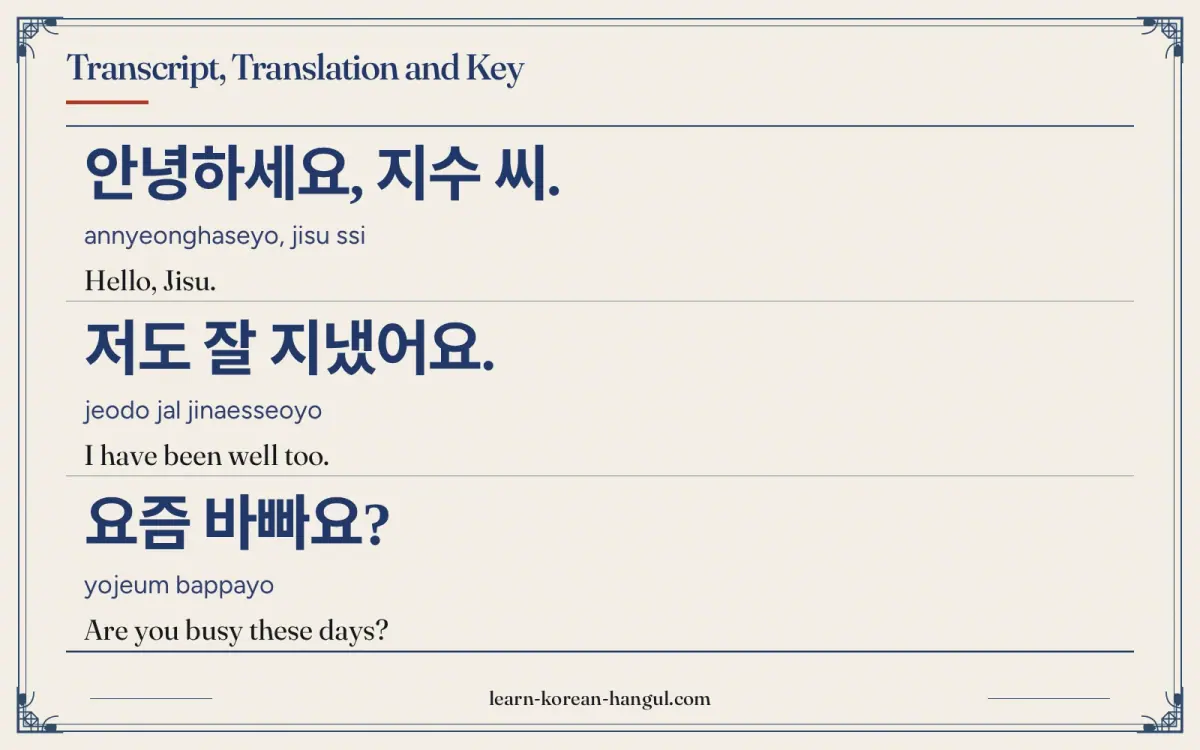
Read the transcript only after both listens. Each line has its own clip, so you can replay any single line.
Two Acquaintances Meet in the Morning
Minho
안녕하세요, 지수 씨.
annyeonghaseyo, jisu ssi
Hello, Jisu.
Jisu
안녕하세요, 민호 씨. 오랜만이에요.
annyeonghaseyo, minho ssi. oraenmanieyo
Hello, Minho. It has been a while.
Minho
네, 정말 오랜만이에요. 잘 지냈어요?
ne, jeongmal oraenmanieyo. jal jinaesseoyo
Yes, it has really been a while. Have you been well?
Jisu
네, 잘 지냈어요. 민호 씨는요?
ne, jal jinaesseoyo. minho ssineunyo
Yes, I have been well. And you, Minho?
Minho
저도 잘 지냈어요.
jeodo jal jinaesseoyo
I have been well too.
Jisu
요즘 바빠요?
yojeum bappayo
Are you busy these days?
Minho
조금 바빠요. 그럼, 다음에 또 봐요.
jogeum bappayo. geureom, daeume tto bwayo
A little busy. Well then, see you again next time.
Jisu
네, 안녕히 가세요.
ne, annyeonghi gaseyo
Yes, goodbye.
Answer key for the listening questions
- They know each other. 오랜만이에요 means "it has been a long time", and both use 씨 and the polite style.
- Both have been well. Jisu says 네, 잘 지냈어요 and Minho says 저도 잘 지냈어요.
- Jisu says 오랜만이에요, "it has been a while".
- Jisu asks 요즘 바빠요?, "Are you busy these days?" Minho answers 조금 바빠요, "a little busy".
- 안녕히 가세요 ends it, and Jisu says it to Minho, who is leaving.
Line-by-Line Notes
- Line 1, 안녕하세요, 지수 씨. The name plus 씨 makes the greeting personal. Attached to a family name alone, 씨 can sound impolite, so use a first name or a full name.
- Line 3, 잘 지냈어요? The only past-tense question in the dialogue. The rise at the end marks it as a question, since the word order does not change.
- Line 4, 민호 씨는요? The particle -는 with 요 means "and as for you?" It returns a question without repeating it.
- Line 5, 저도. 저 is the humble "I" and -도 means "too", so 저도 is "me too".
- Line 8, 안녕히 가세요. Literally "go in peace", said to the person leaving. The person staying receives 안녕히 계세요.
These notes lead into the three spots where the spoken lines differ from their spelling.
Which Sound Changes Are Hidden in the Dialogue?
Three written forms sound different from their spelling, and each is a listening trap. Play each word by itself and match it with the table in the earlier section.
Each one follows the same rule: a final consonant followed by a vowel moves to the front of the next block. Because of this rule, you should never listen for the written final consonant when a vowel follows. In 지냈어요, the written ㅆ is not a stop at the end of 냈. It is the first sound of the next block, so the word is heard as [지내써요] and sounds nothing like "ji-naet eo-yo".
The same idea explains the one real dictation trap. Because 지냈어요 is heard as [지내써요], learners who write it from sound alone often produce 지내서요, which is a different form meaning "because I get along". In speech the two differ only in the tense [ㅆ] versus the plain [ㅅ], so listen for the tighter, sharper 써, and let context confirm which form is meant.
You will meet this contrast again in Korean sentence dictation for beginners. For now, one question deserves a full walk-through.
Worked Example: 잘 지냈어요?
잘 지냈어요? (jal jinaesseoyo) is the question that makes this dialogue a greeting, so it is worth taking apart once.
잘 지냈어요?
jal jinaesseoyo
Have you been well?
- Hear the sound. You hear [잘 지내써요], five syllables: jal, ji, nae, sseo, yo.
- Split the written form. 잘 (well) + 지내- (the stem of 지내다, "to get along, to spend time") + -았/었- (past marker) + -어요 (polite ending). The past marker fuses with the stem to make 지냈.
- Explain the tense. The past tense is used because the question covers the time since the last meeting. English also says "Have you been well?", not "Are you well?"
- Pick the answer. The matching reply is 네, 잘 지냈어요, "Yes, I have been well." You return the question with 민호 씨는요?
Casual speech drops the polite ending, so the same question to a close friend is 잘 지냈어? ([잘 지내써]).
Use 잘 지냈어요? with colleagues and classmates, and keep 잘 지냈어? for close friends and people younger than you. Learners often make mistakes at exactly this boundary, so the next section lists them.
What Mistakes Do Learners Make Here?
Learners often assume the greeting works like English "How are you?" with a stock reply. In Korean the details differ, and four slips are common.
- Replying "I am fine" to 안녕하세요. The reply to 안녕하세요 is 안녕하세요. It is a greeting, not a question about your health. The health question in this dialogue is 잘 지냈어요?.
- Answering 잘 지냈어요? in the present tense. 잘 지내요 means "I am doing well" and is correct, but after a long gap the past form 잘 지냈어요 sounds more natural because it covers the time since the last meeting.
- Saying 안녕히 가세요 to the person who stays. 가세요 means "please go". Say 안녕히 가세요 to the one leaving and 안녕히 계세요 to the one staying. If both leave, each says 안녕히 가세요.
- Using 안녕 with a colleague. 안녕 is casual. It is natural with a friend and rude with a person you address as 씨.
Fixing these slips takes one more pass through the dialogue, so the practice set below tests all four.
Practice and Answer Key
Answer from memory, then check the key. Play the dialogue once more if needed.
- Which phrase asks "Have you been well?"
- What is the spoken form of 지냈어요?
- In this dialogue Minho leaves and Jisu stays. Jisu says 안녕히 가세요. What would Minho say to Jisu if he used the matching goodbye?
- You meet a close friend your age and want to ask the same question. Which form do you use: 잘 지냈어요? or 잘 지냈어?
Answers
- 잘 지냈어요?
- [지내써요]
- 안녕히 계세요, "stay in peace", said by the one who leaves to the one who stays.
- 잘 지냈어? The polite ending -요 is dropped between close friends.
You can now follow a full greeting exchange by ear. The next dialogue moves from greeting to ordering.
Where to Go Next
Replay the dialogue after one day without the transcript and see whether you still catch all three sound changes. When it feels easy, continue with ordering at a cafe dialogue, a ten-line order with a drink, a size and a price. To say the same lines yourself, try Korean conversation practice. All dialogues of this kind are listed in Korean audio dialogues.
What this page does not cover. It does not teach the grammar of speech levels in full, because that lives in the speech-levels lesson, and it does not teach evening or night greetings, which appear on the phrase pages. It also uses one voice per line from a text-to-speech system, so a real speaker may sound faster or slower.
Come back to this Korean greeting dialogue with audio whenever a short exchange at normal speed starts to feel slippery again.
Frequently Asked Questions
Why is 지냈어요 past tense?
지냈어요 is past tense because 잘 지냈어요? asks how the other person has been since you last met. The marker -았/었- joins 지내- to give 지냈-. The question covers a stretch of time that has finished, just like "Have you been well?" in English. For a general present state, 잘 지내요 is also correct.
How do I say 'I am well'?
Say 잘 지내요 (jal jinaeyo) for "I am doing well now" or 잘 지냈어요 for "I have been well". Both are polite. You can then hand the question back with the person's name plus 씨는요?, as Jisu does in line 4.
Is 안녕 enough?
안녕 is enough only with close friends, children and people clearly younger than you. With a colleague you call 씨, it sounds too casual, so use 안녕하세요. The same split applies to the question: 잘 지냈어? is for friends and 잘 지냈어요? is for everyone else.
How do I greet in the evening?
Korean has no separate everyday evening greeting. 안녕하세요 works from morning to night, so the dialogue would be identical at 7 p.m. Phrases tied to a moment, such as good night before sleep, have their own pages. See good evening in Korean for the details.