How Do You Say Good Evening in Korean?
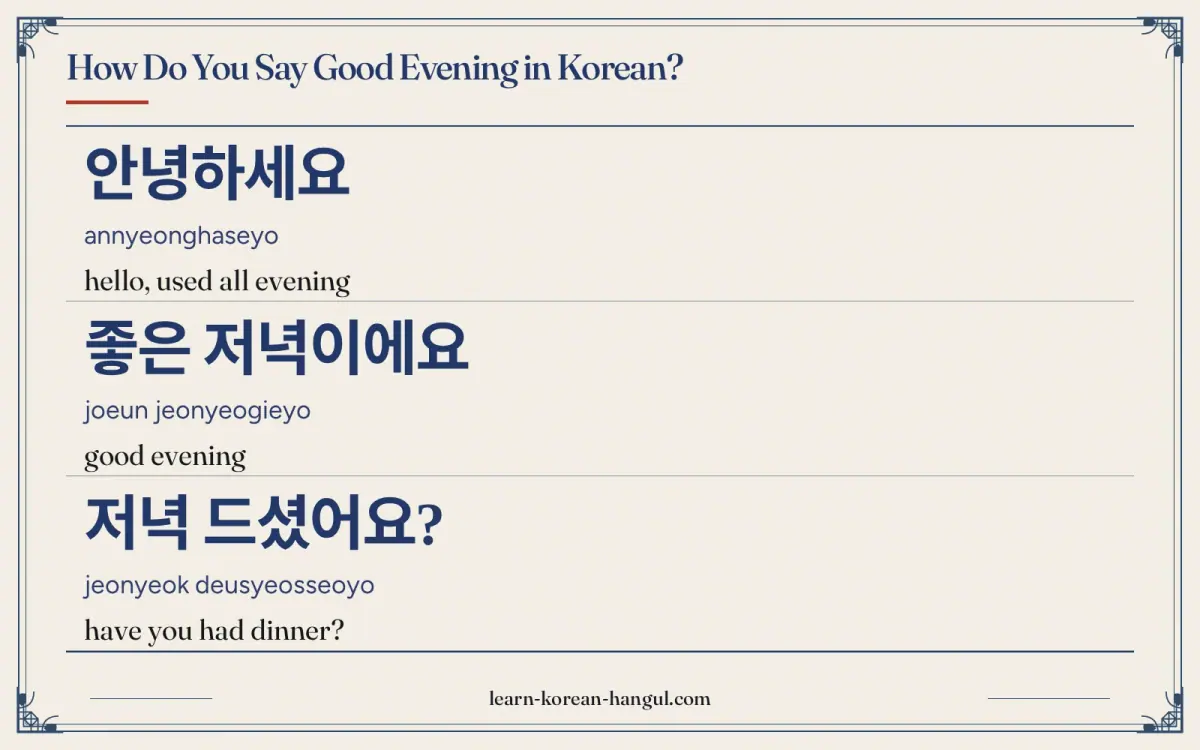
The everyday way to say good evening in Korean is 안녕하세요 (annyeonghaseyo). Use it when you arrive at a restaurant, a friend's home, a hotel desk or an evening class. Korean does not change the hello with the time of day, so the same word that opens the morning also opens the evening.
The three forms below cover almost every evening situation.
| Korean | Revised Romanization | Meaning | Register |
|---|---|---|---|
| 안녕하세요 | annyeonghaseyo | hello, used all evening | polite (해요체) |
| 좋은 저녁이에요 | joeun jeonyeogieyo | good evening | formal in tone, written and announcements |
| 저녁 드셨어요? | jeonyeok deusyeosseoyo | have you had dinner? | polite and respectful |
Revised Romanization (the South Korean government standard of 2000) is only a reading aid. The Hangul is the real spelling. The next section explains how each form fits a listener.
What Are the Formal and Polite Ways to Say Good Evening?
Evening greetings use the same two levels as any Korean sentence: polite (해요체) and formal (합쇼체). The page on Korean speech levels explains how the endings -요 and -ㅂ니다 change a sentence, and the three forms here show both levels at work.
Polite: 안녕하세요 (annyeonghaseyo)
안녕하세요 means "hello" and is what you actually say when you arrive somewhere in the evening. It works for hosts, teachers, coworkers, neighbours and shop staff. For the full story behind it, read the guide to hello in Korean.
Example: 안녕하세요, 저는 지민이에요. (annyeonghaseyo, jeoneun jiminieyo.) "Hello, I am Jimin."
Formal in Tone: 좋은 저녁이에요 (joeun jeonyeogieyo)
좋은 저녁이에요 means "it is a good evening." The phrase copies the pattern of 좋은 아침이에요 from good morning in Korean, and it sounds written or ceremonial even though -이에요 is the polite ending. At an event or in a news broadcast, speakers use the formal ending: 좋은 저녁입니다 (joeun jeonyeogimnida).
Example: 좋은 저녁입니다. 행사에 오신 것을 환영합니다. (joeun jeonyeogimnida. haengsa-e osin geoseul hwanyeonghamnida.) "Good evening. Welcome to the event."
Polite: 저녁 드셨어요? (jeonyeok deusyeosseoyo)
저녁 드셨어요? means "have you had dinner?" It uses the respectful verb 드시다 (deusida, "to eat" for someone you honour) in the past form 드셨어요. The question is a caring opener between hosts and guests, family members and coworkers.
Example: 저녁 드셨어요? 같이 드실래요? (jeonyeok deusyeosseoyo? gachi deusillaeyo?) "Have you had dinner? Would you like to eat together?"
How Do You Ask the Same Question to a Friend?
With a friend or a younger person, drop the respectful verb and the 요: 저녁 먹었어? (jeonyeok meogeosseo?). The respectful 드셨어요 is for elders and guests. The casual 먹었어 is for people of your own age or younger. Choosing 먹었어요 sits in the middle, as the plain polite form.
Which Time Words Does Korean Use for the Evening?
The word 저녁 has two meanings that share one spelling, and the table shows how it sits next to its neighbours.
| Korean | Revised Romanization | Meaning |
|---|---|---|
| 오후 | ohu | afternoon |
| 저녁 | jeonyeok | evening, also dinner |
| 밤 | bam | night |
| 저녁 식사 | jeonyeok siksa | dinner (more formal) |
Because 저녁 means both evening and dinner, 저녁 드셨어요? can sound like a greeting and a question about food at once. The sounds of these words come next.
How Do You Pronounce 안녕하세요?
안녕하세요 is pronounced [안녕하세요], close to "an-nyeong-ha-se-yo," with five syllables of about equal length. Play the slow clip, then the normal clip, and repeat each one.
The final ㅇ in 녕 is the sound "ng," and the ㅎ in 하 is soft and can almost vanish in fast speech. The word does not change in the evening, so the sound is the same as in the morning. A greeting ends with a gentle fall in pitch, while a question such as 저녁 드셨어요? rises on the last syllable, and the rise is what tells the listener that an answer is expected.
Sound Changes to Listen for in the Evening Phrases
The other forms follow the Standard Pronunciation Rules (표준 발음법) of the National Institute of Korean Language (국립국어원).
- 저녁 is read jeo-nyeok, and the final ㄱ is unreleased, which means the tongue stops the sound without a puff of air.
- 좋은 저녁이에요 is read [조은 저녀기에요]. The ㅎ of 좋은 is silent, and the final ㄱ of 저녁 moves to the empty ㅇ of 이에요 (liaison, 연음).
- 드셨어요 is read [드셔써요]. The double ㅆ of 셨 moves to the next syllable and keeps its tense sound.
The page on liaison shows more words that join the same way. With the sounds clear, the next question is when each form fits.
When Should You Use 안녕하세요, and When Should You Not?
Use 안녕하세요 when you arrive somewhere in the evening. 좋은 저녁입니다 appears in news broadcasts and at events, so it belongs on a stage or in a written welcome, not at a doorstep.
Situations Where 안녕하세요 Fits
- Entering a restaurant. Say 안녕하세요 to the host or staff, then state your request.
- Visiting a friend's family at dinner time. Greet the elders with 안녕하세요 and a small bow.
- Joining an evening class. Greet the teacher with 안녕하세요, 선생님.
Situations to Avoid with 좋은 저녁이에요
- Speaking to a neighbour in the hall. The phrase sounds like an announcement. Say 안녕하세요.
- Waiting for a separate evening word. The main trap is hesitating while you search for an evening hello; 안녕하세요 already works.
- Asking 저녁 드셨어요? to a stranger. The question suits people you know.
When you are unsure, say 안녕하세요. The conversations below show the three forms in use.
What Does Good Evening Sound Like in a Real Conversation?
Read each dialogue, play the clip, and then say one role aloud.
Dialogue 1: Visiting a friend's home
- A: 안녕하세요. 저녁 드셨어요? (annyeonghaseyo. jeonyeok deusyeosseoyo?) "Hello. Have you had dinner?"
- B: 아직 안 먹었어요. (ajik an meogeosseoyo.) "I have not eaten yet."
- A: 그럼 같이 먹어요. (geureom gachi meogeoyo.) "Then let's eat together."
안녕하세요. 저녁 드셨어요? 아직 안 먹었어요. 그럼 같이 먹어요.
Dialogue 2: At a restaurant door
- A: 안녕하세요. 저녁 먹을 수 있어요? (annyeonghaseyo. jeonyeok meogeul su isseoyo?) "Hello. Can I have dinner here?"
- B: 네, 이쪽으로 오세요. (ne, ijjogeuro oseyo.) "Yes, please come this way."
안녕하세요. 저녁 먹을 수 있어요? 네, 이쪽으로 오세요.
In Dialogue 1, the host answers a greeting with a question about dinner, which is a form of care. In Dialogue 2, the guest greets first and asks second, which is the polite order. Both scenes rely on a habit that is worth explaining.
What Should You Know about the Culture behind Good Evening?
An evening greeting from the host can be the invitation to eat, so 저녁 드셨어요? often carries real concern about whether you are fed. When a host asks the question, a polite guest answers honestly but gently, with 네, 먹었어요 ("yes, I have eaten") or 아직이에요 (ajigieyo, "not yet"). Refusing the first offer of food once is common, and hosts often offer a second time.
Rank and age shape the choice. An older relative gets 안녕하세요 and a bow, with 드셨어요 for the meal question. A friend gets 안녕 or 저녁 먹었어?. Because food and greeting overlap, the same words can open both a polite visit and a close family dinner. Learners tend to miss this overlap, which leads to a short list of mistakes.
What Mistakes Do Learners Make with Good Evening in Korean?
Learners most often expect a separate word for evening hello, then hesitate when the standard hello works. Five mistakes are common:
- Searching for a separate evening hello. Fix: say 안녕하세요, and add the time only when it helps.
- Using 좋은 저녁이에요 as a spoken greeting. Fix: keep it for written notes and events.
- Using 먹었어요 for an elder. Fix: use the respectful 드셨어요 when asking an older person.
- Using the respectful 드셨어요 about yourself. Fix: say 먹었어요 for your own meal, because respectful verbs are only for the other person.
- Dropping the liaison. Saying "jeo-nyeok i-e-yo" in separate pieces sounds stiff. Fix: join the sounds as [저녀기에요].
The fix for each mistake is a small adjustment, and a few folded searches ask about the same ideas.
Short Answers on Evening Greeting and Good Evening Formal
Two searches lead to this page, so each gets a short answer here.
- Evening greeting in Korean: The usual evening greeting is 안녕하세요. Close contacts also use 저녁 드셨어요? as a caring opener.
- Good evening formal in Korean: The formal form is 좋은 저녁입니다, used on stage, in broadcasts and in written welcomes. For polite daily speech use 안녕하세요.
For the other times of day see good afternoon in Korean and good night in Korean. A quick table then sorts all the forms by listener.
Choosing a Form by Listener
The table matches each listener with one form. When two listeners are present, speak to the one with higher rank.
| Listener | Best choice | Why |
|---|---|---|
| Stranger, restaurant staff | 안녕하세요 | polite at any hour |
| Host or elder at dinner | 안녕하세요, then 저녁 드셨어요? | respectful and caring |
| Coworker after work | 안녕하세요 or 저녁 먹었어요? | polite and friendly |
| Close friend or sibling | 안녕 or 저녁 먹었어? | casual |
| Stage, notice or broadcast | 좋은 저녁입니다 | formal style |
A small bow or nod goes with the spoken greeting, and it deepens with the age or rank of the person. After the choice is clear, the related pages build the rest of the cluster.
Related Phrases to Learn Next
Three pages build on this one and follow the same layout:
- Hello in Korean: the full guide to 안녕하세요 and its casual 안녕.
- Good afternoon in Korean: the previous part of the day.
- Good night in Korean: the phrase for ending the evening.
The complete list sits in the Korean greetings cluster.
Practice: Say It Aloud
Spend five minutes on this routine.
- Play the slow clip of 안녕하세요 and repeat it three times.
- Say 안녕하세요, 저는 지민이에요 aloud, replacing 지민 with your own name.
- Say 저녁 드셨어요? as if you were asking a host, then 저녁 먹었어? as if you were asking a friend.
- Hide the Romanization with the toggle and read the three forms from Hangul only.
- Drill the cluster with the phrase flashcards.
When 안녕하세요 comes out smoothly, you can say good evening in Korean in a way people will recognise.
Frequently Asked Questions
The answers below add details about how to say good evening in Korean beyond the sections above.
Is there a separate Korean word for good evening?
There is a formal one: 좋은 저녁이에요 (joeun jeonyeogieyo), or 좋은 저녁입니다 in announcements. It appears in writing, at events and in broadcasts. In everyday speech, people greet each other in the evening with 안녕하세요, because the hello does not change with the time of day.
What is the difference between 안녕하세요 and 좋은 저녁이에요?
안녕하세요 is the spoken polite greeting, and it fits every listener and every hour. 좋은 저녁이에요 is a written or ceremonial greeting that sounds like an announcement when spoken at a door. Use the first for people, and the second for notices and events.
Is 안녕하세요 formal or casual in the evening?
안녕하세요 is polite (해요체) at every hour. The formal version is 안녕하십니까 (annyeonghasimnikka), used in speeches and news. The casual version is 안녕 (annyeong), used only with close friends and younger people. The time of day does not change the level.
Can I use 안녕하세요 with friends, elders and strangers?
Yes. 안녕하세요 suits strangers, elders, teachers and coworkers, and many friends keep it too. Very close friends of the same age usually say 안녕 or skip the greeting. If you are unsure how close you are, the polite form is the safer choice.
How do I reply when someone asks 저녁 드셨어요?
Answer 네, 먹었어요 (ne, meogeosseoyo) if you have eaten, or 아직이에요 (ajigieyo) if you have not. Use 먹었어요 for yourself, never the respectful 드셨어요, which belongs to the other person. Add 감사합니다 (gamsahamnida, thank you) to thank a host who offered you food.
What is the most common mistake with good evening in Korean?
Learners search for a separate evening hello and then hesitate, when the standard 안녕하세요 already works. A second frequent mistake is using 좋은 저녁이에요 as a spoken greeting to a neighbour, which sounds like a stage announcement instead of a friendly hello.