Korean Clothing Size: Labels and Measurements
Korean clothing size describes a source-specific label, while a measurement describes a recorded dimension. A label such as 66,95 orFREE needs a brand, product and chart category before it can be interpreted. A measurement such as 52 cm also needs its field, unit, basis and measuring method. Keeping those details together prevents two different quantities from looking comparable.
The Nike Korea men's Asian tops chart is explicitly a body chart. A seller's flat chest width instead measures a laid-out garment. Neither quantity should silently replace the other. A garment comparison uses your reference garment and the listing's finished measurements; body-chart selection uses body measurements and a chart written for that purpose.
What Do 55,66 and 77 Mean?
The labels 55,66 and 77 do not establish a universal US or European equivalent. The Nike Korea women's Asian tops chart includesM 85(55–66) andL 90(66–77) in the documented examples. The overlap itself shows why 66 cannot always identify one exclusive letter size. Select the product's chart rather than averaging conflicting generic charts. Physical measurements provide the next layer of evidence.
How Do You Compare a Korean Garment with Your Own?

A garment comparison subtracts the reference measurement from the listing measurement, after matching the field, basis and method. A positive flat-width difference means the listing is wider by that recorded amount. A negative same-method sleeve difference means it is shorter. Those are numerical descriptions, not a fit score.
- Choose the garment category and a comparable reference item.
- Identify the seller's field and measuring method.
- Measure the reference with the same origins, seams and setup.
- Record both values with their actual units, including any declared ranges.
- Compare the result, then check missing dimensions and construction differences.
The tool shows one active field at a time on a phone. Next field retains previous entries, so chest, shoulders and sleeves can be assessed separately. A full export keeps those differences together. A missing value stays missing instead of becoming zero.
Choosing the Right Reference Garment
A reference garment is most informative when its construction and intended use resemble the listing. A fitted woven shirt and a loose knit may have similar chest dimensions but behave differently. Choose an item whose existing fit you understand, lay it flat as required, and note whether it is fastened, relaxed or stretched. The seller's diagram takes precedence over a generic measuring suggestion.
Korean Measurement Terms in a Size Chart
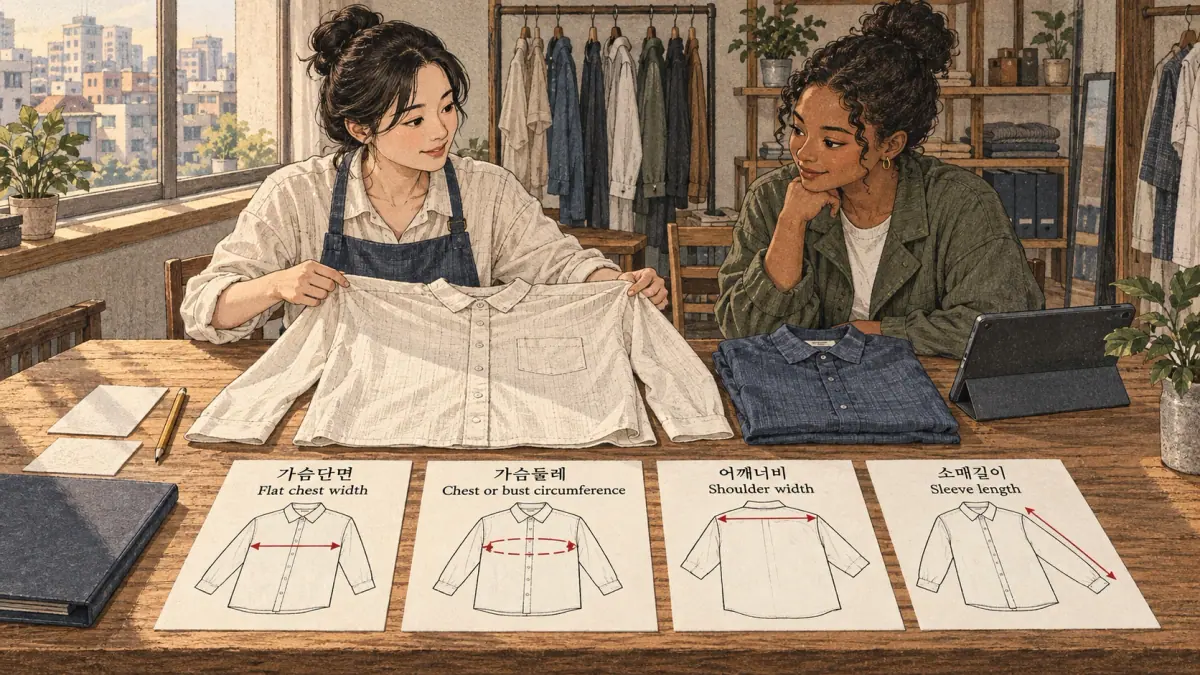
Korean measurement terms identify both the dimension and sometimes its basis. Read the whole heading, not only the familiar word for chest or waist. The MUSINSA measuring-method page illustrates garment measurements such as shoulders, flat chest, sleeve and total length. Individual sellers can use different origins or methods.
| Korean heading | English reading aid | What to confirm |
|---|---|---|
| 가슴단면 | Flat chest width | Laid-flat side-to-side method |
| 가슴둘레 | Chest or bust circumference | Body or finished garment |
| 어깨너비 | Shoulder width | Seam positions and path |
| 소매길이 | Sleeve length | Shoulder seam or neck origin |
| 총장 | Total length | Front/back origin and hem |
| 허리단면 | Flat waist width | Relaxed or stretched waistband |
| 밑위 | Rise | Specified waistband/crotch path |
| 밑단 | Hem width | Flat edge measurement |
| 허벅지 | Thigh measurement | Width or circumference and location |
| 엉덩이둘레 | Hip circumference | Body or finished garment |
Does 가슴단면 Mean Half the Chest?
A flat chest width is a width across the garment, not automatically a body circumference. Conditional doubling can approximate finished-garment circumference only when the laid-flat construction and method justify it. Pleats, gathers, padding, asymmetry and elastic settings can invalidate a simple doubling interpretation. A heading containing only가슴 leaves the basis uncertain; ask the seller before performing cross-basis arithmetic. The distinction leads directly to ease.
Body Size, Garment Size and Ease
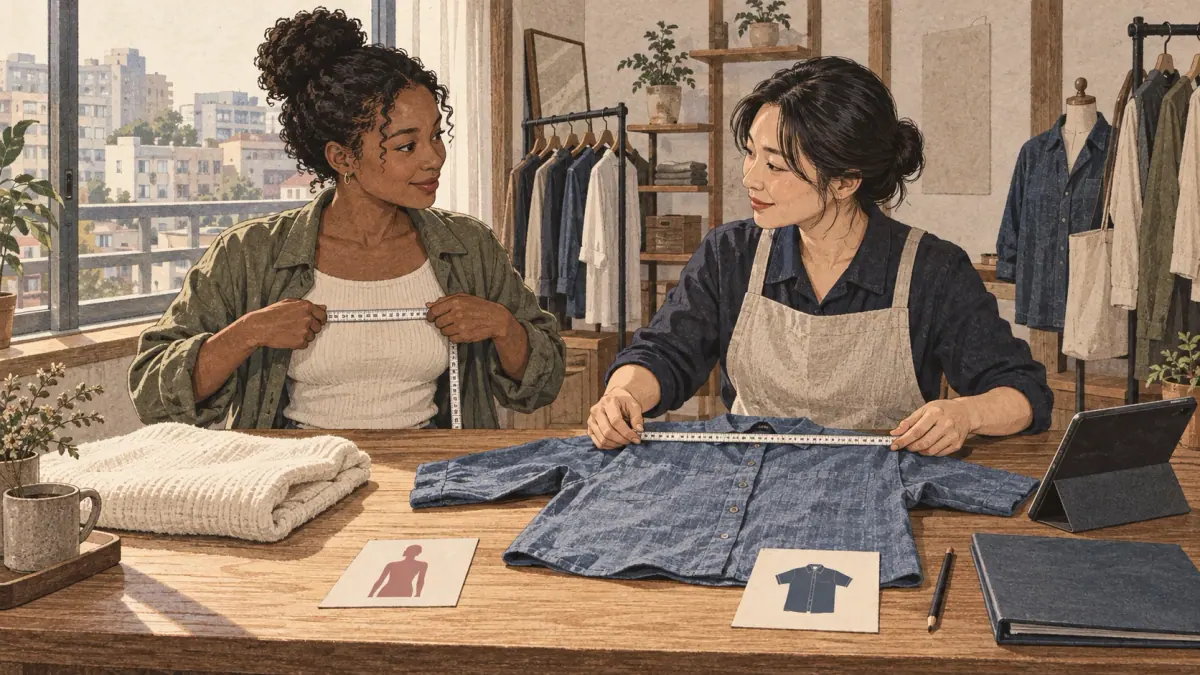
Body size measures the person. Garment size measures the finished clothing. Ease is a recorded difference between a finished-garment circumference and the corresponding body circumference. The subtraction describes space or negative difference under the stated assumptions; it does not specify an ideal amount for every fabric, style or activity.
Enter circumference values explicitly in Ease mode. For a finished chest circumference 104 cm and body chest 96 cm, the result is 8 cm of recorded ease. A garment 90 cm against the same body gives−6 cm. The tool presents the sign neutrally rather than labeling the result good or bad. Stretch, construction and intended fit require separate evidence.
How Much Ease Does This Garment Have?
A flat chest width 52 cm can produce an approximate 104 cm garment circumference only after confirming suitable symmetric flat construction. Comparing that conditional value with 96 cm body chest gives 8 cm approximate ease. Without the confirmation, the body value and flat width are incompatible quantities, and the tool requests a basis check.
A taped finished circumference 104 cm does not need flat-width doubling. Preserve whether a circumference was measured directly or derived approximately. The difference matters when later comparing a shaped jacket, gathered dress or stretch knit. Numerical agreement across unlike measuring methods is not evidence of equal fit.
Measuring Tops and Outerwear

Top measurements usually involve several dimensions, each with its own origin. Shoulder width, chest width, sleeve length and total length answer different questions. A listing 2 cm wider at the chest can still have sleeves 2 cm shorter. The tool reports those trade-offs instead of collapsing them into one size recommendation.
Use the seller's diagram to identify the exact seam or point. Record whether shoulder width runs between seam positions, whether the chest is measured under the armholes, and whether length begins at a front or back neck point. Avoid substituting a familiar method when the product specifies another one.
A jacket's padding, lining or shaped construction can also affect how an exterior flat measurement relates to interior room. Do not treat doubled outside width as a guaranteed usable interior circumference. Missing shoulder or armhole information may matter more than a matching chest number.
Raglan and Dropped Shoulders
A shoulder-seam sleeve and a raglan sleeve starting near the neck use different origins. Comparing raglan 75 cm with shoulder-seam 61 cm must not produce an unqualified 14 cm-longer answer. The tool retains the raw values and flags incompatible methods.
Dropped shoulder seams can similarly move the start of the sleeve measurement. Shoulder width and sleeve length should be considered together, with the seller's construction diagram. A longer shoulder dimension may coexist with a shorter sleeve segment. If the source does not explain the path, ask for the method rather than inventing a correction. Bottom measurements need the same attention to wearing position.
Measuring Trousers, Skirts and Dresses

Bottoms require more than one waist number. A flat waist, a body waist circumference and a stretched elastic-waist reading describe different conditions. Rise, hip, thigh, inseam, hem and overall length can expose differences hidden by one familiar size label.
For a flat waistband, record whether it is relaxed or stretched and whether the garment is fastened. For rise, use the source's stated path between waistband and crotch. For inseam, confirm the crotch-to-hem method. Front and back rise or length can differ; do not substitute one for the other.
Dresses combine top and bottom considerations. A chest match does not resolve waist placement, hip room or length. Two-piece sets should retain separate top and bottom measurements. The category selector treats the set components independently so a compatible top cannot conceal an incompatible trouser method.
Why Are the Waist and Rise Both Needed?
Waist and rise describe different dimensions. Two garments with the same flat waistband width can sit at different positions or have different shapes. A body waist measurement taken at one height does not automatically describe the body circumference where every trouser waistband will sit.
An elastic waistband can publish a relaxed-to-stretched range, but fabric composition alone does not establish that range. Use the actual seller measurements and conditions. Record unknown values explicitly and request clarification when the comparison depends on them. Once methods match, unit conversion is the arithmetic step.
Centimeters, Inches and Measurement Differences
The exact conversion is 1inch=2.54 cm, from the NIST length definition. The tool stores rational values and converts before subtracting. Product minus reference gives the signed difference. Rounding changes only the display; an exact export preserves the numerical representation.
Worked Examples:52 Cm,20 in and Sleeve Length
A reference flat chest 50 cm and listing 52 cm give+2 cm width. With valid conditional doubling, finished-garment circumference changes approximately 100→104 cm, a+4 cm difference. The body circumference remains a separate measurement.
A reference 20 in equals 50.8 cm exactly. Against 52 cm, the listing is+1.2 cm wider, about+0.47 in. Changing the displayed unit does not redefine the source 20 in reading or accumulate repeated rounding drift.
A same-method sleeve 61 cm compared with 59 cm gives−2 cm, meaning the listing's recorded sleeve segment is shorter. If one sleeve is raglan and the other shoulder-seam, the numerical difference is blocked pending method reconciliation.
A reference 50±1 cm covers 49–51 cm. A listing 52±1 cm covers 51–53 cm. Their possible product-minus-reference difference is 0–4 cm. The nominal+2 cm is only the center comparison; the declared tolerances expose the uncertainty. Those conditions also matter forFREE and category labels.
Free Size, Unisex and Children’s Clothing
FREE identifies one offered cut or size in a particular listing. It does not promise a universal 55–66 range, a particular body shape or guaranteed comfort. Obtain the garment's dimensions and compare them with a suitable reference. A missingFREE chart remains unknown rather than being filled with a generic body estimate.
Unisex is a chart namespace or product description. It does not authorize inheriting any arbitrary men's or women's table. Use the actual product measurements and the named source category. Category selection in the tool describes the chart; it does not require a personal gender declaration.
Children's labels can involve letters, height references, numeric sizes and junior families. The Mini Kelly own guide givesM 100 cm andL 110 cm contextual examples, plusJS 130 cm andJM 140 cm junior references. Those facts describe the retailer's own guide, not every Korean brand.
Can a Child's Age Tell You the Clothing Size?
Age is context, not a measurement rule. Children of the same age can have different dimensions, and product styles can use different ranges. Check height and the applicable body or garment fields against the product's own chart.
The Nike boys chart includes documentedS 50–54 in andM 54–58 in height examples. Their regional scope must remain visible; they do not prove a corresponding Korean child label. A boundary may match more than one published row unless the source specifies its endpoint policy. Keep those candidates rather than silently applying an epsilon.
What Counts as a Complete Comparison Record?
A complete record identifies the garment category, dimension, original number, unit, basis, measuring method and source. A stretch range also needs the condition in which each endpoint was measured. A tolerance needs its supplier and scope. The tool accepts positive measurements up to 1,000 cm with up to four decimal places; those interface limits do not define a clothing standard.
An exact unit conversion cannot repair a missing method. Twenty inches is exactly 50.8 cm, but a shoulder-seam sleeve of that length remains incompatible with a neck-origin sleeve. A copied report therefore includes the methods beside the signed difference. Read that context before using the value in a purchasing decision.
A multidimensional result can show chest wider, shoulders equal and sleeves shorter at the same time. Decide which dimensions matter for the intended garment and activity, then ask for missing evidence. The tool deliberately gives no universal weighting or comfortable-fit grade. A transparent measurement record lets you make a comparison that can be checked and corrected.
Brand Charts and International Size Comparisons
A brand chart applies to its named product family, region and measurement basis. The documented Nike men's Asian tops examples giveM/KR 95 andL/KR 100, with original chest ranges 36–38 in and 38–40.5 in. A 37 in body chest matchesM;38 in touches both displayed ranges when no confirmed exclusive endpoint rule is available.
The initial built-in profiles contain individually sourced examples with primary links. They are not a complete authorized standards or brand bank. For another label, category or international system, import the actual seller table or consult the complete primary chart. US, UK, EU, JP andMX outputs require source-supported fields; missing mappings remain missing.
Why Do Two Korean Size Charts Disagree?
Two charts can disagree because they describe different products, categories, regions or measurement bases. Their dates and original units can also differ. Combining two claims about 66 into one averaged international answer would create a third unsupported chart.
Preserve both sources with their category and date. A product-specific table outranks a generic shopping assumption. If the chart changed after a saved session, retain the older snapshot until you explicitly check the update. Label lookup supplies contextual evidence; matched-method physical measurements provide a separate comparison. Range analysis makes the limits of that comparison clearer.
Stretch, Tolerance and Missing Measurements
A measurement range and a seller tolerance describe uncertainty differently from a single nominal value. The tool can retain both endpoints. For reference interval[rLow,rHigh] and product[pLow,pHigh], the difference interval is[pLow−rHigh,pHigh−rLow]. No probability or fit confidence follows from that algebra.
Reference 48–50 cm and product 52–54 cm give a 2–6 cm difference, with disjoint recorded ranges. Reference 48–50 cm and product 50–52 cm touch at 50 cm; mathematical overlap is true. Overlap describes the recorded numbers, not interchangeable garments. Reversed endpoints are rejected rather than silently swapped.
When Should You Ask the Seller for More Measurements?
Ask when the basis, unit, measuring origin, stretched condition or tolerance is missing. A value 52 without a chest basis is not enough for body-versus-garment arithmetic. A garment description containing only height and weight does not reveal its finished dimensions.
A useful English question is: “How are the flat chest width and total length measured?” The copyable question directs attention to method rather than demanding a generic size answer. Shopping phrases in Korean supplies related language practice. Confirm the actual source method before using imported cells in a comparison.
Saved Garments, Imports and Privacy
Saved garments are optional private browser records. Enable saving deliberately, label the record as a reference, comparison or source snapshot, and export a separate backup when needed. The supported lists allow at least 50 reference garments and 100 comparisons. Browser storage can be denied or cleared; manual comparison and export remain available.
PastedCSV, TSV orJSON retains the original cell text alongside the confirmed value. Map the field, unit and basis, then confirm the measuring method before applying it. An ambiguous Korean가슴 heading stays unresolved. Spanish and English field names follow the same confirmation requirement. Spreadsheet formulas are treated as text and neutralized in exports.
The default share contains chart identity and category, with body and reference measurements excluded. Including private measurements requires preview and explicit choice. No body-photo inference, account or tracking is needed. Table-image recognition belongs to a separately evaluated local workflow; manual entry remains available for every value.
Korean Standards and the Limits of a Size Converter
Standards designation and retailer measurement comparison are different tasks. Current catalogue metadata identifies the standards and their scope; it does not provide every numerical table, interval or grammar needed for a faithful designation engine. A competitor's displayed rule cannot substitute for the complete current document.
The KS K 0051 catalogue describes adult women, with a 2025-09-17 revision and scope excluding foundation garments. The KS K 0050 catalogue describes adult men and includes formal dress shirts. Complete current table access, permitted reuse and specialist confirmation are needed before computing official designations.
The tool therefore does not guess aKS code, height variant or universal fit claim. Exact numerical differences remain differences. Construction, fabric behavior, source measurement quality and the wearer's preferences can matter even when every number matches. Continue to Korean clothing words and how to use 사이즈 for the language surrounding these limits.
Frequently Asked Questions
Can Washing Change the Measurements I Saved?
Yes. A garment can change after washing, drying or wear, but the amount depends on its material, construction and care. No universal shrinkage percentage is applied here. Save measurements with their condition and date, follow the care label, and remeasure the reference before relying on an old comparison.
Should I Measure a Garment Buttoned or Open?
Use the seller’s specified setup. A fastened garment and an open garment can produce different flat measurements, especially around shaped fronts or overlaps. Record that condition in the method notes. When the seller gives no setup, ask before assuming the two values are comparable; the tool does not choose it from the garment name.
Can I Compare a Knit with a Woven Shirt?
You can compare matching recorded dimensions and methods, but their fabric behavior may differ. A relaxed knit and a woven shirt can have equal width while feeling different in use. Enter actual stretch ranges only when supplied or measured under a stated method. Material composition alone does not generate a numerical stretch allowance.
What Should I Do If the Seller Lists Only Height and Weight?
Ask for finished-garment dimensions and the measuring method. Height and weight do not establish flat chest width, shoulder position, sleeve origin or waistband condition. A source body chart can be used for its stated scope, but it cannot fill missing garment measurements automatically. Keep those fields unknown until the seller supplies them.
Can I Share a Comparison without Sharing My Body Measurements?
Yes. The default share contains chart identity and category while excluding body and reference measurements. Private measurement inclusion requires a separate preview and deliberate choice. Downloaded backups can contain the values you saved, so inspect a file before sharing it. Resetting the current session and deleting private browser records are separate actions.
Use Korean Clothing Size Measurements When Shopping
Use Korean clothing size measurements with the seller's source, date, basis and method. Compare several dimensions, preserve missing fields and treat conditional circumference as approximate. Check the actual product and its returns before ordering. Continue with Korean shopping vocabulary, practise clothing vocabulary, or hear a Korean shopping conversation. Return to other Korean learning tools for related tasks, and report a changed source through the contact channel.