Key facts
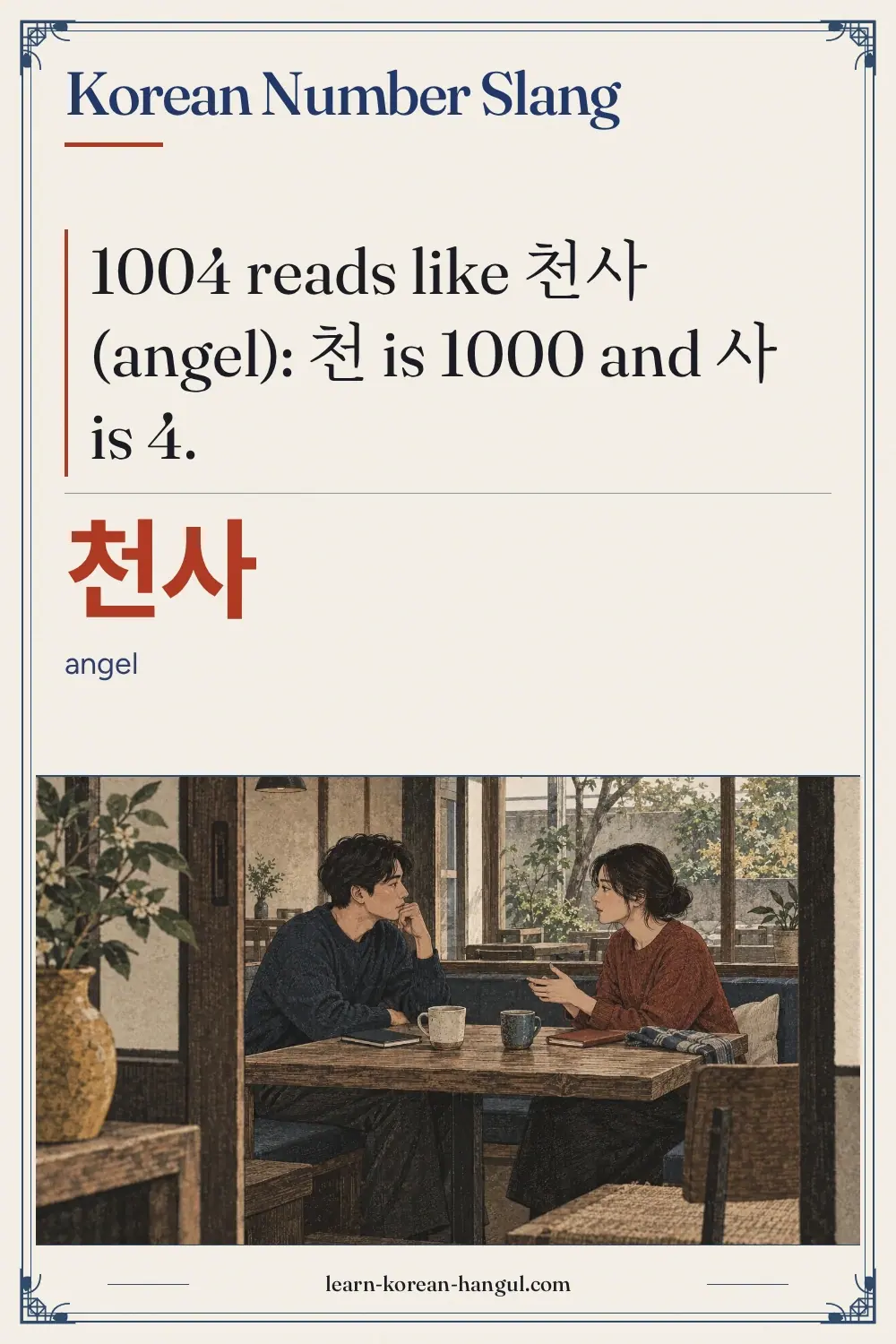
- 1004: read as 천사 (one thousand four), the word for angel.
- 8282: read digit by digit as 팔이팔이, close to 빨리빨리 (hurry hurry).
- The number 4: 사 shares its sound with 死 (death), so some buildings label floor 4 as F.
- The key detail: only the Sino-Korean 사 is avoided, not the native 넷 or 네.
- Context: number puns began with 1990s pagers and live on in names, jokes and memorable numbers.
What Is Korean Number Slang?
Korean number slang is the habit of reading a string of digits aloud so that it sounds like a word or phrase. A reader says each digit in its Sino-Korean form (1 is 일, 2 is 이, 4 is 사), listens to the result and hears a message. It is a kind of homophony, which means words that sound alike but differ in meaning.
Two ideas keep this topic straight. A number pun (숫자 은어) is a playful reading of digits, such as 1004 for 천사. A number superstition is a belief about whether a digit brings luck, such as the avoidance of 4. They are related, because both start from the sound of the number, but they do different jobs: puns are for fun and secret messages, and superstitions are for caution.
Which Sounds Do the Digits Give?
Each Sino-Korean digit has a short syllable, and people stretch each one toward words that sound similar. The table lists the digit, its reading and the sounds that puns most often borrow. Treat the right column as a pattern seen in puns and not as a fixed rule.
| Digit | Reading | Sounds that puns borrow |
|---|---|---|
| 0 | 영 or 공 | 영, 공 |
| 1 | 일 | 일 (as in 1도, "not even one") |
| 2 | 이 | 이, or 리 after 팔 (팔이 is said [파리], close to 빨리) |
| 3 | 삼 | 삼 |
| 4 | 사 | 사 (as in 사이, "relationship", and 死, death) |
| 5 | 오 | 오 |
| 6 | 육 | 육 |
| 7 | 칠 | 친 (as in 친구, friend) |
| 8 | 팔 | 빨 (as in 빨리, quickly), 팔팔 (lively) |
| 9 | 구 | 구 (as in 구구, 99) |
The loose matches are possible because Korean puns tolerate small differences in consonants: aspirated ㅍ for tense ㅃ (팔 and 빨), and final ㄹ for final ㄴ (칠 and 친). That tolerance is the key to decoding the examples in the next section.
Which Digit Puns Are Common?
The best-known Korean number puns are 1004 for 천사 (angel) and 8282 for 빨리빨리 (hurry hurry). Others come from the pager era, and they show how far a string of digits can stretch. The table gives the number, the reading and the message.
| Digits | Read as | Message |
|---|---|---|
| 1004 | 천사 (one thousand four) | angel |
| 8282 | 팔이팔이 | 빨리빨리, hurry hurry |
| 7942 | 칠구사이 | 친구 사이, being friends |
| 486 | 사팔육 | 사랑해, I love you (usually explained by counting the strokes of 사, 랑 and 해, not by sound) |
| 1010235 | 열 열 이 삼 오 (10 is read with the native 열) | 열렬히 사모해, I adore you passionately |
| 9988234 | 구구팔팔이삼사 | a long-life slogan, explained in the next section |
The first two are the ones to learn. The others come from lists of pager-era codes and are recognised mostly by older speakers, so they serve you better for reading than for writing. Each pun works in the same way, as the next two sub-sections show.
How Does 1004 Become 천사?
1004 becomes 천사 because it is read as a whole number, not digit by digit. The number 1,004 splits into 천 (1,000) and 사 (4), which gives 천사 (cheonsa). The word 천사 means "angel", so a message of 1004 is a sweet one. People use it in nicknames, in captions and as a pet name for someone they care about.
The pun has also entered branding. The coastal county of Sinan (신안) promotes its many islands as the "angel islands", and the number 1004 appears in that slogan. This is a good case of a pun that works in written form on signs because it needs no explanation for Korean readers.
How Does 8282 Become 빨리빨리?
8282 becomes 빨리빨리 because it is read digit by digit: 팔 (8), 이 (2), 팔 (8), 이 (2), which gives 팔이팔이, pronounced [파리파리] (paripari). Said quickly, this is almost the same as 빨리빨리 (ppallippalli), the common phrase for "hurry, hurry" or "quickly, quickly". The only change is the tense ㅃ in 빨 becoming the aspirated ㅍ in 팔.
The phrase 빨리빨리 itself is among the best-known Korean expressions, used in daily speech to ask for speed. A pager message of 8282 meant "call me back quickly", and today it appears as a joke about being impatient.
Knowing those two examples, you can build a method for decoding any new number.
How Do You Decode a Number Pun?
To decode a number pun, read each digit in Sino-Korean, say the result aloud at speed, and then listen for words that sound similar. The method has four steps.
- Decide how to chunk the digits. Read as one number (1004 is 천사) or digit by digit (8282 is 팔이팔이). If the string ends in zeros or looks like a year or price, try the whole-number reading first.
- Read each chunk in Sino-Korean. Use 일, 이, 삼, 사, 오, 육, 칠, 팔, 구, and 영 or 공 for 0.
- Say it fast. Join the syllables so the sound stops sounding like a list.
- Match with plain words. Allow small shifts such as 팔 to 빨 and 칠 to 친, and check the meaning in context.
You will know the method works if 7942 turns into 칠구사이 and then 친구 사이 (being friends). A string like 9988234 is longer, and it needs chunks of two digits, as the next section shows.
Common mistake: expecting a unique answer. A string of digits can match more than one phrase, so the same number may mean different things to different people. Context decides, which is why puns are best learned as shared jokes and not as rules.
What Does 9988234 Mean?
9988234 is a long-life slogan that older Koreans repeat as a joke and a wish: 구구팔팔이삼사. It splits into 99, 88 and 234. The first part means "live to 99", the second 팔팔 means "in lively health" (팔팔하다 means to be full of energy), and the last part, 이삼사, means "two or three days of illness, then 4". The 4 here is 사, the sound of death, so the slogan wishes for a long healthy life that ends after a very short illness.
The slogan shows how number puns mix digits with chunking and with the death meaning of 사 from the section on the number 4. It also shows that the whole joke is for adults: grandparents say it, and it is not a code for texting.
Where Did the Habit Come From?
The habit comes largely from pagers (삐삐, ppippi), small devices that Korean users carried in the 1990s. A caller could send only digits, so people invented codes: 1004 for angel, 486 for a love message and 8282 for urgency. When mobile phone texting replaced pagers, the codes lost their purpose but kept their charm, and some survived as slang.
Two things are worth remembering. First, the codes depend on reading the digits aloud in Sino-Korean, so they teach the digits well. Second, most of them are retro today. Many young speakers know 1004 and 8282 but not 7942 or 1010235. Use the retro ones to recognise older jokes and the common ones to join in.
The next topic is the other half of numbers and sound: the beliefs that make some numbers welcome and others unwelcome.
Why Is the Number 4 Avoided?
The number 4 is avoided because its Sino-Korean reading, 사, sounds exactly like the reading of the character 死 (death). The two are different Hanja (四 and 死), but in Hangul both are written and said 사, which gives the number a gloomy association. The same happens in other cultures that use Chinese characters, such as Japan, where 四 is also read shi, the sound of 死.
The avoidance shows up in several quiet ways:
- Floors. Some buildings label the fourth floor F (for "four") instead of 4. An elevator panel may therefore show 3, F, 5. The page on the 층 counter shows how to read floor numbers.
- Rooms. Some hospitals and funeral halls skip room 4.
- Gifts. A set of four cups or four plates can feel unlucky as a gift, so shops often sell sets of three or five.
The practices are common but not universal. Many modern apartment blocks have a normal floor 4, and nobody objects to saying the number in speech.
Is the Avoidance about Every Word for Four?
No. Only the Sino-Korean 사 sounds like death. The native Korean number 넷 (and its short form 네) has no such link, so 네 개 (four things) and 네 시 (four o'clock) are perfectly ordinary. This is a good case of the two number systems behaving differently.
| Reading | Number system | Sound link to death? |
|---|---|---|
| 사 | Sino-Korean | yes, same sound as 死 |
| 넷, 네 | native Korean | no |
The practical rule: when a Korean speaker avoids 4, they are avoiding the Sino-Korean reading in a place where Sino numbers apply, such as floors, rooms, and sets of items. The lesson on Sino vs native Korean numbers explains which system goes where.
Which Numbers Are Considered Lucky?
The numbers most often called lucky in Korea are 7, 3 and 8, but the reasons differ and the beliefs are lighter than the avoidance of 4. Treat the list below as common ideas, not as rules.
| Number | Why it is seen as lucky | Strength of the belief |
|---|---|---|
| 7 | 럭키 세븐 (lucky seven), borrowed from Western games and baseball | widespread but modern |
| 3 | 삼세번, the idea that the third try counts | an old saying |
| 8 | links to prosperity in Chinese-influenced traditions | some people, mostly in business |
The saying 삼세번 means "three times": give something three chances before you give up, so 삼세번 해 보자 means "let's try three times". It fits the common habit of settling games as best of three. A lucky 7 comes from international slot machines and baseball culture, and the link of 8 with wealth is borrowed from Chinese beliefs. None of them is a strict taboo or rule.
What Is 아홉수?
아홉수 (ahopsu) is the belief that ages ending in 9, such as 19, 29 and 39, are a delicate time. The word joins 아홉 (nine) and 수 (a number or luck). People who believe in it avoid big decisions in an 아홉수 year, such as marriage or moving house, or they take extra care. Many people treat it as a joke, and others plan around it.
People often apply the belief to the traditional counting age, so it did not disappear when the law moved to international age, a change described in the Korean age section.
What Other Number Slang Do Koreans Use?
Beyond pager codes, Korean uses numbers in slang for people and times of life. Three examples that appear in news and conversation are listed here, with their literal meaning.
- 이태백 (itaebaek): a pun on 이십대 태반이 백수, "most people in their twenties are jobless", which also sounds like the name of the Tang-dynasty poet.
- 사오정 (saojeong): from 사십오 세 정년, "retirement at forty-five", which also echoes a character from a famous story.
- 삼포 세대 (sampo sedae): "the three-give-up generation", a label for people who give up dating, marriage and children because of cost.
A different type of number slang is 1도 없다 (ildo eopda), where the digit 1 is read 일 and means "not even one". It is a common way to say "none at all", as in 1도 몰라 (I know nothing at all). These expressions show that number slang is more than pager codes. Many of them describe social life, and they appear in news headlines.
The readings above come from commonly cited glosses and can differ in tone by speaker, so the full range belongs to a dedicated slang lesson. The goal here is recognition.
Where Do You See These Numbers?
You see number puns in phone numbers, names and shop signs, and you see number beliefs in building layouts. A few places to look:
- Memorable numbers. Businesses and people prefer numbers with repeated or meaningful digits, so a customer line or a mobile number may hold 8282 or 1004.
- Usernames and emails. Younger users add 1004 or 8282 to nicknames.
- Floor buttons. Look for F in place of 4 in elevators.
- Gift shops. Sets in threes and fives are common.
- Calendar dates. The date 11/11 is Pepero Day (빼빼로데이), a day on which friends give a thin biscuit stick called Pepero. The four 1s in the date look like four sticks. This is a visual pun, not a sound pun.
Dates like this show that number play in Korea works through shapes as well as sounds. The next section contrasts the Korean method with a familiar English one.
How Is Korean Number Slang Different from English Texting?
Korean number slang uses digits as stand-alone sounds, while English texting such as "gr8" and "2day" puts a digit inside a spelled word. English letters and numbers mix in the same word, but Korean puns are strings of digits, with no letters at all. This makes them harder to read for beginners, because you must hear the string.
The other difference is time. English-style shortcuts live on in short messages, but Korean texting today relies on Hangul consonant shortcuts such as ㅋㅋ (laughter) and ㅇㅇ (yes), described on the page about Korean texting abbreviations. Number codes are mostly a source of jokes. Learn them for culture and for recognition, and do not rely on them for daily messages.
Limitation: number puns are informal, local and short-lived. A pun that one group knows can mean nothing to another, and the matches above are common readings and not dictionary entries. Do not use them in formal writing or in a conversation with someone you have just met, unless the other person starts the joke.
Practice Set
Answer each item before you read the answers.
- How is 1004 read, and what does it mean?
- Read 8282 digit by digit.
- Why do some buildings label floor 4 as F?
- Which reading of "four" is not linked to death: 사 or 넷?
- What is 아홉수?
Practice · 5
What does 1004 mean as number slang?
Show answer
천사 (angel)
Which phrase does 8282 sound like?
Show answer
빨리빨리
Why is the number 4 avoided in some buildings?
Show answer
사 sounds like 死 (death)
Which word for four has no link to death?
Show answer
넷
What is 아홉수?
Show answer
The belief that ages ending in 9 need care
Answers:
- 천사 (one thousand four), meaning angel.
- 팔이팔이.
- The Sino-Korean 사 sounds like 死 (death).
- 넷 (and its short form 네).
- The belief that ages ending in 9 are a delicate time.
Four or more correct means you can recognise the main ideas.
What to Learn Next
You can now explain Korean number slang: decode 1004 and 8282, say why 4 is avoided and name the lucky numbers. Continue in this order:
- The 층 counter for floor numbers, including the missing 4.
- Sino-Korean numbers 1-100 for the digit readings that every pun relies on.
- Korean texting abbreviations for the shortcuts people use in chat today.
- Korean Numbers for the whole section.
Frequently Asked Questions
Is 13 unlucky in Korea?
Not traditionally. The fear of 13 is a Western custom, and Korean tradition has no matching taboo. Because of Western influence, a few hotels and apartment buildings skip a 13th floor, but most do not. The number that Korean buildings are more likely to avoid is 4, because of its link to death.
Do Koreans still text with number codes?
Rarely. Number codes belong mostly to the pager era of the 1990s, when only digits could be sent. Today people type full words, Hangul consonant shorthand such as ㅋㅋ and emoji. Number puns survive as jokes, nicknames, usernames and memorable phone or room numbers, and many younger people recognise only the best-known ones.
Is it rude to say the number 4 in Korean?
No. People say 사 in dates, prices and phone numbers every day, and the native number 넷 or 네 is used for counting things. The avoidance is a quiet building and gift custom, not a spoken taboo. You only need to think about it when you choose a floor, a room or a set of gifts.
Why do some people avoid writing 18?
The reading 십팔 sounds close to a strong swear word, so in chat and online comments the digits 18 can stand for that word. Ordinary uses are normal, such as 18세 (age 18) and 18일 (the 18th). Avoid jokes with the bare number 18 until you know your audience.
Can I use a number pun in a username or phone number?
Yes. Pick a pun you understand, such as 1004 for 천사 or 8282 for 빨리빨리, and check that the sound does not carry a bad meaning in the other reading. Avoid 4 and 18 in names meant for the public. Memorable repeated digits are popular for the same reason.