What you'll learn
- Choose the correct number system for 10 everyday situations: age, hour, minute, date, price, phone number, floor, people, bottles and months.
- Read a clock time such as 3:15 with both systems in the right places.
- Spot the exceptions that break the simple rule, such as 번, 분 and 인분.
- Explain each choice with the "how many?" versus "which one / how much?" test.
- Prerequisites: you can say 1–10 in at least one system. Estimated time: 20 minutes.
Sino Korean vs Native Korean Numbers: the Essentials

The two Korean number systems are two complete sets of number words that share one job split between them. The native Korean set (고유어 수사, "native numerals") is the original Korean vocabulary. The Sino-Korean set (한자어 수사, "Chinese-character numerals") was borrowed from Chinese characters such as 一, 二 and 三. Every adult speaker uses both every day, often in the same sentence.
The Two Counting Sequences from 1 to 10
| Number | Native Korean | Native before a counter | Sino-Korean |
|---|---|---|---|
| 1 | 하나 (hana) | 한 (han) | 일 (il) |
| 2 | 둘 (dul) | 두 (du) | 이 (i) |
| 3 | 셋 (set) | 세 (se) | 삼 (sam) |
| 4 | 넷 (net) | 네 (ne) | 사 (sa) |
| 5 | 다섯 (daseot) | 다섯 | 오 (o) |
| 6 | 여섯 (yeoseot) | 여섯 | 육 (yuk) |
| 7 | 일곱 (ilgop) | 일곱 | 칠 (chil) |
| 8 | 여덟 (yeodeol) [여덜] | 여덟 | 팔 (pal) |
| 9 | 아홉 (ahop) | 아홉 | 구 (gu) |
| 10 | 열 (yeol) | 열 | 십 (sip) |
| 20 | 스물 (seumul) | 스무 (seumu) | 이십 (isip) |
The third column matters. Five native numbers shorten when a counter follows them: 하나 becomes 한, 둘 becomes 두, 셋 becomes 세, 넷 becomes 네, and 스물 becomes 스무. For example, three apples is 사과 세 개, never 사과 셋 개. The romanization in brackets follows the Revised Romanization of Korean (2000) and is only a reading aid.
Ten Everyday Situations in One Table
| Situation | System | Counter or unit | Written | Said | English |
|---|---|---|---|---|---|
| Age in speech | Native | 살 | 25살 | 스물다섯 살 | 25 years old |
| Hour on the clock | Native | 시 | 3시 | 세 시 | 3 o'clock |
| Minutes | Sino | 분 | 15분 | 십오 분 | 15 minutes |
| Date | Sino | 월, 일 | 10월 9일 | 시월 구 일 | 9 October |
| Price | Sino | 원 | 5,000원 | 오천 원 | 5,000 won |
| Phone number | Sino | none | 010-1234-5678 | 공일공 일이삼사 오육칠팔 | phone number |
| Floor | Sino | 층 | 3층 | 삼 층 | 3rd floor |
| People | Native | 명 | 2명 | 두 명 | two people |
| Bottles | Native | 병 | 맥주 1병 | 맥주 한 병 | one bottle of beer |
| Months of duration | Native or Sino | 달 or 개월 | 2달 / 2개월 | 두 달 / 이 개월 | two months |
A short memory rule covers most of the table. Native numbers answer "how many?": how many apples, people, bottles, hours or years of age. Sino numbers answer "which one?" or "how much?": which floor, which date, which phone number, how much money, how many minutes on a clock face. The rule has exceptions, and they appear later on this page, but it gives the right answer in most everyday cases.
The table raises an obvious question: why would one language keep two full sets of numbers? The history explains the split.
Why Does Korean Have Two Number Systems?
Korean has two number systems because it kept its own number words and also borrowed a second set from Chinese characters. For centuries, government, scholarship and record keeping in Korea used Classical Chinese. Numbers for dates, money, measurements and official counts came in through that written channel, with Korean pronunciations of characters such as 一 (일), 二 (이) and 三 (삼).
The native set survived in daily speech, where people counted things they could see and hold. That history still shows in the split. Native numbers handle small, concrete, spoken counts. Sino numbers handle anything written, official, large or abstract, such as 2026년 (the year 2026) or 오천 원 (5,000 won).
Two facts follow from this history:
- Native numbers stop at 99. The largest native number word is 아흔아홉 (99). Korean has no native word in common use for 100, 1,000 or 10,000, so these are always Sino: 백 (100), 천 (1,000), 만 (10,000). One hundred people is 백 명, not a native form.
- Sino numbers can go as high as you need. Large numbers group by 만 (10,000) rather than by thousands, so 50,000 won is 오만 원. The page on Sino-Korean numbers 1-100 builds the full list.
The same division of labour applies to vocabulary in general, not only to numbers. If you want the wider picture, the comparison of sino korean vs native korean words shows how Sino-Korean words dominate formal and technical vocabulary. With the history in place, the most confusing everyday case, clock time, becomes easier to read.
Why Does the Time Use Both Systems?
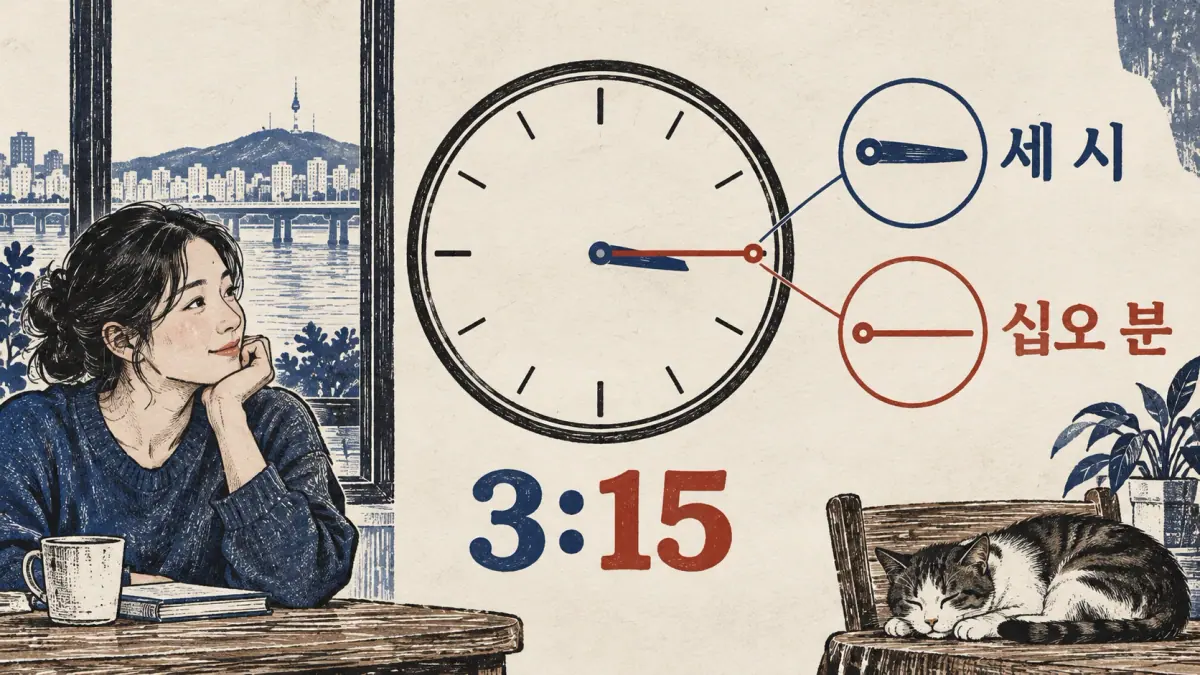
Clock time uses both systems because Korean treats the hour and the minute as different kinds of number. The hour is counted with native numbers and the counter 시: 세 시 is literally "three hours on the clock". The minute is labelled with Sino numbers and the counter 분: 십오 분 is "minute fifteen". So 3:15 is 세 시 십오 분.
Build any time in three steps:
- Say the hour with a native number in its short form, followed by 시: 한 시, 두 시, 세 시, 네 시, up to 열두 시.
- Say the minutes with a Sino number followed by 분: 오 분, 십 분, 삼십 분, 사십오 분.
- Add 오전 (a.m.) or 오후 (p.m.) in front when you need to: 오후 세 시 십오 분 (3:15 p.m.).
| Written | Said | Note |
|---|---|---|
| 1:00 | 한 시 | 한, not 하나 |
| 2:30 | 두 시 삼십 분 or 두 시 반 | 반 means half |
| 4:45 | 네 시 사십오 분 | 네, not 넷 |
| 10:10 | 열 시 십 분 | native 열, then Sino 십 |
| 12:05 | 열두 시 오 분 | 열두, not 십이 |
Duration follows the same pattern. Hours of duration use native numbers with 시간 (hours), and minutes stay Sino: 한 시간 삼십 분 means "one hour and thirty minutes". Seconds use Sino numbers with 초: 삼십 초 (30 seconds).
Expert insight: the 10:10 row is the best self-test. If you can say 열 시 십 분 without hesitating, you have understood that the same number can need two different words in one phrase. The full hour pattern is in the lesson on telling hours with 시. Clock time is the meeting point of the two systems; the next two sections map each system's own territory.
What Do Native Korean Numbers Count?

Native Korean numbers count concrete units: things, people, animals, hours, ages, times and months. In almost every case a counter follows the number, and the number takes its short form when it can (한, 두, 세, 네, 스무).
| What you count | Counter | Example | English |
|---|---|---|---|
| Things in general | 개 | 사과 세 개 | three apples |
| People | 명 | 학생 두 명 | two students |
| People, honorific | 분 | 손님 세 분 | three guests |
| Animals | 마리 | 고양이 한 마리 | one cat |
| Books | 권 | 책 네 권 | four books |
| Cups and glasses | 잔 | 커피 두 잔 | two coffees |
| Bottles | 병 | 물 한 병 | one bottle of water |
| Flat sheets | 장 | 종이 다섯 장 | five sheets of paper |
| Cars and machines | 대 | 차 한 대 | one car |
| Age | 살 | 스무 살 | 20 years old |
| Hour on the clock | 시 | 일곱 시 | 7 o'clock |
| Hours of duration | 시간 | 두 시간 | two hours |
| Times (occurrences) | 번 | 세 번 | three times |
| Months of duration | 달 | 두 달 | two months |
Two sentences show the pattern in use. 커피 두 잔 주세요 means "two coffees, please": the noun 커피 comes first, then the native number 두, then the counter 잔. 고양이 한 마리가 있어요 means "there is one cat": 한 is the short form of 하나.
Native numbers also appear without a counter when you count aloud: 하나, 둘, 셋 before a photo, or the numbers called out in a taekwondo class. In casual speech a full native number can follow a noun directly, as in 사과 하나 주세요 ("one apple, please"). The general counter to learn first is the 개 counter, and the complete native list is on native Korean numbers 1-100. Native numbers own the countable world; the Sino system owns almost everything else.
What Do Sino-Korean Numbers Cover?
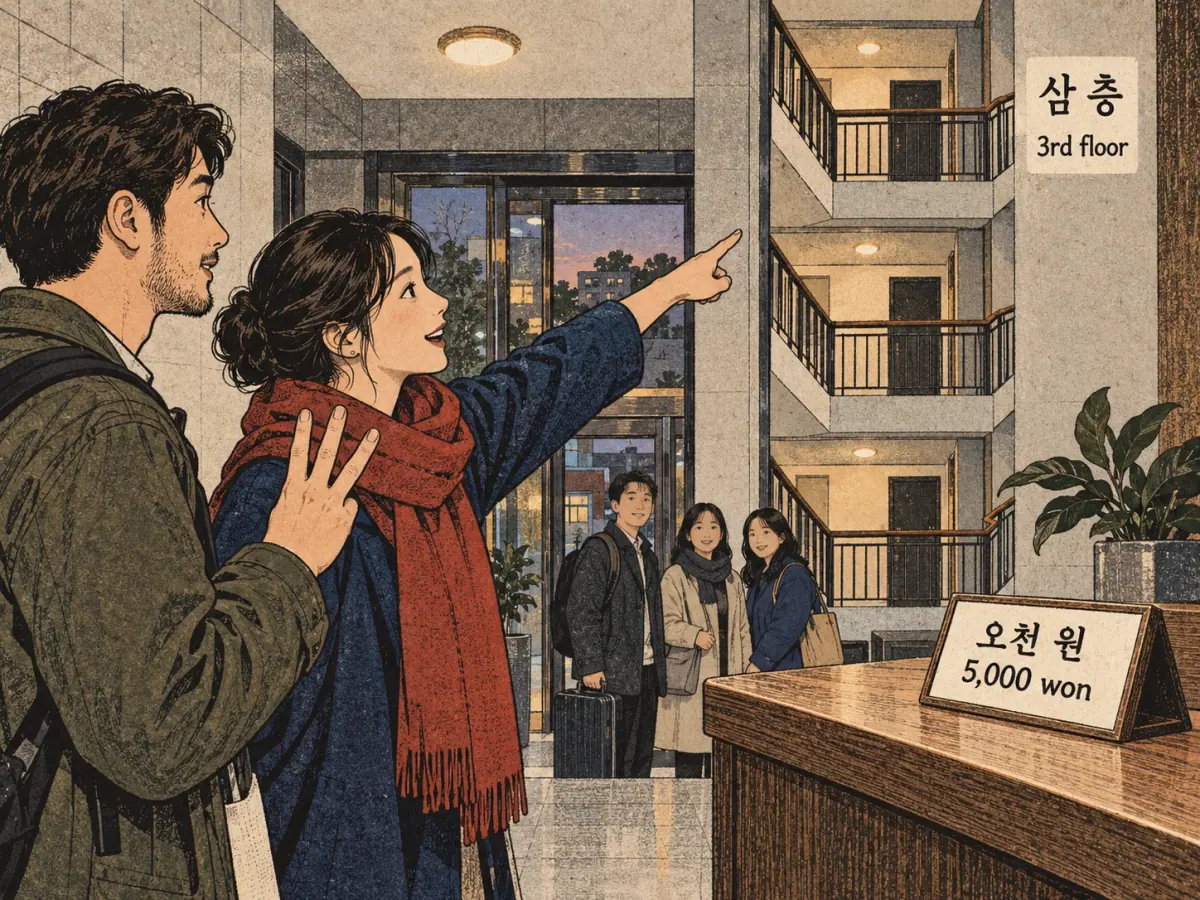
Sino-Korean numbers cover labels, measurements, money, calendar dates and any number of 100 or more. A Sino number usually tells you which item it is or how much there is, rather than how many separate things you can count.
- Minutes and seconds: 십 분 (10 minutes), 삼십 초 (30 seconds).
- Dates and years: 2026년 10월 9일 is 이천이십육 년 시월 구 일. Counting years also uses Sino: 삼 년 (three years).
- Money: 오천 원 (5,000 won), 만 오천 원 (15,000 won).
- Phone and ID numbers: each digit is read separately, with 0 read as 공: 공일공 (010).
- Floors and rooms: 삼 층 (3rd floor), 삼백이 호 (room 302).
- Bus routes and numbered items: 삼 번 버스 (bus number 3), 일 번 출구 (exit 1).
- Measurements: 이 킬로그램 (2 kg), 백 미터 (100 m), 삼십 퍼센트 (30 percent).
- School years and periods: 이 학년 (2nd year), 삼 교시 (3rd class period).
- Formal age and servings: 이십오 세 (age 25 on a form), 이 인분 (two servings).
- Months with 개월: 육 개월 (six months).
A shop dialogue shows the Sino system at work. A customer asks 이거 얼마예요? ("How much is this?") and the clerk answers 만 오천 원이에요 ("It's 15,000 won"). Notice that 10,000 is just 만, not 일만, at the start of a price.
이거 얼마예요?
How much is this?
만 오천 원이에요.
It's 15,000 won.
Phone numbers deserve their own practice because they are long and fast; the guide on how to say a phone number in Korean covers grouping and the 공 versus 영 choice. The two territories are clear in most cases, but a handful of words sit on the border and catch every learner at least once.
Which Exceptions Break the Simple Rule?
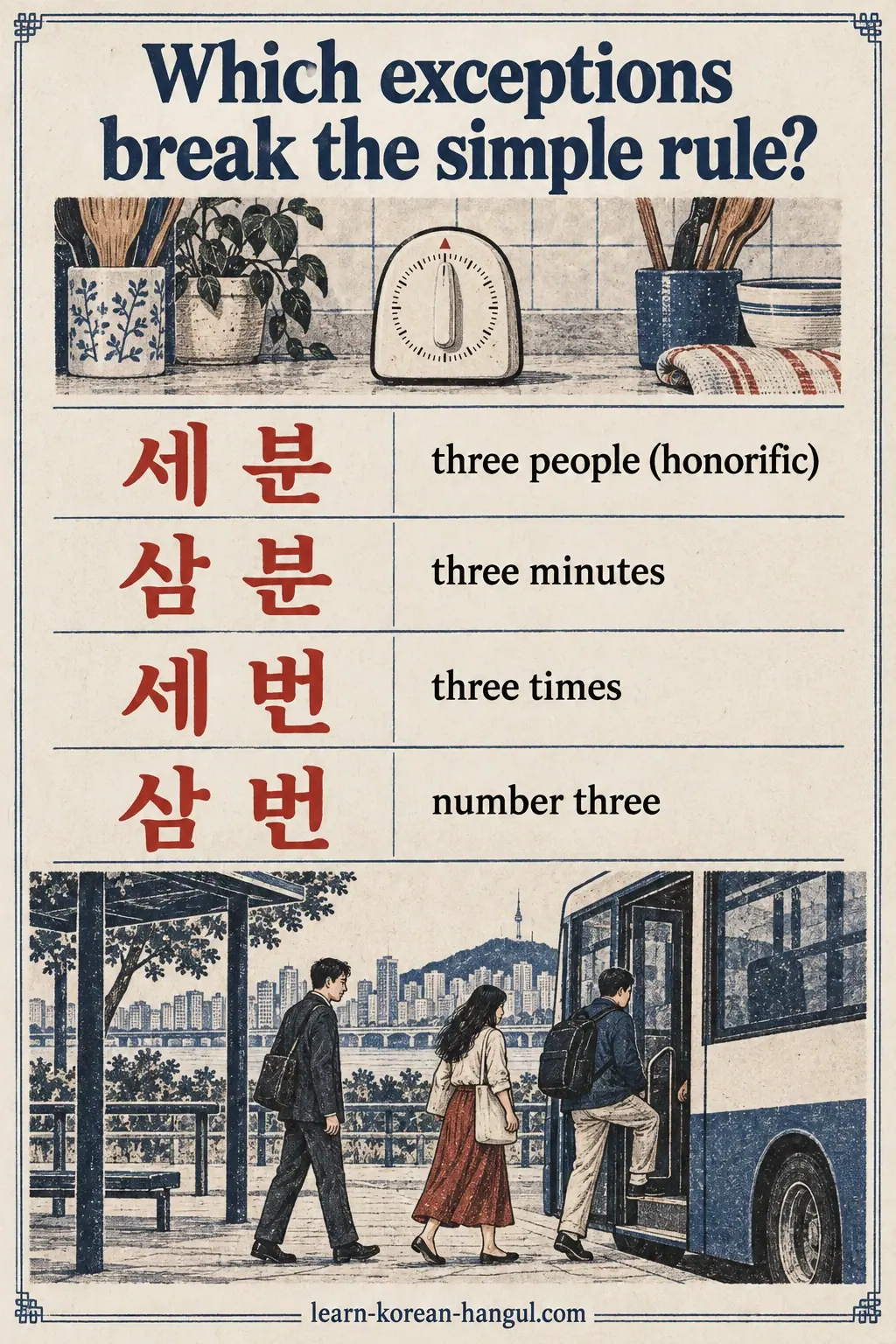
Seven common words break or complicate the "how many versus which one" rule. Most of them are pairs where the same sound or meaning takes different systems.
| Word | Native use | Sino use | Why it trips learners |
|---|---|---|---|
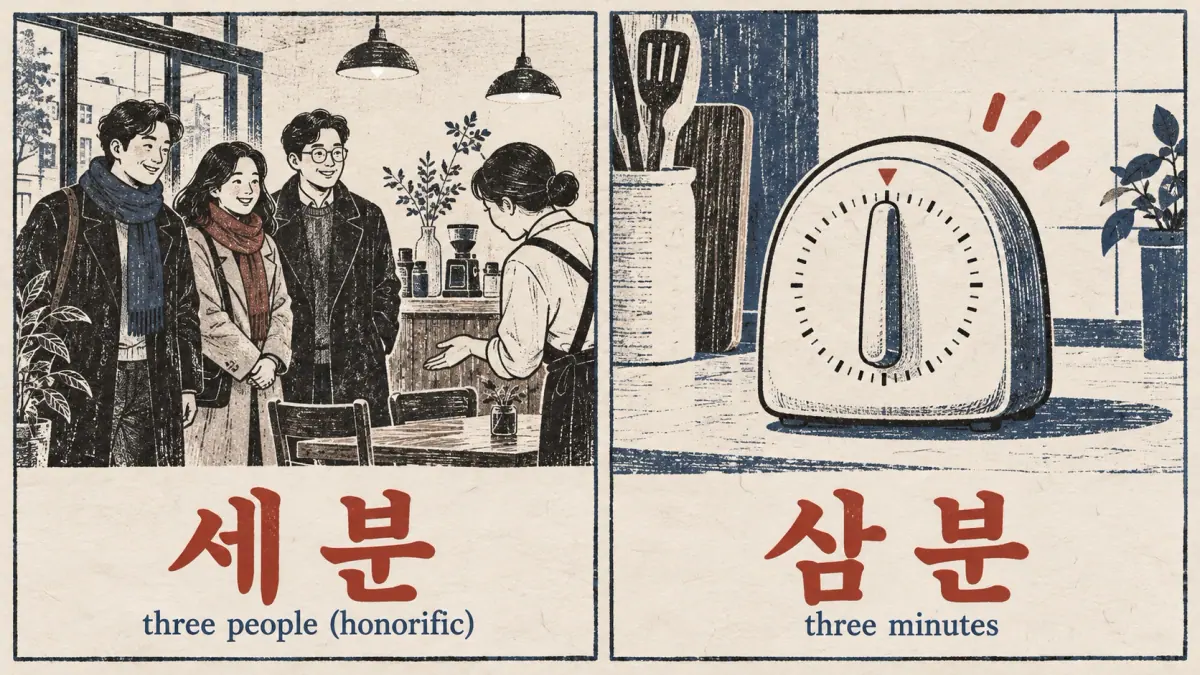
| 분 | 세 분 = three people (honorific) | 삼 분 = three minutes | Same spelling, two different words |
| 번 | 세 번 = three times | 삼 번 = number three | One word, two jobs |
| Months | 두 달 = two months | 이 개월 = two months | Same meaning, two counters |
| Age | 스무 살 = 20 (speech) | 이십 세 = 20 (forms) | Same meaning, two registers |
| 층 | 한 층 = one floor (as in 한 층 위, one floor up) | 삼 층 = 3rd floor | Floor labels are Sino; counting floors moved can be native |
| 인분 | none | 이 인분 = two servings | Food, yet Sino |
| Month names | none | 유월 (June), 시월 (October) | Irregular sound changes |
Each pair has a clear lesson of its own. The honorific counter 분 is a polite way to count people, and it is a different word from 분 for minutes. The 번 counter counts times with native numbers but labels buses and exits with Sino numbers. The month pair is explained in 달 and 개월, and the age pair in the 살 counter.
The month names need one more note. Korean month names are Sino number + 월, but two of them change sound: 6월 is 유월, not 육월, and 10월 is 시월, not 십월. The spelling in Hangul changes too, so these are true exceptions, not just pronunciation habits.
Ordinals add a final twist. "First, second, third" use native numbers with 번째: 두 번째 (second), 세 번째 (third). "First" is irregular: 첫 번째, not 한 번째.
Expert insight (counterintuitive): many learners guess that a Sino-Korean counter must take Sino numbers. That guess fails for the most common counters. 개 (個), 명 (名), 권 (卷), 잔 (盞), 병 (甁) and 대 (臺) all come from Chinese characters, yet all take native numbers. Learn the system with each counter rather than reasoning from the counter's origin. The exceptions are easier to remember once you see them working together in one real day.
Worked Example: One Day Described in Numbers
A full day in Korean uses both systems many times. Here are five sentences, each analysed number by number.
- 일곱 시 삼십 분에 일어났어요. "I got up at 7:30." The hour 일곱 is native with 시; the minutes 삼십 are Sino with 분.
- 백사십 번 버스를 탔어요. "I took bus 140." The route is a label, so it is Sino: 백사십 번.
- 오 층 사무실에 갔어요. "I went to the office on the 5th floor." Floor labels are Sino: 오 층.
- 커피 두 잔을 구천 원에 샀어요. "I bought two coffees for 9,000 won." The cups are counted, so 두 잔 is native; the price is an amount of money, so 구천 원 is Sino.
- 동료 세 명하고 한 시간 동안 회의했어요. "I had a one-hour meeting with three colleagues." People take native 세 명; the duration takes native 한 시간.
Sentence 4 is the most useful pattern to copy. One sentence holds a native count (두 잔) and a Sino amount (구천 원), and the counter next to each number tells you which to use. The same habit of checking the counter prevents most of the mistakes listed next.
Common Mistakes and Misconceptions
Learners often make the same five errors with the two systems. Each one has a reason and a fix.
- Learners often assume one system is "more correct"; actually both are standard, because each covers different situations. 사과 삼 개 sounds wrong, and so does 세 층 for "3rd floor". The fix is to learn the system with the counter.
- Learners often say 하나 개 or 셋 시; actually the short forms are required, because native numbers shorten before a counter. Say 한 개 and 세 시.
- Learners often read 3시 as 삼 시; actually it is 세 시, because clock hours count with native numbers. The minutes in the same phrase stay Sino.
- Learners often say 이십 살; actually 살 takes native numbers, so it is 스무 살. If you want Sino, switch the counter to 세: 이십 세.
- Learners often think 30 years old is too big for native numbers; actually native numbers work up to 99, so 서른 살 is normal. Only from 100 do you need Sino: 백 살 is "100 years old".
These mistakes rarely stop communication. They do mark your Korean as unsure, which leads to a fair question about shortcuts.
Can You Just Use Sino-Korean Numbers Everywhere?
No. Using Sino numbers everywhere works for prices, dates, phone numbers and floors, but it breaks down as soon as you count things, people or hours. A shop clerk will probably understand 사과 삼 개, yet it sounds clearly wrong. With clock time the shortcut causes real confusion, because 3 o'clock is 세 시, and a Sino form here is not what listeners expect.
A realistic survival plan is narrower. Learn Sino numbers well first, because money, dates and phone numbers use them and they continue past 99. Then learn native 1–10 with the short forms 한, 두, 세, 네, which already covers ordering food, buying tickets for a group and saying the hour.
Limitations of this page: the rules here describe standard Seoul Korean as used in everyday speech and writing. Fast casual speech sometimes switches large native numbers to Sino forms, and some counters (such as 주 for weeks) accept both systems in certain phrases. This page does not list every counter; the cluster on how Korean counters work explains the counter system as a whole. The fastest way to make the rules automatic is short, mixed practice.
Practice: Choose the Number System
Decide whether each phrase needs native or Sino numbers, then say it aloud. Answers follow the list.
- 5 o'clock (시)
- 20 minutes (분)
- 4 students (명)
- 30,000 won (원)
- Room 501 (호)
- 22 years old, said in conversation (살)
- 2 bottles of water (병)
- 25 December (월, 일)
Practice · 8
How do you say 3:15 on the clock?
Show answer
세 시 십오 분
Hours count with native numbers and 시, while minutes take Sino numbers and 분.
How do you say "20 years old" in conversation with 살?
Show answer
스무 살
살 takes native numbers, and 스물 shortens to 스무 before a counter. For Sino you must switch to 세: 이십 세.
How do you say the 3rd floor?
Show answer
삼 층
Floor labels answer "which one?", so they use Sino numbers: 삼 층.
How do you say "two coffees" with the counter 잔?
Show answer
커피 두 잔
Cups are counted, so they take native numbers in the short form: 두 잔.
How is the month 6월 (June) said?
Show answer
유월
Month names use Sino numbers, but 6월 changes sound and spelling to 유월.
What does 세 번 mean?
Show answer
three times
번 with native numbers counts occurrences; with Sino numbers (삼 번) it labels number three.
How do you say 15,000 won?
Show answer
만 오천 원
Money uses Sino-Korean numbers, and 10,000 is just 만 at the start of a price, so 15,000 won is 만 오천 원. 오천 원 is only 5,000 won.
How do you say "second" as an ordinal?
Show answer
두 번째
Ordinals use native numbers with 번째, in the short form before the counter: 두 번째.
Answers: 1. Native: 다섯 시. 2. Sino: 이십 분. 3. Native: 학생 네 명. 4. Sino: 삼만 원. 5. Sino: 오백일 호. 6. Native: 스물두 살. 7. Native: 물 두 병. 8. Sino: 십이월 이십오 일.
If you got items 1, 3 and 6 right, you have the native short forms under control. If items 4 and 5 felt slow, spend more time with the Sino list before moving on.
What to Learn Next
The best next step depends on which system felt weaker in the practice set.
- If native counting was slow, continue with Native Korean Numbers and the full native Korean numbers 1-100 list.
- If Sino numbers were slow, drill Sino-Korean numbers 1-100 before prices and dates.
- If counters confused you, read how Korean counters work, then the 개 counter.
- For the full map of number topics, return to Korean Numbers.
The choice between Sino Korean vs native Korean numbers becomes automatic once you link each number to its counter instead of memorising rules in isolation.
Frequently Asked Questions
Is there a quick rule to decide between Sino and native numbers? Yes. Ask whether you are answering "how many?" or "which one / how much?". "How many things, people or times?" takes native numbers: 세 개, 두 명, 한 번. "Which number, how much money, what date or how long in minutes?" takes Sino numbers: 삼 번 버스, 오천 원, 십 분. Then check the counter's own rule.
Which number system do Koreans use for age? Koreans use native numbers with 살 when they say an age in conversation: 스물다섯 살 (25 years old). Forms, news reports and formal writing use Sino numbers with 세: 이십오 세. Both refer to the same age. Since 28 June 2023 that age is normally the international age (만 나이) in official use.
What number system do I use with 개? 개, the general counter for things, takes native numbers: 한 개, 두 개, 세 개, 네 개, 다섯 개. Remember the short forms 한, 두, 세, 네 and 스무 before a counter. From 100 upward you switch to Sino numbers, so 100 items is 백 개, and 150 items is 백오십 개.
Which system do you use for years such as 2026? Years always use Sino-Korean numbers followed by 년: 2026년 is 이천이십육 년. Counting a number of years also uses Sino numbers: 삼 년 means three years. Korean writes dates from largest to smallest unit, so 9 October 2026 is 2026년 10월 9일, read 이천이십육 년 시월 구 일.
Is zero read 영 or 공? Zero is 영 in mathematics, temperatures and scores, as in 영 도 (zero degrees). In phone numbers, room numbers and bank account numbers Koreans usually say 공, so 010 is read 공일공. Both words are Sino-Korean. Native Korean has no everyday word for zero, which is one more reason codes and IDs use the Sino system.