Key facts
- Spellings in dojangs often differ from Revised Romanization, so the same word may appear as "yeoseot" in one list and "yuh-sut" in another.
Korean Numbers Taekwondo: the Essentials
Korean numbers taekwondo students need fall into two jobs: counting repetitions and naming things that have a number. Counting uses the native set, because it answers "how many". Naming forms, belts and ranks uses the Sino-Korean set, because it answers "which one". The table shows the split with a typical example for each.
| Job | Number set | Example | Reading |
|---|---|---|---|
| Counting kicks or push-ups | Native Korean | 하나, 둘, 셋 | hana, dul, set |
| Naming a form | Sino-Korean | 태극 1장 | Taegeuk il jang |
| Naming a coloured-belt rank | Sino-Korean | 10급 | sip geup |
| Naming a black-belt degree | Sino-Korean | 1단 | il dan |
| Saying how many times | Native + 번 | 열 번 | yeol beon |
The word taekwondo itself is Korean: 태권도 (taegwondo in Revised Romanization), made of 태 "foot", 권 "fist" and 도 "way". Many of the words used in class are Korean too, which is why learning ten numbers pays off quickly. Start with the counting set, because you will hear it first.
How Do Instructors Count 1-10?
Instructors count 1 to 10 with the native Korean numbers, one count for each repetition. Each word is short and sharp so that the class can keep the rhythm of the movement. The table lists all ten with Revised Romanization and the pronunciation when it differs from the spelling.
| No. | Hangul | Revised Romanization | Sounds like |
|---|---|---|---|
| 1 | 하나 | hana | [하나] |
| 2 | 둘 | dul | [둘] |
| 3 | 셋 | set | [섣] |
| 4 | 넷 | net | [넫] |
| 5 | 다섯 | daseot | [다섣] |
| 6 | 여섯 | yeoseot | [여섣] |
| 7 | 일곱 | ilgop | [일곱] |
| 8 | 여덟 | yeodeol | [여덜] |
| 9 | 아홉 | ahop | [아홉] |
| 10 | 열 | yeol | [열] |
Two sound rules explain the brackets. A final ㅅ is pronounced as ㄷ, so 셋 sounds like [섣], 넷 like [넫] and 다섯 like [다섣]. The two-consonant ending ㄼ of 여덟 is simplified to ㄹ, so the word is pronounced [여덜]. These changes are part of the standard pronunciation rules (표준 발음법) of the National Institute of Korean Language.
A full 10-count is the usual warm-up. Listen to it at normal speed first, then at the slower speed.
하나, 둘, 셋, 넷, 다섯, 여섯, 일곱, 여덟, 아홉, 열
One, two, three, four, five, six, seven, eight, nine, ten
You will know it worked when you can say all ten in time with a steady beat, about one word per second. The common mistake is to blur 여섯 and 여덟, which share the first syllable 여, so listen to the ending: 섯 is [섣] and 덟 is [덜].
Counting past Ten
Past ten, add the ones word after 열. So 11 is 열하나, 12 is 열둘 and so on until 20, which is 스물. Most basic drills stop at ten and start again, but longer sets run to 20 or beyond.
| No. | Korean | No. | Korean |
|---|---|---|---|
| 11 | 열하나 | 16 | 열여섯 |
| 12 | 열둘 | 17 | 열일곱 |
| 13 | 열셋 | 18 | 열여덟 |
| 14 | 열넷 | 19 | 열아홉 |
| 15 | 열다섯 | 20 | 스물 |
The native numbers are taught step by step, starting with native Korean numbers 1-10. Counting is half of the story, because the other half of class uses the second set.
Sino-Korean Numbers in Forms and Ranks
Forms and ranks use Sino-Korean numbers, the set that came into Korean from Chinese: 일, 이, 삼, 사, 오, 육, 칠, 팔, 구, 십. A form (poomsae, 품새) is a fixed sequence of movements, and its name carries a number that shows its place in the order.
| No. | Sino-Korean | Romanization |
|---|---|---|
| 1 | 일 | il |
| 2 | 이 | i |
| 3 | 삼 | sam |
| 4 | 사 | sa |
| 5 | 오 | o |
| 6 | 육 | yuk |
| 7 | 칠 | chil |
| 8 | 팔 | pal |
| 9 | 구 | gu |
| 10 | 십 | sip |
The eight Taegeuk forms (태극, taegeuk) are numbered with the counter 장 (jang), which means "chapter". The number comes before 장, so the first form is 태극 일 장.
What Is "Il Jang" in Korean?
Il jang is 일 장, "chapter one", and 태극 1장 is the first Taegeuk form. The same pattern gives the other seven: 이 장 (i jang), 삼 장 (sam jang), 사 장 (sa jang), 오 장 (o jang), 육 장 (yuk jang), 칠 장 (chil jang) and 팔 장 (pal jang).
| Form | Reading | Romanization |
|---|---|---|
| 태극 1장 | 태극 일 장 | Taegeuk il jang |
| 태극 2장 | 태극 이 장 | Taegeuk i jang |
| 태극 3장 | 태극 삼 장 | Taegeuk sam jang |
| 태극 4장 | 태극 사 장 | Taegeuk sa jang |
| 태극 5장 | 태극 오 장 | Taegeuk o jang |
| 태극 6장 | 태극 육 장 | Taegeuk yuk jang |
| 태극 7장 | 태극 칠 장 | Taegeuk chil jang |
| 태극 8장 | 태극 팔 장 | Taegeuk pal jang |
Notice that the Sino-Korean number is followed by a short counter, and that the Hangul digit and the Arabic digit mean the same thing. Written 1장 and spoken 일 장 are the same form, which is why a printed list may show numerals while the instructor says Hangul.
How Are Belt Ranks Numbered?
Belt ranks use two counters: 급 (geup, "grade") for coloured belts and 단 (dan, "degree") for black belts. Coloured-belt grades count down toward the black belt, so a beginner holds a high number and moves toward 1. Black-belt degrees count up from 1.
| Rank | Reading | Romanization | Counts |
|---|---|---|---|
| 10급 | 십 급 | sip geup | down toward black belt |
| 9급 | 구 급 | gu geup | down |
| 1급 | 일 급 | il geup | last grade before black belt |
| 1단 | 일 단 | il dan | up |
| 2단 | 이 단 | i dan | up |
| 3단 | 삼 단 | sam dan | up |
Younger students may receive a junior black-belt rank, 품 (poom), counted the same way: 1품 is 일 품 (il poom). The colours that go with each grade, and the number of grades, differ between schools and organisations, so use your own school's list.
The belt itself is 띠 (tti). Rank numbers are the one place where the count goes down, so a student who says "I am 팔 급" is higher than one who says "I am 십 급".
Why Do Forms Use Sino-Korean and Drills Use Native Numbers?
Native numbers answer "how many", and Sino-Korean numbers answer "which one" or "what level". A drill needs a quantity: the class kicks ten times. A form name needs a label: this is the first form. The same split runs through all Korean numbers, and it is explained on the page for Sino vs native Korean numbers.
The counter 번 shows both uses side by side.
| Phrase | Number set | Meaning |
|---|---|---|
| 열 번 | native | ten times |
| 한 번 더 | native | one more time |
| 일 번 | Sino-Korean | number one (a label) |
An instructor who says 한 번 더 asks for one more repetition, and the class understands that it needs to do the movement again. A student who says 일 번 is naming the first item on a list. Both are correct for their purpose. For the underlying rule, see Sino vs native Korean numbers.
Do you need both sets for taekwondo? Yes, but not equally. Native numbers 1 to 10 matter first, because class begins with counting. Sino-Korean numbers matter when you start forms and testing.
Class Sentences with Numbers
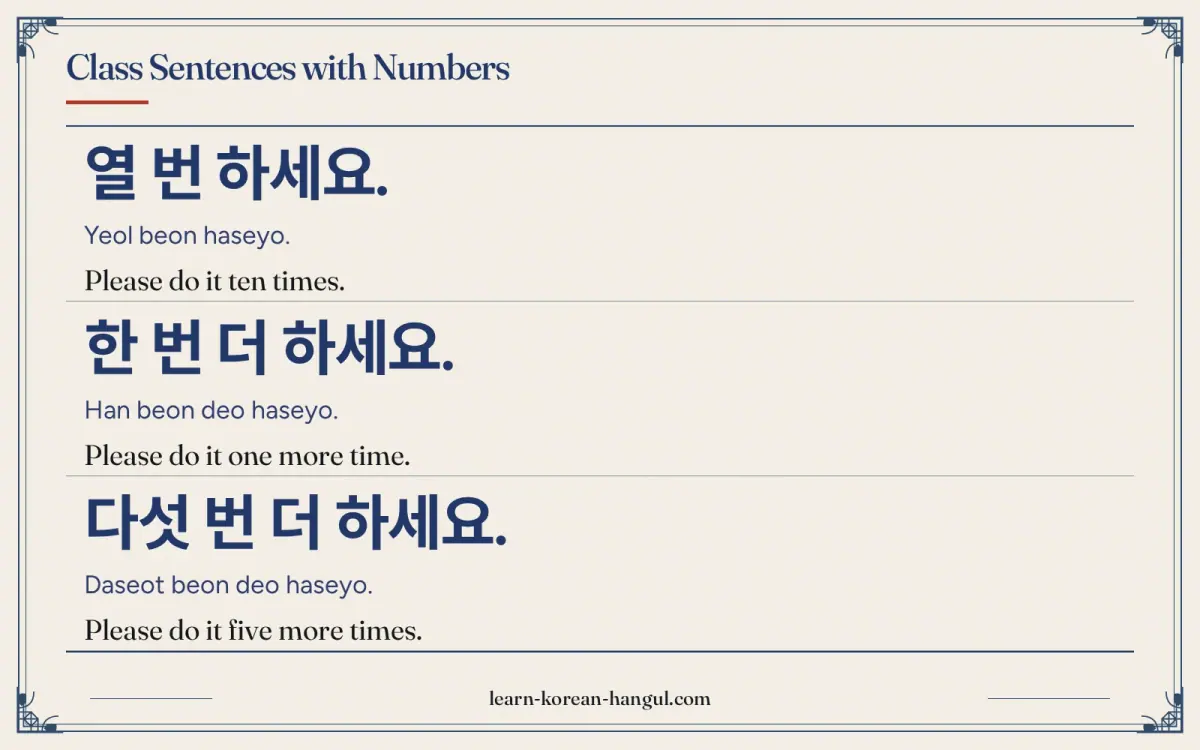
In class, numbers sit inside short sentences, and each sentence follows the rule you have just seen: native numbers for how many, Sino-Korean numbers for which one. Six sentences cover most of what a beginner needs to say or understand.
열 번 하세요.
Yeol beon haseyo.
Please do it ten times.
열 is the native ten and 번 is the counter for times. The ending 하세요 is a polite request, so it fits an instructor speaking to a class.
한 번 더 하세요.
Han beon deo haseyo.
Please do it one more time.
Here 하나 shortens to 한 before the counter 번, and 더 means "more". Students hear this sentence often, so it is worth learning early.
다섯 번 더 하세요.
Daseot beon deo haseyo.
Please do it five more times.
Only the number changes. If you can say this sentence, you can swap in any native number up to ten.
저는 태극 삼 장을 연습해요.
Jeoneun taegeuk sam jangeul yeonseupaeyo.
I practise Taegeuk 3 Jang.
Here the form number is Sino-Korean: 삼 장. 을 marks the form as the object of 연습해요, "practise".
저는 십 급이에요.
Jeoneun sip geubieyo.
I am tenth grade (a beginner).
A new student with a white belt starts at the highest grade number, so 십 급 is the starting point in a school that uses ten grades.
저는 이 단이에요.
Jeoneun i danieyo.
I am second dan.
이 단 is a black-belt degree. 이 is also the word for "this", but the counter 단 after it tells you it is a rank number.
A short call-and-response shows how a drill sounds from start to finish.
- 사범님: 준비! 시작!
- 학생들: 하나, 둘, 셋, 넷, 다섯!
- 사범님: 한 번 더 하세요.
(Instructor: Ready! Begin! Students: One, two, three, four, five! Instructor: One more time, please.)
준비! 시작!
Ready! Begin!
하나, 둘, 셋, 넷, 다섯!
One, two, three, four, five!
한 번 더 하세요.
Please do it one more time.
Asking about Someone's Rank or Form
To ask about a rank, put 몇 ("which number") before the counter: 몇 급이에요? asks "Which grade are you?", and 몇 단이에요? asks "Which degree are you?". The answer is a Sino-Korean number plus the counter, such as 팔 급 or 삼 단.
| Question | Meaning | Sample answer |
|---|---|---|
| 몇 급이에요? | Which grade are you? | 팔 급이에요. |
| 몇 단이에요? | Which dan are you? | 삼 단이에요. |
| 몇 장이에요? | Which form is it? | 사 장이에요. |
Notice that 몇 is the same question word in every row, and that the answer repeats the counter. The polite ending 이에요 attaches directly to the number plus counter. These questions are everyday small talk between training partners, and they are also a simple way to practise the Sino-Korean numbers in context.
Class Words That Go with the Numbers
Counting is always part of a command sequence, and the same few commands appear in almost every class. Learn them with the numbers so that you can follow a whole drill.
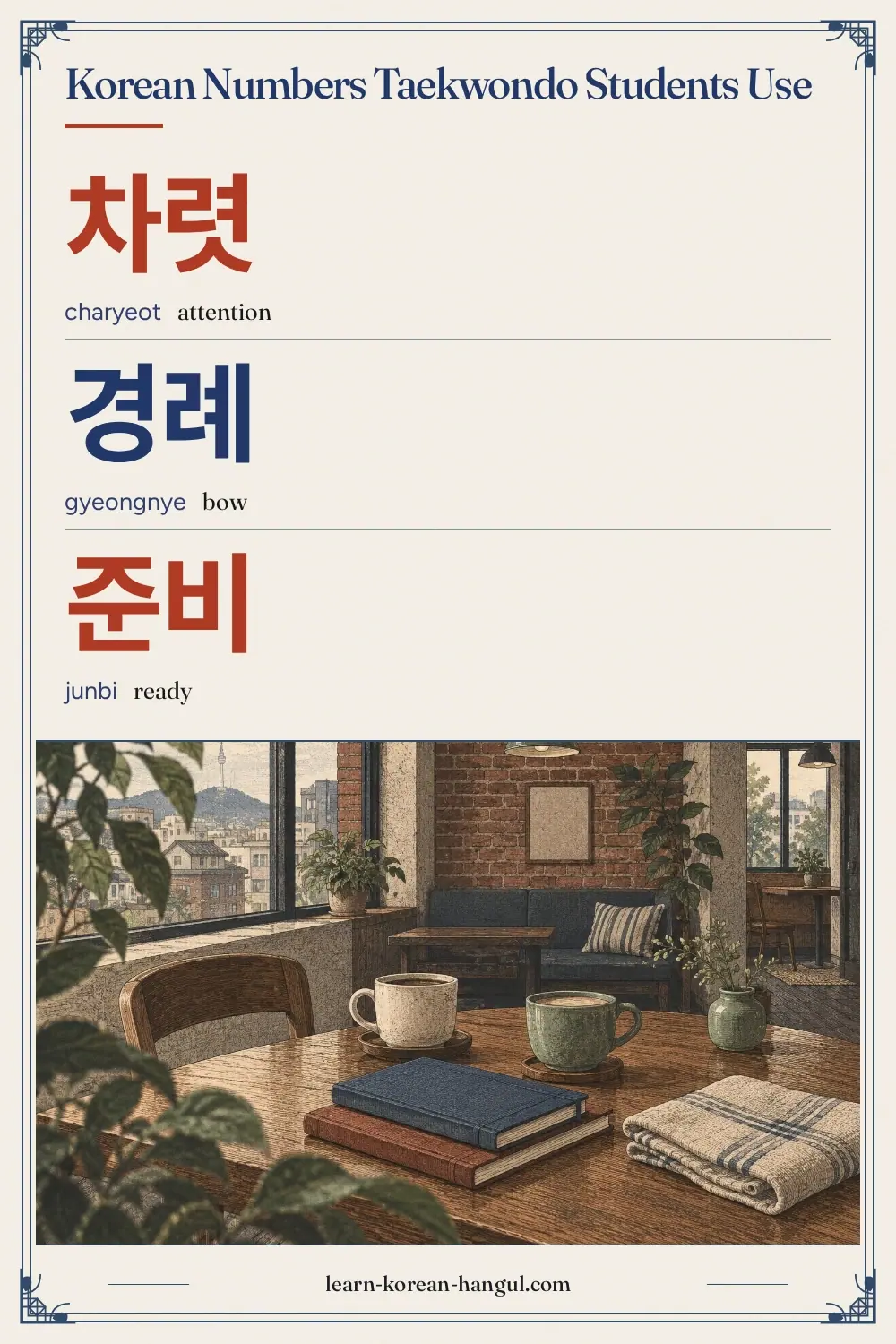
| Korean | Romanization | Meaning |
|---|---|---|
| 차렷 | charyeot | attention |
| 경례 | gyeongnye | bow |
| 준비 | junbi | ready |
| 시작 | sijak | begin |
| 그만 | geuman | stop |
| 바로 | baro | return to ready position |
How Do I Say "Ready" or "Begin" in Korean?
Say 준비 for "ready" and 시작 for "begin". A typical drill call is 준비 followed by 시작, then the count: 하나, 둘, 셋. The word for a command call is 구령 (guryeong), and the person who gives it is usually the instructor.
Other words you will meet are 도장 (dojang, the training hall), 사범님 (sabeomnim, instructor) and 관장님 (gwanjangnim, the head of the school). The ending 님 is an honorific, so both titles are respectful. Next, the part that confuses most students: why the same word looks different on different lists.
Why Do Spellings Differ between Schools?
Spellings differ because dojangs often use older or English-based romanization, not the official Revised Romanization. Revised Romanization, adopted by South Korea in 2000, writes ㅓ as "eo" and ㅡ as "eu". Older systems and English-sounding spellings choose other letters for the same sounds.
| Sound | Revised Romanization | Typical alternatives in school lists |
|---|---|---|
| ㅓ | eo | o, u, uh |
| ㅡ | eu | u |
| ㅅ at the end | s or t | t, s |
| ㅂ, ㄷ, ㄱ at the start | b, d, g | p, t, k |
So 여섯 is yeoseot in Revised Romanization, and a school list may write it as "yuh-sut". The two spellings stand for the same word. Taegeuk may appear as "Taeguk", and taegwondo as "taekwondo", which is the spelling used by the sport's international body and by most clubs. For the full system, read the page on Korean romanization.
When spellings disagree, trust the Hangul. If your school list has no Hangul, ask the instructor to say the word, or compare it with the table above. That solves most confusion about why Korean numbers look different in a school's list.
Do All Taekwondo Schools Count in Korean?
No. Some schools count entirely in Korean, some count in English and some use both, depending on the instructor and the organisation. The numbers on this page are the ones you meet in a school that follows Korean-language class customs, and a school's practice is not a rule of the language.
A grading shows the difference clearly. An examiner who calls a form by its Sino-Korean number, for example 사 장, expects you to recognise the number and step forward, while a warm-up led in English asks for no Korean at all. That is why this page describes what is common, not what is required. Ask your instructor which counts are used in class, which belt rank list the school follows, how many grades it has and how forms are named. If your school counts in English, the Korean numbers still help at gradings, in forms and when you train with Korean-speaking partners.
Common Mistakes with These Numbers
Students tend to mix up the two sets, to mishear the final consonants and to treat a school's habits as the rule. Review this list before a grading.
- Counting with Sino-Korean numbers in a native-count class. If the instructor says 하나, answer with 둘, not 이.
- Using native numbers for forms. The form is 태극 삼 장, never 태극 셋 장.
- Reading 급 in the wrong direction. 일 급 is the last grade before black belt, so it is higher than 십 급.
- Pronouncing 셋 and 넷 with a clear final s. They end in a stopped [ㄷ] sound, so keep the final consonant short.
- Treating one school's spelling as the standard. "yuh-sut" and yeoseot are the same word.
- Forgetting the short form 한. Say 한 번 and not 하나 번.
A good check is to say the count and the rank out loud, once each, then compare your answers with the audio. The quickest fix for items 1 and 2 is to remember the question each set answers: how many, or which one.
Practising before Class
A short routine builds the counts quickly. Spend about ten minutes a day for a week.
- Say 하나 to 열 aloud, once with the audio and once without.
- Add a movement: lift your knee on each count.
- Say the Sino-Korean numbers 일 to 십 once.
- Read the belt and form list from your own school in Hangul.
- Test yourself with the questions below.
Practice · 8
Which number set counts repetitions in a drill?
Show answer
Native Korean (하나, 둘, 셋)
Counting reps answers "how many", so it uses the native set.
How do you say the form Taegeuk 3 Jang (태극 3장)?
Show answer
태극 삼 장
Form numbers are labels, so they take Sino-Korean numbers: 삼 장 (sam jang).
Which counter is used for black-belt degrees?
Show answer
단
Black-belt degrees use 단 (dan); coloured-belt grades use 급 (geup), and 장 numbers the forms.
Which grade is higher: 일 급 or 십 급?
Show answer
일 급
Coloured-belt grades count down toward the black belt, so 일 급 is the last grade before black belt.
How does an instructor say "one more time"?
Show answer
한 번 더 하세요.
Times are counted with native numbers, and 하나 shortens to 한 before the counter 번. 일 번 is the label "number one".
How is 셋 pronounced?
Show answer
[섣]
A final ㅅ is pronounced as ㄷ, so 셋 sounds like [섣].
What is the Korean word for "begin" in a drill call?
Show answer
시작
준비 means "ready", 시작 means "begin", and 그만 means "stop".
A school list writes 여섯 as "yuh-sut". What does that mean?
Show answer
It is the same word in a different romanization
Dojangs often use older or English-based spellings; yeoseot and "yuh-sut" stand for the same word, so trust the Hangul.
Practice questions
- Which number set counts repetitions in class?
- How do you say "number 3" for the form Taegeuk 3 Jang?
- What is 5 in the native set?
- Which counter is used for black-belt degrees?
- How do you say "ten times"?
Answers
- The native set (하나, 둘, 셋).
- 삼 장 (sam jang).
- 다섯 (daseot).
- 단 (dan).
- 열 번 (yeol beon).
What This Page Does Not Cover
This page covers the numbers 1 to 10 in class and the number words in form and rank names. It does not cover every Korean term of the sport, the full Kukkiwon grading syllabus or the names of the advanced forms. Class customs also vary, so confirm them with your instructor. The audio is generated by text-to-speech and is checked by a Korean teacher before publication, so a live instructor may sound shorter and louder than the clips.
The Bottom Line
Korean numbers taekwondo students need are the ten native counting words for drills and the Sino-Korean numbers for forms and ranks. Counting says how many; naming says which one. The two details that matter most are that rank grades count down toward the black belt and that dojang spellings often differ from Revised Romanization. Next, study native Korean numbers 1-10 and Sino-Korean numbers 1-100.
Frequently Asked Questions
Do all taekwondo schools count in Korean?
No. Some schools count entirely in Korean, some in English and some use both, depending on the instructor and the organisation. Ask your instructor which counts your class uses. The Korean numbers on this page still help at gradings, in forms and with Korean-speaking partners.
What is "il jang" in Korean?
Il jang is 일 장, "chapter one", and Taegeuk 1 Jang (태극 1장) is the first Taegeuk form. The number comes from the Sino-Korean set and the counter 장 follows it. The next forms are 이 장, 삼 장 and so on up to 팔 장.
Why do Korean numbers look different in my school's list?
School lists often use older or English-based romanization, not Revised Romanization. The word 여섯 is yeoseot in Revised Romanization but may appear as "yuh-sut". Both stand for the same Hangul word. When a list disagrees with another, trust the Hangul.
Are the Sino and native sets both needed for taekwondo?
Yes, but the native set comes first. Instructors count drills with the native numbers 하나 to 열, and they name forms, belt grades and degrees with the Sino-Korean numbers 일 to 십. Learn the native ten first, then the Sino-Korean ten.
How do I say "ready" or "begin" in Korean?
Say 준비 for "ready" and 시작 for "begin". A drill often runs 준비, 시작, then the count 하나, 둘, 셋. The word for stop is 그만, and 바로 returns the class to the ready position. Learn the count words next, since they follow these commands.