아이씨
아이씨
What you'll learn
- Write and say 아이씨, 아씨, 아이참 and 에이 and tell how strong each one is.
- Pronounce the tense ㅆ in 아이씨 correctly.
- Decide when the expression is safe and when to leave it out.
- Spot the learner mistakes that make adults wince.
Before you start: the lesson on Korean speech levels explains why casual speech is risky with seniors. Time: about 10 minutes. Audio plays only when you press a button.
How Do You Say Aish in Korean?
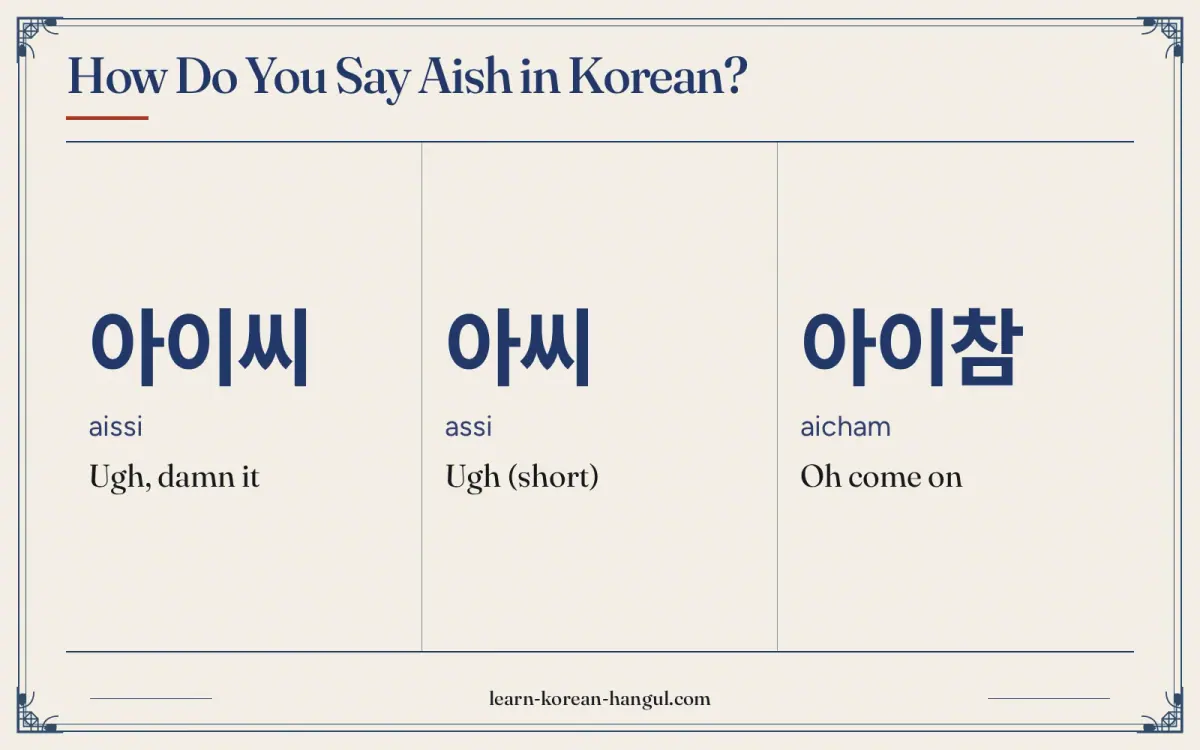
The usual Hangul spelling for aish is 아이씨. An interjection (감탄사) like this has no verb ending, so it never changes with the listener, which is why the choice between forms depends on strength and not on politeness endings.
| Korean | Romanization | Meaning | Strength |
|---|---|---|---|
| 아이씨 | aissi | Ugh, damn it | Mild but impolite to elders |
| 아씨 | assi | Ugh (short) | Same, quicker |
| 아이참 | aicham | Oh come on | Milder, playful |
| 에이 | ei | Come on, aw | Mildest, friendly |
Revised Romanization (the South Korean government standard of 2000) is only a reading aid here. Learn the Hangul first. The next section sorts the four expressions by how safe they are.
What Are the Casual Ways to Say Aish?
All four expressions are casual, and they differ in how sharp they feel. None of them has a formal version, because Korean has no polite way to say "damn it". The choice is about the situation and the audience.
Casual: 아이씨 (aissi)
Casual · 반말아이씨 is the main answer: ugh, damn it. It reacts to a small failure, such as a forgotten phone, and is directed at the situation, not at a person.
아이씨, 휴대폰 두고 왔어.
aissi, hyudaepon dugo wasseo
Ugh, I left my phone behind.
Casual: 아씨 (assi)
Casual · 반말아씨 is the clipped version. It is quicker and reads as more irritated, since the speaker does not bother with the extra syllable.
아씨, 또 늦었네.
assi, tto neujeonne
Ugh, late again.
Casual: 아이참 (aicham)
Casual · 반말아이참 is a milder way to say "oh come on". People use it for light frustration and teasing, and it carries no hint of swearing.
아이참, 그만해.
aicham, geumanhae
Oh come on, stop it.
Casual: 에이 (ei)
Casual · 반말에이 is the friendliest of the four. It means "aw" or "come on", and it also shows playful disbelief.
에이, 설마.
ei, seolma
Aw, no way.
If you only want one expression for general use, 에이 is the safest, because it is the only one that never doubles as a mild swear. The sound of 아이씨 is the next thing to check.
How Do You Pronounce 아이씨?
아이씨 is pronounced [아이씨], a-i-ssi, in three syllables. Say each one separately: a short "ah", a clear "ee", then a tense "ssi".
- 아 (a): an open "ah", not stressed.
- 이 (i): a clear "ee". The vowels are two separate syllables, not a glide.
- 씨 (ssi): a hissing s with firm tongue and throat, and no puff of air.
Sound Changes to Listen For
아이씨 has no hidden sound change, so the spelling and the sound match. The one feature to listen for is the tense consonant ㅆ.
- Written tense ㅆ. The tense sound is part of the spelling, as in 씨. It is different from 시, which is softer and breathier.
- Rule-made tensing. Some words become tense only through a rule, such as 학교 [학꾜]. In 아이씨 nothing needs to be applied. The difference is explained in Korean tensification.
- Short form. 아씨 has the same ㅆ, so it sounds like [아씨] with a short first vowel.
- Where "aish" comes from. Before ㅣ, ㅆ sounds close to a tense "sh", and in fast, irritated speech the final vowel is often clipped. That is why English speakers hear "aish".
If you say 아이시 (with a plain ㅅ), the word loses its edge and sounds like a different, softer syllable. The right pronunciation also depends on knowing when to use the word.
When Should You Use 아이씨, and When Should You Not?
Use 아이씨 with close friends when you are frustrated at a situation. Avoid it everywhere else, because the word is a softened version of a stronger swear and many Koreans find it rude.
Situations Where It Fits
- You drop or spill something with friends nearby. 아이씨, 커피 쏟았어.
- You realize you forgot something. 아이씨, 지갑 두고 왔네.
- A friend teases you. 아이참, 그만해 (the milder form works better here).
Situations to Avoid
- Elders, teachers and bosses. Even a quiet 아이씨 can sound disrespectful. Choose 어머 (oh my) or 어떡하죠 (what should we do).
- Customers and strangers. Keep the reaction silent or use 아이고 (oh dear), which is mild and common.
- Aimed at a person. Directing 아이씨 at someone reads as an insult.
- Written messages to adults. Typed text lasts longer than speech, so leave it out.
The dialogues below show how friends use the family of expressions.
What Does Aish Sound Like in a Real Conversation?
Friends use 아이씨 for small accidents and 에이 or 아이참 for teasing. Listen for the short, sharp 아이씨 and the lighter 에이.
Spilled Coffee
Ha-Rin
아이씨, 커피 쏟았어.
aissi, keopi ssodasseo
Ugh, I spilled my coffee.
Jun
괜찮아? 휴지 줄게.
gwaenchana? hyuji julge
Are you okay? I'll give you a tissue.
What to notice: 아이씨 reacts to the accident, and the friend answers with care, not with the same word.
Playful Disbelief
Seo-Yeon
나 오늘 일등 했어.
na oneul ildeung haesseo
I came first today.
Tae-Hyun
에이, 설마.
ei, seolma
Aw, no way.
What to notice: 에이 is light and friendly, and it shows disbelief without any annoyance.
Teasing a Friend
Yu-Na
아이참, 왜 자꾸 놀려?
aicham, wae jakku nollyeo
Oh come on, why do you keep teasing me?
Min-Ho
미안, 재미있어서.
mian, jaemiisseoseo
Sorry, it's just funny.
What to notice: 아이참 expresses light annoyance and invites a joking reply. That mix of tones leads to the culture behind the word.
What Should You Know about the Culture behind Aish?
아이씨 sits in a grey area of Korean speech: very common among young people and in dramas, yet widely understood as a softened swear.
- Euphemism. 아이씨 stops short of the stronger word, much as "shoot" stands in for a swear word in English. The listener often still hears the original, which is why elders react.
- Drama versus life. In dramas, characters say 아이씨 to show a rough or irritated personality. In real life, the same line has real social weight.
- Friendly alternatives. 에이 and 아이참 are common in drama scenes with playful teasing, and they come across as warmer.
- Context matters. Among close friends, 아이씨 usually carries no offence. Families, offices and classrooms are the places to keep it out.
An expert insight: because the interjection never changes form, learners cannot make it polite by adding -요. The only way to be polite is to pick a different expression. The mistakes below follow from that.
What Mistakes Do Learners Make with Aish in Korean?
Most aish mistakes come from copying drama language into real situations.
| Mistake | Why it is a problem | Fix |
|---|---|---|
| Using 아이씨 with a teacher or boss | Sounds like swearing near a senior | Use 어머 or stay silent |
| Spelling it "aiish" or typing 아이시 | Loses the tense ㅆ | Write 아이씨 |
| Adding -요 to make it polite (아이씨요) | Interjections do not take -요 this way | Choose another expression |
| Aiming it at a person | Reads as an insult | Aim it at the situation |
| Saying [아이시] with plain ㅅ | Soft and wrong | Use a tense ssi |
Learners often assume 아이씨 is as harmless as English "darn". Actually, the strength depends on the listener, so the same word may be funny with friends and offensive with a grandfather.
Is It the Same as Aish Meaning?
Yes. "Aish", "aish meaning", "aish korean" and "what does aish mean in Korean" all point to 아이씨 and its relatives. The short answers below cover each search.
- Aish meaning: a mild expression of annoyance, like "ugh" or "damn it".
- Aish Korean spelling: 아이씨, romanized aissi.
- What does aish mean in Korean: it reacts to a small problem. It is not a word for a person or an object.
- Milder choices: 아이참 and 에이. For other reactions, see aigoo in Korean and omg in Korean.
Now practise with your own voice.
Practice: Say It Aloud
Play the slow clip and repeat 아이씨 three times with a firm, tense ssi. Then pick the best reaction for each scene. Answers follow.
- You drop your keys while walking with a close friend.
- A friend says they got the top score, and you doubt it playfully.
- Your grandmother watches you spill tea.
- Write the standard romanization of 아이씨.
Answers
- 아이씨 (or the milder 아이참).
- 에이, 설마.
- 어머, or say nothing and apologize: 죄송해요.
- aissi.
The phrase flashcards drill these reactions with audio.
Related Phrases to Learn Next
Aish belongs to a small family of reaction words.
- Aigoo in Korean: the milder, all-ages exclamation.
- OMG in Korean: how Koreans express surprise.
This guide belongs to the kdrama Korean phrases collection. What this page does not cover: stronger swear words, regional slang and written chat abbreviations. Match the expression to the listener, and you can say aish in Korean without causing offence.
Frequently Asked Questions
How do you say aish in Korean?
Write it 아이씨, romanized aissi. It is an interjection of mild annoyance, like "ugh" or "damn it". Friends use it when something goes wrong, such as spilling a drink. Milder choices are 아이참 and 에이. Because the word is a softened swear, keep it away from elders, bosses and customers.
How do you pronounce 아이씨?
Say a-i-ssi, in three syllables, with a short 아, a clear 이 and a tense ㅆ in the last syllable. The tense ㅆ is a hissing s with the tongue held firm and no puff of air. There is no hidden sound change, so the spelling and the sound match. Play the slow clip to hear the rhythm.
What is the difference between 아이씨 and 아씨?
Both express annoyance, and 아씨 is simply the clipped, quicker version. 아이씨 has the extra 이 and sounds a little drawn out, as in a sigh. The register is equally casual, so the same warnings apply. Neither belongs in polite conversation with people you want to respect.
Can I use 아이씨 with friends, elders and strangers?
Use it only with close friends, and even then only when frustrated at a situation rather than at a person. With elders, bosses and strangers it can sound rude or even offensive. If you need to react politely, say 어머 (oh my) or 어떡해요 (what should I do), which carry no hint of swearing.
What is the most common mistake with aish in Korean?
Learners copy the word from K-dramas and use it everywhere, including with adults. Others type it as 아이시, which loses the tense ㅆ. The usual spelling is 아이씨. A gentler habit is to use 에이 or 아이참 until you know how the listener reacts.