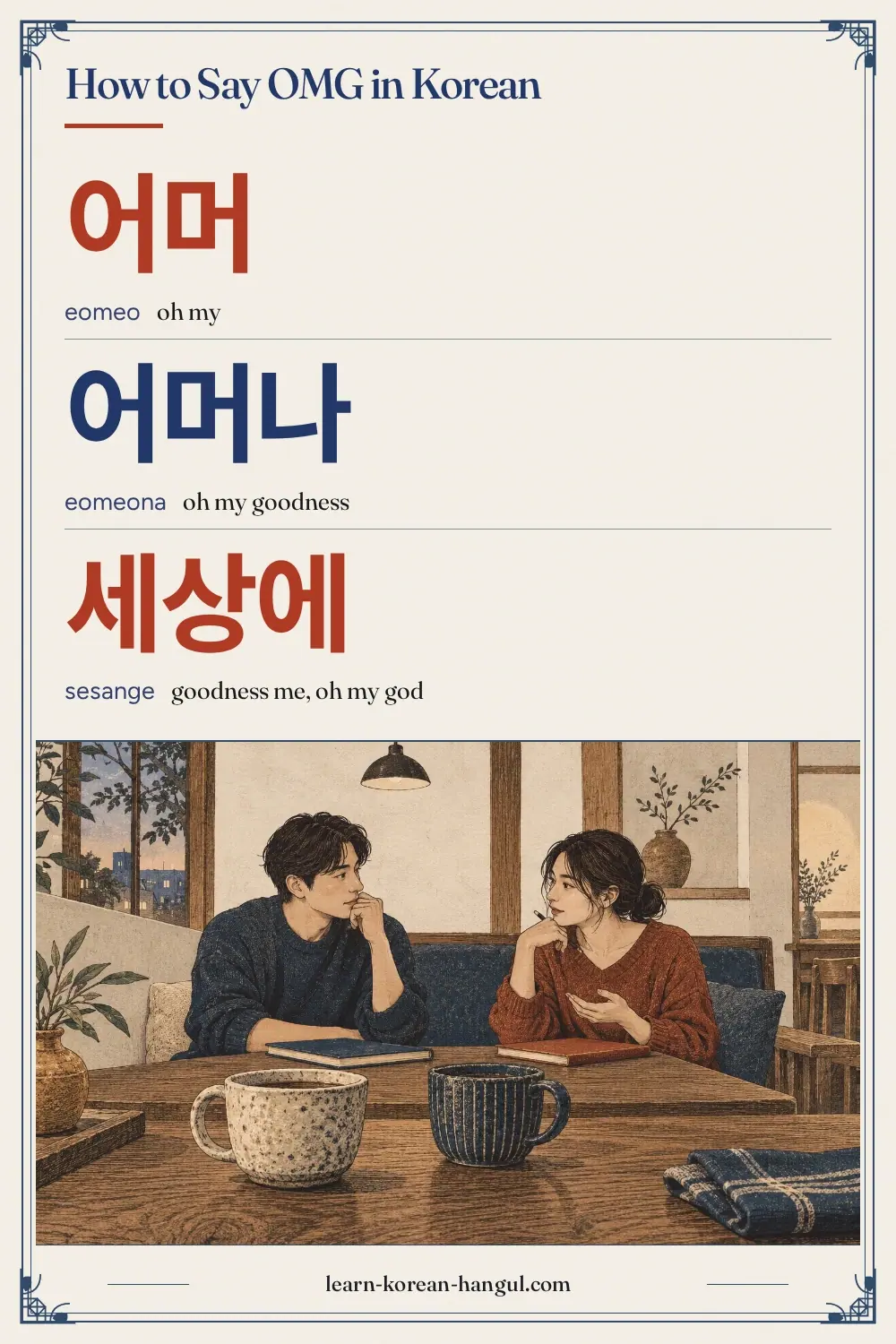
어머
어머
What you'll learn
- Say 어머, 어머나, 세상에, 맙소사 and 헐, and know how strong each one is.
- Choose a word for friends, family, elders and strangers.
- Pronounce 맙소사 as [맙쏘사] and keep the vowel in 어머 unrounded.
- Avoid the borrowed 오마이갓 and the "omo" spelling.
Before you start: you should read Hangul. The pages on wow in Korean and aigoo in Korean make a good warm-up. Time: about 11 minutes. Audio plays only when you press a button.
Key facts
- 어머 (eomeo) is the everyday "OMG" or "oh my".
- 어머나 (eomeona) is softer, and 세상에 (sesange) is stronger.
- 맙소사 (mapsosa) means "good grief" and sounds like [맙쏘사].
- 헐 (heol) is slang for young friends.
- 오마이갓 is a borrowing and sounds jokey.
How Do You Say Omg in Korean?
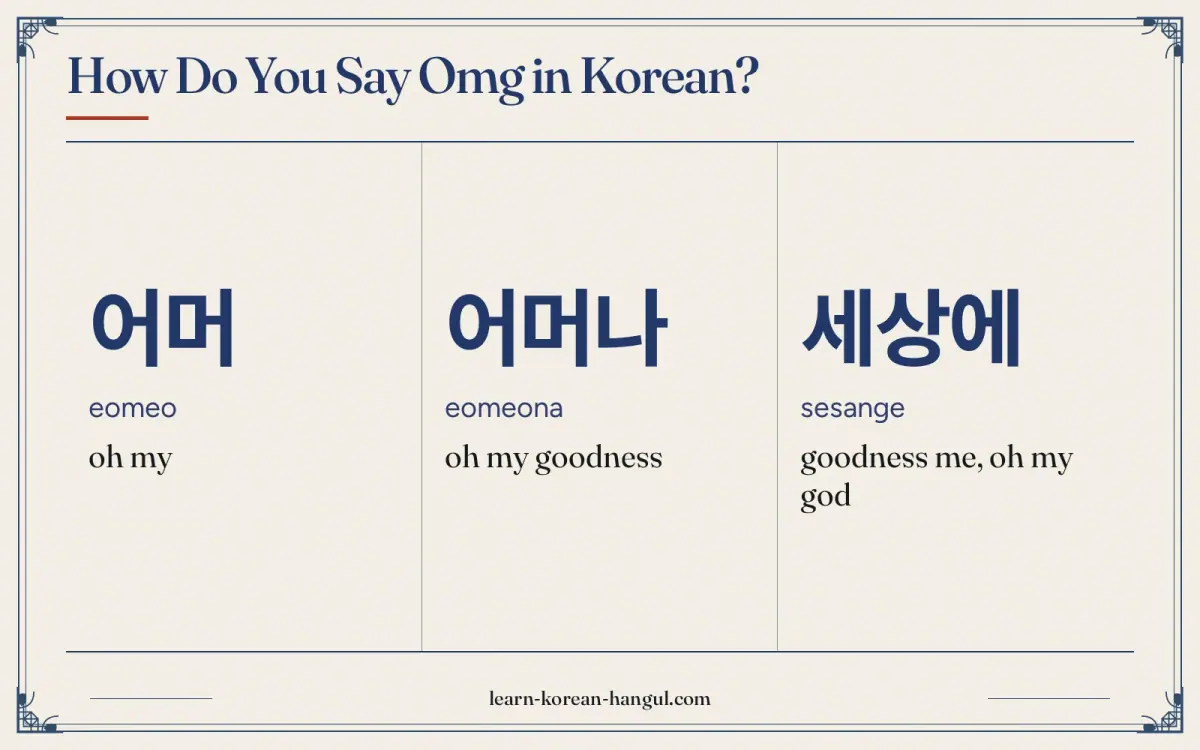
Say 어머 when something surprises you in a small or pleasant way: a gift, a shock, a funny photo. It is a pure reaction, so it needs no verb and no ending. Fans of Korean dramas write it "omo" or "eomo", but the standard romanization is eomeo.
| Korean | Romanization | Meaning | Feel |
|---|---|---|---|
| 어머 | eomeo | oh my | mild surprise, casual |
| 어머나 | eomeona | oh my goodness | softer, a bit longer |
| 세상에 | sesange | goodness me, oh my god | strong shock |
| 맙소사 | mapsosa | good grief | dramatic, a bit old-fashioned |
| 헐 | heol | omg, what | slang, disbelief |
| 오마이갓 | omaigat | oh my God (borrowed) | jokey |
All of these are interjections: words of feeling that stand alone. They have no politeness ending, so you pick the word by mood and by who is listening, not by grammar.
The word 세상에 looks like a normal phrase: 세상 (sesang) is "the world" and 에 is the particle "in", so it literally says "in the world!". You use it where English says "goodness me" or "oh my God", and it does not mention any god.
What Are the Casual Ways to Say Omg?
All of the words below are casual reactions. The guide to Korean speech levels explains why: an interjection has no verb, so the politeness comes from the next sentence.
Casual: 어머 (eomeo)
Casual · 반말어머 is the all-round choice. Say it with a quick breath in, and add a question after it if you want to know more.
어머, 이게 뭐야?
eomeo, ige mwoya
Oh my, what is this?
Casual: 어머나 (eomeona)
Casual · 반말어머나 is a little longer and softer. It often shows happy surprise, such as a lovely view or a sweet surprise.
Casual: 세상에 (sesange)
Casual · 반말세상에 is for stronger shock, either good or bad. It is the best match for "oh my God" and is safe in many settings.
세상에, 정말요?
sesange, jeongmaryo
Oh my goodness, really?
Casual: 맙소사 (mapsosa)
Casual · 반말맙소사 means "good grief" or "for heaven's sake". It sounds dramatic and slightly old-fashioned, and you hear it in dramas and from older speakers.
Casual Slang: 헐 (heol)
Casual · 반말헐 is slang for disbelief, close to "what?!" or "no way". Young friends use it all the time, and the page on heol in Korean covers it in depth.
헐, 진짜?
heol, jinjja
No way, really?
The sounds are easy, with one tense consonant to notice.
How Do You Pronounce 어머?
어머 has two syllables: eo-meo. Both vowels are ㅓ. This vowel is unrounded, so spread your lips a little, open your mouth and say a sound close to the "u" in "cut". English "omo" is wrong because there is no "o" sound here.
Sound Changes to Listen For
- 어머 has no sound change. Each syllable is pronounced as it is written.
- 맙소사 is [맙쏘사]. After a final ㅂ, the ㅅ becomes tense (Standard Pronunciation Article 23). Revised Romanization does not mark tensing caused by a neighbouring sound, so it writes mapsosa.
- 헐 ends with a clear ㄹ. At the end of a syllable ㄹ is a held "l", not a flap: keep the tongue tip on the ridge behind the upper teeth.
- 세상에 has no change. It sounds like se-sang-e, three syllables.
The syllable counts are easy to remember: 어머 has two, and 어머나, 세상에 and 맙소사 each have three. The page on Korean tensification explains the tense ㅅ in more detail. Next comes the question of when each word fits.
When Should You Use 어머, and When Should You Not?
Use the mildest word that matches your feeling. 어머 for small surprises, 세상에 for big ones and 헐 only with friends your age.
Situations Where It Fits
- A surprise gift or party. 어머, 어머나.
- Shocking news. 세상에, 정말요?
- A funny or unbelievable story among friends. 헐, 진짜?
- A dramatic moment in a drama. 맙소사.
Situations to Avoid
- Slang with elders. Do not use 헐 with older people or in a business setting.
- A serious loss. The light 어머나 can sound too playful. Use 세상에 and a sympathetic sentence.
- Written formal text. Interjections are spoken forms. Write the full sentence.
- Every moment. Too many reactions sound tiring.
If you are unsure, 세상에 followed by a polite question like 정말요? works with almost anyone.
How Can You Build a Longer Reaction?
A single word is fine, but Koreans often add one short phrase to say what caused the surprise. The pattern is simple: reaction word, then a comment.
- Add praise: 어머, 너무 예뻐요! (eomeo, neomu yeppeoyo, "Oh my, it is so pretty!").
- Add a start: 어머, 깜짝이야! (eomeo, kkamjjagiya, "Oh, you startled me!").
- Add a question: 세상에, 무슨 일이에요? (sesange, museun irieyo, "Goodness, what happened?").
- Add worry: 세상에, 어떡해! The page on ottoke in Korean explains this pairing.
Notice that the comment carries the polite ending 요 when the listener is older. The reaction word stays short and the comment brings the politeness, which is why a learner can use 어머 safely if the next sentence is polite.
What Does Omg Sound Like in a Real Conversation?
The reaction is usually short and sharp, followed by a question. Listen to the rising breath in the first dialogue and the slower, shocked tone in the second.
A Surprise Party
Friends
서프라이즈!
seopeuraijeu
Surprise!
Yuna
어머! 이게 다 뭐야?
eomeo! ige da mwoya
Oh my! What is all this?
Friends
생일 축하해!
saengil chukahae
Happy birthday!
What to notice: 이게 다 뭐야 is a question with the question word 뭐, so it does not climb sharply at the end. 축하해 is the verb 축하하다 (chukahada), and its Revised Romanization shows the aspirated sound as chukahae.
Shocking News
Minji
수진이가 결혼한대.
sujiniga gyeolhonhandae
I heard Sujin is getting married.
Haneul
세상에, 정말?
sesange, jeongmal
Oh my goodness, really?
What to notice: -ㄴ대 reports something you heard. The reply 정말? is a yes/no question and rises at the end.
Seeing a Celebrity
Doyun
나 어제 버스에서 연예인 봤어.
na eoje beoseueseo yeonyein bwasseo
I saw a celebrity on the bus yesterday.
Jihun
헐, 진짜?
heol, jinjja
No way, really?
What to notice: 헐 and 진짜 appear together, a very common pair among young friends. The page on really in Korean covers 진짜 and its polite form.
What Should You Know about the Culture behind Omg?
Korean reactions are mostly built from everyday words, not from religion. That is why you will not hear a standard "oh my God" in Korean, even though the English phrase is common among young people online.
- 어머 is often a woman's word. Women use it more, and men more often say 어, 헐 or 아이고. This is a tendency, not a rule.
- 세상에 is the neutral strong word. It is common across ages.
- 오마이갓 is a borrowing. It appears in jokes and in pop songs, but it is not a normal way to react.
- Age matters. 맙소사 is more dramatic and leans older, and 헐 leans young.
- Sound effects count. Many speakers add a gasp or a hand over the mouth, which shows the surprise even in a short word.
An expert insight: the same word can mean joy or shock. Listen to the voice that follows. A rising, bright tone suggests delight, and a low, slow tone suggests worry.
What Mistakes Do Learners Make with Omg in Korean?
Most mistakes come from copying English habits.
| Mistake | Why it is a problem | Fix |
|---|---|---|
| Saying 오마이갓 in daily speech | It sounds borrowed and jokey | Say 어머 or 세상에 |
| Writing and saying "omo" | The vowel is not "o" | Say eo-meo with an unrounded ㅓ |
| 헐 with an elder | It is slang | Use 세상에, 정말요? |
| Confusing 어머 with 어머니 | 어머니 means "mother" | 어머 is a separate reaction word |
| Reading 맙소사 as [맙소사] | The ㅅ is tense in speech | Say [맙쏘사] |
The confusion with 어머니 is easy to fix. 어머니 is a longer word that means "mother" and has three syllables, and 어머 is only a reaction. They look alike in writing, but they are used in different situations.
Is It the Same as Oh My God?
It is close in feeling, but Korean words differ in strength and listener. The related searches map as follows.
- Oh my god in Korean: 세상에, or among friends 헐.
- Oh my gosh in Korean: 어머 or 어머나, which are milder.
- Omo in Korean: a common English spelling of 어머.
- Eomo in Korean: another English spelling of 어머; the standard romanization is eomeo.
- Oh my in Korean: 어머 is the nearest match.
- OMG Korean: 어머, 세상에, 헐 or the borrowed 오마이갓, depending on mood.
Related Phrases to Learn Next
Reaction words come in sets, so learn the neighbours too:
- Wow in Korean: 와, for wonder.
- Aigoo in Korean: 아이고, for sighs and sympathy.
- Heol in Korean: 헐, a closer look at the slang.
- Really in Korean: 정말요, for checking news.
This guide belongs to the K-drama phrases collection. What this page does not cover: strong swear words and religious language, which are not taught here, and the grammar of reported speech (-ㄴ대), which has its own lesson. Match the word to the moment, and you can say omg in Korean like a natural.
Practice: Say It Aloud
Play the slow clip of 어머 and repeat it three times, then 세상에 and 맙소사.
Then pick a reaction. Answers follow.
- A friend gives you a surprise gift.
- A teacher tells you a classmate won a national prize.
- Your young friend says they saw a celebrity.
- A character in a drama learns a terrible secret.
Answers
- 어머! or 어머나!
- 세상에, 정말요?
- 헐, 진짜?
- 맙소사.
The phrase flashcards drill these reactions with audio.
Frequently Asked Questions
How do you say omg in Korean?
The closest everyday word is 어머 (eomeo), a short reaction of surprise. For stronger shock say 세상에 (sesange), and among young friends say 헐 (heol). Korean has no common religious exclamation like "oh my God", so these words do the same job without any reference to God.
How do you pronounce 어머?
Say eo-meo, two syllables, with the same unrounded ㅓ in both. Spread your lips a little and open the mouth like the "u" in "cut". The English spelling "omo" is not accurate, because the vowel is not "o". Revised Romanization writes eomeo, and the pronunciation has no sound change.
What is the difference between 어머 and 어머나?
어머 is the short, quick reaction. 어머나 adds 나 and sounds longer, softer and a little more surprised or delighted, like "oh my goodness". Both are casual interjections. Neither has a polite ending, so politeness comes from the sentence that follows, for example 어머, 정말요?
Can I use 어머 with friends, elders and strangers?
Yes with friends and family. With elders and strangers 어머 is acceptable as a quick reaction, especially for women, but follow it with a polite sentence ending in 요. Avoid 헐 with anyone older, because it is slang. If you are unsure, use 세상에 followed by 정말요?
What is the most common mistake with omg in Korean?
Learners say 오마이갓, which sounds borrowed and often jokey. Native speakers say 어머, 세상에 or 헐 instead. A second mistake is spelling the word as "omo" and saying it with an "o" sound. The vowel is the unrounded ㅓ, so say eo-meo.