아이고
아이고
What you'll learn
- Say 아이고 aloud in three syllables, and change its meaning with tone.
- Use 아이고 for pain, tiredness, surprise and sympathy, and 아이고 + body part + 야 for aches.
- Add the right polite sentence after it, as in 아이고, 죄송합니다.
- Avoid the sigh that sounds like a complaint about the listener.
Before you start: you need to read Hangul; romanization is shown as an aid and can be hidden. Time: about 9 minutes. Audio plays only when you press a button.
What Does Aigoo Mean in Korean?
Aigoo means "oh dear" in Korean in its widest sense: one sound for many feelings. 아이고 is a 감탄사, an interjection, so it has no grammar of its own; the tone and the situation fill in the meaning.
| Feeling | How it sounds | English feel |
|---|---|---|
| Pain | Short and sharp | Ouch |
| Tiredness | Long, falling sigh | Phew, oh my |
| Surprise | Quick, high start | Oh my, whoa |
| Sympathy | Soft, falling | Oh no, poor thing |
| Frustration | Heavy sigh | Ugh, good grief |
| Delight | Soft, rising, warm | Aww |
Because one sound covers all of these, Korean speakers often add a word that names the feeling. The next section shows the most useful combinations.
Which Forms of Aigoo Should You Know?
아이고 does not change for speech level, because interjections have no ending. What changes is the sentence after it, which follows the Korean speech levels.
Casual: 아이고 (aigo)
Casual · 반말아이고 on its own reacts to whatever just happened. Elders use it constantly, and you will hear it in markets, on buses and in every family drama.
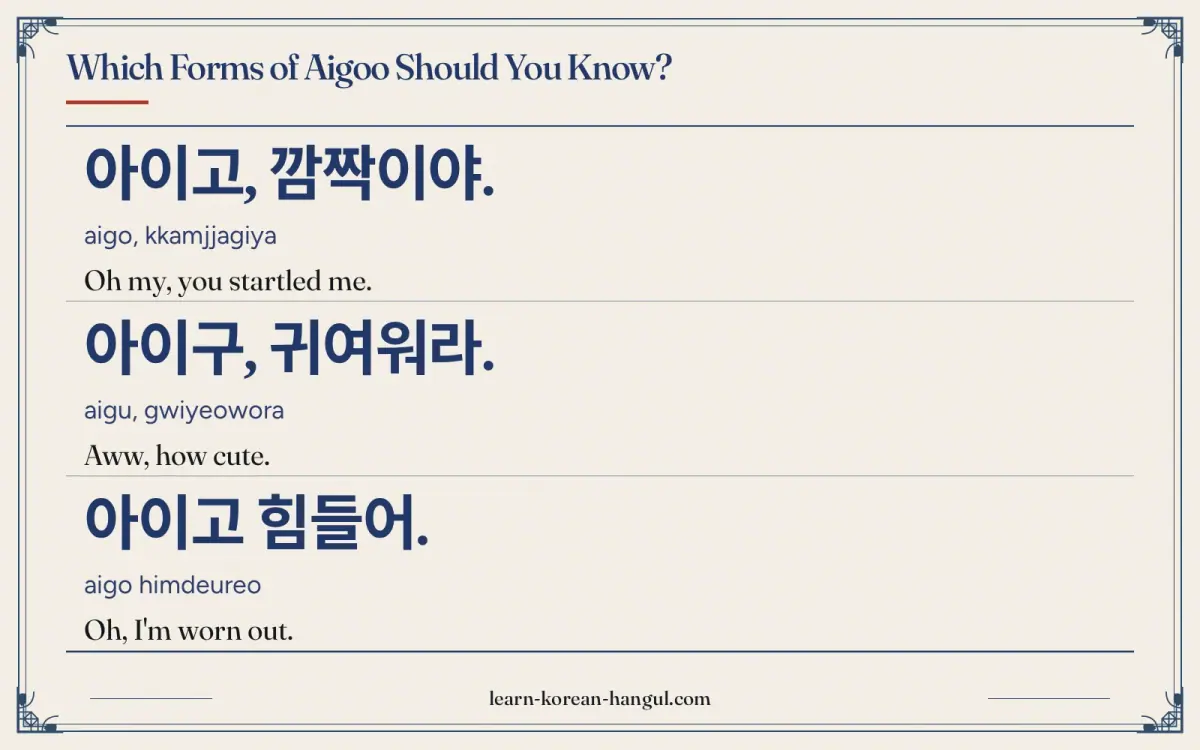
아이고, 깜짝이야.
aigo, kkamjjagiya
Oh my, you startled me.
Casual: 아이구 (aigu)
Casual · 반말아이구 is a common spoken variant with an "oo" at the end, which is where the spelling aigoo comes from. It often sounds softer and is popular for delight, for example when seeing a baby or a puppy.
아이구, 귀여워라.
aigu, gwiyeowora
Aww, how cute.
Casual: 아이고 힘들어 (aigo himdeureo)
Casual · 반말아이고 힘들어 means "oh, this is hard" or "I'm worn out". It is a complaint to yourself or to friends after a long day, a climb or heavy lifting. The page on I'm tired in Korean covers related phrases.
아이고 힘들어.
aigo himdeureo
Oh, I'm worn out.
Formal: 아이고, 죄송합니다 (aigo, joesonghamnida)
Formal · 합쇼체When 아이고 comes before a formal sentence, the whole utterance becomes polite. 아이고, 죄송합니다 is what people say after bumping into someone or spilling something, and the 아이고 shows the mistake was sudden. The apology itself is explained in sorry in Korean.
아이고, 죄송합니다. 제가 못 봤어요.
aigo, joesonghamnida. jega mot bwasseoyo
Oh dear, I'm so sorry. I didn't see you.
The forms are set. Getting the tone right is the next step.
How Do You Pronounce 아이고?
아이고 is pronounced [아이고], a-i-go, in three syllables. Each vowel is clear, and the first ㅇ is silent, so the word starts straight on "ah".
- 아 (a): an open "ah".
- 이 (i): "ee", gliding quickly from the a.
- 고 (go): a soft g and a rounded "oh".
Sound Changes to Listen For
아이고 has no spelling-based sound change. Its pronunciation lives in rhythm and pitch:
- Stretching. For tiredness or pity, speakers stretch the last syllable: 아이고오.
- Shortening. In quick speech, 아이고 shortens to 에구 or 아구.
- Body part + 야. Aches take the pattern 아이고 + body part + 야: 아이고 허리야 (oh, my back), 아이고 다리야 (oh, my legs).
Revised Romanization, the official system for writing Korean in Latin letters, gives aigo. Fan spellings such as aigoo and aigu reflect the variant 아이구. Knowing when to say it matters more than the spelling, as the next section shows.
When Should You Say 아이고, and When Should You Not?
Say 아이고 whenever something surprises, hurts or tires you, and when you sympathise with someone. Avoid aiming a heavy sigh at a senior, and never let 아이고 replace an apology or a thank-you.
Situations Where It Fits
- Standing up after sitting on the floor. 아이고 is almost automatic.
- Hearing bad news from a friend. 아이고, 어떡해 (Oh no, what will you do?).
- Seeing a cute baby. 아이구, 귀여워라.
Situations to Avoid
- When your boss hands you extra work. A loud 아이고 sounds like a complaint about the boss.
- As the whole apology. After bumping into someone, add 죄송합니다.
- Formal writing. Use 아이고, not 아이구, if you quote it at all.
These choices are easier to feel in real exchanges, so here are three.
What Does Aigoo Sound Like in a Real Conversation?
아이고 usually opens a reaction, and the next words explain it. Listen to how the tone changes the meaning.
Bumping into Someone on a Crowded Street
You
아이고, 죄송합니다.
aigo, joesonghamnida
Oh dear, I'm so sorry.
Passer-By
괜찮아요.
gwaenchanayo
It's fine.
What to notice: 아이고 shows surprise, and 죄송합니다 does the apologising.
A Grandmother Stands Up
Grandmother
아이고, 허리야.
aigo, heoriya
Oh, my back.
Grandson
할머니, 괜찮으세요?
halmeoni, gwaenchaneuseyo?
Grandma, are you all right?
What to notice: the ache pattern 아이고 + 허리 + 야, and the grandson's polite reply.
A Friend Failed a Test
Sua
시험 망쳤어.
siheom mangchyeosseo
I messed up the test.
Minsu
아이고, 어떡해.
aigo, eotteokae
Oh no, what now.
What to notice: a soft, falling 아이고 shows sympathy. That sympathetic use has deep cultural roots.
What Should You Know about the Culture behind Aigoo?
아이고 is one of the most recognisable sounds of Korean speech, tied to family life, hard work and shared feeling.
- The grandparent sound. Dramas often give 아이고 to grandmothers and market vendors, so it carries a warm, homely image.
- Mourning. At traditional funerals, a long, rhythmic 아이고 was part of the ritual wailing (곡) for the dead.
- Shared feeling. Saying 아이고 when someone shares bad news shows you feel it with them.
- Online. In chats, younger people often replace it with ㅠㅠ or the short 에구.
An expert insight: learners often treat 아이고 as a cute K-drama catchphrase to say at any moment. Actually, it is a real, functional reaction with a wide emotional range, and its tone can sound comic, tired, pained or grieving. Listen to how native speakers pitch it before you copy it. The common mistakes below come from ignoring tone and context.
What Mistakes Do Learners Make with Aigoo in Korean?
Most aigoo mistakes come from context, from tone, or from treating it as a full sentence.
| Mistake | Why it is a problem | Fix |
|---|---|---|
| 아이고 alone after bumping into someone | Not an apology | Say 아이고, 죄송합니다 |
| Sighing 아이고 at a boss's request | Sounds like a complaint | Say 네, 알겠습니다 |
| Using a cheerful tone for bad news | Sounds mocking | Use a soft, falling tone |
| Thinking it is a swear word | It is a neutral interjection | Use it freely in daily life |
| Writing 아이구 in formal text | 아이고 is the main dictionary form | Write 아이고 |
Learners often assume 아이고 is only for older people. Actually, Koreans of all ages say it, especially when they stand up, stretch or hear bad news; young speakers just use it with more humour.
Other Ways People Search for Aigoo in Korean
People search for aigoo in Korean in many spellings. The short answers below cover each one.
- Aigo / aigu / aegoo in Korean: all the same sound, 아이고 or 아이구; aigo is the Revised Romanization. Romanization is an aid, not the real spelling.
- Aigoo meaning / what does aigoo mean in Korean: oh dear, ouch, oh my, phew, depending on tone.
- Aigoo korean drama: the sigh or cry characters use for pain, tiredness and sympathy.
- Oh my god in Korean: a stronger shock word, covered in OMG in Korean.
Reading the uses is one thing; producing the right tone is another, so practise now.
Practice: Say It Aloud
Play the slow clip of 아이고, repeat it three times, then try 아이고 허리야 with a tired sigh. Then choose a reaction for each situation. Answers follow.
- You stub your toe on a table.
- A friend tells you their phone was stolen.
- You spill water near an older stranger's bag.
Answers
- 아이고, short and sharp, or 아이고 발이야 (oh, my foot).
- 아이고, 어떡해, soft and falling.
- 아이고, 죄송합니다.
Drill 아이고 and related reactions with the phrase flashcards, which include audio.
Related Phrases to Learn Next
아이고 belongs to the reactions you hear constantly in K-dramas.
- OMG in Korean: 헐 and 대박, for shock; learn it next.
- Wow in Korean: 와 and 우와, for amazement.
- Sorry in Korean: 죄송합니다, which often follows 아이고.
This guide belongs to the K-drama Korean phrases collection. What this page does not cover: every regional variant of the sound and the full history of funeral rites. Let the tone do the work, add a polite sentence when it matters, and you will use aigoo in Korean naturally.
Frequently Asked Questions
How do you write aigoo in Hangul?
Aigoo is written 아이고 in Hangul, three blocks: 아, 이 and 고. The first two blocks begin with the silent ㅇ, so the word starts with a vowel sound. The variant 아이구 changes only the last block to 구. Fans write aigoo, aigu or aegoo, but they all point to these Hangul spellings.
Is 아이고 rude?
No. 아이고 is a neutral, everyday interjection that elders use constantly, so it is fine in front of anyone. It becomes rude only through context, such as sighing 아이고 loudly when a boss gives you work or when an elder speaks, because it then sounds like you are complaining about them.
What is the difference between 아이고 and 어머?
Both are exclamations of surprise. 아이고 covers a wide range, from pain and tiredness to sympathy, and it is used by everyone. 어머 (eomeo) expresses sudden surprise or delight and is used mostly by women. For a stubbed toe, say 아이고; for surprising news, many women say 어머.
Do young Koreans say 아이고?
Yes, but less often than older people, and sometimes with a playful edge, as if imitating a grandparent. Young people also use the shorter 에구 or 아이구 in speech and texts, and add 아이고 to complaints such as 아이고 피곤해 (oh, I'm so tired). In chats, ㅠㅠ often does the same job.
What is the most common mistake with aigoo in Korean?
The most common mistake is treating 아이고 as a full sentence in polite situations. When you bump into a stranger, 아이고 alone is not an apology; add 죄송합니다. The second is sighing 아이고 at a boss or teacher. A third is writing 아이구 in formal text, where the main dictionary form 아이고 is the safer choice.