경찰을 불러 주세요
경찰을 불러 주세요
What you'll learn
- Say 경찰을 불러 주세요, 경찰에 신고해 주세요 and 112에 전화해 주세요 in an emergency.
- Pronounce 경찰을 as [경차를] and 112 as [이리리].
- Ask a stranger, a hotel clerk and a 112 operator for help.
- Avoid dialling 119 when you need the police.
Before you start: a shout for help comes first, so see help in Korean if you have not learned it. Time: about 12 minutes. Audio plays only when you press a button. This page teaches language, not legal advice, and in a real emergency you should call 112 first.
How Do You Say Call the Police in Korean?
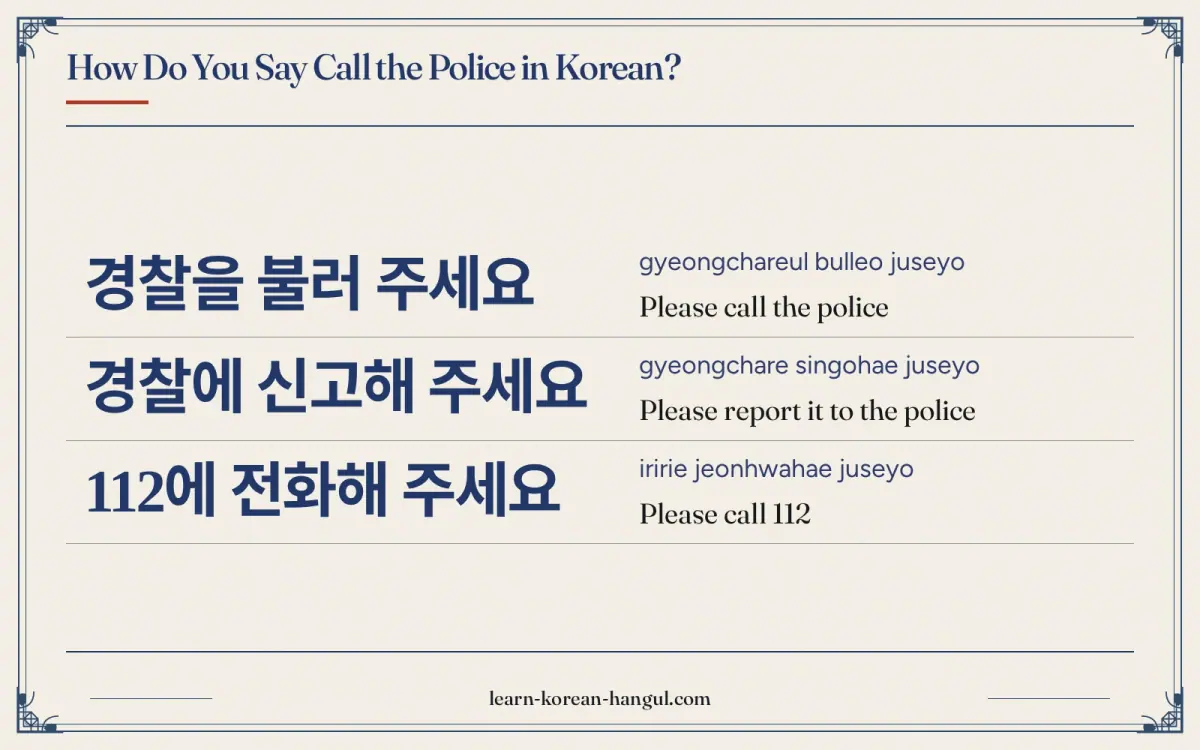
The standard way to ask for the police in Korean is 경찰을 불러 주세요. The noun 경찰 means "police" or "police officer", the particle 을 marks it as the object, and 불러 주세요 means "please call (summon)". The verb 부르다 fits because you want officers to come, not because you want a chat on the phone.
| Korean | Romanization | Meaning | Where you hear it |
|---|---|---|---|
| 경찰을 불러 주세요 | gyeongchareul bulleo juseyo | Please call the police | Asking a bystander or staff |
| 경찰에 신고해 주세요 | gyeongchare singohae juseyo | Please report it to the police | Reporting a crime or accident |
| 112에 전화해 주세요 | iririe jeonhwahae juseyo | Please call 112 | Asking someone with a phone |
| 112입니다 | iririimnida | This is 112 | A typical opening from the operator |
Revised Romanization (the South Korean government standard of 2000) is only a reading aid here. Learn the Hangul first. The next section shows how each form fits a different situation.
What Are the Polite Ways to Say Call the Police?
Emergency Korean is short and polite, not casual. Use the 요 or 습니다 style with strangers and staff. The reasons are explained in Korean speech levels. Friends can use casual forms, but a polite sentence is always safe.
Polite: 경찰을 불러 주세요 (gyeongchareul bulleo juseyo)
Polite · 해요체경찰을 불러 주세요 is the main request. Say what has happened first, then the request. In a rush, you can drop the particle: 경찰 불러 주세요 is also normal. The request needs the verb 불러. A bare 경찰 주세요 means "give me police", which makes no sense.
지갑을 도둑맞았어요. 경찰을 불러 주세요.
jigabeul dodungmajasseoyo. gyeongchareul bulleo juseyo
My wallet was stolen. Please call the police.
Polite: 경찰에 신고해 주세요 (gyeongchare singohae juseyo)
Polite · 해요체경찰에 신고해 주세요 uses 신고하다, which means to report something officially. Use it for a crime, an accident or a missing item. The particle 에 shows the place the report goes to. It sounds a little more formal than 불러 주세요 and is common with hotel and shop staff.
사고가 났어요. 경찰에 신고해 주세요.
sagoga nasseoyo. gyeongchare singohae juseyo
There has been an accident. Please report it to the police.
Polite: 112에 전화해 주세요 (iririe jeonhwahae juseyo)
Polite · 해요체112에 전화해 주세요 asks the listener to phone the police number. Use it when you can see that the other person has a phone. Numbers like 112 use the Sino-Korean system, so you read the number as 일일이.
112에 전화해 주세요. 싸움이 났어요.
iririe jeonhwahae juseyo. ssaumi nasseoyo
Please call 112. A fight has broken out.
Three requests cover most situations: summon the police, report a crime, or name the number. The next section shows how to say them.
How Do You Pronounce 경찰을 불러 주세요?
경찰을 불러 주세요 is pronounced [경차를 불러 주세요], in nine syllables. The spelling differs from the sound at one point, in 경찰을, and the numbers need practice.
- 경 (gyeong): a g, the vowel ㅕ (a quick y plus ㅓ), and the ng sound at the end.
- 찰 (chal): an aspirated ch with a puff of air, then a final ㄹ.
- 을 (eul): the flat ㅡ vowel, with the lips spread and not rounded.
- 불 (bul): a plain b and a final ㄹ.
- 러 (reo): the ㄹ again, so 불러 has a long l.
- 주 (ju), 세 (se), 요 (yo): plain, short and light.
Sound Changes to Listen For
- Linking ㄹ. The final ㄹ of 찰 moves to the vowel of 을, so 경찰을 sounds like [경차를]. With the particle 에, 경찰에 is [경차레].
- Number 112. 일일이 is pronounced [이리리], because each final ㄹ links to the next vowel. With the particle, 112에 is [이리리에].
- Number 119. If you hear 일일구 ([이릴구]), it is the ambulance and fire number. Do not mix them up.
- Tense ㅆ. In 싸움, the written ㅆ is already tense. Say it with a tight tongue and no puff of air.
A common slip is to pronounce the ㄹ of 경찰 separately, as in "gyeong-chal-eul". Link it to the vowel instead. Once the sound is smooth, the next question is when each phrase fits.
When Should You Use 경찰을 불러 주세요, and When Should You Not?
Use 경찰을 불러 주세요 when someone near you can help right now. Use 경찰에 신고해 주세요 when a crime or an accident needs a report. Use 112에 전화해 주세요 when you see a phone in the other person's hand. The same words work in the street, in a shop and in a hotel.
Situations Where It Fits
- Theft. If a bag or wallet is taken, say the problem and then 경찰을 불러 주세요.
- A traffic accident. Ask a driver or a shop owner to report it with 경찰에 신고해 주세요.
- A fight or a threat nearby. Say 112에 전화해 주세요 to anyone with a phone.
Situations to Avoid
- Dialling 119 for the police. 119 reaches fire and ambulance. The police number is 112.
- 경찰서를 불러 주세요. 경찰서 means the police station, which you cannot summon. Say 경찰.
- Minor questions. For directions or a lost item that is not urgent, ask at a neighbourhood police box or see i lost my passport in Korean.
Three short scenes show the lines in context.
What Does Call the Police Sound Like in a Real Conversation?
Police requests are short and direct. Listen for the problem first and the request second.
A Theft on the Street
Tourist
도둑이에요! 경찰을 불러 주세요.
dodugieyo! gyeongchareul bulleo juseyo
Thief! Please call the police.
Passer-By
네, 제가 112에 전화할게요.
ne, jega iririe jeonhwahalgeyo
Yes, I'll call 112.
What to notice: 도둑이에요 is pronounced [도두기에요]. The ㄱ links to the vowel of 이에요. 전화할게요 sounds like [전화할께요].
On the Phone with 112
Operator
112입니다. 어디세요?
iririimnida. eodiseyo
This is 112. Where are you?
Caller
명동역 앞이에요. 지갑을 도둑맞았어요.
myeongdongyeok apieyo. jigabeul dodungmajasseoyo
In front of Myeongdong Station. My wallet was stolen.
What to notice: 어디세요 is a wh-question, so the operator's pitch falls or rises and then falls, with no sharp final rise. 도둑맞았어요 is pronounced [도둥마자써요], because ㄱ before ㅁ turns into ㅇ.
Asking Hotel Staff
Guest
방에 도둑이 들어왔어요. 경찰에 신고해 주세요.
bange dodugi deureowasseoyo. gyeongchare singohae juseyo
A thief came into my room. Please report it to the police.
Staff
네, 지금 신고하겠습니다.
ne, jigeum singohagetseumnida
Yes, I'll report it now.
What to notice: The staff answer with 신고하겠습니다 [신고하겓씀니다], the formal ending that shows they will act at once.
What Should You Know about the Culture behind Call the Police?
Knowing how the system works helps you use the language. These facts are general, and official sources give the latest details.
- Two numbers. In South Korea, 112 reaches the police and 119 reaches fire and ambulance. The Korean National Police Agency (경찰청) runs the police service.
- Dial only the digits. The numbers have three digits and need no area code. They work from ordinary mobile phones and landlines.
- Police boxes. Neighbourhood police boxes, called 지구대 (jigudae) or 파출소 (pachulso), take walk-in reports for small matters.
- Keep it short. Operators ask for your place first, then the problem. A short answer works better than a long one.
An expert tip: learn the verbs that go with the problem. 도둑맞다 (to have something stolen), 잃어버리다 (to lose) and 사고가 나다 (to have an accident) cover most police calls. For other emergency lines, see korean emergency phrases, and for the single word, see police in korean.
What Mistakes Do Learners Make with Call the Police in Korean?
Most mistakes with the police in Korean come from the wrong number or the wrong noun.
| Mistake | Why it is a problem | Fix |
|---|---|---|
| Dialling 119 for the police | 119 reaches fire and ambulance | Dial 112 for the police |
| Saying 경찰 주세요 without 불러 | It means "give me police" | Say 경찰을 불러 주세요 |
| Saying 경찰서를 불러 주세요 | You cannot call a building | Use 경찰, not 경찰서 |
| Using casual 불러 줘 with staff | It sounds rude to strangers | Say 불러 주세요 |
| Pronouncing 경찰을 as [경찰을] | The ㄹ should link to the vowel | Say [경차를] |
Learners often reach for the word 경찰서 because it appears on maps. In speech, 경찰 is the people and 경찰서 is the building.
Is It the Same as Police, Call 112 or Emergency Number?
Mostly yes. The searches below lead to the same set of words with small differences.
- Police in Korean: 경찰 (gyeongchal), pronounced [경찰]. A police officer can also be called 경찰관 (gyeongchalgwan).
- Call 112 in Korean: 112에 전화하다 (iririe jeonhwahada), as in 112에 전화해 주세요.
- Emergency number in Korean: 112 for the police and 119 for fire and ambulance.
- I need the police in Korean: 경찰이 필요해요 (gyeongchari piryohaeyo), pronounced [경차리 피료해요].
Practice: Say It Aloud
Play the slow clip and repeat 경찰을 불러 주세요 three times. Then choose the best line for each scene. Answers follow.
- Your wallet is stolen and a stranger is nearby.
- A clerk asks what you want them to do after an accident.
- You see someone with a phone and want them to call the police number.
- How is 경찰을 pronounced?
Answers
- 도둑맞았어요. 경찰을 불러 주세요.
- 경찰에 신고해 주세요.
- 112에 전화해 주세요.
- [경차를]: the ㄹ links to the vowel of 을.
The phrase flashcards drill these lines with audio.
Related Phrases to Learn Next
Calling the police connects to other emergency phrases.
- help in Korean: the first shout when something goes wrong.
- call an ambulance in Korean: the line for 119.
- i lost my passport in Korean: when a lost document needs a report.
This guide belongs to the korean emergency phrases collection. What this page does not cover: legal rights, insurance claims and how to fill in a police report. Learn the number 112 and one polite request, and you can call the police in Korean when it matters.
Frequently Asked Questions
How do you say call the police in Korean?
Say 경찰을 불러 주세요 (gyeongchareul bulleo juseyo) for "please call the police". To report a crime, say 경찰에 신고해 주세요. To name the number, say 112에 전화해 주세요. All three are polite and safe with strangers. Put the problem first, then the request, so the listener knows why you ask.
How do you pronounce 경찰을 불러 주세요?
Say gyeong-cha-reul bul-leo ju-se-yo. The ㄹ of 경찰 links to the vowel of 을, so the first word sounds like 경차를. 불러 has a long l sound, and the ㅡ in 을 is flat with the lips unrounded. Revised Romanization writes gyeongchareul bulleo juseyo.
What is the difference between 경찰을 불러 주세요 and 경찰에 신고해 주세요?
경찰을 불러 주세요 asks someone to bring the police to you. 경찰에 신고해 주세요 asks them to make an official report, for example of a theft or an accident. In a real emergency the two overlap, and both lead to the same call to 112.
Can I use 경찰을 불러 주세요 with friends, elders and strangers?
Yes. The ending 주세요 is polite and works with every listener, including strangers, staff and elders. With close friends, you may say 경찰 불러 줘, but the polite form is never wrong. In an emergency, clarity and speed matter more than choosing a register.
What is the most common mistake with call the police in Korean?
Dialling 119, which reaches fire and ambulance, when the police number is 112. A second mistake is saying 경찰 주세요 without 불러, which means "give me police". A third is asking for the 경찰서, the building, instead of 경찰, the officers.