도와주세요
도와주세요
What you'll learn
- Say 도와주세요 aloud with a clear, even rhythm.
- Choose between 도와주세요, 도와줘요, 도와줘 and 도와주실 수 있어요? for a stranger, an equal and a friend.
- Tell everyday help from emergency help, and know when 살려 주세요 is the right call.
- Name the two emergency numbers used in Korea and say the first words into the phone.
Before you start: if you have not met the polite ending yet, read Korean speech levels for a short overview. Time: about 12 minutes.
How Do You Say Help in Korean?
The standard way to say help in Korean is 도와주세요 (dowajuseyo), "please help me". It is polite enough for any listener, and it is short enough to shout. Korean asks for help with a verb request, not a one-word cry, so each form below is built from the verb 돕다 (to help).
| Form | Romanization | Meaning | Register | Say it to |
|---|---|---|---|---|
| 도와주세요 | dowajuseyo | please help me | Polite, respectful | Strangers, staff, elders |
| 살려 주세요 | sallyeo juseyo | save me | Emergency | Anyone, in real danger only |
| 도와줘요 | dowajwoyo | help me | Polite, plain | Equals you speak politely with |
| 도와줘 | dowajwo | help me | Casual (반말) | Close friends, family, children |
| 도와주실 수 있어요? | dowajusil su isseoyo | could you help me? | Very polite | Seniors, customers, officials |
The noun "help" is 도움 (doum), as in 도움이 필요해요 (I need help). The sections below take each form in turn, starting with the question learners ask most: which one fits which person.
What Are the Polite, Plain and Casual Ways to Say Help?
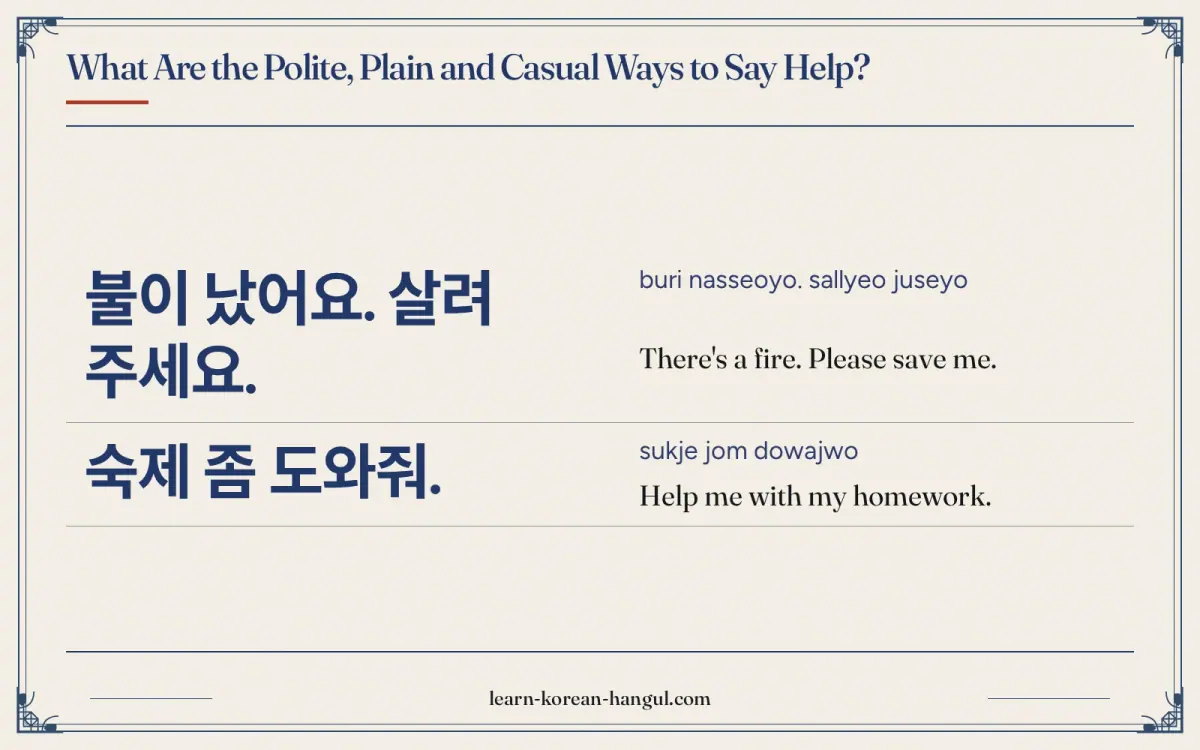
Korean help phrases follow the speech levels, the endings that change with the listener, which the guide to Korean speech levels explains in full. Unlike English, the request itself changes shape: the more respect you owe the listener, the more indirect the sentence becomes.
Polite: 도와주세요 (dowajuseyo)
Polite · 해요체도와주세요 is the everyday request. It ends in -(으)세요, an honorific polite ending that honours the person you ask to act, so it suits a stranger at a station, a clerk in a shop or a teacher. Add 좀 (jom, a little) to soften it: 좀 도와주세요 (please help me a little) sounds gentler and is very common.
지하철역을 찾고 있어요. 도와주세요.
jihacheollyeogeul chatgo isseoyo. dowajuseyo
I'm looking for the subway station. Please help me.
Emergency: 살려 주세요 (sallyeo juseyo)
Polite · 해요체살려 주세요 is the cry for rescue. 살리다 (salida) means "to save" or "to bring to life", so the phrase means "please save me". Koreans shout it for fire, drowning, an attack or a medical collapse. Everyday problems never need it. Hear the form first, then the example.
불이 났어요. 살려 주세요.
buri nasseoyo. sallyeo juseyo
There's a fire. Please save me.
Polite and Plain: 도와줘요 (dowajwoyo)
Polite · 해요체도와줘요 uses the ordinary polite ending -요 without the honorific -세요. It sounds friendly and direct, like asking a coworker your own age or a classmate you do not know well. It is slightly too casual for a stranger who is clearly older than you.
민수 씨, 이 짐 좀 도와줘요.
minsu ssi, i jim jom dowajwoyo
Minsu, help me with this luggage.
Casual: 도와줘 (dowajwo)
Casual · 반말도와줘 is the casual request, in 반말 (banmal, intimate speech). Use it with close friends, siblings, partners and children. With an older person or a stranger, it would sound rude.
숙제 좀 도와줘.
sukje jom dowajwo
Help me with my homework.
Very Polite: 도와주실 수 있어요? (dowajusil su isseoyo)
Polite · 해요체도와주실 수 있어요? asks "are you able to help me?" instead of giving a request, so it feels softer than 도와주세요. The -시- inside 도와주실 honours the helper. Use it with a senior colleague, a customer service desk or an official. The formal version for signs and written notices is 도와주십시오.
이 양식 쓰는 걸 도와주실 수 있어요?
i yangsik sseuneun geol dowajusil su isseoyo
Could you help me fill in this form?
Five forms reduce to two questions: how serious is the problem, and how much respect does the listener deserve. Pronouncing them cleanly comes next.
Why Does 도와주세요 Look the Way It Does?
도와주세요 is two verbs joined into one request: 도와 (the helping form of 돕다, to help) plus 주세요 (please give). Literally it means "help-and-give", the pattern 아/어 주세요, "please do it for me". The same pattern turns any verb into a favour: 설명해 주세요 means "please explain".
Two details help with spelling. First, 돕다 is a ㅂ-irregular verb, so its ㅂ turns into 오 before an ending: 돕 + 아 gives 도와, not 도바. Second, 주어 shrinks to 줘 in plain and casual speech, which is why 도와줘 and 도와줘요 are written with 줘. After this section, the sound of each form is the next job.
How Do You Pronounce 도와주세요?
도와주세요 is pronounced as it is written, in five even syllables: do-wa-ju-se-yo. There is no sound change inside it, which makes it a friendly first emergency phrase.
- 도 (do): a soft d, close to the "do" in "dome" but shorter.
- 와 (wa): like "wa" in "water".
- 주 (ju): a soft j; between vowels it sounds slightly voiced, like "ju" in "June".
- 세 (se): "seh".
- 요 (yo): "yo" as in "yoga".
Keep the stress flat. Korean does not stress one syllable heavily, and a loud, rising 도와주세요 reads as urgent without any extra words.
Sound Changes to Listen For
These details follow the National Institute of Korean Language (국립국어원) Standard Pronunciation rules (표준 발음법), plus natural speech:
- Tensified 수 in 도와주실 수 있어요. After the future modifier -ㄹ, the next ㅅ is said tense, so 수 sounds like 쑤: [도와주실쑤 이써요]. This is the same pattern as in Korean tensification.
- Liaison in 도움이 필요해요. The final ㅁ of 도움 moves onto the next vowel, giving [도우미 피료해요].
- Doubled ㄹ in 살려. The final ㄹ of 살 meets the ㄹ that starts 려, and ㄹ plus ㄹ is said as one long l: sal-lyeo.
- 져 said as 저 in 쓰러졌어요. In the dialogue below, 쓰러졌어요 is said [쓰러저써요]: after ㅈ the vowel ㅕ is said as ㅓ (Standard Pronunciation Article 5), and the final ㅆ moves onto 어 as a tense [ㅆ].
A well-pronounced request still fails if it is aimed at the wrong person, so the next section covers who gets which form.
When Should You Use 도와주세요, and When Should You Not?
Use 도와주세요 for everyday help with anyone you do not know well, and save 살려 주세요 for situations where a life is at risk. With close friends, switch to 도와줘.
Situations Where It Fits
- Directions. You cannot find the subway exit. 저기요, 도와주세요 gets attention and help.
- Luggage on stairs. 이 짐 좀 도와주세요 (please help me with this luggage) is polite and clear.
- Machines. At a ticket kiosk or ATM, 이거 좀 도와주세요 (please help me with this) works with any staff member.
- A language gap. Say 도와주세요 and point; staff usually understand.
- Emergencies. When a friend collapses, 도와주세요 draws nearby people. Add 119 if you can.
Situations to Avoid
- A small favour for a friend. 도와주세요 sounds too stiff; say 좀 도와줘.
- Lost wallet, missed bus. 살려 주세요 would alarm everyone.
- A request to a boss. 도와줘요 is too plain; use 도와주실 수 있어요?
- A demand. A bare 도와줘 said sharply sounds like an order. Keep the tone gentle and add 좀.
The short conversations below show these choices in context.
What Does Help Sound Like in a Real Conversation?
Real help requests are short, and the helper usually answers with 네 (yes) and an action. Notice how the asker's phrase changes with the stakes.
At the Ticket Machine
Traveller
저기요, 표 사는 걸 좀 도와주세요.
jeogiyo, pyo saneun geol jom dowajuseyo
Excuse me, please help me buy a ticket.
Staff
네, 이쪽으로 오세요.
ne, ijjogeuro oseyo
Yes, please come this way.
What to notice: 저기요 gets attention first, and 좀 makes the request gentle.
A Friend Collapses
Hana
도와주세요. 친구가 쓰러졌어요.
dowajuseyo. chinguga sseureojyeosseoyo
Please help. My friend has collapsed.
Passer-By
119에 전화할게요.
irilgue jeonhwahalgeyo
I'll call 119.
What to notice: Hana states the problem in four words after 도와주세요, and the helper names the emergency number. Behind the phrases sits a cultural habit worth knowing.
What Should You Know about the Culture around Asking for Help?
Asking for help in Korea is acceptable and usually works, as long as you start with a polite word and name the problem plainly. These points shape how the phrases are heard.
- Two numbers. In South Korea, 119 connects to fire and ambulance services, and 112 to the police. Say 도와주세요 first, then the place and the problem.
- Attention first. 저기요 (jeogiyo, excuse me) before 도와주세요 is normal and makes the request feel less abrupt.
- Passers-by. A loud, clear 도와주세요 in public usually draws people over. For non-urgent help, a quiet 저기요 is better manners.
- Titles. To a stranger, 선생님 (seonsaengnim) or 아저씨/아주머니 are common attention words, but 저기요 is the safe default.
An expert insight: learners often shorten everything to the noun and say "도움" alone, which sounds like a headline. Korean prefers the full verb request, and 도와주세요 is both short and clearer than a bare noun. The common mistakes below follow from the same idea.
What Mistakes Do Learners Make with Help in Korean?
Most mistakes come from using English "help" as a single word, or from picking an emergency phrase for a small problem.
| Mistake | Why it is a problem | Fix |
|---|---|---|
| Shouting 살려 주세요 for a lost bag | Sounds like a life-threatening emergency | Say 도와주세요 |
| Saying 도와줘 to a stranger | Casual speech is rude to unknown adults | Say 도와주세요 |
| Saying only the English word help | Not everyone understands it | Say 도와주세요, then point |
| Saying only 도움 | Names help without asking for it | Say 도움이 필요해요 or 도와주세요 |
| Spelling it 도와주세여 | Informal texting spelling | Write 도와주세요 |
Learners often assume that adding -요 to 도와줘 makes it safe for any listener. Actually, 도와줘요 is polite in form but plain in tone, so a stranger who is clearly older still expects 도와주세요, with the honorific -세요. The next section answers the other phrasings people search for.
Is 도와주세요 the Same as "Please Help Me"?
Yes. Korean does not need a word for "me" or "please": 도와주세요 already carries both ideas, and the speaker is understood from context. The short answers below cover the other ways people ask.
- Please help me in Korean: 도와주세요.
- Help me in Korean: 도와줘요 (polite), 도와줘 (casual).
- Help me please in Korean: 좀 도와주세요, or 도와주세요 with a gentle voice. Korean has no separate word for "please" here.
- Save me in Korean: 살려 주세요, for danger only.
- I need help in Korean: 도움이 필요해요; for a stranger, 도와주세요 is faster.
- Can you help me in Korean: 도와주실 수 있어요? for respect, or 도와줄 수 있어? with a friend.
For the ordinary word "please", see please in Korean. Now practise.
Practice: Say It Aloud
Play the slow clip of 도와주세요 and repeat it three times, then try 도와줘요 and 도와줘. Next choose the form for each case. Answers follow.
- You cannot find the exit at a big subway station and ask a clerk.
- Your best friend is stuck on a maths problem and asks you.
- A swimmer is struggling in a river.
- Your manager is carrying heavy boxes and you want to offer help. What can you say to ask whether you may help? (Hint: it is a different verb pattern.)
Answers
- 저기요, 도와주세요 (or 도와주실 수 있어요?).
- 도와줘 (casual, between friends). The offer in reply is 도와줄게 (I'll help you).
- 살려 주세요, and call 119.
- 도와 드릴까요? (dowa deurilkkayo, shall I help you?). The "do for" verb changes to 드리다 when you help someone above you.
The phrase flashcards drill all five help forms with audio.
Related Phrases to Learn Next
Help phrases sit next to the other lines you need in a stressful moment.
- I need a doctor in Korean: the next step when the problem is medical.
- Call the police in Korean: how to ask someone to phone 112.
- I'm lost in Korean: 길을 잃었어요 and directions follow-ups.
- Excuse me in Korean: attention words to use before 도와주세요.
This guide belongs to the Korean emergency phrases collection. What this page does not cover: calling emergency services in detail, describing symptoms and medical vocabulary. Say 도와주세요 for everyday help, 살려 주세요 only for danger, and match the ending to the listener, and you can say help in Korean clearly in any situation.
Frequently Asked Questions
How do you ask for help in Korean when you do not speak Korean?
Say 도와주세요 (dowajuseyo) and add 영어 할 수 있어요? (yeongeo hal su isseoyo, can you speak English?). You can also point at the problem and say 이거 좀 도와주세요 (igeo jom dowajuseyo, please help me with this). Staff at stations, hotels and tourist desks usually understand the first phrase at once.
What is the difference between 도와주세요 and 도와줘요?
도와주세요 uses the honorific ending -(으)세요, so it is a respectful request and is safe with strangers and elders. 도와줘요 is polite but plain, so it suits equals such as a coworker your age. When unsure, choose 도와주세요, because no listener will mind the extra respect.
Can I say 살려 주세요 in a normal situation?
No. 살려 주세요 literally means "please let me live", so it sounds dramatic when you only need directions or a favour. Use it for fire, drowning, an attack or another life-threatening danger. For ordinary problems, such as a missed train or a lost bag, say 도와주세요 instead.
How do you say "I need help" in Korean?
Say 도움이 필요해요 (doumi piryohaeyo), which means "I need help" and is polite. For urgent help from a stranger, 도와주세요 is shorter and more direct. For a formal letter or a hotel desk, 도움이 필요합니다 (doumi piryohamnida) is the formal form. All three are understood everywhere.
What numbers do I call for help in Korea?
Call 119 for fire and ambulance, and 112 for the police. Both numbers work across South Korea. Say 도와주세요 first, then give the place and the problem in a few short words, such as 불이 났어요 (there is a fire) or 사고가 났어요 (there has been an accident).