여권을 잃어버렸어요
여권을 잃어버렸어요
What you'll learn
- Say a lost passport with 여권을 잃어버렸어요, 잃어버렸습니다 or 잃어버렸어.
- Swap the object for a wallet, a phone or a bag.
- Say that something was stolen with 도둑맞았어요.
- Tell 잃어버리다 (lose) apart from 잊어버리다 (forget).
Before you start: you only need to read Hangul. This page teaches language, not legal advice. In an emergency in Korea, 112 reaches the police and 119 reaches an ambulance or the fire service. For the steps to replace a passport, check your own embassy's website, because rules differ by country. Time: about 10 minutes. Audio plays only when you press a button.
Key facts
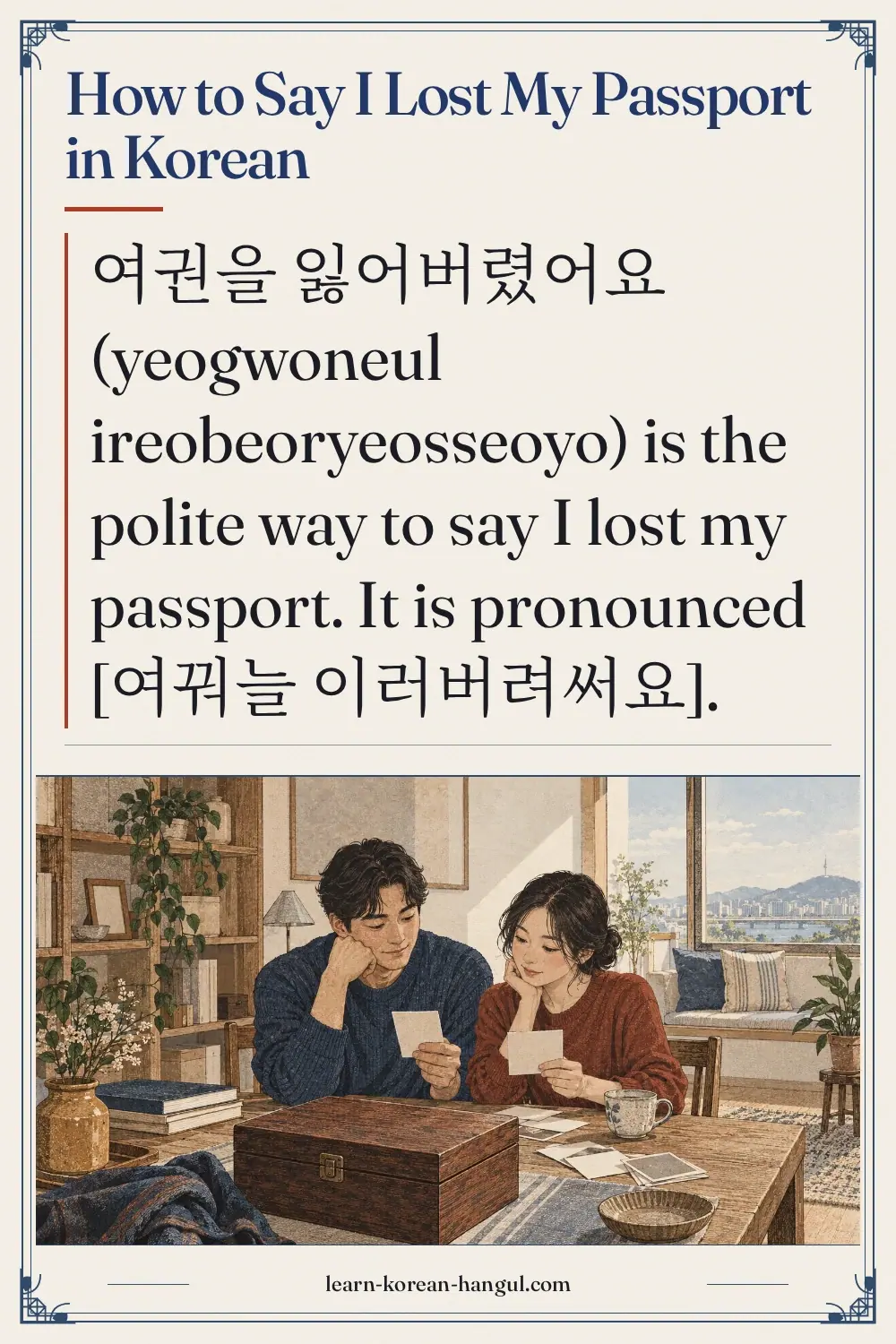
- 여권을 잃어버렸어요 (yeogwoneul ireobeoryeosseoyo) is the polite way to say I lost my passport.
- Korean says "lost" in the past tense: 잃어버렸어요.
- 잃어버리다 (to lose) and 잊어버리다 (to forget) differ by one letter and one sound.
How Do You Say I Lost My Passport in Korean?
The standard way to say I lost my passport in Korean is 여권을 잃어버렸어요. It is built from 여권 (yeogwon, passport), the object marker 을 (eul), the verb 잃어버리다 (ireobeorida, to lose) in the past tense and the polite ending 요. The result is a sentence you can use at a counter, a police station or a hotel.
| Situation | Best form | Romanization | Why |
|---|---|---|---|
| Telling police, hotel or airport staff | 여권을 잃어버렸어요 | yeogwoneul ireobeoryeosseoyo | Polite, the default |
| Telling a close friend | 여권을 잃어버렸어 | yeogwoneul ireobeoryeosseo | Casual |
| A written report or formal statement | 여권을 잃어버렸습니다 | yeogwoneul ireobeoryeotseumnida | Formal |
| Someone took it | 여권을 도둑맞았어요 | yeogwoneul dodungmajasseoyo | Stolen |
| You left it somewhere | 여권을 두고 왔어요 | yeogwoneul dugo wasseoyo | Left behind |
| Reading a form or a sign | 여권 분실 | yeogwon bunsil | Passport loss, as a noun |
Korean separates "lost", "stolen" and "left behind", and the right choice helps the staff help you. The next section sorts the forms by level.
What Are the Formal, Polite and Casual Ways to Say I Lost My Passport?
The forms follow the Korean speech levels, explained in the guide to Korean speech levels. Here we move from formal to casual.
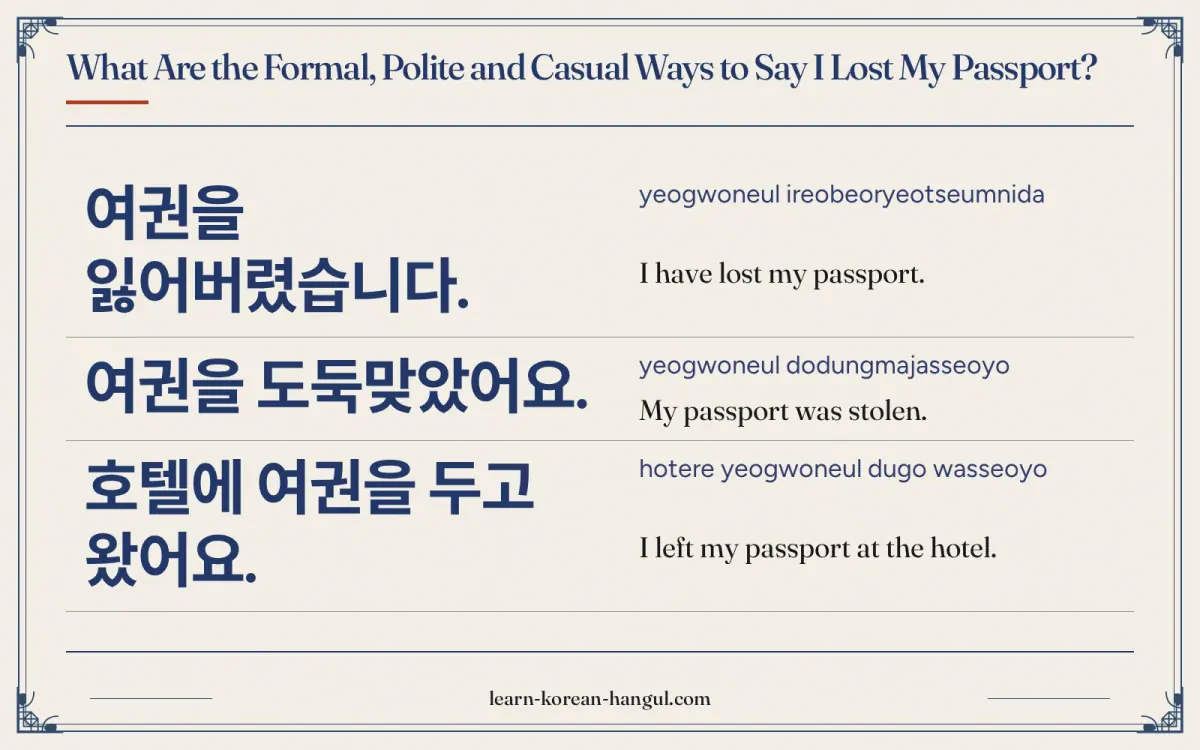
Formal: 여권을 잃어버렸습니다 (yeogwoneul ireobeoryeotseumnida)
Formal · 합쇼체여권을 잃어버렸습니다 uses the formal -습니다 ending after the past marker ㅆ. It fits a written statement, a police form or a message to an embassy. It is pronounced [여꿔늘 이러버려씀니다], with the final ㅆ said as ㄷ and then a tense ㅆ.
여권을 잃어버렸습니다.
yeogwoneul ireobeoryeotseumnida
I have lost my passport.
Polite: 여권을 잃어버렸어요 (yeogwoneul ireobeoryeosseoyo)
Polite · 해요체여권을 잃어버렸어요 is the everyday default. It suits police officers, hotel staff, airline staff and strangers. Add the time or place to help them: 어제 지하철에서 여권을 잃어버렸어요, "I lost my passport on the subway yesterday".
어제 지하철에서 여권을 잃어버렸어요.
eoje jihacheoreseo yeogwoneul ireobeoryeosseoyo
I lost my passport on the subway yesterday.
Casual: 여권을 잃어버렸어 (yeogwoneul ireobeoryeosseo)
Casual · 반말여권을 잃어버렸어 drops the polite 요. Use it with a friend or a travel partner: 나 여권 잃어버렸어, "I lost my passport". People often drop the particle in casual talk.
Stolen: 여권을 도둑맞았어요 (yeogwoneul dodungmajasseoyo)
Polite · 해요체도둑맞다 (dodungmatda) combines 도둑 (thief) and 맞다 (here, to suffer or undergo), so it means "to be robbed of something". It is pronounced [도둥마자써요]. Use it when you know someone took your passport, for instance from a bag.
여권을 도둑맞았어요.
yeogwoneul dodungmajasseoyo
My passport was stolen.
Left behind: 여권을 두고 왔어요 (yeogwoneul dugo wasseoyo)
Polite · 해요체두고 왔어요 means "I put it down and came away". It is the right phrase when your passport is at the hotel or a restaurant and you know where. It is pronounced [두고 와써요]. This tells the listener that it is not lost.
호텔에 여권을 두고 왔어요.
hotere yeogwoneul dugo wasseoyo
I left my passport at the hotel.
Other Objects: 지갑, 휴대폰
Polite · 해요체The same pattern works for any object. 지갑을 잃어버렸어요 means "I lost my wallet", and 휴대폰을 잃어버렸어요 means "I lost my phone". The particle is 을 after a consonant and 를 after a vowel: 지갑을 and 우산을, but 카드를.
지갑을 잃어버렸어요.
jigabeul ireobeoryeosseoyo
I lost my wallet.
휴대폰을 잃어버렸어요.
hyudaeponeul ireobeoryeosseoyo
I lost my phone.
The Pattern behind It: Object + 을/를 + past Verb
The sentence pattern is object, particle, past verb. 여권 (object) + 을 + 잃어버렸어요. The past ending -었어요 joins the stem 잃어버리-, and 리 + 었 contracts to 렸, giving 잃어버렸어요. Once you know it, you can say 가방을 잃어버렸어요 (I lost my bag) or 열쇠를 잃어버렸어요 (I lost my key).
How Do You Pronounce 여권을 잃어버렸어요?
여권을 잃어버렸어요 is pronounced [여꿔늘 이러버려써요], yeo-kkwo-neul i-reo-beo-ryeo-sseo-yo, in nine syllables. The phrase flows through linking, because several syllables end in a consonant that moves forward.
- 여권을: 권 ends in ㄴ, and 을 begins with silent ㅇ, so ㄴ moves forward: [여꿔늘]. The ㄱ of 권 is also tense in the standard dictionary pronunciation of 여권, [여꿘]. RR does not show this tensing, so the spelling stays yeogwon.
- 잃어: the ㅎ in 잃 is silent, and the ㄹ moves to the next syllable: [이러].
- 버려: a simple 버려, with an unrounded ㅓ.
- 써요: the final ㅆ of 렸 moves forward to give [려써요].
Sounds to Listen For
These notes follow the National Institute of Korean Language standard pronunciation rules (표준 발음법):
- Silent ㅎ. In 잃어, the ㅎ is not said before a vowel, and the ㄹ links forward (Articles 12 and 13).
- Lost versus forgotten. 잃어버리다 is [이러버리다] and 잊어버리다 is [이저버리다]. The only difference is the second syllable, 러 versus 저, but it changes the meaning.
- Formal ending. 잃어버렸습니다 is [이러버려씀니다]: ㅆ is said as ㄷ at the end of a syllable (Article 9), ㅅ becomes tense ㅆ (Article 23) and ㅂ before ㄴ turns into ㅁ (Article 18). See Korean tensification.
Say the long word in chunks: 여권을, 잃어버렸어요. Then link them. Keep the tempo even, and do not rush the middle.
When Should You Use 여권을 잃어버렸어요, and When Should You Not?
Use 여권을 잃어버렸어요 when the passport is gone and you do not know where. It starts a conversation with the person who can help.
Situations Where It Fits
- At a police station. 여권을 잃어버렸어요.
- At a hotel or airline desk. 공항에서 여권을 잃어버렸어요.
- When phoning an embassy or a friend. 어제 여권을 잃어버렸어요.
Situations to Avoid
- You left it at the hotel. Say 두고 왔어요, so staff does not start a search.
- Someone took it. Say 도둑맞았어요, so the police take it as a theft.
- You forgot to bring it. Say 여권을 안 가져왔어요 (yeogwoneul an gajyeowasseoyo), "I didn't bring my passport".
Two short conversations show how the phrase sounds.
What Does I Lost My Passport Sound Like in a Real Conversation?
In real life, the sentence is followed by questions about time and place, and then by forms or instructions. Listen for the wh-questions, which end with a fall or a rise-fall rather than a sharp rise.
At the Police Station
Traveller
여권을 잃어버렸어요.
yeogwoneul ireobeoryeosseoyo
I lost my passport.
Officer
언제 잃어버렸어요?
eonje ireobeoryeosseoyo?
When did you lose it?
Traveller
어제 지하철에서 잃어버렸어요.
eoje jihacheoreseo ireobeoryeosseoyo
I lost it on the subway yesterday.
Officer
이 서류를 작성해 주세요.
i seoryureul jakseonghae juseyo
Please fill in this form.
What to notice: 언제 잃어버렸어요? is a wh-question, so it does not end with a sharp rise. The traveller repeats the verb 잃어버렸어요 and drops the object, because it is clear from the context.
At the Airport Desk
Traveller
공항에서 여권을 잃어버렸어요. 어떻게 해야 해요?
gonghangeseo yeogwoneul ireobeoryeosseoyo. eotteoke haeya haeyo?
I lost my passport at the airport. What should I do?
Staff
먼저 경찰서에 가세요. 그리고 대사관에 연락하세요.
meonjeo gyeongchalseoe gaseyo. geurigo daesagwane yeollakaseyo
First go to the police station. Then contact your embassy.
Traveller
네, 감사합니다.
ne, gamsahamnida
Yes, thank you.
What to notice: the staff member uses -세요 twice for polite instructions. 어떻게 해야 해요? is a wh-question and does not rise, and 해야 해요 means "I have to do".
What Should You Know about the Culture behind I Lost My Passport?
Travellers in Korea can ask for help at a police station (경찰서, gyeongchalseo), a hotel desk or a tourist information centre. Staff are usually patient with learners, and a short sentence plus a gesture goes a long way. Rules for replacing a passport depend on your country, so contact your embassy (대사관, daesagwan) and follow its instructions.
- Say what and when. After the first sentence, listeners ask 언제요? (when?) and 어디서요? (where?). Be ready with 어제 (yesterday) and 지하철에서 (on the subway).
- Have a copy. A photo of your passport on your phone helps in any office. Say 여권 사진이 있어요 (I have a photo of my passport).
- Use the polite level. 요 endings are enough for officers and clerks, and the formal level is only needed on written statements.
An expert tip: write 저는 외국인이에요 (I am a foreigner) beside your first sentence on a note. It tells staff that you need slower, simpler Korean, and staff may fetch a colleague who speaks English.
What Mistakes Do Learners Make with I Lost My Passport in Korean?
Most mistakes come from tense and from a similar-looking verb.
| Mistake | Why it is a problem | Fix |
|---|---|---|
| 여권을 잃어버려요 | Present tense sounds like a habit | Say 잃어버렸어요 |
| 여권을 잊어버렸어요 | Means "I forgot my passport" | Say 잃어버렸어요 |
| 여권이 잃어버렸어요 | The passport does not lose things | Use 을 or say 여권이 없어졌어요 |
| 여권을 도둑맞았어요 when only lost | Starts a theft report | Say 잃어버렸어요 |
| 잃어버렸습니다 to a friend | Stiff and distant | Say 잃어버렸어 |
Learners often assume that the passport is the subject, as in English "my passport is lost". Actually, Korean puts you in charge: you lost it, so the object takes 을/를.
Is It the Same as Lost Passport, Lost Wallet or Stolen?
Mostly. The short answers below cover the other searches folded into this page.
- Lost passport in Korean: 여권 분실 (a noun for forms) or 여권을 잃어버렸어요 (the sentence).
- Lost wallet in Korean: 지갑을 잃어버렸어요.
- I lost my wallet in Korean: the same sentence, 지갑을 잃어버렸어요.
- Lost my phone in Korean: 휴대폰을 잃어버렸어요.
- Stolen in Korean: 도둑맞았어요.
- For the word on its own: see passport in Korean.
Now say them aloud.
Practice: Say It Aloud
Play the slow clip of 여권을 잃어버렸어요 three times, then say it in two chunks, 여권을 and 잃어버렸어요. Choose a phrase. Answers follow.
- You tell a police officer that you lost your passport.
- You say that your wallet was lost.
- You say that your passport was stolen.
- You say that you left your passport at the hotel.
Answers
- 여권을 잃어버렸어요.
- 지갑을 잃어버렸어요.
- 여권을 도둑맞았어요.
- 호텔에 여권을 두고 왔어요.
The phrase flashcards drill these lines with audio.
Related Phrases to Learn Next
After you say that the passport is lost, you will need help.
- Call the police in Korean: 경찰을 불러 주세요 for an urgent situation.
- Help in Korean: 도와주세요 for calling attention.
- I'm lost in Korean: 길을 잃었어요 when you are the one who is lost.
This guide belongs to the Korean emergency phrases collection. What this page does not cover: legal procedures, visa rules and replacement documents. Remember that Korean uses the past tense, 잃어버렸어요, pick a level, and you can say i lost my passport in Korean clearly and calmly.
Frequently Asked Questions
How do you say I lost my passport in Korean?
Say 여권을 잃어버렸어요 (yeogwoneul ireobeoryeosseoyo) in a polite setting and 여권을 잃어버렸어 to a close friend. In a formal setting, say 여권을 잃어버렸습니다. Korean uses the past tense, because the loss already happened. Add where or when for help: 어제 지하철에서 여권을 잃어버렸어요.
How do you say lost passport in Korean?
As a noun phrase, say 여권 분실 (yeogwon bunsil), which means "passport loss". It appears on forms and signs, such as 여권 분실 신고 (a passport loss report). In speech, people say the full sentence 여권을 잃어버렸어요. Use the noun form when you read a form or ask where to make a report.
How do you say I lost my wallet or my phone in Korean?
Swap the object: 지갑을 잃어버렸어요 (jigabeul ireobeoryeosseoyo) for a wallet and 휴대폰을 잃어버렸어요 (hyudaeponeul ireobeoryeosseoyo) for a phone. The particle 을 follows a word that ends in a consonant, and 를 follows a vowel. So say 가방을 (bag) and 우산을 (umbrella), but 카드를 (card).
How do you say my passport was stolen in Korean?
Say 여권을 도둑맞았어요 (yeogwoneul dodungmajasseoyo), which literally means "I was robbed of my passport". Use it only if someone took it. If you are unsure, say 잃어버렸어요 first, because you may have just left it somewhere. For a theft, tell the police: 도둑맞았어요 is the key word.
What is the difference between 잃어버리다 and 잊어버리다?
잃어버리다 (ireobeorida) means to lose an object. 잊어버리다 (ijeobeorida) means to forget a fact. They look alike and sound close, but 잃어 is said [이러] and 잊어 is said [이저]. If you say 여권을 잊어버렸어요, a listener hears "I forgot my passport", not "I lost it".
What is the most common mistake with I lost my passport in Korean?
Learners use the present tense 잃어버려요, which sounds like a habit or a future event. Use the past 잃어버렸어요. A second slip is 여권을 없어졌어요, which mixes two patterns. If your passport vanished, say 여권이 없어졌어요 with 이/가, or use 잃어버렸어요 with 을/를.