결혼 축하드립니다
결혼 축하드립니다
What you'll learn
- Choose between 결혼 축하드립니다, 결혼 축하해요 and 결혼 축하해 for each listener.
- Add the blessing 행복하세요 after your congratulations.
- Pronounce 축하 as [추카] and 드립니다 as [드림니다].
- Understand what Korean wedding guests usually do, and avoid the common register mistake.
Before you start: the endings below follow the levels explained in Korean speech levels. For the general word, see congratulations in Korean. Time: about 14 minutes. Audio plays only when you press a button.
How Do You Say Congratulations on Your Wedding in Korean?
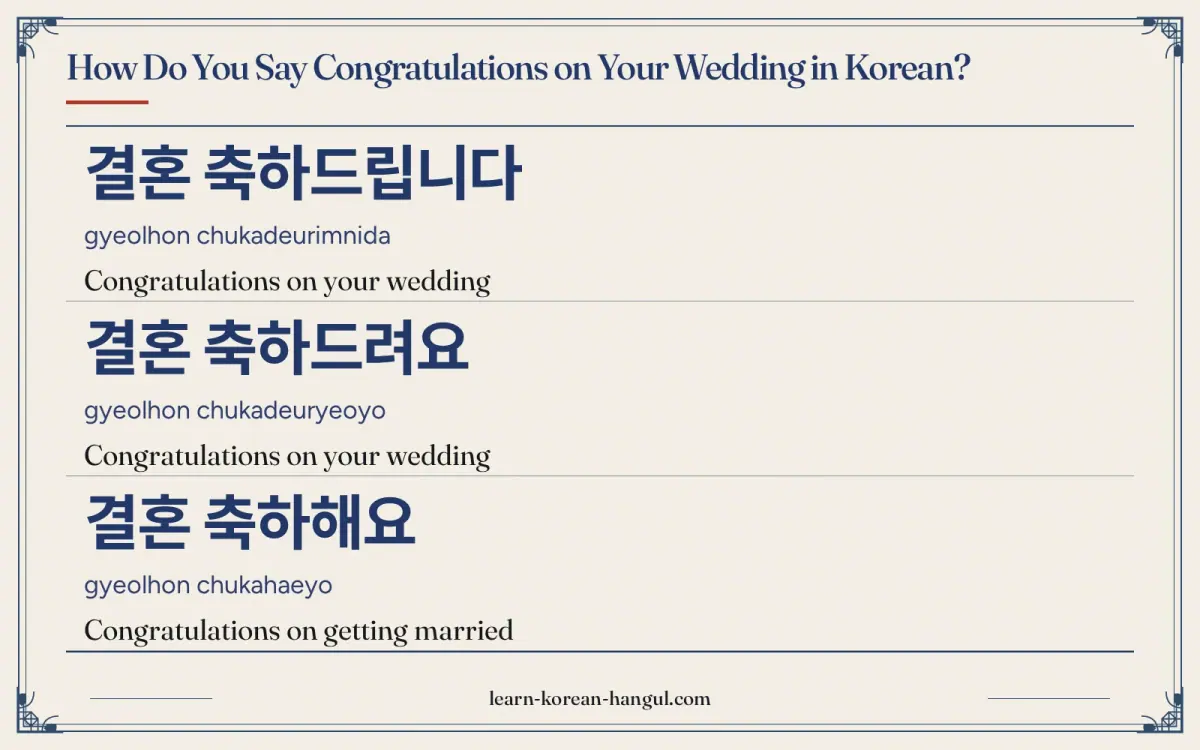
The standard way to congratulate someone on a wedding in Korean is 결혼 축하드립니다. It combines 결혼 (marriage), 축하 (celebration) and the humble verb 드리다 (to give, humbly), so it literally offers the couple your congratulations. The table shows the form for each listener.
| Listener | Korean | Romanization | Meaning |
|---|---|---|---|
| Senior, groom's or bride's parents, reception | 결혼 축하드립니다 | gyeolhon chukadeurimnida | Congratulations on your wedding |
| Warm and respectful | 결혼 축하드려요 | gyeolhon chukadeuryeoyo | Congratulations on your wedding |
| Coworker, acquaintance | 결혼 축하해요 | gyeolhon chukahaeyo | Congratulations on getting married |
| Close friend, sibling | 결혼 축하해 | gyeolhon chukahae | Congrats on the wedding |
| Blessing for the couple | 행복하세요 | haengbokaseyo | Be happy |
Revised Romanization (the South Korean government standard of 2000) is a reading aid here. It writes the noun 축하 as chukha, but the verb forms show the aspirated sound, as in chukahaeyo. Learn the Hangul first. The next section explains each form.
What Are the Formal, Polite and Casual Ways to Say Congratulations on Your Wedding?
Congratulations on your wedding has four main forms, and the relationship decides which one fits. The words 결혼 and 축하 stay the same, while the verb ending and the humble verb change.
Formal: 결혼 축하드립니다 (gyeolhon chukadeurimnida)
Formal · 합쇼체결혼 축하드립니다 uses the formal ending -ㅂ니다 and the humble 드리다. Use it at the reception, with a boss or with the parents of the couple. Adding 진심으로 ("sincerely") makes it warmer in a card or message.
결혼 진심으로 축하드립니다.
gyeolhon jinsimeuro chukadeurimnida
Sincere congratulations on your wedding.
A softer version with the same respect is 결혼 축하드려요, which swaps the formal ending for the polite -요.
Polite: 결혼 축하해요 (gyeolhon chukahaeyo)
Polite · 해요체결혼 축하해요 is the everyday polite form. It fits coworkers, neighbours and acquaintances around your age. Add 정말 잘됐어요 ("that's wonderful") to show you are glad.
결혼 축하해요! 정말 잘됐어요.
gyeolhon chukahaeyo! jeongmal jaldwaesseoyo
Congratulations on getting married! That is wonderful.
Blessing: 행복하세요 (haengbokaseyo)
Polite · 해요체행복하세요 means "please be happy". It is not a replacement for the congratulation, but a blessing that follows it. The honorific ending -(으)세요 makes it respectful, so it works for both peers and elders.
오래오래 행복하세요.
oraeorae haengbokaseyo
Be happy for a long, long time.
Casual: 결혼 축하해 (gyeolhon chukahae)
Casual · 반말결혼 축하해 drops the polite ending. Use it with close friends, siblings and classmates. People often add 진짜 기뻐 ("I'm really happy for you").
결혼 축하해! 진짜 기뻐.
gyeolhon chukahae! jinjja gippeo
Congrats on the wedding! I'm really happy for you.
Four forms cover almost every wedding conversation. The sounds are the next challenge, because two letters change.
How Do You Pronounce 결혼 축하드립니다?
결혼 축하드립니다 is pronounced [결혼 추카드림니다], gyeol-hon chu-ka-deu-rim-ni-da, in eight syllables. The spelling and the sound differ in two places.
- 결 (gyeol) 혼 (hon): "gyeol" and "hon", read as spelled.
- 축 (chuk) 하 (ha) → 추카 (chu-ka): the final ㄱ and the ㅎ merge into a single [ㅋ].
- 드 (deu) 립 (rim) → 드림: the ㅂ is said [ㅁ] before the next ㄴ.
- 니 (ni) 다 (da): "ni" and "da".
Sound Changes to Listen For
Three features shape this phrase:
- Aspiration. When ㄱ meets ㅎ, the two sounds merge into [ㅋ], so 축하 is [추카]. The same happens in 축하해요 [추카해요] and 행복하세요 [행보카세요], where ㄱ meets ㅎ again.
- Nasalization. The ㅂ at the end of 립 becomes [ㅁ] before ㄴ, so 드립니다 is [드림니다]. The rule is covered in Korean nasalization.
- No change in 결혼. Learners often over-correct this word. Say each syllable clearly: [결혼].
Practise the merged [추카] first, then add the rest. The right form still depends on who is listening.
When Should You Use 결혼 축하드립니다, and When Should You Not?
Use 결혼 축하드립니다 when you want to show respect, and switch to a lighter form with peers. The phrase suits both live greetings and written messages.
Situations Where It Fits
- You meet the couple or their parents at the reception. 결혼 축하드립니다.
- A boss or teacher announces a wedding. 결혼 축하드립니다 or 결혼 축하드려요.
- A coworker shares the news. 결혼 축하해요! 행복하세요.
- You send a card or message to a senior. 결혼 진심으로 축하드립니다.
Situations to Avoid
- A close friend, with the stiff 축하드립니다. It can sound distant, so say 결혼 축하해.
- A senior, with 결혼 축하해요 alone. It is polite, but the humble 드리다 shows more respect.
- A person who has not shared the news yet. Wait until the couple or their family announces it before you congratulate.
Three short dialogues show how these forms sound.
What Does Congratulations on Your Wedding Sound Like in a Real Conversation?
Congratulations on your wedding is usually the opening line, and the other person answers with thanks. Listen for the rising pitch on 정말요 and the warm tone on 행복하세요.
At the Reception Desk
Guest
결혼 축하드립니다.
gyeolhon chukadeurimnida
Congratulations on the wedding.
Groom's Father
와 주셔서 감사합니다.
wa jusyeoseo gamsahamnida
Thank you for coming.
What to notice: the host answers with 와 주셔서 감사합니다, which uses the honorific 주시다 to thank a guest.
A Coworker Shares News
Coworker
저 다음 달에 결혼해요.
jeo daeum dare gyeolhonhaeyo
I'm getting married next month.
You
정말요? 결혼 축하해요! 행복하세요.
jeongmaryo? gyeolhon chukahaeyo! haengbokaseyo
Really? Congratulations on getting married! Be happy.
What to notice: the surprised 정말요? rises and is pronounced [정말료], because a ㄴ sound slips in before 요 and turns into ㄹ after the ㄹ of 말. The congratulation and the blessing fall warmly.
A Friend Announces a Wedding
Friend
나 결혼해!
na gyeolhonhae
I'm getting married!
You
진짜? 결혼 축하해! 행복하게 잘 살아.
jinjja? gyeolhon chukahae! haengbokage jal sara
Really? Congrats! Live happily.
What to notice: between friends, every ending is casual, and 행복하게 잘 살아 ("live happily") replaces 행복하세요.
What Should You Know about the Culture behind Congratulations on Your Wedding?
Korean weddings follow a recognisable routine, and the phrases fit into it. Details vary by family and venue, so treat the points below as typical.
- Gift money. Guests usually give money, called 축의금 (chuguigeum), in a white envelope. The amount depends on how close you are to the couple.
- The reception desk. Guests often hand the envelope at a desk near the entrance and sign a guest book.
- The meal. After the ceremony, guests typically eat a meal, often a buffet, in the same building.
- A short ceremony. The ceremony itself, 결혼식 (gyeolhonsik), is often brief, so most greetings happen before and after it.
An expert insight: 결혼 means the marriage, while 결혼식 means the ceremony. You congratulate the marriage with 결혼 축하, even when you speak at the ceremony. The mistakes below come from the register more than from vocabulary.
What Mistakes Do Learners Make with Congratulations on Your Wedding in Korean?
Most mistakes involve the register and the sound of 축하.
| Mistake | Why it is a problem | Fix |
|---|---|---|
| 결혼 축하해요 to the groom's parents | Polite, but less respectful than the humble form | Say 결혼 축하드립니다 |
| 결혼 축하드립니다 to a close friend | Sounds stiff | Say 결혼 축하해 |
| Saying [축하] with a hard ㄱ and ㅎ | Misses the merged sound | Say [추카] |
| Saying [드립니다] without the nasal change | Misses the sound of the phrase | Say [드림니다] |
| Using 행복하세요 alone | A blessing, not a congratulation | Add 결혼 축하해요 first |
Learners often assume the humble verb is optional, but 드리다 is what separates a respectful congratulation from a friendly one.
Is It the Same as Wedding Congratulations, Congrats on Your Wedding and Happy Wedding?
Yes. The searches "wedding congratulations in Korean", "congrats on your wedding in Korean" and "happy wedding in Korean" lead to the same phrases. The short answers below cover each one.
- Wedding congratulations in Korean: 결혼 축하드립니다 in formal settings, or 결혼 축하해요 with peers.
- Congrats on your wedding in Korean: 결혼 축하해 for a close friend.
- Happy wedding in Korean: there is no fixed greeting for this. Use 결혼 축하해요, plus 행복하세요 as a blessing.
Now practise the sounds with your own voice.
Practice: Say It Aloud
Play the slow clip and repeat 결혼 축하드립니다 three times, merging 축하 into [추카]. Then choose the right congratulation for each listener. Answers follow.
- The bride's father greets you at the reception.
- A coworker your age says she is getting married.
- Your childhood friend tells you about her wedding.
- Which phrase means "be happy"?
Answers
- 결혼 축하드립니다.
- 결혼 축하해요!
- 결혼 축하해!
- 행복하세요
The phrase flashcards drill these forms with audio.
Related Phrases to Learn Next
Congratulations on your wedding connects to other celebration phrases.
- Congratulations in Korean: the general phrase for exams, jobs and other good news.
- Happy anniversary in Korean: what to say to a couple a year later.
- Will you marry me in Korean: the question that comes before the wedding.
This guide belongs to the Korean celebration phrases collection. What this page does not cover: wedding speeches and the vocabulary of the ceremony. Pick the ending that matches your listener, and you can say congratulations on your wedding in Korean with confidence.
Frequently Asked Questions
How do you say congratulations on your wedding in Korean?
Say 결혼 축하드립니다 (gyeolhon chukadeurimnida) in formal settings such as a reception, or to a senior. To a coworker, say 결혼 축하해요. To a close friend, say 결혼 축하해. You can add 행복하세요, "be happy", as a short blessing to the couple.
How do you pronounce 결혼 축하드립니다?
Say gyeol-hon chu-ka-deu-rim-ni-da, written [결혼 추카드림니다]. The ㄱ at the end of 축 and the ㅎ of 하 merge into a single [ㅋ] sound. The ㅂ in 립 becomes [ㅁ] before the ㄴ of 니. The stress falls evenly across the syllables.
What is the difference between 결혼 축하드립니다 and 결혼 축하해요?
결혼 축하드립니다 uses the humble verb 드리다 and the formal ending -ㅂ니다, so it respects the person you congratulate. 결혼 축하해요 uses the plain verb 하다 with the polite ending -요. Use the first with seniors and at ceremonies, and the second with peers and coworkers.
Is 결혼 축하드립니다 formal or casual?
It is formal. The ending -ㅂ니다 belongs to the formal speech level, and 드리다 is the humble form of 주다. It suits wedding halls, speeches, messages to a boss and cards. Friends usually say 결혼 축하해, and coworkers 결혼 축하해요.
Can I use 결혼 축하드립니다 with friends, elders and strangers?
You can use it with elders and strangers, and it is the safest choice with them. With close friends it can sound stiff, so 결혼 축하해 is more natural. If you are unsure of the relationship, use 결혼 축하드려요, which is warm and still respectful.
What is the most common mistake with congratulations on your wedding in Korean?
Using 결혼 축하해요 with a senior or with the groom's or bride's parents, when the humble 축하드립니다 or 축하드려요 shows more respect. Another mistake is pronouncing 축하 as [축하] with a hard ㄱ and ㅎ, instead of [추카]. A third is saying [드립니다] without the nasal change.