축하해요
축하해요
What you'll learn
- Congratulate people with 축하해요, 축하합니다, 축하해 and 축하드립니다.
- Name the occasion first, as Koreans do.
- Pronounce 축하 as [추카] and not "chuk-ha".
- Avoid the most common register mistake with elders.
Before you start: the lesson on Korean speech levels explains the endings used below. Time: about 12 minutes. Audio plays only when you press a button.
How Do You Say Congratulations in Korean?
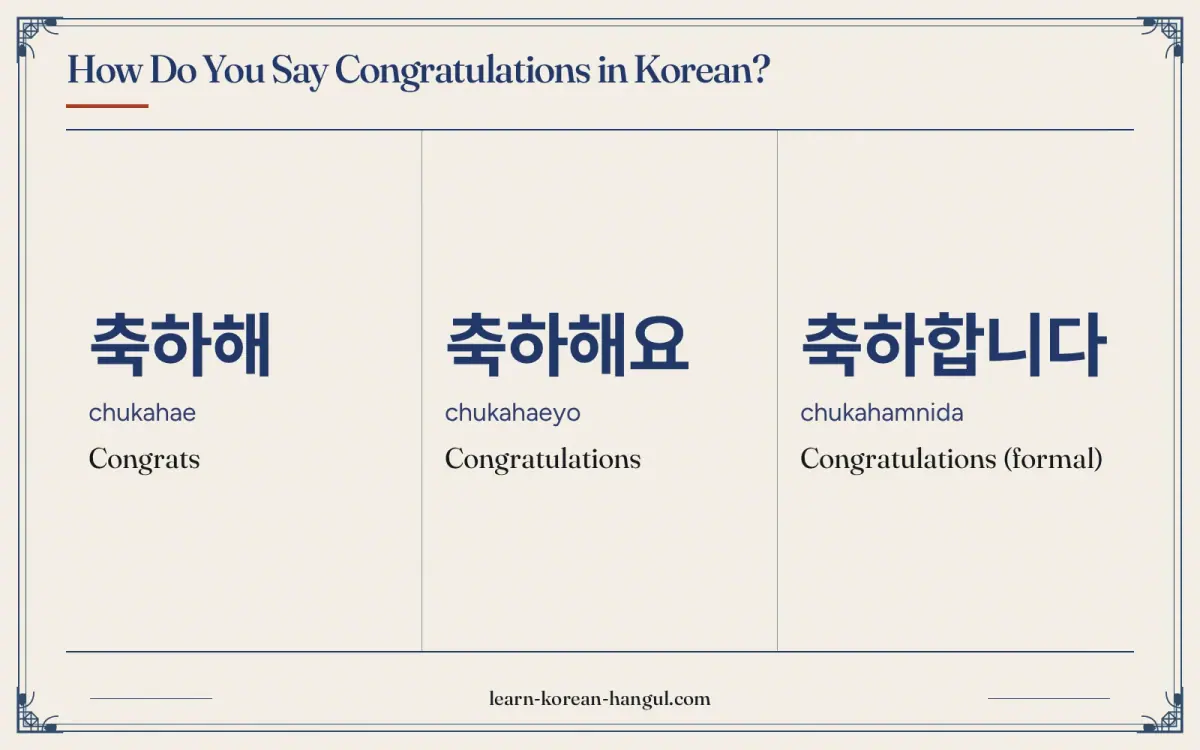
The standard way to say congratulations in Korean is 축하해요, from the noun 축하 (celebration, congratulation) and the verb 하다 (to do) in the polite ending. The whole phrase literally means "I congratulate (you)".
| Listener | Korean | Romanization | Meaning |
|---|---|---|---|
| Friend, sibling, younger person | 축하해 | chukahae | Congrats |
| Coworker, acquaintance | 축하해요 | chukahaeyo | Congratulations |
| Ceremony, speech, card | 축하합니다 | chukahamnida | Congratulations (formal) |
| Boss, teacher, elder | 축하드립니다 | chukadeurimnida | Congratulations (humble) |
| Any, with emphasis | 정말 축하해요 | jeongmal chukahaeyo | Congratulations, truly |
Revised Romanization (the South Korean government standard of 2000) is only a reading aid here. Learn the Hangul first. The next section goes through each form.
What Are the Formal, Polite and Casual Ways to Say Congratulations?
Congratulations has four main forms, and the listener decides which one to use. The noun 축하 stays the same, while the ending and the verb change.
Polite: 축하해요 (chukahaeyo)
Polite · 해요체축하해요 is the default. It is warm and safe with coworkers, neighbours and acquaintances. Name the occasion before it: 졸업 축하해요 means "congratulations on your graduation".
졸업 축하해요!
joreop chukahaeyo
Congratulations on your graduation!
Formal: 축하합니다 (chukahamnida)
Formal · 합쇼체축하합니다 uses the formal ending -ㅂ니다. It is what a host says in a speech, what appears on a printed card and what a presenter says at an award ceremony. The song line 생일 축하합니다 uses it, as shown on the page for happy birthday in Korean.
Humble: 축하드립니다 (chukadeurimnida)
Formal · 합쇼체축하드립니다 replaces 하다 with the humble verb 드리다 (to give respectfully). It is the right choice for bosses, teachers, clients and elders. The softer version is 축하드려요. Learn more about this respect system in the guide to Korean honorifics.
승진 축하드립니다.
seungjin chukadeurimnida
Congratulations on your promotion.
Casual: 축하해 (chukahae)
Casual · 반말축하해 drops the polite -요. It is for friends, siblings, partners and people younger than you. Add 정말 or 진짜 (really) and a compliment to make it warm.
합격 축하해! 정말 대단해.
hapgyeok chukahae! jeongmal daedanhae
Congrats on passing! You're amazing.
For extra warmth in any register, add 정말 (really) before the phrase.
정말 축하해요. 저도 기뻐요.
jeongmal chukahaeyo. jeodo gippeoyo
Congratulations, truly. I'm happy too.
Four forms cover most situations. The sound change in 축하 is the next thing to learn.
How Do You Pronounce 축하해요?
축하해요 is pronounced [추카해요], chu-ka-hae-yo, in four syllables. The key point is that the written ㄱ and ㅎ merge into one aspirated sound.
- 추 (chu): the 축 loses its final ㄱ, and the vowel is a rounded "oo".
- 카 (ka): the ㄱ and the ㅎ merge into an aspirated ㅋ, with a puff of air.
- 해 (hae): a gentle h and the vowel ㅐ.
- 요 (yo): a short, level "yo".
Sound Changes to Listen For
Rules from the Standard Pronunciation (표준 발음법) of the National Institute of Korean Language explain the sound:
- Aspiration (격음화). When ㄱ and ㅎ meet, they merge into ㅋ. So 축하 is [추카], not [축하]. More examples are on the aspiration rules.
- Nasalization in the formal form. In 축하합니다 the ㅂ before ㄴ becomes [ㅁ], giving [추카함니다]. The humble form 축하드립니다 is [추카드림니다].
- Light ㅎ. The ㅎ in 해 and 하 is soft between vowels.
Say "chu-ka", not "chuk-ha", and your congratulations will sound natural. Sound is only half of it, since the occasion is part of the phrase.
How Do You Name the Occasion in a Congratulation?
Koreans put the occasion first and 축하해요 after it. The pattern is noun + 축하해요, with no particle needed in everyday speech.
| Occasion | Korean | Meaning |
|---|---|---|
| Graduation | 졸업 축하해요 | Congratulations on graduating |
| Promotion | 승진 축하드립니다 | Congratulations on your promotion |
| Passing an exam | 합격 축하해요 | Congratulations on passing |
| Wedding | 결혼 축하드립니다 | Congratulations on your wedding |
| New job | 취직 축하해요 | Congratulations on getting a job |
Wedding, birthday and holiday greetings have their own pages: happy birthday in Korean and the wider Korean celebration phrases. This section lets you reuse one pattern for many occasions. The next question is when to use it.
When Should You Use 축하해요, and When Should You Not?
Use 축하해요 for good news that came from effort or a life event. Avoid it when the news is mixed or uncertain, and change the form for elders.
Situations Where It Fits
- A coworker is promoted. 승진 축하해요.
- A friend passes an exam. 합격 축하해!
- A neighbour has a baby. 출산 축하드려요.
- A senior receives an award. 수상 축하드립니다.
Situations to Avoid
- Elders with 축하해요. Use 축하드려요 or 축하드립니다.
- Unconfirmed news. Wait until the result is certain, then congratulate.
- Birthdays with the wrong word. Use 생일 축하해요, not 축하 alone.
- Sensitive events. For a divorce, a layoff or a funeral, 축하 is wrong. See sorry for your loss in Korean.
Two short dialogues show how these forms sound together.
What Does Congratulations Sound Like in a Real Conversation?
축하해요 usually appears right after the good news, and a thank-you follows. Listen for the bright, lively tone on 축하.
A Friend Passes an Exam
Seong-Min
나 시험 합격했어!
na siheom hapgyeokhaesseo
I passed the exam!
Ara
우와, 정말 축하해! 대단하다.
uwa, jeongmal chukahae! daedanhada
Wow, congratulations! That's great.
What to notice: 우와 shows surprise, and 대단하다 praises the effort, not just the result.
A Promotion at Work
Manager
이번에 부장으로 승진했어요.
ibeone bujangeuro seungjinhaesseoyo
I was promoted to department head this time.
Employee
승진 축하드립니다. 정말 잘되셨네요.
seungjin chukadeurimnida. jeongmal jaldoesyeonneyo
Congratulations on your promotion. That's wonderful for you.
What to notice: the employee uses the humble 축하드립니다 and the honorific 되셨네요. That combination shows respect, and it points to the culture around the phrase.
What Should You Know about the Culture behind Congratulations?
Congratulating someone in Korea is both a phrase and a gesture, and the form of the gesture depends on the event.
- Many occasions share one word. Koreans say 축하해요 for births, weddings, promotions and exams, so one pattern covers a wide range of events.
- Wedding gifts are usually cash. Guests commonly bring money in a white envelope (축의금) instead of a physical gift.
- Praise the effort. Friends often add 고생했어 (you worked hard) or 대단해 (you're amazing) to show that they noticed the work behind the result.
- Humility in reply. The person congratulated often answers 감사합니다 or 고마워요, and may add 운이 좋았어요 (I was lucky).
An expert insight: the respectful form changes the verb, not only the ending. 드리다 is a different verb from 하다, so adding -요 to 축하해 will never reach the same level of respect as 축하드려요. The mistakes below come from this gap.
What Mistakes Do Learners Make with Congratulations in Korean?
Most congratulations mistakes are about register and pronunciation.
| Mistake | Why it is a problem | Fix |
|---|---|---|
| 축하해요 to a boss or elder | Not humble enough | Say 축하드립니다 or 축하드려요 |
| Reading 축하 as [축하] | Misses the aspirated ㅋ | Say [추카] |
| Saying 축하 with no occasion | Sounds incomplete | Name the occasion first |
| Using 축하 for sad news | Wrong tone | Use a sympathy phrase |
| Adding -요 to 축하드립니다 | Already humble and formal | Use 축하드려요 for a softer tone |
Learners often assume 축하해요 is enough for everyone. Actually, bosses and elders expect 축하드립니다, and a casual 축하해 can sound abrupt to anyone senior.
Do Congrats and Congratulation Use the Same Korean Word?
Yes. "Congrats in Korean", "congratulation in Korean", "congratulations formal in Korean" and "congratulations casual in Korean" all lead to 축하. The short answers below cover each search.
- Congrats in Korean: 축하해 (casual) or 축하해요 (polite).
- Congratulation in Korean: the singular noun is 축하; the phrase is 축하해요.
- Congratulations formal in Korean: 축하합니다 or 축하드립니다.
- Congratulations casual in Korean: 축하해.
- Good luck: a related wish for the future, on good luck in Korean.
Now practise the four forms with your own voice.
Practice: Say It Aloud
Play the slow clip and repeat 축하해요 three times, with a puff of air on 카. Then choose the right form for each listener. Answers follow.
- Your best friend wins a prize.
- Your manager gets promoted.
- A neighbour you greet in the lift gets married.
- How is 축하 pronounced, and why?
Answers
- 축하해!
- 승진 축하드립니다.
- 결혼 축하드려요.
- [추카]: ㄱ and ㅎ merge into ㅋ.
The phrase flashcards drill all four forms with audio.
Related Phrases to Learn Next
Congratulations is part of a family of celebration phrases.
- Happy birthday in Korean: the birthday greeting, with the song line.
- Good luck in Korean: wishes before an exam, a trip or a new job.
- Cheers in Korean: the toast that follows the good news.
This guide belongs to the Korean celebration phrases collection. What this page does not cover: long written congratulation messages and holiday greetings. Match the form to the listener, and you can say congratulations in Korean for any occasion.
Frequently Asked Questions
How do you say congratulations in Korean?
Say 축하해요 (chukahaeyo) in polite speech. Use 축하합니다 in formal settings, 축하해 with friends and 축하드립니다 with bosses and elders. Name the occasion first for a natural sound, such as 졸업 축하해요 for graduation. The word is pronounced [추카해요], with an aspirated k sound.
How do you pronounce 축하해요?
Say chu-ka-hae-yo, written [추카해요]. The final ㄱ of 축 meets the ㅎ of 하, and the two merge into an aspirated ㅋ that starts the second syllable. So the word is not "chuk-ha". Play the slow clip, and notice the puff of air on the "ka" sound.
What is the difference between 축하해요 and 축하합니다?
Both are polite, and 축하합니다 is the formal version. 축하해요 is the everyday conversational form, with a soft, warm tone. 축하합니다 sounds more official and suits speeches, ceremonies and written cards. With a senior, the humble 축하드립니다 is still more respectful than either of them.
Is 축하해요 formal or casual?
축하해요 is polite and sits in the middle. It suits coworkers, acquaintances and shop staff. The formal form is 축하합니다 and the casual form is 축하해. When the listener is clearly senior, such as a boss or a grandparent, change to 축하드립니다 or 축하드려요 to show respect.
What is the most common mistake with congratulations in Korean?
Saying 축하해요 to an elder, when the humble 축하드려요 or 축하드립니다 is expected. A second mistake is reading 축하 as [축하] and missing the real sound [추카]. A third is saying 축하 on its own without the occasion, which sounds incomplete in many situations.