기념일 축하해요
기념일 축하해요
What you'll learn
- Say 기념일 축하해요, 결혼기념일 축하드립니다 and 100일 축하해 and match each one to a listener.
- Pronounce 축하해요 as [추카해요] and 100일 as [배길].
- Congratulate a couple, a senior and a partner in three short scenes.
- Avoid the most common mistake, which is using 생일 for an anniversary.
Before you start: you only need basic Hangul and the polite ending 요. If you also want the birthday wish, see happy birthday in Korean. Time: about 12 minutes. Audio plays only when you press a button.
How Do You Say Happy Anniversary in Korean?
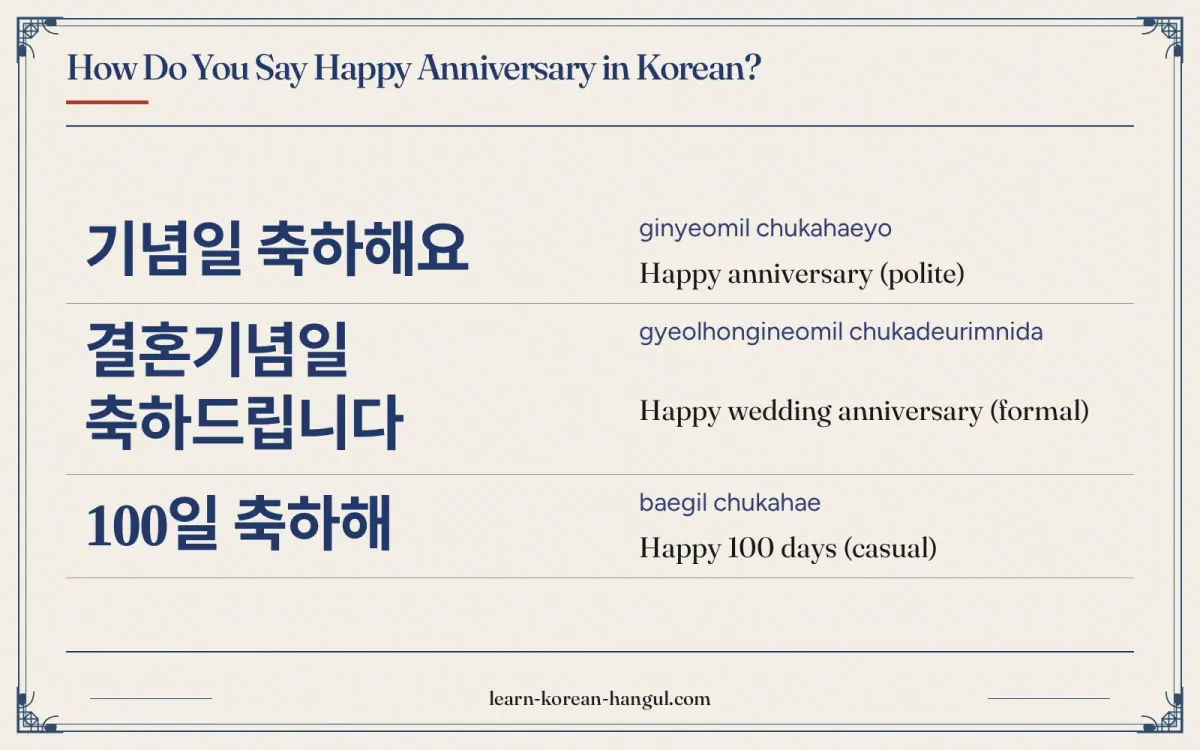
The most useful way to say happy anniversary in Korean is 기념일 축하해요. Word by word, 기념일 (ginyeomil) means "anniversary" or "memorial day", and 축하해요 (chukahaeyo) means "congratulations". Korean does not use the English word "happy" here. It congratulates the occasion instead.
| Korean | Romanization | Meaning | Where you hear it |
|---|---|---|---|
| 기념일 축하해요 | ginyeomil chukahaeyo | Happy anniversary (polite) | Peers, coworkers, friends |
| 결혼기념일 축하드립니다 | gyeolhongineomil chukadeurimnida | Happy wedding anniversary (formal) | Seniors, teachers, bosses |
| 100일 축하해 | baegil chukahae | Happy 100 days (casual) | New couples, close friends |
Revised Romanization (the South Korean government standard of 2000) is only a reading aid here. Learn the Hangul first. The next section shows how to choose between the forms.
What Are the Formal, Polite and Casual Ways to Say Happy Anniversary?
Happy anniversary in Korean has formal, polite and casual choices, and the listener decides. The occasion is the same, but the ending changes how much respect you show.
Polite: 기념일 축하해요 (ginyeomil chukahaeyo)
Polite · 해요체기념일 축하해요 is the safe default. Use it with a coworker who married last year, a neighbour or a friend you see sometimes. It names the occasion and congratulates, so the listener knows exactly why you are speaking.
오늘 기념일이죠? 기념일 축하해요!
oneul ginyeomirijyo? ginyeomil chukahaeyo
Today is your anniversary, right? Happy anniversary!
Formal: 결혼기념일 축하드립니다 (gyeolhongineomil chukadeurimnida)
Formal · 합쇼체결혼 (gyeolhon) means "marriage", so 결혼기념일 is a wedding anniversary. 축하드립니다 uses 드리다 (deurida), the humble form of "to give". It lifts the listener and lowers the speaker, so it suits a teacher, a boss or a senior couple.
선생님, 결혼기념일 축하드립니다.
seonsaengnim, gyeolhongineomil chukadeurimnida
Teacher, happy wedding anniversary.
A softer polite version is 축하드려요 (chukadeuryeoyo). Children can say it to their parents.
부모님, 결혼기념일 축하드려요.
bumonim, gyeolhongineomil chukadeuryeoyo
Mom and Dad, happy wedding anniversary.
Casual: 100일 축하해 (baegil chukahae)
Casual · 반말100일 (baegil) means "100 days". New couples count days from the day they started dating, so 100일 is a first milestone. The casual 축하해 drops the polite ending, so it is for partners and close friends.
우리 벌써 100일이야! 100일 축하해!
uri beolsseo baegiriya! baegil chukahae
It's already our 100 days! Happy 100 days!
Choosing a form is half the job. The other half is saying 축하해요 with the right sounds, which the next section breaks down.
How Do You Pronounce 기념일 축하해요?
기념일 축하해요 is pronounced [기녀밀 추카해요]. The phrase has two words and seven syllables, and both words hide a sound change. Play the slow clip and follow along.
- 기 (gi): a plain ㄱ and ㅣ.
- 념 (nyeom): ㄴ plus a y glide, ㅓ with relaxed lips, and a final ㅁ that moves forward.
- 일 (il): a short ㅣ and a light ㄹ; it picks up the ㅁ, so you hear "mil".
- 축 (chuk): an aspirated ㅊ, with a puff of air, and ㅜ.
- 하 (ha): the ㅎ blends with the ㄱ before it.
- 해 (hae): ㅎ and ㅐ.
- 요 (yo): a short, light ending.
Sound Changes to Listen For
- ㄱ + ㅎ becomes ㅋ. The final ㄱ of 축 meets the ㅎ of 하, and the two make an aspirated ㅋ (Standard Pronunciation Rules, Article 12). So 축하해요 sounds like [추카해요]. The Revised Romanization of the verb forms shows it as chukahaeyo, while the noun 축하 alone is written chukha.
- Linking in 기념일. The ㅁ at the end of 념 slides into the vowel of 일, so you hear [기녀밀].
- Reading 100일. 100일 is the Sino-Korean number 백 (baek) plus 일 (il, "day"), so it is 백일. The ㄱ at the end of 백 links to the vowel of 일, giving [배길]. With the particle, 100일이야 sounds like [배기리야].
- Nasal sound in 드립니다. The ㅂ turns into ㅁ before ㄴ, so 드립니다 is [드림니다] (Article 18). Revised Romanization writes deurimnida.
The most common slip is to say the ㄱ and the ㅎ of 축하 as two separate sounds ("chuk-ha"). Blend them: [추카]. Once the sound is right, the next question is when to say it.
When Should You Use 기념일 축하해요, and When Should You Not?
Use 기념일 축하해요 for an anniversary of a couple, a friendship or a company that you know about. Use the formal form for senior listeners, and the casual form for partners and close friends. The key difference is who is listening: the same occasion needs a different ending for a boss and for a partner.
Situations Where It Fits
- A coworker's wedding anniversary. You see it on a shared calendar and say 기념일 축하해요.
- A teacher or a senior couple. You say 결혼기념일 축하드립니다 in person or in a card.
- Your own 100 days. You and your partner say 100일 축하해 to each other.
- A parents' anniversary. You say 결혼기념일 축하드려요 over dinner.
Situations to Avoid
- Using 생일. 생일 means "birthday", not anniversary.
- Casual 축하해 with a boss. It drops the polite ending and sounds too familiar.
- Mentioning it when you are not sure. If you do not know the date, wait. It is better to say nothing than to say the wrong day.
Short scenes make these choices clearer. The next section shows three real exchanges.
What Does Happy Anniversary Sound Like in a Real Conversation?
Anniversary talk is short and warm. Listen for the occasion word in each dialogue.
A Couple on Their 100th Day
Ha-Na
오빠, 오늘 무슨 날인지 알아?
oppa, oneul museun narinji ara
Oppa, do you know what day it is today?
Min-Su
당연하지. 100일이잖아.
dangyeonhaji. baegirijanha
Of course. It's our 100 days.
Ha-Na
100일 축하해!
baegil chukahae
Happy 100 days!
Min-Su
나도 100일 축하해.
nado baegil chukahae
Happy 100 days to you too.
What to notice: both speakers drop the ending 요, because they are a couple. 오빠 (oppa) is what a woman calls an older man she is close to. The ending -잖아 (janha) means "as you know".
Two Colleagues at Work
Ji-Hyeon
민수 씨, 오늘 결혼기념일이죠?
minsu ssi, oneul gyeolhongineomirijyo
Min-su, today is your wedding anniversary, right?
Min-Su
네, 어떻게 아셨어요?
ne, eotteoke asyeosseoyo
Yes, how did you know?
Ji-Hyeon
달력에서 봤어요. 기념일 축하해요!
dallyeogeseo bwasseoyo. ginyeomil chukahaeyo
I saw it on the calendar. Happy anniversary!
Min-Su
감사해요.
gamsahaeyo
Thank you.
What to notice: Ji-hyeon uses the polite 기념일 축하해요. Min-su asks 어떻게 아셨어요? with the honorific -시- to show respect for the person who remembered.
Congratulating a Teacher
Student
선생님, 결혼기념일 축하드립니다.
seonsaengnim, gyeolhongineomil chukadeurimnida
Teacher, happy wedding anniversary.
Teacher
고마워요. 정말 기뻐요.
gomawoyo. jeongmal gippeoyo
Thank you. I'm really happy.
What to notice: the student uses the formal 축하드립니다 with the title 선생님. The teacher answers in the plain polite style, which is normal for a teacher speaking to a student.
What Should You Know about the Culture behind Happy Anniversary?
Anniversaries in Korea come in two main kinds, and the habits are general, so couples and families differ.
- Counting days. Many couples count days from the start of dating and celebrate 100일, 200일 and 1주년 (iljunyeon, "one year"), often with gifts. A day count is read with Sino-Korean numbers, so 200일 is 이백일 (ibaegil).
- Wedding anniversaries. Families mark 결혼기념일, and children often congratulate their parents with a card, a meal or a gift.
- A second meaning of 100일. 백일 (baegil) is also a baby's 100th day, which families celebrate. Context tells you which one is meant.
- Reminders. People often note dates on a calendar or a phone, so a colleague may know your anniversary.
An expert tip: name the occasion every time. Because 축하해요 alone only says "congratulations", adding 기념일 or 100일 removes any doubt. For the structure behind the endings, see Korean speech levels, which explains why 요 and 드립니다 mark different levels. For other occasions, congratulations in Korean covers the general phrase.
What Mistakes Do Learners Make with Happy Anniversary in Korean?
Most mistakes come from the wrong noun or the wrong ending.
| Mistake | Why it is a problem | Fix |
|---|---|---|
| Saying 생일 축하해요 | It is a birthday wish | Say 기념일 축하해요 |
| Saying 축하해요 alone | It does not say what the occasion is | Add 기념일 or 100일 |
| Saying "chuk-ha" with two sounds | The sound is [추카] | Blend ㄱ and ㅎ into ㅋ |
| Using 축하해 with a boss | It drops the polite ending | Use 축하드립니다 |
| Saying 100일 as "baek il" | The sound links to [배길] | Link the ㄱ forward |
| Using English "happy" | Korean congratulates the occasion | Use 축하해요 |
Learners often think there must be a word for "happy". In Korean, 축하 means "congratulate", and the occasion word completes the idea.
Is It the Same as Anniversary, 100 Days or Wedding Anniversary?
Mostly yes. These searches all point to the same small set of phrases, with a few differences in the noun.
- Anniversary in Korean: 기념일 (ginyeomil). For a yearly anniversary, use 주년 (junyeon), as in 1주년 (iljunyeon, "first anniversary").
- 100 days in Korean: 백일 (baegil) or 100일. For a couple, 100일 축하해. For a baby, 백일 축하해요 (baegil chukahaeyo) goes to the parents.
- Wedding anniversary in Korean: 결혼기념일 (gyeolhongineomil), and the wish is 결혼기념일 축하해요 or 축하드립니다.
Practice: Say It Aloud
Play the slow clip and repeat 기념일 축하해요 three times, then choose the best wish for each person. Answers follow.
- A coworker's wedding anniversary.
- Your partner on your 100th day.
- A teacher's wedding anniversary.
- How is 축하해요 pronounced?
Answers
- 기념일 축하해요.
- 100일 축하해.
- 결혼기념일 축하드립니다.
- [추카해요]: the ㄱ and ㅎ blend into ㅋ.
The phrase flashcards drill these wishes with audio.
Related Phrases to Learn Next
Anniversary wishes connect to several celebration phrases.
- happy birthday in Korean: the wish you should not mix up with this one.
- i love you in Korean: what couples often add on the day.
- congratulations in Korean: the general phrase for any good news.
This guide belongs to the korean celebration phrases collection. What this page does not cover: anniversary gift customs, card wording and company anniversaries. Learn 기념일 축하해요 for peers, 결혼기념일 축하드립니다 for seniors and 100일 축하해 for partners, and you can say happy anniversary in Korean to anyone.
Frequently Asked Questions
How do you say happy anniversary in Korean?
Say 기념일 축하해요 (ginyeomil chukahaeyo) in a polite setting. For a wedding anniversary, use 결혼기념일 축하해요, or 결혼기념일 축하드립니다 to a senior couple. For new couples celebrating 100 days, friends say 100일 축하해. The noun 기념일 means "anniversary" and 축하해요 means "congratulations".
How do you pronounce 기념일 축하해요?
It is pronounced [기녀밀 추카해요]. The ㅁ in 기념일 links to the vowel of 일, and the ㄱ of 축 joins the ㅎ of 하 to make an aspirated ㅋ. Revised Romanization writes ginyeomil chukahaeyo. The noun 축하 alone is written chukha, but the verb forms show the aspiration.
What is the difference between 기념일 축하해요 and 결혼기념일 축하드립니다?
기념일 축하해요 is polite and general: it fits any anniversary and is said to peers. 결혼기념일 축하드립니다 is formal and is for a wedding anniversary, usually said to a senior couple. The verb 드리다 is the humble form of 주다 (to give), so it shows respect. In everyday speech, 축하드려요 is a softer polite choice.
Is 기념일 축하해요 formal or casual?
It is polite. The ending 요 makes it fit most adults, including coworkers and neighbours. It is not the most formal form. The casual version is 기념일 축하해, for partners and friends, and the formal version is 축하드립니다, for seniors.
Can I use 기념일 축하해요 with friends, elders and strangers?
Yes for coworkers and acquaintances. With a partner or close friend, drop the 요 and say 기념일 축하해. For an older person or a boss, say 결혼기념일 축하드립니다 or 축하드려요. Strangers rarely mention anniversaries, so you will mostly use the form with people you know.
What is the most common mistake with happy anniversary in Korean?
Using 생일 (saengil, birthday) for an anniversary, or saying 축하해요 with no noun. 생일 is only for birthdays, and 축하해요 alone just means "congratulations", so the listener does not know what the occasion is. Add 기념일 or 100일 to be clear.