
What Are the Most Useful Korean Dialogues to Learn First?
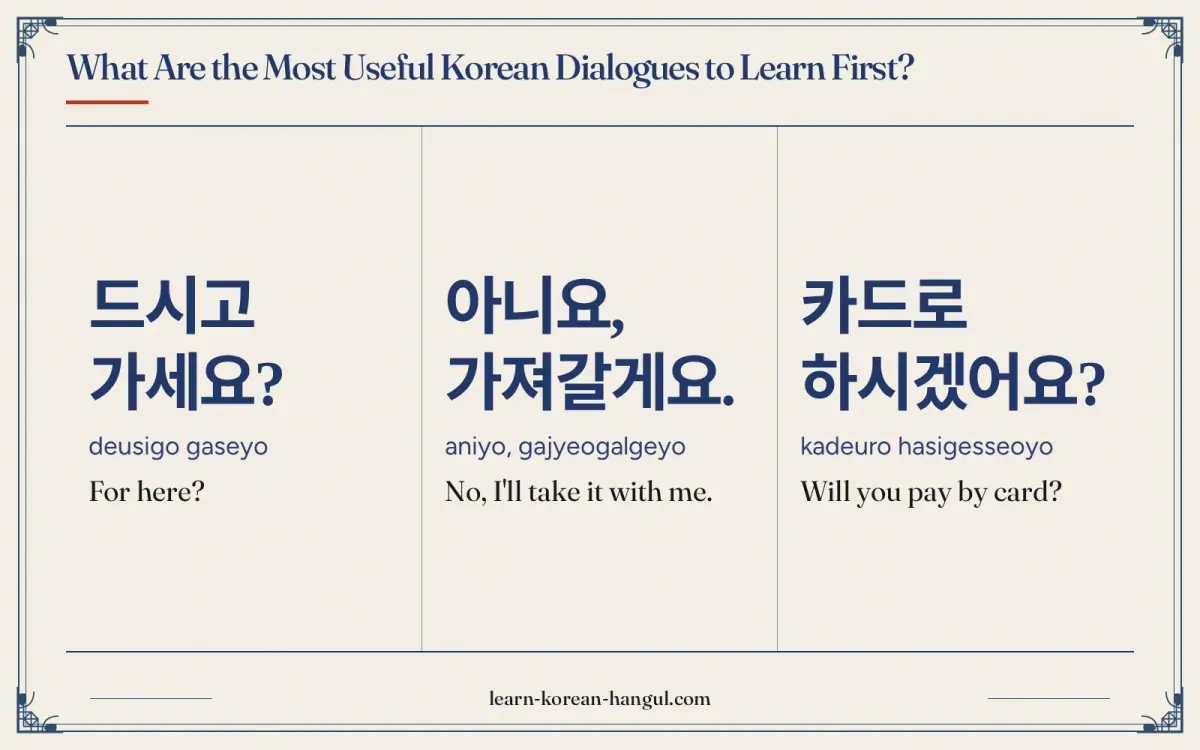
Learn the cafe order first, then directions, then the restaurant, because each one adds a new skill: ordering with a number, asking where something is, and calling a server. The three scripts below give the core lines for each situation.
Dialogue 1: a Cafe Order
| Speaker | Korean | Revised Romanization | Meaning |
|---|---|---|---|
| Customer | 아이스 아메리카노 한 잔 주세요. | aiseu amerikano han jan juseyo | One iced Americano, please. |
| Staff | 드시고 가세요? | deusigo gaseyo | For here? |
| Customer | 아니요, 가져갈게요. | aniyo, gajyeogalgeyo | No, I'll take it with me. |
| Staff | 카드로 하시겠어요? | kadeuro hasigesseoyo | Will you pay by card? |
| Customer | 네, 카드로 할게요. | ne, kadeuro halgeyo | Yes, I'll pay by card. |
The learner's lines are the customer's. The staff lines 드시고 가세요? and 카드로 하시겠어요? are questions to recognise, not to say. See Order Coffee in Korean.
Dialogue 2: Asking for Directions
| Speaker | Korean | Revised Romanization | Meaning |
|---|---|---|---|
| Traveller | 실례합니다, 지하철역이 어디예요? | sillyehamnida, jihacheollyeogi eodiyeyo | Excuse me, where is the subway station? |
| Passer-by | 저쪽으로 쭉 가세요. | jeojjogeuro jjuk gaseyo | Go straight that way. |
| Traveller | 감사합니다. | gamsahamnida | Thank you. |
실례합니다 (sillyehamnida, "excuse me") gets attention before a question. See Asking for Directions in Korean.
Dialogue 3: Ordering Food
| Speaker | Korean | Revised Romanization | Meaning |
|---|---|---|---|
| Customer | 여기요! | yeogiyo | Excuse me! |
| Server | 네, 주문하시겠어요? | ne, jumunhasigesseoyo | Yes, would you like to order? |
| Customer | 김치찌개 하나 주세요. | gimchijjigae hana juseyo | One kimchi stew, please. |
여기요 is how Koreans call a server across the room, and it is not rude. See Ordering Food in Korean.
The next section explains how to use these scripts without memorising them.
How Do You Choose between Formal, Polite and Casual Korean Dialogues?
Use the polite style (해요체) for your own lines in every script, and expect staff to answer in honorific or formal forms (합쇼체). The page on Korean speech levels explains both. Staff and helpful passers-by add the honorific -시- for the customer, so you will hear 하시겠어요? and 가세요 while you answer in the plain polite 요 style.
| Role | Style you will hear or say | Example |
|---|---|---|
| Customer, learner's lines | Polite 요 style | 주세요, 어디예요? |
| Staff or passer-by, lines to recognise | Honorific or formal style | 하시겠어요?, 주문하시겠습니까? |
| Friend, casual scene | Casual style (반말) | 커피 마실래? |
Reading a Dialogue Once for Meaning
Read the dialogue once in English to know the purpose of each line. Then read the Hangul alone, without the Romanization. Play the audio last, because hearing a script you already understand makes the sounds stick.
Which Lines Are Yours and Which Are the Staff's?
The customer's lines are the ones you say: 주세요, 가져갈게요, 어디예요. The staff's lines are scripts that shops repeat daily: 드시고 가세요?, 카드로 하시겠어요?, 주문하시겠어요?. Recognise them by their honorific ending -시-, which a customer never uses about themselves.
Which Script Fits Which Goal
| Goal | Script | New skill | Key line |
|---|---|---|---|
| Buy a drink or snack | Order coffee | Counting with 한 잔 and answering a choice question | 아이스 아메리카노 한 잔 주세요 |
| Find a place | Asking for directions | The question word 어디 and direction words | 지하철역이 어디예요? |
| Eat out | Ordering food | Calling staff and ordering by dish | 김치찌개 하나 주세요 |
These three scripts are a starting set, not a full course. Real conversations vary with the shop, the speaker and the day, so expect extra words such as 좀 ("a little") or 혹시 ("by any chance") in live speech. Treat each script as a safe model that you adapt, and use the guides to learn the follow-up questions that staff ask.
The cards below list every guide in the cluster.
All Korean Dialogues Guides
The list has all 3 guides, each with its lead line and an audio clip. Start with the cafe, since it is the shortest. The Korean conversation hub holds the other conversation clusters.
Start Here
Asking for Directions
The key phrase is 실례합니다, 지하철역이 어디예요? (sillyehamnida, jihacheollyeogi eodiyeyo), which means "excuse me, where is the subway station?" 실례합니다 opens the question politely, and 지하철역 is the word for a subway station.
Order Coffee
The key phrase is 아이스 아메리카노 한 잔 주세요 (aiseu amerikano han jan juseyo), which means "one iced Americano, please." 한 잔 counts one cup with the native number 한, so two drinks are 두 잔.
Ordering Food
The key phrase is 여기요 (yeogiyo), which means "excuse me (calling staff)." Say it first, then order by dish and number, as in 김치찌개 하나 주세요 (one kimchi stew, please).
How Do You Practise Korean Dialogues?
A dialogue works best when you play one side and let the audio play the other. Use this routine for ten minutes:
- Play the full script of one dialogue and follow the Hangul.
- Play it again and say the learner's lines aloud with the audio.
- Say the learner's lines alone, and read the staff lines silently.
- Change one detail: a hot coffee, another station, another dish.
- Review the lines with the phrase flashcards, which pair each phrase with audio.
Switching one detail tests whether you understand the pattern or only remember the script. After a few rounds, check yourself against the mistakes below.
What Mistakes Do Learners Make with Korean Dialogues?
Learners most often memorise a whole script and freeze when the other person changes a line. Four mistakes appear again and again:
- Learning only your own lines. The staff will ask follow-up questions. Fix: learn to recognise 드시고 가세요? and 카드로 하시겠어요?.
- Using 주세요 in every sentence. It means "please give me" and does not fit a question. Fix: use 어디예요? for places.
- Leaving out the opener. Starting without 실례합니다 or 여기요 sounds abrupt. Fix: begin with the opener.
- Mixing honorific forms into your own lines. Fix: use -시- only for the other person.
Each fix comes from knowing who says what, which is the first skill in Korean dialogues. The questions below cover details that the cards do not.
Frequently Asked Questions
These answers add details about Korean dialogues beyond the guides above.
How do I practise Korean dialogues?
Play a script, follow the Hangul, then say your lines aloud with the audio while the other voice plays. Next, say your lines alone and read the other side silently. Change one detail, such as the drink or the station, so you practise the pattern instead of one memorised sentence. Repeat the script on three different days.
Which Korean dialogue should I start with?
Start with the cafe order, because it is short and uses only a number pattern and 주세요. Move to directions next, which adds a question word, 어디. Finish with the restaurant, which adds calling the server with 여기요. The order matches the way each script adds one new skill to the last.
Can I play only my part in a dialogue?
Yes. The audio for each guide plays the whole script, and the guides mark which lines belong to the learner. Play it once to hear both sides, then say only the customer lines while you listen to the staff lines. This builds listening and speaking together, as a real conversation does.
Are the scripts natural?
The scripts use common polite forms that staff and customers say daily, such as 주세요 and 어디예요?, but real speech varies by place and speaker. A Korean teacher checks the Korean before publication. Treat each script as a safe model, and expect extra words such as 좀 or 혹시 in live speech.
What if the staff ask something I did not learn?
Say 다시 말해 주세요 ("please say it again") or 천천히 말해 주세요 ("please speak slowly"). Staff usually repeat with simpler words or gestures. You can also point at the menu and say 이거 주세요 ("this one, please"). A calm, polite request for a repeat is always better than guessing.