실례합니다, 지하철역이 어디예요?
실례합니다, 지하철역이 어디예요?
What you'll learn
- Ask where a place is, and open with a polite attention word.
- Understand the short answer 쭉 가서 왼쪽이에요.
- Thank the person and ask follow-up questions about distance and exits.
- Hear the ㄴ-insertion in 지하철역이.
Before you start: you need to read Hangul; romanization is shown as an aid and can be hidden. Time: about 10 minutes. Audio plays only when you press a button.
Key facts
- 저기요 is a lighter way to get a stranger's attention.
How Do You Say Asking for Directions in Korean?
To ask for directions in Korean, get attention, name the place and ask "where". Put it together as: 실례합니다 (excuse me) + the place + 이 + 어디예요? (where is it?). So the pattern is "Excuse me, where is the ___?".
| Part | Korean | Meaning |
|---|---|---|
| Attention | 실례합니다 | Excuse me |
| Place | 지하철역이 | the subway station (topic) |
| Question | 어디예요? | Where is it? |
| Answer | 쭉 가서 왼쪽이에요 | Go straight and it is on the left |
You can swap 지하철역 for any place: 화장실 (toilet), 버스 정류장 (bus stop), 은행 (bank). A question with 어디 does not end with a sharp rise; the pitch usually falls, or rises and falls a little. The next section shows each form in a sentence.
What Are the Formal and Polite Ways to Say Asking for Directions?
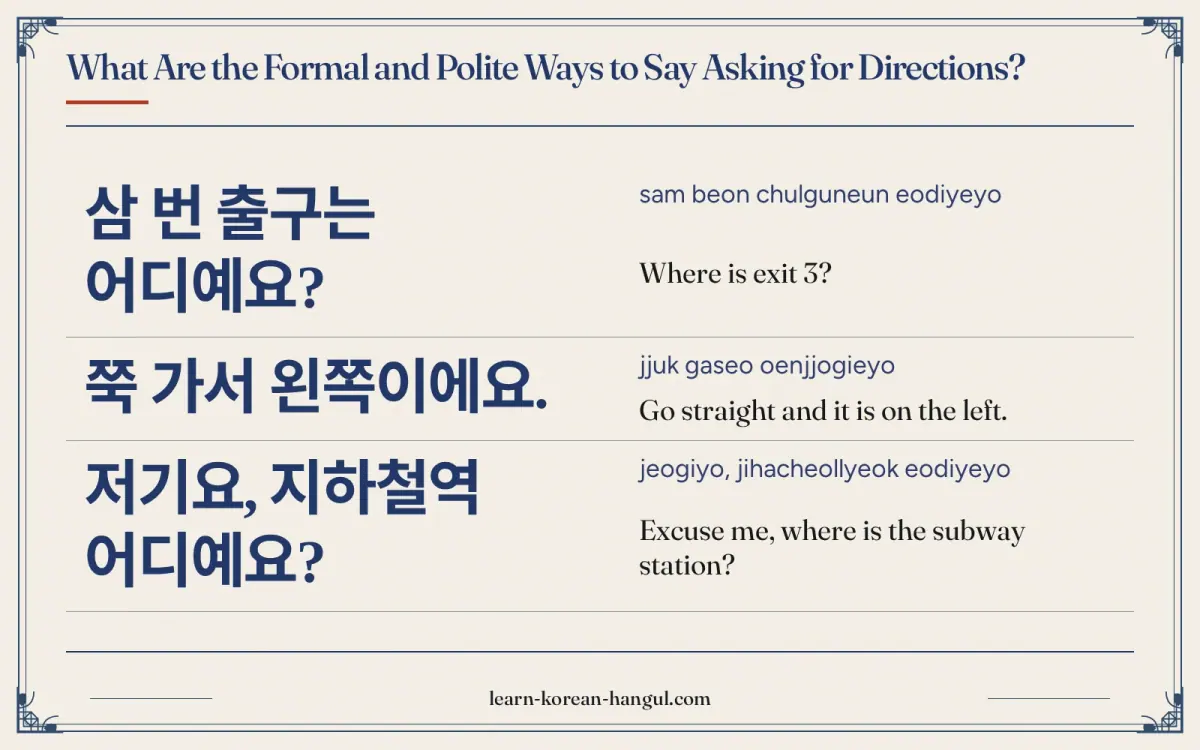
The question stays the same, and the opener changes the tone. The sentence endings follow the Korean speech levels.
Formal: 실례합니다, 지하철역이 어디예요? (sillyehamnida jihacheollyeogi eodiyeyo)
Formal · 합쇼체실례합니다 is a formal opener, and the question after it uses the ordinary polite ending 예요. The mix is natural: formal to catch attention, polite to ask.
삼 번 출구는 어디예요?
sam beon chulguneun eodiyeyo
Where is exit 3?
Polite: 쭉 가서 왼쪽이에요 (jjuk gaseo oenjjogieyo)
Polite · 해요체This is the typical answer. 쭉 가서 means "go straight and then", from 가다 plus -아/어서, which chains an action to its result. 이에요 closes the sentence and tells you where the place is: on the left.
쭉 가서 왼쪽이에요.
jjuk gaseo oenjjogieyo
Go straight and it is on the left.
Formal: 감사합니다 (gamsahamnida)
Formal · 합쇼체감사합니다 is the formal "thank you". Say it as the person walks away or after the last step.
Polite: 저기요, 지하철역 어디예요? (jeogiyo jihacheollyeok eodiyeyo)
Polite · 해요체저기요 is a lighter way to get attention, and it works for staff and strangers alike. Dropping the 이 after 지하철역 is common in speech and sounds lighter.
저기요, 지하철역 어디예요?
jeogiyo, jihacheollyeok eodiyeyo
Excuse me, where is the subway station?
Follow-Ups: Distance and Crossing
Polite · 해요체Two short questions are very useful. 여기에서 가까워요? asks if the place is close. The answer may name a crosswalk (횡단보도) to cross.
여기에서 가까워요?
yeogieseo gakkawoyo
Is it close to here?
횡단보도를 건너서 오른쪽이에요.
hoengdanbodoreul geonneoseo oreunjjogieyo
Cross the crosswalk and it is on the right.
The forms are set. Saying the question with the right sound changes is the next step.
How Do You Pronounce 실례합니다, 지하철역이 어디예요?
The question is pronounced [실례함니다, 지하철려기 어디예요], sillyehamnida, jihacheollyeogi eodiyeyo. Say it as two phrases, with a short pause after the comma.
- 실례합니다 (sillyehamnida): a tight ㄹ sound in the middle, and ㅁ at the end of 함.
- 지하철역이 (jihacheollyeogi): the longest word, said with a long ㄹ sound.
- 어디예요 (eodiyeyo): an open "uh", then "dee", then "yeh-yo".
Sound Changes to Listen For
Three places in the question sound different from the spelling:
- 지하철역이 [지하철려기]. The word 역 starts with a y-sound after a consonant, so a ㄴ is added. After the ㄹ of 철, that ㄴ becomes ㄹ, and the written ㄱ links to 이.
- 왼쪽이에요 [왼쪼기에요]. The final ㄱ of 쪽 moves onto 이, so you hear 쪼기.
- 실례합니다 [실례함니다]. The ㅂ meets the ㄴ and is said as ㅁ. In 실례, two ㄹ sounds meet and make one long ㄹ.
Revised Romanization, the official system for writing Korean in Latin letters, writes these as they sound: jihacheollyeogi and oenjjogieyo. These rules are explained in Korean liaison and n-insertion. Knowing whom to ask matters more than the spelling, as the next section shows.
When Should You Use 실례합니다, 지하철역이 어디예요?, and When Should You Not?
Use it with strangers, staff and anyone older than you. Use 저기요 and a shorter question when the street is busy or when you want a lighter tone.
Situations Where It Fits
- A stranger on the street. 실례합니다 stops a person politely.
- Station staff. The formal opener suits an information desk.
- A shop assistant. Ask for the nearest station or toilet.
Situations to Avoid
- Calling out in a loud voice from far away. Walk close, then ask.
- An apology word. Do not open with 미안합니다; it says "I am sorry".
- A friend. Between friends, a casual 지하철역 어디야? is enough.
These choices are easier to feel in real exchanges, so here are three.
What Does Asking for Directions Sound Like in a Real Conversation?
The question is short, the answer is a direction, and the thanks closes it. Listen for how the local shortens the answer.
Asking the Way to the Station
Visitor
실례합니다, 지하철역이 어디예요?
sillyehamnida, jihacheollyeogi eodiyeyo
Excuse me, where is the subway station?
Local
쭉 가서 왼쪽이에요.
jjuk gaseo oenjjogieyo
Go straight and it is on the left.
Visitor
감사합니다.
gamsahamnida
Thank you.
What to notice: the local gives the whole answer in one short sentence, and the visitor thanks them.
Finding the Right Exit
Visitor
저기요, 삼 번 출구는 어디예요?
jeogiyo, sam beon chulguneun eodiyeyo
Excuse me, where is exit 3?
Staff
저쪽 끝에 있어요.
jeojjok kkeute isseoyo
It is at the far end over there.
What to notice: Korean subway stations number their exits, so a question like 삼 번 출구는 어디예요? is very common. The staff member answers with a place, not a turn.
Asking How Far It Is
Visitor
여기에서 가까워요?
yeogieseo gakkawoyo
Is it close to here?
Local
네, 횡단보도를 건너서 오른쪽이에요.
ne, hoengdanbodoreul geonneoseo oreunjjogieyo
Yes, cross the crosswalk and it is on the right.
What to notice: the visitor asks a simple yes/no question first, and the local replies with 네 and a full direction.
What Should You Know about the Culture behind Asking for Directions?
In Korea you usually ask a stranger politely, then thank them. Directions are often given with landmarks as well as turns.
- Map apps. Many people use local map apps such as Naver Map or Kakao Map to find a place. Even so, people stop to ask.
- Exit numbers. Subway stations have numbered exits. Knowing the exit number is often the fastest way to find a place.
- Landmarks. Locals often name a bank, a convenience store or a pharmacy instead of street names.
- Politeness. A short thanks such as 감사합니다 is expected after the answer.
An expert insight: learners often think the key part is the question. Actually, the answer is harder, because it comes in a fast chain of directions with a verb at the end. Practise by listening to the answer, as in the Korean directions dialogue audio. The common mistakes below come from opening words and left–right confusion.
What Mistakes Do Learners Make with Asking for Directions in Korean?
Most mistakes come from the opener, a missing ending, or a direction mix-up.
| Mistake | Why it is a problem | Fix |
|---|---|---|
| Opening with 미안합니다 | It apologises instead of getting attention | Say 실례합니다 or 저기요 |
| Saying 지하철역 어디 only | Sounds clipped | Add 예요: 어디예요? |
| Swapping 왼쪽 and 오른쪽 | You walk the wrong way | Repeat it back: 왼쪽이요? |
| Writing 지하철려기 | Spelling stays 지하철역이 | Keep the spelling and say the sound |
| Rising sharply on 어디 | Sounds like "somewhere?" | Let the pitch fall or rise and fall |
Learners often assume a polite question needs 습니다 endings. Actually, the polite 예요 ending is right for strangers, and the formal 실례합니다 only opens the question.
Other Ways People Search for Asking for Directions in Korean
People search for asking for directions in Korean in several ways. The short answers below cover each one.
- Ask directions in Korean: 실례합니다, ...이/가 어디예요? is the standard way, with any place.
- Direction dialogue in Korean: a complete sample is in the Korean directions dialogue audio, and more are in Korean dialogues.
- Where is the station: see where is the subway station in Korean.
Reading the rules is one thing; producing the right sentence on cue is another, so practise now.
Practice: Say It Aloud
Play the slow clip of the question, repeat it three times, then try the answer 쭉 가서 왼쪽이에요. Then choose a sentence for each situation. Answers follow.
- You ask a stranger where the bus stop is.
- You ask how to get to exit 3.
- A local says "go straight and it is on the right". Write it.
- You want to thank them.
Answers
- 실례합니다, 버스 정류장이 어디예요?
- 저기요, 삼 번 출구는 어디예요?
- 쭉 가서 오른쪽이에요.
- 감사합니다.
Drill the question and the related phrases with the phrase flashcards, which include audio for each form.
Related Phrases to Learn Next
Asking is only the first step. These pages cover the rest of the route.
- Where is the subway station in Korean: the same question in more detail.
- Go straight in Korean: the most common direction.
- How do I get to in Korean: a question for longer trips.
This guide belongs to the Korean dialogues collection. What this page does not cover: bus and taxi directions, and street addresses. Open with 실례합니다, ask 어디예요?, repeat the direction back, and you will manage asking for directions in Korean.
Frequently Asked Questions
How do you say asking for directions in Korean?
Say 실례합니다, 지하철역이 어디예요? (sillyehamnida, jihacheollyeogi eodiyeyo), "Excuse me, where is the subway station?". Replace 지하철역 with any place. 실례합니다 gets attention, and 어디예요 asks "where is it?". The usual answer is a short direction such as 쭉 가서 왼쪽이에요.
How do you pronounce 실례합니다, 지하철역이 어디예요?
Say [실례함니다, 지하철려기 어디예요]. In 실례합니다, ㅂ becomes ㅁ before ㄴ. In 지하철역이, an extra ㄴ appears before 역, becomes ㄹ after 철, and the final ㄱ links to 이. The Revised Romanization is sillyehamnida, jihacheollyeogi eodiyeyo.
What is the difference between 실례합니다, 지하철역이 어디예요? and 쭉 가서 왼쪽이에요?
The first is the question a visitor asks, and the second is a typical answer a local gives. The question names the place and asks 어디예요. The answer says "go straight" with 쭉 가서 and states where the place is with 왼쪽이에요. Together they make one short exchange.
Is 실례합니다, 지하철역이 어디예요? formal or casual?
It mixes two levels. 실례합니다 is formal and gets attention, while 지하철역이 어디예요? uses the ordinary polite ending 예요. The mix suits strangers. For a lighter tone, replace the opener with 저기요. Between friends, use the casual 지하철역 어디야?.
Can I use 실례합니다, 지하철역이 어디예요? with friends, elders and strangers?
Yes with strangers and elders, because it is polite and respectful. It is too formal for close friends, who would say 지하철역 어디야?. With staff at a desk, it is ideal. For a very casual street question, 저기요, 지하철역 어디예요? is lighter.
What is the most common mistake with asking for directions in Korean?
The most common mistake is opening with 미안합니다, which is an apology, not an attention word. Use 실례합니다 or 저기요. The second is leaving off 예요 and saying only 지하철역 어디. A third is mixing up 왼쪽 (left) and 오른쪽 (right), so repeat the direction back to check.