
What Are the Most Useful Korean Conversation Phrases to Learn First?
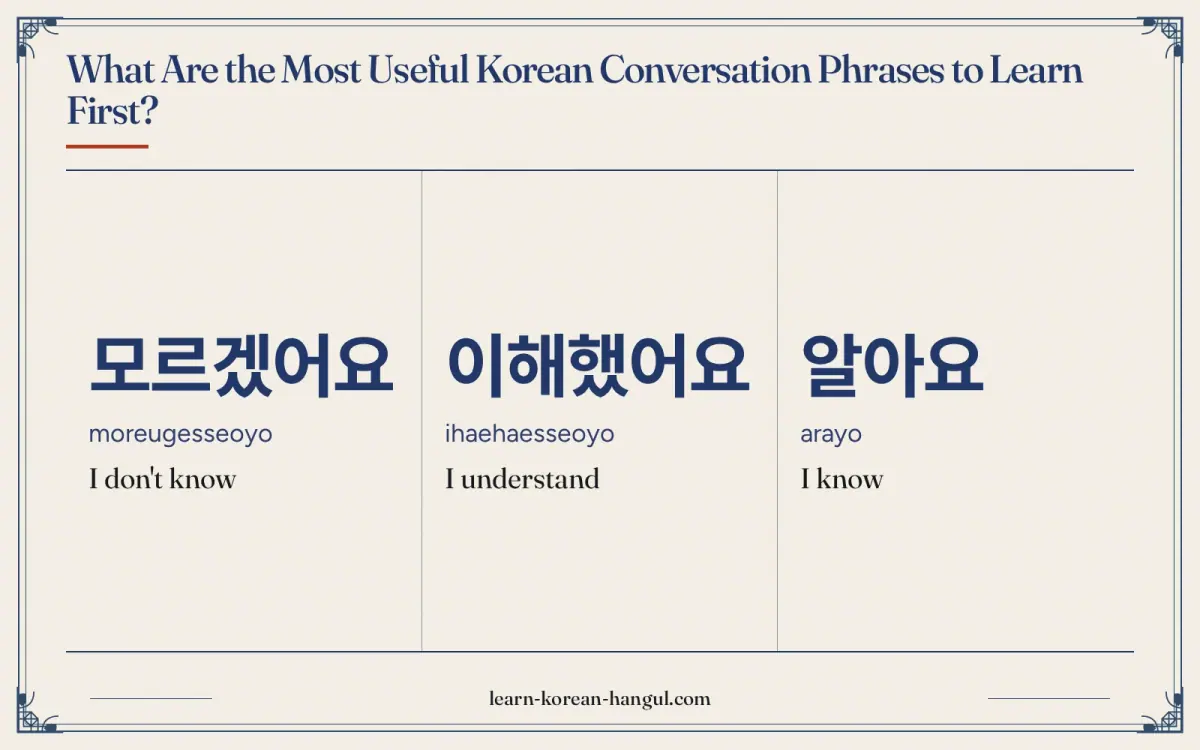
Start with the three reply phrases that every learner needs, then add one question from each cluster. The reply phrases let you answer honestly when you do not know, when you understand and when you already know something.
| Korean | Revised Romanization | Meaning | Guide |
|---|---|---|---|
| 모르겠어요 | moreugesseoyo | I don't know | i don't know in korean |
| 이해했어요 | ihaehaesseoyo | I understand | i understand in korean |
| 알아요 | arayo | I know | i know in korean |
| 뭐 해요? | mwo haeyo | what are you doing? | what are you doing in korean |
| 괜찮아요? | gwaenchanayo | are you okay? | are you okay in korean |
| 여보세요 | yeoboseyo | hello (on the phone) | hello on the phone in korean |
All six lines are in the polite 요 style, so you can say them to a classmate, a coworker or a stranger. The table shows the lead form of each guide, and the cards below cover the four clusters. Revised Romanization (the South Korean government system of 2000) is a reading aid only, so learn the Hangul first. Play the sample exchange to hear a question and a short reply.
The next section explains why a short reply keeps a Korean conversation going.
How Do You Keep a Korean Conversation Going?
Reply in one short line, then pass the turn back with a question or a reaction. Korean speakers keep a chat moving with small reply words, not long speeches. A reaction such as 그래요? ("Really?") shows that you are listening and invites the other person to say more.
| Reply word | Revised Romanization | Use |
|---|---|---|
| 네 | ne | Yes, or "I hear you" |
| 아니요 | aniyo | No |
| 그래요? | geuraeyo | Really? (a question of interest) |
| 정말요? | jeongmaryo | Really? (stronger surprise) |
| 그렇군요 | geureokunyo | I see (new information) |
Food Questions as Greetings
Questions such as 밥 먹었어요? ("did you eat?") and 어디 가요? ("where are you going?") are greetings of care, not requests for facts. A short answer, 네 or 아직요 ("not yet"), is enough. This habit is why the small talk cluster begins with food, weather and plans.
Which Style Should You Use with New People?
Use the polite style (해요체) with anyone new, the honorific forms with elders, and the casual style (반말) only after the other person agrees. The page on Korean speech levels explains each style. The table shows one reply in each.
| Reply | Formal | Polite (safe default) | Casual |
|---|---|---|---|
| I understand | 이해했습니다 (ihaehaetseumnida) | 이해했어요 (ihaehaesseoyo) | 이해했어 (ihaehaesseo) |
| I don't know | 모르겠습니다 (moreugetseumnida) | 모르겠어요 (moreugesseoyo) | 모르겠어 (moreugesseo) |
| I know | 압니다 (amnida) | 알아요 (arayo) | 알아 (ara) |
The same ending pattern repeats across all four clusters, so one table covers the rule for the whole hub. The cards below list every guide.
All Korean Conversation Guides
The list has 3 reply-phrase guides and 4 clusters, each with a lead phrase and an audio clip. Read the three reply phrases first, then choose a cluster by situation. Every published guide has a quick answer, a register table, pronunciation with audio, usage scenes, short dialogues and common mistakes. The Korean phrases hub holds the other situation groups.
Start Here
I Don't Know
The lead phrase is 모르겠어요 (moreugesseoyo), which means "I don't know." It says you are not sure or cannot tell, and it is softer than the blunt 몰라요. The page shows when to follow it with 잘 모르겠어요 ("I'm not really sure").
I Understand
The lead phrase is 이해했어요 (ihaehaesseoyo), which means "I understand." It reports that you followed an explanation, and it sounds like [이해해써요]. The page contrasts it with 알겠어요 ("got it") and the formal 알겠습니다.
I Know
The key phrase is 알아요 (arayo), which means "I know." It says you know a fact or a person. ("do you know?").
More Conversation Hubs
Four deeper hubs hold the situation guides.
Small Talk
The lead phrase is 뭐 해요? (mwo haeyo), which means "what are you doing?" This subhub lists 16 guides to everyday questions about meals, weather, plans, hobbies and the day. The lead question 뭐 해요? opens many chats, and the cluster explains why 밥 먹었어요? and 어디 가요? work as greetings.
Phone Calls
The lead phrase is 여보세요 (yeoboseyo), which means "hello (on the phone)." This subhub lists 9 guides for answering, holding, call-backs and ending calls. The lead word 여보세요 is used only on the phone, and the cluster adds 끊을게요 and the way phone numbers are read.
Texting
The lead phrase is 가는 중이에요 (ganeun jungieyo), which means "I'm on my way." This subhub lists 4 guides to messages for KakaoTalk, plans and arrival. The lead line 가는 중이에요 is the arrival message, and the cluster points slang to the vocabulary section.
Sample Dialogues
The lead phrase is 실례합니다 (sillyehamnida), which means "excuse me." This subhub lists 3 short scripts for a cafe, directions and a restaurant. The lead word 실례합니다 opens the directions script, and each script marks the learner's lines apart from the staff lines.
How Do You Practise Korean Conversation?
Conversation improves when you practise in question-and-answer pairs. Use this routine for ten minutes:
- Play the sample exchange and repeat both lines.
- Pick one question from each cluster and write a true answer for it.
- Ask the question aloud, pause, and say your answer.
- Add one reaction word, such as 그래요? or 그렇군요, after each answer.
- Drill the lines with the phrase flashcards, which pair each phrase with audio.
The routine builds the habit of answering and returning a question in one breath. After practice, check yourself against the mistakes below.
What Mistakes Do Learners Make with Korean Conversation?
Learners most often answer a question with a long explanation or with a word that is too blunt. Four mistakes appear again and again:
- Using 몰라요 when you mean "I'm not sure." It can sound dismissive. Fix: say 모르겠어요, or 잘 모르겠어요 for "I'm not really sure".
- Using 알아요 to an elder or boss for "understood." It can sound curt. Fix: say 알겠습니다 or 알겠어요.
- Giving a long reply to 밥 먹었어요? It is a greeting. Fix: answer 네 or 아직요.
- Dropping the question back. A silent pause ends the chat. Fix: add 그쪽은요? ("and you?").
Each fix comes from keeping replies short and returning the turn, which is the core habit in Korean conversation. The questions below cover details that the cards do not.
Frequently Asked Questions
These answers add details about Korean conversation beyond the guides above.
How do I start a conversation in Korean?
Start with 안녕하세요, then ask a safe question about food, weather or plans, such as 밥 먹었어요? or 오늘 날씨 어때요? Keep the polite 요 style. If the other person looks busy, ask 지금 시간 있어요? first. A smile and a short reply to their answer matter more than a perfect sentence.
What are good small talk questions?
Good first questions are 밥 먹었어요? ("did you eat?"), 오늘 날씨 어때요? ("how's the weather?"), 주말에 뭐 해요? ("what do you do at weekends?") and 취미가 뭐예요? ("what's your hobby?"). They are safe with new people because they need no private details. The small-talk hub lists sixteen such guides with audio.
How do I keep a conversation going in Korean?
Reply in one line, then react or ask back. Use 그래요? ("really?") or 그렇군요 ("I see") to show you follow, and 그쪽은요? ("and you?") to return the turn. Add a follow-up that uses the other person's word, such as 영화요? ("movies?"). Short, frequent reactions sound more natural than long answers.
Which register should I use with new people?
Use the polite 요 style. It is safe with strangers, coworkers and teachers, and it does not need the formal endings of speeches. Move to casual speech only after the other person does, or after you both agree. When you are unsure of someone's age, the polite style is the neutral choice.