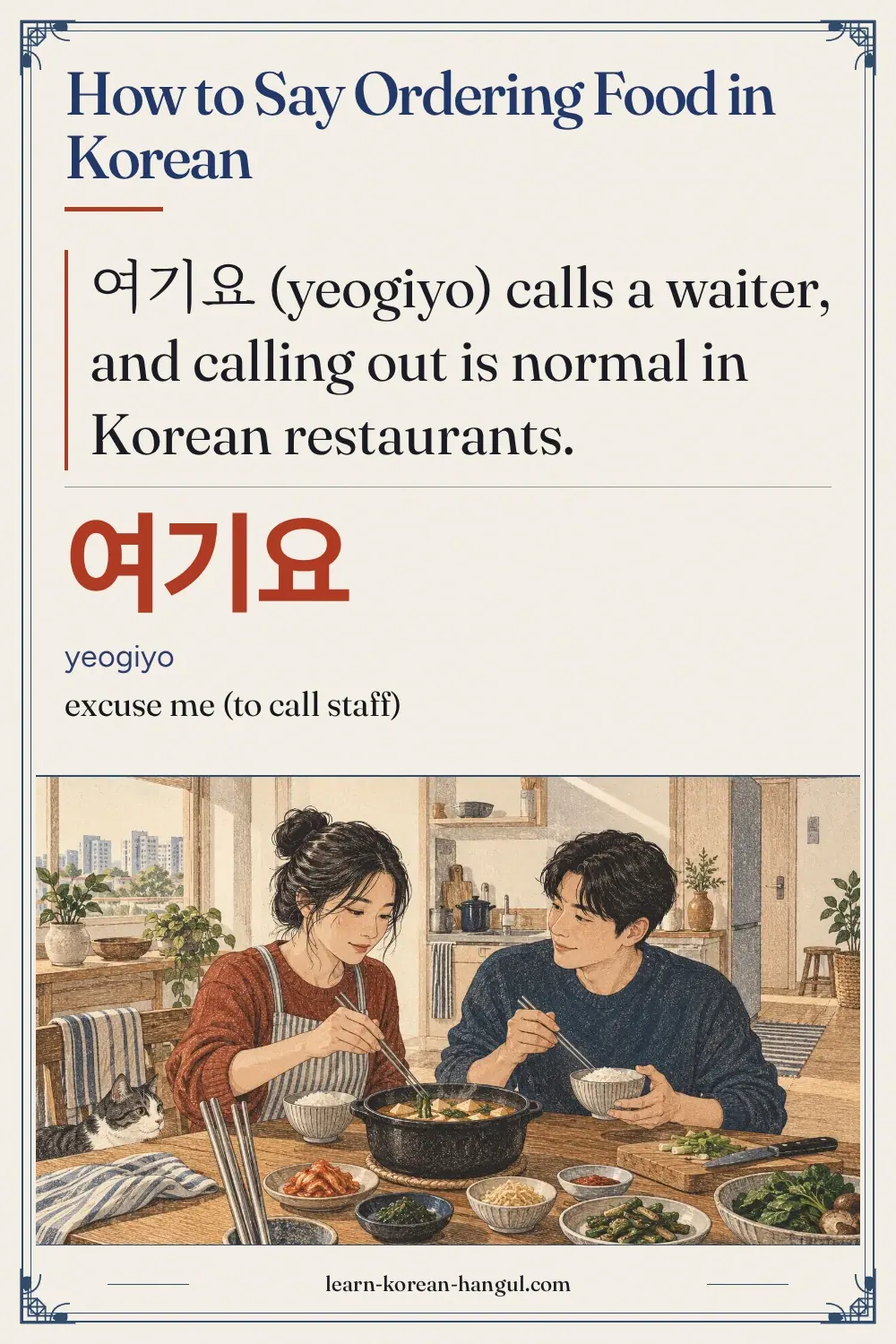
여기요
여기요
What you'll learn
- Call staff with 여기요 and order with dish + number + 주세요.
- Ask about a dish with 이거 맛있어요? and ask for the bill.
- Use the right numbers for dishes and for portions.
- Pronounce 맛있어요 as [마시써요] and the tense 찌 in 김치찌개.
Before you start: you should read Hangul and know the native numbers 하나, 둘, 셋. The page on water please in Korean is a good small start. Time: about 12 minutes. Audio plays only when you press a button.
Key facts
- 여기요 (yeogiyo) is the normal way to call a waiter.
- The order pattern is dish + native number + 주세요.
- 이거 맛있어요? asks "is this tasty?" and 계산해 주세요 asks for the bill.
- Dishes use 하나, 둘, 셋, while portions use Sino numbers with 인분.
- A call button and a pay-at-the-counter routine are common.
How Do You Say Ordering Food in Korean?
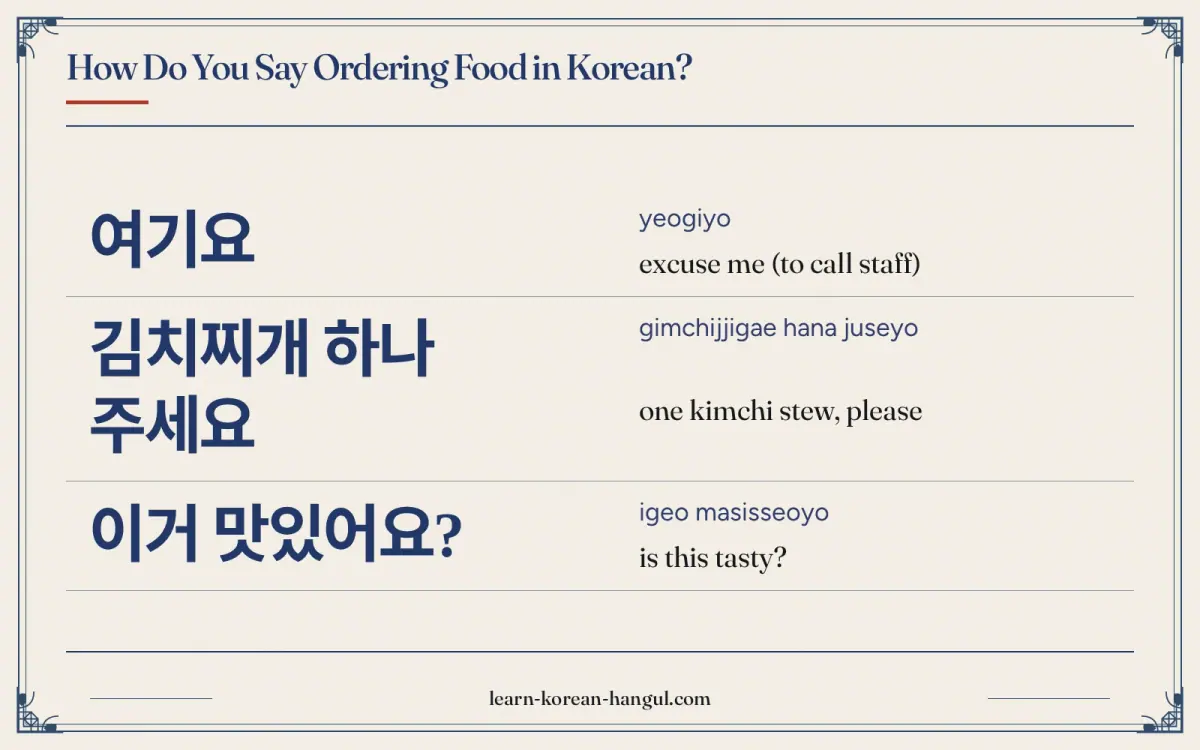
A restaurant visit has four steps, and each has a short phrase. Learn them in order and you can handle a whole meal.
| Step | Korean | Romanization | Meaning |
|---|---|---|---|
| Call the staff | 여기요 | yeogiyo | excuse me (to call staff) |
| Order | 김치찌개 하나 주세요 | gimchijjigae hana juseyo | one kimchi stew, please |
| Ask | 이거 맛있어요? | igeo masisseoyo | is this tasty? |
| Pay | 계산해 주세요 | gyesanhae juseyo | the bill, please |
The order phrase has the same shape as in a cafe: the thing, the number, and 주세요 ("please give me"). The word 하나 (hana) is the native Korean number "one". For two dishes of different kinds, repeat the pattern: 김치찌개 하나, 비빔밥 하나 주세요 (gimchijjigae hana, bibimbap hana juseyo).
The word 여기요 comes from 여기 (yeogi, "here") and the polite 요. It is how you say "over here, please". A close alternative is 저기요 (jeogiyo), which comes from 저기 ("over there") and is also used to call someone. Both are polite, and both work in restaurants.
What Are the Polite Ways to Order in a Restaurant?
All the forms below are polite, because the listener is a stranger. The guide to Korean speech levels explains the polite 요 style.
Polite: 여기요 (yeogiyo)
Polite · 해요체Use 여기요 when you need someone to come to the table. Raise your hand a little and say it clearly, not loudly. You may also say 저기요 for the same job.
Polite: 김치찌개 하나 주세요 (gimchijjigae hana juseyo)
Polite · 해요체This is the order. For two of the same dish, change 하나 to 둘 (dul) and say 김치찌개 둘 주세요.
삼겹살 2인분 주세요.
samgyeopsal i inbun juseyo
Two portions of pork belly, please.
Polite: 이거 맛있어요? (igeo masisseoyo)
Polite · 해요체이거 means "this", and 맛있어요 means "it is tasty". Point at the menu and ask. The voice rises at the end because it is a yes/no question. To ask for advice, use the question word 뭐가: 뭐가 맛있어요? (mwoga masisseoyo, "what is good here?"), which does not rise.
Polite: 계산해 주세요 (gyesanhae juseyo)
Polite · 해요체계산 means "payment", and 해 주세요 means "please do it". Together they ask for the bill.
Polite: 반찬 더 주세요 (banchan deo juseyo)
Polite · 해요체반찬 are the small side dishes. Many restaurants refill them for free, and 더 주세요 means "more, please". The same pattern works for 물 더 주세요 (mul deo juseyo, "more water, please").
반찬 더 주세요.
banchan deo juseyo
More side dishes, please.
How Do You Pronounce 여기요?
여기요 has three syllables: yeo-gi-yo. The ㅕ starts with a quick "y" and then an unrounded ㅓ, so keep your lips relaxed. The ㄱ between two vowels sounds softer, close to an English g.
Sound Changes to Listen For
- 맛있어요 is [마시써요]. The final ㅅ of 맛 moves onto the next syllable (맛 + 있 sounds like [마시]), and the final ㅆ of 있 moves onto 어 as [써]. The standard rules also accept [마디써요], but [마시써요] is what you will hear almost everywhere. Revised Romanization writes masisseoyo.
- 김치찌개 has a tense ㅉ. The spelling already shows the tense letter, so you say a firm, unaspirated ㅉ and Revised Romanization writes jj: gimchijjigae. The page on Korean tensification explains tense sounds.
- 계산해 is [계산해]. The vowel ㅖ in 계 can also be pronounced like ㅔ, so [게산해] is accepted.
- 하나 주세요 has no change. Say each syllable evenly.
Next, when to use each phrase.
When Should You Use 여기요, and When Should You Not?
Use 여기요 in everyday restaurants, pubs and eateries, where staff wait for you to call them. In very formal restaurants, a waiter often stands nearby, and you may simply catch their eye.
Situations Where It Fits
- Casual restaurants. Call the staff once you are ready to order.
- When the staff are busy. A short 여기요 is polite and expected.
- To ask for more. Say 여기요, 물 좀 주세요 ("excuse me, some water please").
- When you finish. Say 여기요, 계산해 주세요.
Situations to Avoid
- A person who is carrying a heavy tray. Wait a moment.
- Fine dining. Wait for the server to come, or ask quietly.
- Calling a friend. The word is for staff and strangers.
- A loud shout. A clear, medium voice is enough.
What Else Will the Staff Ask You?
Before you order, the staff ask a few short questions. If you know them, you will not freeze at the door.
| Staff say | Romanization | Meaning | You can answer |
|---|---|---|---|
| 몇 분이세요? | myeot buniseyo | how many people? | 두 명이에요. |
| 주문하시겠어요? | jumunhasigesseoyo | would you like to order? | 네, 김치찌개 하나 주세요. |
| 더 필요하신 거 있으세요? | deo piryohasin geo isseuseyo | do you need anything else? | 아니요, 괜찮아요. |
몇 분이세요 sounds like [멷뿌니세요]. The ㅊ at the end of 몇 sounds like ㄷ, and the ㅂ after it is tense, like in 몇 시 [멷씨]. The reply 두 명이에요 (du myeongieyo) means "two people", and 명 is the counter for people.
If you want something that is not on the menu, or something different, try these:
- 이거 말고 다른 거 있어요? (igeo malgo dareun geo isseoyo) "Do you have something other than this?"
- 추천해 주세요. (chucheonhae juseyo) "Please recommend something."
- 이거 두 개 주세요. (igeo du gae juseyo) "Two of these, please."
Each one reuses a pattern you already know: 주세요 for requests and 있어요? for "do you have?".
What Does Ordering Food Sound Like in a Real Conversation?
A real order is brief. Listen for the polite endings and for the rising voice on yes/no questions.
Placing an Order
Customer
여기요!
yeogiyo
Excuse me!
Waiter
네, 주문하시겠어요?
ne, jumunhasigesseoyo
Yes, would you like to order?
Customer
김치찌개 하나, 비빔밥 하나 주세요.
gimchijjigae hana, bibimbap hana juseyo
One kimchi stew and one bibimbap, please.
Waiter
네, 알겠습니다.
ne, algetseumnida
Yes, understood.
What to notice: 알겠습니다 is formal and sounds like [알겓씀니다]. Staff use it to confirm an order. 비빔밥 is pronounced [비빔빱].
Asking about a Dish
Customer
이거 맛있어요?
igeo masisseoyo
Is this tasty?
Waiter
네, 인기 메뉴예요.
ne, ingi menyuyeyo
Yes, it is a popular dish.
Customer
그럼 그걸로 주세요.
geureom geugeollo juseyo
Then I will take that one, please.
What to notice: 그걸로 is the spoken short form of 그것으로, "with that one", and 그럼 adds "then". The customer uses it to choose.
Paying
Customer
여기요, 계산해 주세요.
yeogiyo, gyesanhae juseyo
Excuse me, the bill please.
Waiter
입구에서 계산해 주세요.
ipgueseo gyesanhae juseyo
Please pay at the entrance.
What to notice: many restaurants ask you to pay at the counter near the door, so the waiter points you to 입구 (ipgu, "entrance"), pronounced [입꾸].
What Should You Know about the Culture behind Ordering Food?
Korean restaurant service is quick and direct. Staff expect you to call them, and nobody will think it rude.
- Calling out is normal. 여기요 is not impolite.
- Many tables have a call button. Press it, and a staff member comes.
- Paying often happens at the counter. Check the shop, because some bring a bill to the table.
- Side dishes may be free. Many restaurants refill banchan at no cost.
- Tipping is not expected. The price on the menu is what you pay.
- Some barbecue restaurants ask for a minimum number of portions. Look for the number on the menu.
An expert insight: the staff speak briefly and quickly. They use polite forms with -시- for you, and you reply with short polite phrases. You do not need long sentences.
What Mistakes Do Learners Make with Ordering Food in Korean?
Most mistakes are about numbers and about the call word.
| Mistake | Why it is a problem | Fix |
|---|---|---|
| 김치찌개 일 주세요 | 일 is a Sino-Korean number, not used for dishes | 김치찌개 하나 주세요 |
| 하나 인분 | 인분 takes Sino numbers | 일 인분 (1인분) |
| Silent hand waving only | Staff may not see you | Add 여기요 |
| 주세요 left out | It sounds like a command | Add 주세요 |
| Saying [맛있어요] with a hard ㅅ | The word is [마시써요] | Say the liaison |
The second mistake needs one example: portions at a barbecue restaurant use the unit 인분 with Sino numbers, so you order 삼겹살 2인분 (samgyeopsal i inbun), and the dishes use 하나, 둘.
Is It the Same as Restaurant Dialogue?
The searches "restaurant dialogue in Korean" and "restaurant conversation in Korean" ask for a full scene, and the three dialogues above are that scene. A complete short version looks like this:
- Call: 여기요!
- Order: 김치찌개 하나 주세요.
- Ask: 이거 맛있어요?
- More: 물 좀 주세요. 반찬 더 주세요.
- Pay: 계산해 주세요.
Learn these five lines, and you can run a whole meal.
Related Phrases to Learn Next
Restaurant phrases come in a set, so learn these in the same session:
- I'd like to order in Korean: a fuller way to start your order.
- The bill please in Korean: more ways to ask for the bill.
- Water please in Korean: asking for water.
This guide belongs to the Korean dialogues collection. What this page does not cover: full menu reading and allergy questions, which have their own pages. Say 여기요 and then your dish, and you can handle ordering food in Korean.
Practice: Say It Aloud
Play the slow clip of 여기요 and repeat it three times, then 김치찌개 하나 주세요 and 계산해 주세요. Then say each line. Answers follow.
- You want a waiter to come over.
- You want one bibimbap.
- You want to know if a dish is tasty.
- You are ready to pay.
Answers
- 여기요!
- 비빔밥 하나 주세요.
- 이거 맛있어요?
- 계산해 주세요.
The phrase flashcards drill these lines with audio.
Frequently Asked Questions
How do you say ordering food in Korean?
Call the staff with 여기요 (yeogiyo), then say the dish, the number and 주세요: 김치찌개 하나 주세요 (gimchijjigae hana juseyo), "one kimchi stew, please". Finish the meal with 계산해 주세요 (gyesanhae juseyo), "the bill, please". These four steps cover most restaurant visits.
How do you pronounce 여기요?
Say yeo-gi-yo, three syllables, with a light, rising call. The ㅕ starts with a quick "y", and the ㅓ part is unrounded. The ㄱ between vowels sounds softer, close to a g. Revised Romanization writes yeogiyo. There is no big sound change, so each syllable stays clear.
What is the difference between 여기요 and 김치찌개 하나 주세요?
여기요 gets the staff member's attention, like "excuse me". 김치찌개 하나 주세요 is the actual order, "one kimchi stew, please". You normally use them in sequence: first 여기요, then wait for the staff to arrive, then say the order. They do different jobs and do not replace each other.
Can I use 여기요 with friends, elders and strangers?
Use 여기요 with strangers, because it calls waiters politely and is the normal form in a restaurant. With friends at the table you would not use it to each other. For an older person you want to speak to in public, 저기요 (jeogiyo, "excuse me over there") works too. Both are accepted.
What is the most common mistake with ordering food in Korean?
The most common mistake is using the Sino-Korean numbers 일, 이, 삼 for dishes. Say 김치찌개 하나 (hana, one), not 김치찌개 일. Use 하나, 둘, 셋 for dishes. The Sino numbers belong with 인분 (portion), as in 2인분, which you read 이 인분.