영어 메뉴판 있어요?
영어 메뉴판 있어요?
What you'll learn
- Ask for an English menu with 영어 메뉴판 있어요? and the formal 영어 메뉴 있습니까?
- Ask for a picture menu with 사진 메뉴 있어요? and for any menu with 메뉴판 주세요.
- Tell 메뉴판 (the menu) apart from 메뉴 (a dish).
- Pronounce 있어요 as [이써요] and 있습니까 as [읻씀니까].
Before you start: the endings below follow the levels explained in Korean speech levels. When you are ready to order, see I'd like to order in Korean. Time: about 12 minutes. Audio plays only when you press a button.
How Do You Say Do You Have an English Menu in Korean?
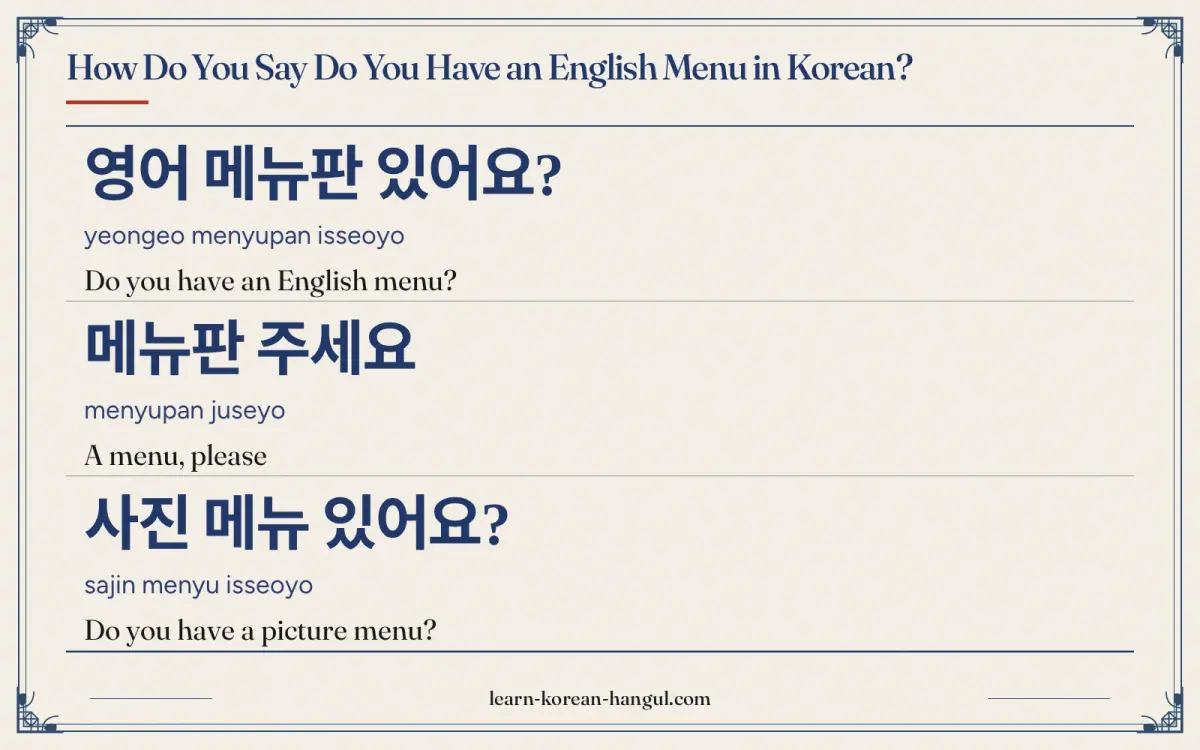
The standard way to say do you have an english menu in Korean is 영어 메뉴판 있어요?, built from 영어 (English), 메뉴판 (menu) and 있어요 (there is). It has no particle, which is normal in spoken Korean. The table shows the choices.
| Situation | Korean | Romanization | Meaning |
|---|---|---|---|
| Standard question | 영어 메뉴판 있어요? | yeongeo menyupan isseoyo | Do you have an English menu? |
| Asking for any menu | 메뉴판 주세요 | menyupan juseyo | A menu, please |
| No English available | 사진 메뉴 있어요? | sajin menyu isseoyo | Do you have a picture menu? |
| Formal or hotel restaurant | 영어 메뉴 있습니까? | yeongeo menyu itseumnikka | Do you have an English menu? |
| Friend (rarely needed) | 영어 메뉴판 있어? | yeongeo menyupan isseo | Is there an English menu? |
Revised Romanization (the South Korean government standard of 2000) is a reading aid here. Learn the Hangul first. The next section explains each phrase.
What Are the Formal and Polite Ways to Say Do You Have an English Menu?
Do you have an english menu has four useful phrases. Three are polite, one is formal, and the choice depends on the place and on what the server can offer.
Polite: 영어 메뉴판 있어요? (yeongeo menyupan isseoyo)
Polite · 해요체영어 메뉴판 있어요? is the default. It is a yes or no question, so the pitch rises on the last syllable. Start with 저기요 ("excuse me") to get the server's attention.
저기요, 영어 메뉴판 있어요?
jeogiyo, yeongeo menyupan isseoyo
Excuse me, do you have an English menu?
Polite: 메뉴판 주세요 (menyupan juseyo)
Polite · 해요체메뉴판 주세요 is a request, not a question, so the pitch stays level or falls. It asks for any menu. Use it when you are seated, then add a promise to take your time.
메뉴판 주세요. 천천히 볼게요.
menyupan juseyo. cheoncheonhi bolgeyo
A menu, please. I will look slowly.
Polite: 사진 메뉴 있어요? (sajin menyu isseoyo)
Polite · 해요체사진 메뉴 means a menu with photos (사진 is a photo). Ask for it when no English menu exists, because pictures work in any language. You can add that you do not know Korean well.
사진 메뉴 있어요? 한국어를 잘 몰라요.
sajin menyu isseoyo? hangugeoreul jal mollayo
Do you have a picture menu? I do not know Korean well.
Formal: 영어 메뉴 있습니까? (yeongeo menyu itseumnikka)
Formal · 합쇼체영어 메뉴 있습니까? uses the formal question ending -ㅂ니까. It suits hotel restaurants, business dinners and any place with formal service. It uses 메뉴 instead of 메뉴판. With 영어 in front, 메뉴 clearly means the menu, so both words work in either register.
실례합니다. 영어 메뉴 있습니까?
sillyehamnida. yeongeo menyu itseumnikka
Excuse me. Do you have an English menu?
Four phrases cover most menu requests. Next, the sounds, because three letters change in the formal form.
How Do You Pronounce 영어 메뉴판 있어요?
영어 메뉴판 있어요? is pronounced [영어 메뉴판 이써요], yeong-eo me-nyu-pan i-sseo-yo, in eight syllables. The question mark in writing matches a rising pitch in speech.
- 영 (yeong) 어 (eo): "yeong-eo", with the nasal "ng" kept separate from the vowel.
- 메 (me) 뉴 (nyu) 판 (pan): "menyupan", with a clear "nyu".
- 있 (is) → 이 (i): the final ㅆ moves forward.
- 어 (eo) → 써 (sseo): the moved ㅆ sounds tense.
- 요 (yo): a short "yo", with the pitch rising for a question.
Sound Changes to Listen For
Three features shape this phrase and its relatives:
- Liaison. The final ㅆ of 있 moves onto the next vowel, so 있어요 is [이써요]. The final ㅇ of 영 is different: it does not move, so 영어 stays [영어].
- Nasalization. In the formal 있습니까, the 있 is said [읻], the ㅅ of 습 becomes tense, and the ㅂ is said [ㅁ] before ㄴ, giving [읻씀니까]. The rule is covered in Korean nasalization.
- Tensing after ㄷ. Revised Romanization writes 있 as it, as in itseumnikka, and does not show the tensing of ㅅ after ㄷ.
Say the polite form three times with a tense [써], then try the formal one slowly. The right words also depend on what the restaurant offers.
When Should You Use 영어 메뉴판 있어요?, and When Should You Not?
Use 영어 메뉴판 있어요? as soon as you sit down, or at the counter before you order. Skip it where the menu is a single board or a kiosk.
Situations Where It Fits
- A restaurant in a tourist district. 영어 메뉴판 있어요? is a normal question.
- A café with a printed menu. 저기요, 영어 메뉴판 있어요?
- A hotel restaurant. 영어 메뉴 있습니까? sounds right.
- A small place with no English. Ask 사진 메뉴 있어요? as the next step.
Situations to Avoid
- A kiosk or a tablet. Look for a language button on the screen, because the staff may not take the order.
- A one-dish restaurant. Some places serve a single dish, so there is no menu to read.
- A busy counter with a queue. Check the board or screen first, and ask only if you cannot find an English option.
Three short dialogues show how it sounds.
What Does Do You Have an English Menu Sound Like in a Real Conversation?
A menu request usually takes one exchange, and the answer is either a menu or a polite no. Listen for the rising tone on the question and the helpful 여기 있어요 in reply.
The Server Has One
Guest
저기요, 영어 메뉴판 있어요?
jeogiyo, yeongeo menyupan isseoyo
Excuse me, do you have an English menu?
Server
네, 여기 있어요.
ne, yeogi isseoyo
Yes, here it is.
Guest
감사합니다.
gamsahamnida
Thank you.
What to notice: 여기 있어요 means "here it is", and it is the same 있어요 as in the question, now said with a falling tone.
No English Menu
Guest
영어 메뉴판 있어요?
yeongeo menyupan isseoyo
Do you have an English menu?
Server
죄송해요. 없어요. 사진 메뉴는 있어요.
joesonghaeyo. eopseoyo. sajin menyuneun isseoyo
Sorry, we don't. We have a picture menu.
Guest
네, 사진 메뉴 주세요.
ne, sajin menyu juseyo
Yes, a picture menu, please.
What to notice: 없어요 is the opposite of 있어요, and the server offers an alternative with 는, which contrasts the two menus.
Asking about a Dish
Guest
이거 영어로 뭐예요?
igeo yeongeoro mwoyeyo
What is this in English?
Server
불고기예요. 소고기 요리예요.
bulgogiyeyo. sogogi yoriyeyo
It's bulgogi. It's a beef dish.
Guest
아, 그걸로 주세요.
a, geugeollo juseyo
Ah, I'll have that one.
What to notice: 이거 영어로 뭐예요? has the question word 뭐, so it falls or rise-falls instead of ending with a sharp rise.
What Should You Know about the Culture behind Asking for an English Menu?
Menu practice varies by place, and a few habits help. The points below are typical, not universal.
- Tourist areas help travellers. Restaurants in busy tourist districts often keep English or other foreign-language menus.
- Local places may not. Small neighbourhood restaurants may only have a Korean menu, so pictures and pointing are normal.
- Ordering systems vary. Many places use a picture menu, a QR code, a tablet or a kiosk. A server may point you to it instead of bringing a menu.
- Pointing is fine. Saying 이거 주세요 ("this one, please") while you point is accepted and friendly.
An expert insight: 메뉴 is the word Koreans use for a dish, while 메뉴판 is the paper or board. A bare 메뉴 can be unclear, so add 판, or 영어 in front, when you mean the sheet. The mistakes below follow from this.
What Mistakes Do Learners Make with Do You Have an English Menu in Korean?
Most mistakes involve the word 메뉴 and the sounds of 있어요.
| Mistake | Why it is a problem | Fix |
|---|---|---|
| A bare 메뉴 있어요? | Can be unclear, because 메뉴 also means a dish | Say 메뉴판 있어요? or 영어 메뉴 있어요? |
| Flat tone on 있어요 | Sounds like the statement "there is one" | Raise the last syllable |
| Saying only "English?" with a rising tone | Works with gestures, but sounds abrupt | Say 저기요, 영어 메뉴판 있어요? |
| Saying [잇어요] | Misses the liaison | Say [이써요] |
| Saying 영어 with a hard g, as in [영거] | Adds a sound that is not written | Say [영어] |
Learners often assume 영어 covers any foreign-language menu, but it means English only. For Chinese, ask for 중국어 (jungugeo), and for Japanese, 일본어 (ilboneo).
Is It the Same as English Menu in Korean and Menu in Korean?
Not exactly. The search "english menu in Korean" leads to this page, and "menu in Korean" leads to a word page. The short answers below separate them. The page on menu in Korean covers the word 메뉴 in depth.
- English menu in Korean: 영어 메뉴판 (yeongeo menyupan), as in this page.
- Menu in Korean: 메뉴 (menyu) for a dish or a menu, and 메뉴판 for the physical sheet.
- Picture menu in Korean: 사진 메뉴.
- Formal request: 영어 메뉴 있습니까?
Now practise the question with your own voice.
Practice: Say It Aloud
Play the slow clip and repeat 영어 메뉴판 있어요? three times, raising the last syllable. Then choose the right phrase. Answers follow.
- You sit in a tourist-area restaurant and need English.
- The server says there is no English menu, and you want pictures.
- You are at a hotel restaurant and want the formal question.
- How do you ask "what is this in English?"
Answers
- 영어 메뉴판 있어요?
- 사진 메뉴 있어요?
- 영어 메뉴 있습니까?
- 이거 영어로 뭐예요?
The phrase flashcards drill these phrases with audio.
Related Phrases to Learn Next
Do you have an english menu connects to the phrases for ordering.
- I'd like to order in Korean: what to say once you have chosen.
- What do you recommend in Korean: how to ask the server for a suggestion.
- Water please in Korean: the first request at most tables.
This guide belongs to the Korean restaurant phrases collection. What this page does not cover: allergies and dietary requests. Ask with a rising tone, add a smile, and you can say do you have an english menu in Korean at any table.
Frequently Asked Questions
How do you say do you have an English menu in Korean?
Say 영어 메뉴판 있어요? (yeongeo menyupan isseoyo) with a rising tone. If the server has none, ask 사진 메뉴 있어요? ("do you have a picture menu?") or say 메뉴판 주세요 ("a menu, please") and point. In a formal setting, 영어 메뉴 있습니까? is the more formal question.
How do you pronounce 영어 메뉴판 있어요?
Say yeong-eo me-nyu-pan i-sseo-yo, written [영어 메뉴판 이써요]. The ㅇ at the end of 영 stays a nasal "ng" and does not link to 어. The ㅆ of 있 moves onto the next syllable, so 있어요 sounds like 이써요. Raise your pitch on the last syllable to ask.
What is the difference between 영어 메뉴판 있어요? and 메뉴판 주세요?
영어 메뉴판 있어요? asks whether an English menu exists. 메뉴판 주세요 is a request for a menu, in any language. Ask the first question when you need English, and say the second when you are seated and want to see what is available. Both are polite.
Is 영어 메뉴판 있어요? formal or casual?
영어 메뉴판 있어요? is polite, not formal and not casual. It is the normal tone for talking to restaurant staff. The formal form is 영어 메뉴 있습니까?, which suits hotel restaurants and very formal places. The casual form, 영어 메뉴판 있어?, is for friends, not for servers.
Can I use 영어 메뉴판 있어요? with friends, elders and strangers?
Yes, with servers of any age, because it is polite. With a friend you would drop the ending, but you would rarely ask this question to a friend. For an older or more formal setting, use 영어 메뉴 있습니까? If you are unsure, the polite form is the safe choice.
What is the most common mistake with do you have an english menu in Korean?
Asking a bare 메뉴 있어요?, with no 영어 and no 판. Because 메뉴 can also mean a dish, the question can be unclear; 메뉴판 있어요? or 영어 메뉴 있어요? is clearer. Another mistake is a flat tone, which makes it a statement. A third is saying 있어요 as [잇어요], instead of [이써요].