주문할게요
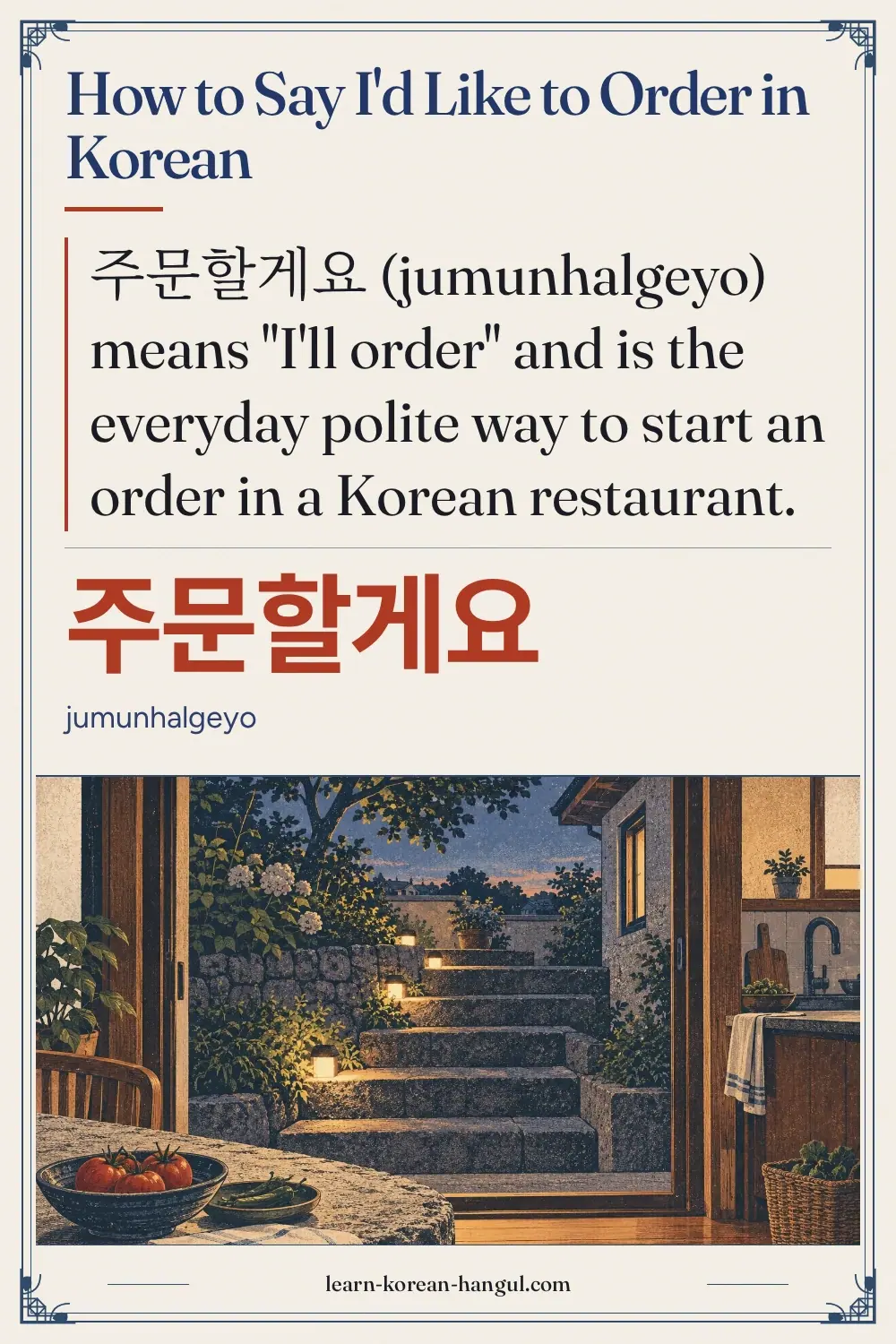
주문할게요
What you'll learn
- Say 주문할게요 aloud as [주문할께요], with the tense sound in the ending.
- Choose between 주문할게요, 주문하고 싶어요, 이거 주세요 and 여기 주문 받아 주세요.
- Call the staff politely and name your dish with 주세요.
- Avoid the common mistake of using 주문해요 as a request.
Before you start: you need to read Hangul; romanization is shown as an aid and can be hidden. Time: about 9 minutes. Audio plays only when you press a button.
Key facts
- 주문할게요 (jumunhalgeyo) means "I'll order" and is the everyday polite way to start an order.
How Do You Say I'd Like to Order in Korean?
The direct answer is 주문할게요. The word 주문 (jumun) means "an order" and comes from Chinese-based vocabulary, and 하다 means "to do", so 주문하다 is "to place an order". The ending -ㄹ게요 adds a promise to the listener: "I will do it, so you can start". Korean has several ways to order, and the table shows how they differ.
| Form | Romanization | Meaning | Use it for |
|---|---|---|---|
| 주문할게요 | jumunhalgeyo | I'll order | Starting your order once staff arrive |
| 주문하고 싶어요 | jumunhago sipeoyo | I'd like to order | Politely signalling that you want to order |
| 이거 주세요 | igeo juseyo | This one, please | Pointing at a dish or menu line |
| 여기 주문 받아 주세요 | yeogi jumun bada juseyo | Please take our order | Asking staff to come to the table |
| 하나 더 주세요 | hana deo juseyo | One more, please | Adding another portion or drink |
All five are polite, so none of them will sound rude to staff. The next section looks at each one in a sentence.
What Are the Polite and Formal Ways to Say I'd Like to Order?
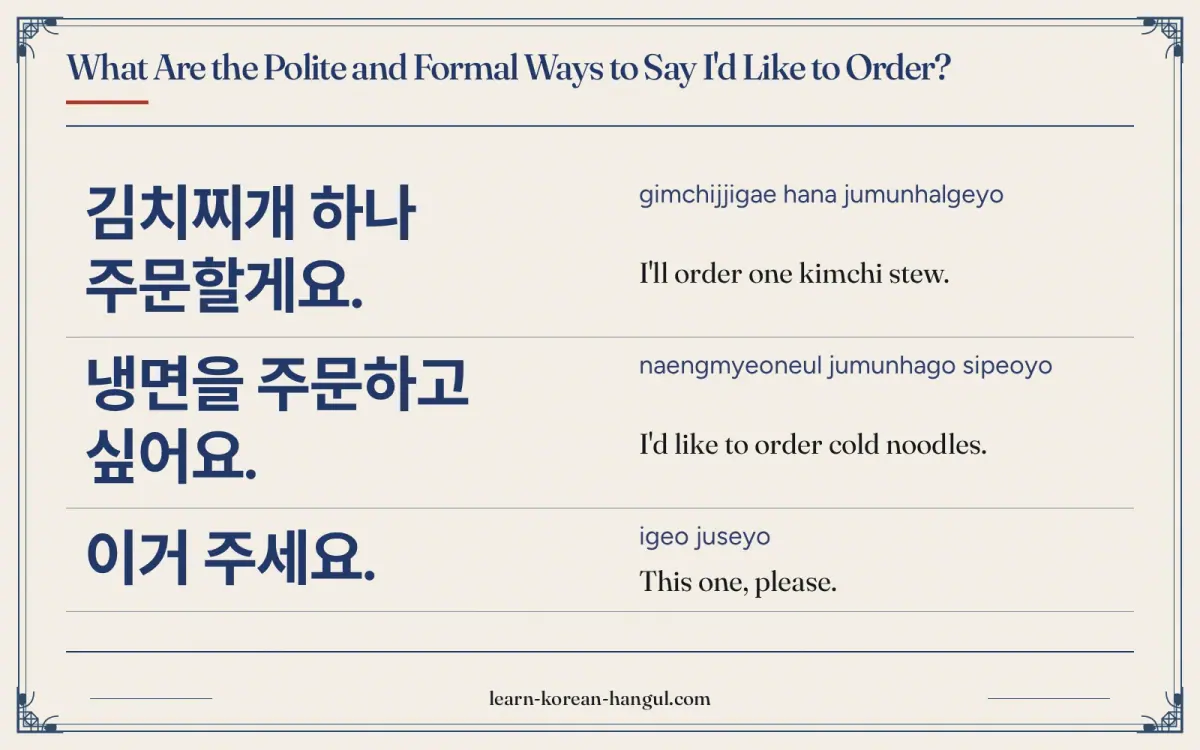
Restaurant Korean is mostly polite, the -요 style used with strangers, as explained in the guide to Korean speech levels. The formal style appears only at banquets and official dinners. The casual style does not suit staff at all.
Polite: 주문할게요 (jumunhalgeyo)
Polite · 해요체Use 주문할게요 when the staff member is standing at your table. It announces that you are ready. Add the dish and a number: 김치찌개 하나 주문할게요, "I'll order one kimchi stew".
김치찌개 하나 주문할게요.
gimchijjigae hana jumunhalgeyo
I'll order one kimchi stew.
Polite: 주문하고 싶어요 (jumunhago sipeoyo)
Polite · 해요체주문하고 싶어요 uses -고 싶어요, "I want to", so it sounds like a wish and not a promise. It is useful when you catch a staff member's eye from a distance or when you want to start with a drink.
냉면을 주문하고 싶어요.
naengmyeoneul jumunhago sipeoyo
I'd like to order cold noodles.
Polite: 이거 주세요 (igeo juseyo)
Polite · 해요체이거 주세요 is the shortest order in Korean. You point at the dish on the menu or on a nearby table and say 이거 주세요. The verb 주다 means "to give", and 주세요 is its polite request form.
이거 주세요.
igeo juseyo
This one, please.
Polite: 여기 주문 받아 주세요 (yeogi jumun bada juseyo)
Polite · 해요체When nobody has come to your table, ask for the order to be taken. 여기 means "here", and 받아 주세요 means "please receive". Start with 저기요 (excuse me) to get attention.
저기요, 여기 주문 받아 주세요.
jeogiyo, yeogi jumun bada juseyo
Excuse me, please take our order.
Polite: 하나 더 주세요 (hana deo juseyo)
Polite · 해요체After the first order, 하나 더 주세요 adds another portion. 하나 is "one", from the native Korean numbers, and 더 means "more".
하나 더 주세요.
hana deo juseyo
One more, please.
Formal: 주문하겠습니다 (jumunhagetseumnida)
Formal · 합쇼체At a banquet or a business dinner, a host may say 주문하겠습니다, "I will place the order", for the whole table. It uses the formal ending -겠습니다 and sounds like [주문하겓씀니다].
The forms differ in tone, not in meaning, so pronunciation matters next.
How Do You Pronounce 주문할게요?
주문할게요 is pronounced [주문할께요], jumunhalgeyo in Revised Romanization, the official system for writing Korean in Latin letters. The tricky part is the tense g in the ending.
- 주 (ju): like "ju" in "June", with the lips relaxed.
- 문 (mun): "moon" with a short vowel, and a clear n at the end.
- 할 (hal): a light h, "ah", then an l that is not rolled.
- 께요 (kkeyo): written 게요, but said with a tense, firm k, close to "kkeh-yo".
Sound Changes to Listen For
- Tensification (경음화). After the ㄹ of the ending -(으)ㄹ, the next ㄱ, ㄷ, ㅂ, ㅅ or ㅈ becomes tense. So 할게요 is [할께요]. Revised Romanization does not show tensing caused by a neighbouring sound, so you read jumunhalgeyo but say "jumunhal-kkeyo". You can read more in the lesson on Korean tensification.
- Liaison in 받아. The final ㄷ of 받 moves onto the silent ㅇ of 아, so 받아 is [바다] and 받아 주세요 is [바다 주세요].
- The ㅍ in 싶어요. The final ㅍ of 싶 moves onto 어, so 싶어요 is [시퍼요] and 주문하고 싶어요 is [주문하고 시퍼요].
Knowing the sounds is half of ordering. The other half is when to say each form, and the next section covers that.
When Should You Use 주문할게요, and When Should You Not?
Use 주문할게요 when the staff member is next to you and you know what you want. Call the staff first with 여기요 or 저기요, then say 주문할게요, then name each dish with a number and 주세요.
Situations Where It Fits
- A sit-down restaurant. Press the call button or say 여기요, then 주문할게요.
- A café counter. Say the drink and 주세요, or 주문하고 싶어요 if you are still reading the board.
- A group meal. One person says 주문할게요 for the whole table, then lists the dishes.
Situations to Avoid
- When the staff are not at your table. Saying 주문할게요 to an empty room does nothing; call them first.
- Instead of naming the dish. 주문할게요 alone only says you are ready, so you still have to tell them what you want.
- As a request. Do not say 주문해요; use 주문할게요 or finish with 주세요.
These choices are easier to feel in real exchanges, so here are three.
What Does I'd Like to Order Sound Like in a Real Conversation?
A Korean order is short: a call, a promise to order and the dish. Listen for how each speaker keeps it brief.
Calling the Staff at a Restaurant Table
You
여기요!
yeogiyo
Excuse me!
Staff
네, 주문하시겠어요?
ne, jumunhasigesseoyo
Yes, would you like to order?
You
네, 주문할게요. 김치찌개 하나 주세요.
ne, jumunhalgeyo. gimchijjigae hana juseyo
Yes, I'll order. One kimchi stew, please.
What to notice: the staff use the honorific 주문하시겠어요, while you use the plain polite 주문할게요, because the honorific -시- is for the other person's actions, never your own.
Ordering at a Café Counter
You
아이스 아메리카노 한 잔 주문하고 싶어요.
aiseu amerikano han jan jumunhago sipeoyo
I'd like to order one iced Americano.
Staff
네, 알겠습니다.
ne, algetseumnida
Yes, understood.
What to notice: the drink comes with 한 잔 (one cup), and the staff answer with the formal 알겠습니다, a customer-service habit.
Asking the Staff to Take the Order
You
저기요, 여기 주문 받아 주세요.
jeogiyo, yeogi jumun bada juseyo
Excuse me, please take our order.
Staff
네, 금방 갈게요.
ne, geumbang galgeyo
Yes, I'll be right there.
What to notice: the staff use the same -ㄹ게요 promise ending as you, and it sounds like [갈께요]. The habits behind these exchanges are part of Korean restaurant culture.
What Should You Know about the Culture behind Ordering in Korea?
Ordering in Korea is more direct than many learners expect, and the speed is a sign of efficiency and not rudeness.
- Call buttons. Many restaurants have a bell on the table. Pressing it is the normal way to get the staff to come, so you do not have to wait for eye contact.
- 여기요 and 저기요. Both mean "excuse me" for calling staff. Say them clearly and politely, without waving or snapping. The page on excuse me in Korean explains the difference.
- Kiosks and counters. Cafés and fast-food places often use a counter or a self-order kiosk (키오스크), where you press the screen and pay in advance.
- Paying afterwards. In many sit-down restaurants you pay at the front desk when you leave, and the staff do not bring the bill unasked. See the bill please in Korean.
- Portions. Menus often list dishes per portion (인분), and some barbecue places set a minimum number of portions per table, so check the menu.
An expert insight: learners often build a long sentence such as "I would like to order the bibimbap" and say it slowly. Actually, a Korean customer usually says just the dish, the number and 주세요: 비빔밥 하나 주세요. The short form is the natural one, and 주문할게요 is the optional signal that you are ready. The mistakes below come from over-translating.
What Mistakes Do Learners Make with I'd Like to Order in Korean?
Most mistakes in this phrase come from the verb ending or from translating word for word.
| Mistake | Why it is a problem | Fix |
|---|---|---|
| 주문해요 as a request | States "I order" and asks nothing | Say 주문할게요 or finish with 주세요 |
| 주문할게요 with a plain g | The ending is tense in speech | Say [주문할께요] |
| Waiting silently for staff | Staff expect you to call them | Say 여기요 or press the call button |
| 원해요 for "I want" a dish | Sounds stiff and bookish when ordering | Say 이거 주세요 |
| 이거 줘 to staff | Casual and blunt | Keep 이거 주세요 |
Learners often assume the longest phrase is the most polite. Actually, 이거 주세요 is fully polite already, and a longer sentence does not make an order more respectful.
Other Ways People Search for I'd Like to Order in Korean
People look up ordering in a few shapes. The short answers below cover each one.
- Order food in Korean: 음식을 주문하고 싶어요, or simply the dish plus 주세요.
- Order please in Korean: 주문할게요, or 주문 받아 주세요 to ask the staff to come.
- Menu please in Korean: 메뉴판 주세요 (menupan juseyo); 메뉴판 is the menu board or booklet.
- Order at a restaurant in Korean: call with 여기요, say 주문할게요, then name each dish with a number and 주세요.
- Romanized: jumunhalgeyo, following the Revised Romanization of Korean; romanization is an aid, not the real spelling.
Reading the forms is one thing; saying them on cue is another, so practise now.
Practice: Say It Aloud
Play the slow clip of 주문할게요 and repeat it three times, making the ending [께요] firm. Then say 이거 주세요 as you point at an imaginary menu. Choose a phrase for each situation, and check the answers below.
- The staff member arrives at your table and you are ready.
- You are at a café and still reading the board.
- You want a second bowl of rice.
Answers
- 주문할게요.
- 주문하고 싶어요, or 잠시만요 if you need time.
- 밥 하나 더 주세요.
Drill these lines with the phrase flashcards, which include audio for each form.
Related Phrases to Learn Next
Ordering leads to a short chain of restaurant phrases.
- Water please in Korean: 물 주세요, the first extra request.
- Not spicy please in Korean: how to ask for milder food.
- The bill please in Korean: how to finish the meal.
This guide belongs to the Korean restaurant phrases collection. What this page does not cover: menu vocabulary and allergy statements. Say 주문할게요, name the dish and add 주세요, and you will order in Korean the way Koreans do.
Frequently Asked Questions
How do you say I'd like to order in Korean?
Say 주문할게요 (jumunhalgeyo), "I'll order", once the staff member arrives. If you are not ready, say 주문하고 싶어요 (jumunhago sipeoyo), "I'd like to order". Then name the dish and add 주세요, for example 김치찌개 하나 주세요. Both forms are polite and safe in any restaurant or café.
How do you pronounce 주문할게요?
It sounds like [주문할께요], ju-mun-hal-kke-yo. The ending -ㄹ게요 always has a tense ㄱ, a firm sound with no puff of air, even though it is written with a plain ㄱ. Revised Romanization shows it as jumunhalgeyo, because it does not write tensing caused by a neighbouring sound.
What is the difference between 주문할게요 and 주문하고 싶어요?
주문할게요 is a decision: you are ready, and you promise to order now. 주문하고 싶어요 is a wish: you would like to order, perhaps in a moment. In a busy restaurant, 주문할게요 gets the staff to take your order, while 주문하고 싶어요 is gentler and often follows 저기요 (excuse me).
Can I use 주문할게요 with friends, elders and strangers?
Yes. Both 주문할게요 and 주문하고 싶어요 end in the polite -요, so they suit strangers, staff and elders. With close friends you can drop the order wording and say 나는 이거 줘, but never use that blunt style with staff. For a very formal setting, such as a banquet, use 주문하겠습니다.
What is the most common mistake with I'd like to order in Korean?
The most common mistake is saying 주문해요 as a request. That form states a fact, "I order", so it does not ask the staff to do anything. Use 주문할게요 to announce your order, or finish with 주세요 to ask for the dish. A second mistake is saying the -ㄹ게요 ending with a plain g instead of the tense [께].