물 주세요
물 주세요
What you'll learn
- Say 물 주세요 and 물 좀 주세요 aloud with the correct sounds.
- Ask for a glass, two glasses or ice water with 잔 and 얼음물.
- Choose the right form for staff, an elder and a close friend.
- Know when you do not need to ask, because water is often self-service.
Before you start: you need to read Hangul; romanization is shown as an aid and can be hidden. Time: about 10 minutes. Audio plays only when you press a button.
How Do You Say Water Please in Korean?
The standard way to ask for water is 물 주세요 (mul juseyo). It joins 물 (water) with 주세요, the polite request form of the verb 주다 (to give). Four versions cover most restaurant and café situations.
| Form | Romanization | Meaning | Register | Say it to |
|---|---|---|---|---|
| 물 주세요 | mul juseyo | water, please | Polite (해요체) | Staff, strangers, elders |
| 물 좀 주세요 | mul jom juseyo | could I have some water, please | Polite (해요체), softer | Staff, strangers, elders |
| 물 한 잔 주세요 | mul han jan juseyo | a glass of water, please | Polite (해요체) | Staff, café counter |
| 얼음물 주세요 | eoreummul juseyo | ice water, please | Polite (해요체) | Staff, café counter |
The table lists the options. The next section shows each one in a sentence.
What Are the Polite Ways to Say Water Please?
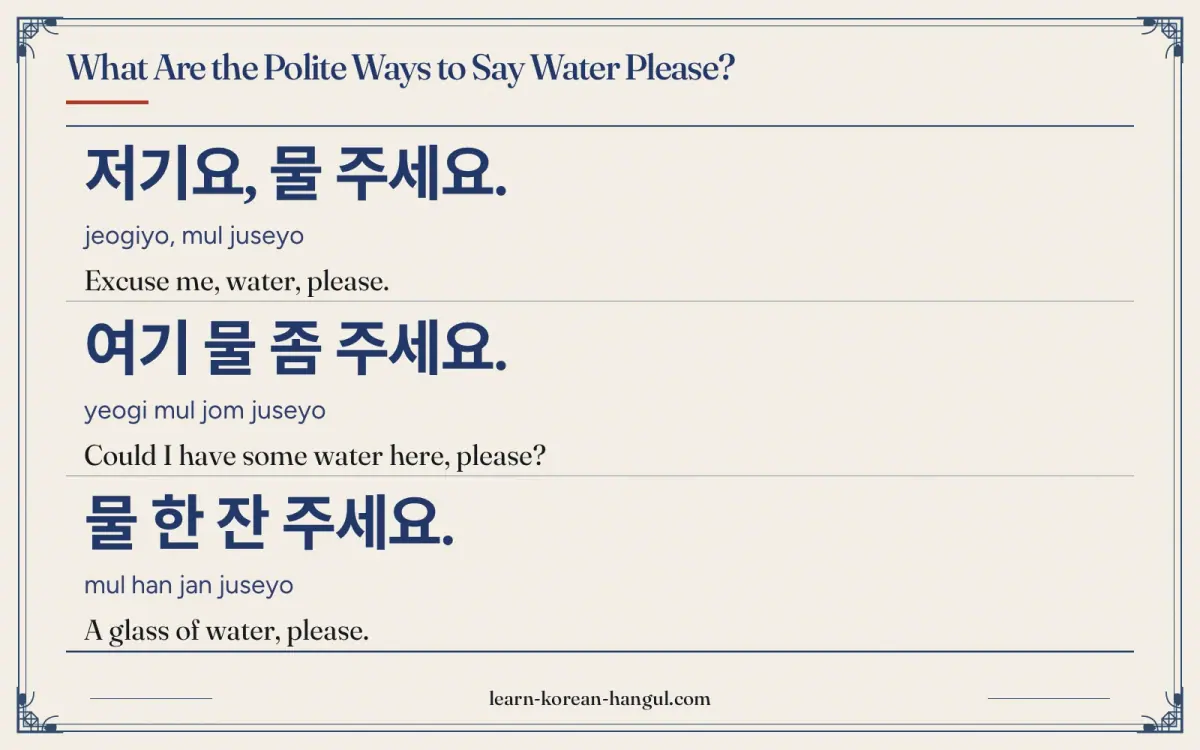
Korean changes the ending of a sentence to match the listener's age, status and closeness. These endings are called speech levels, and the guide to Korean speech levels explains them in full. For a request such as "water, please," the polite 주세요 is the safe default almost everywhere.
Polite: 물 주세요 (mul juseyo)
Polite · 해요체물 주세요 is the basic request. Name the thing, then add 주세요. The same pattern works for other items: 휴지 주세요 (tissues, please) and 숟가락 주세요 (a spoon, please). Staff hear it all day, and it never sounds rude.
저기요, 물 주세요.
jeogiyo, mul juseyo
Excuse me, water, please.
Polite: 물 좀 주세요 (mul jom juseyo)
Polite · 해요체좀 (jom) is a short form of 조금 (a little). In requests it works as a softener that means "if you could." Koreans add it to nearly every ask, so a request without 좀 can sound slightly bare. 물 좀 주세요 is the form to remember.
여기 물 좀 주세요.
yeogi mul jom juseyo
Could I have some water here, please?
Polite: 물 한 잔 주세요 (mul han jan juseyo)
Polite · 해요체잔 (jan) is the counter for glasses and cups. Use a native Korean number before it: 한 잔 (one glass), 두 잔 (two glasses), 세 잔 (three glasses). The number goes between the item and the verb. For a group, say 물 세 잔 주세요.
물 한 잔 주세요.
mul han jan juseyo
A glass of water, please.
Polite: 얼음물 주세요 (eoreummul juseyo)
Polite · 해요체얼음물 is 얼음 (ice) plus 물 (water), so it means ice water. Cafés and summer restaurants use it often. For cold water without ice, say 찬물 (chanmul). For warm water, say 따뜻한 물 (ttatteutan mul).
얼음물 두 잔 주세요.
eoreummul du jan juseyo
Two glasses of ice water, please.
Casual and Formal Alternatives
With a close friend, the casual 물 줘 (mul jwo) is natural, and 물 좀 줘 (mul jom jwo) is a little gentler. In a very formal setting, 물 좀 주시겠어요? (mul jom jusigesseoyo) means "would you give me some water?" and sounds more deferential. These two sit at the edges, and 물 좀 주세요 sits in the middle.
Four versions and four sentences are enough to order. How they sound comes next.
How Do You Pronounce 물 주세요?
물 주세요 is pronounced [물 주세요], with each syllable as written. It has five syllables in two words: 물 (mul) and 주세요 (ju-se-yo).
- 물 (mul): "mool," ending with the tongue tip touching the ridge behind your upper teeth, the Korean final ㄹ.
- 주 (ju): "joo."
- 세 (se): "seh."
- 요 (yo): "yoh."
Sound Changes to Listen For
Most of this phrase sounds as written. Three points need care.
- Final ㄹ in 물. The tongue touches the ridge and stays there. It is not an English "l" with an extra vowel after it, so do not add a vowel sound at the end.
- Liaison in 얼음물. The ㄹ of 얼 moves onto the next vowel, so 얼음물 is [어름물]. The page on liaison (resyllabification) explains the rule.
- Smooth link. 물 and 주세요 are said in one breath, with no pause: [물주세요].
With the sounds set, the next question is when to use each form.
When Should You Use 물 주세요, and When Should You Not?
Use 물 좀 주세요 with staff and strangers, and use 물 주세요 anywhere a quick request is normal. Check for a self-service cooler first.
Situations Where It Fits
- A restaurant table. Call the server with 저기요 (jeogiyo, "excuse me") and add 물 좀 주세요.
- A café counter. 얼음물 한 잔 주세요 gets you a cup of ice water.
- A food stall. 물 주세요 gets you a cup of water. Bottled water is 생수 (saengsu), which you usually take from the fridge yourself in a convenience store.
- A hotel front desk. 물 좀 주세요 asks for a bottle or a glass.
Situations to Avoid
- A bare 물 or 물 줘 to staff. It sounds like an order.
- Shouting across the room. Call 저기요 and wait for eye contact.
- Asking when a cooler is in plain sight. In many restaurants, helping yourself is expected.
These rules are easier to feel in real exchanges, so here are three.
What Does Water Please Sound Like in a Real Conversation?
A water request is short. The customer asks, the server answers, and the customer thanks them.
At a Restaurant Table
Guest
저기요, 물 좀 주세요.
jeogiyo, mul jom juseyo
Excuse me, could I have some water, please?
Server
네, 잠시만요.
ne, jamsimanyo
Yes, just a moment.
What to notice: 잠시만요 (jamsimanyo) means "just a moment." Servers say it when they will come back soon.
Self-Service Water
Guest
물 좀 주세요.
mul jom juseyo
Could I have some water, please?
Server
물은 셀프예요. 저쪽에 있어요.
mureun selpeuyeyo. jeojjoge isseoyo
Water is self-service. It is over there.
Guest
아, 감사합니다.
a, gamsahamnida
Oh, thank you.
What to notice: 셀프 (selpeu) comes from "self." The server points to the cooler with 저쪽 (that way).
At a Café
Customer
얼음물 한 잔 주세요.
eoreummul han jan juseyo
One glass of ice water, please.
Staff
네, 여기 있어요.
ne, yeogi isseoyo
Yes, here you are.
What to notice: 여기 있어요 (yeogi isseoyo) is what staff say when they hand something over. The next section explains why servers sometimes do not bring water at all.
What Should You Know about the Culture behind Water Please?
In many Korean restaurants, water is free, and you serve yourself. A cooler, called a 정수기 (jeongsugi, water purifier), often stands near the entrance, and cups sit beside it. Some places also put a jug on the table. The sign 물은 셀프 (mureun selpeu) means "water is self-service."
- Water is usually free. Most restaurants do not charge for it, though a few upscale places serve bottled water at a price.
- Staff may point, not bring. The answer 저쪽에 있어요 (it is over there) is normal and polite.
- Tipping is not part of the exchange. Koreans do not tip for water or ordinary service.
- Cups are often small. Refilling a cup at the cooler is normal, so you can go back as often as you like.
An expert tip: 좀 is the quiet workhorse of Korean requests. It does not change the meaning, but it changes how the request feels. Adding 좀 to 물 주세요 tells the listener that you know you are asking a favour. This page covers asking for water. Ordering food, paying and asking for the bill are covered on the other restaurant pages.
What Mistakes Do Learners Make with Water Please in Korean?
Most mistakes with this phrase come from missing softeners, sound and habit.
| Mistake | Why it is a problem | Fix |
|---|---|---|
| Saying only 물 | A bare noun sounds like an order | Say 물 좀 주세요 |
| Using 물 줘 with staff | The casual ending is rude to strangers | Use 주세요 |
| Skipping 저기요 | You have not got the server's attention | Say 저기요, then ask |
| Saying "한 잔 물" | Korean puts the noun first | Say 물 한 잔 |
| Waiting for water to arrive | Many restaurants are self-service | Look for the 정수기 |
Learners often think 감사합니다 (thank you) must come before or inside the request. It comes after you receive the water. The request itself needs only 좀 and 주세요, and 주세요 already carries the politeness.
How Do You Say Water, a Glass of Water or Ice Water in Korean?
Water is 물, a glass of water is 물 한 잔, and ice water is 얼음물. The short answers below cover the other ways people search for this phrase.
- Water in Korean: the word is 물. The dedicated page on water in Korean covers meaning, pronunciation and compound words.
- Can I have water in Korean: 물 좀 주세요 is the natural request. For more deference, 물 좀 주시겠어요? means "would you give me some water?"
- A glass of water in Korean: 물 한 잔 (mul han jan). Add 주세요 to ask for it.
- Ice water in Korean: 얼음물 (eoreummul). Ask for cold water without ice with 찬물 (chanmul).
Reading the forms is one thing; producing them on cue is another, so practise now.
Practice: Say It Aloud
Play the slow clip of 물 주세요, repeat it three times, then say 물 좀 주세요 in one breath. Then choose a form for each situation. Answers follow.
- You sit down at a restaurant and want the server's attention and water.
- You want two glasses of water at a café.
- You are with your best friend, and he is closer to the jug.
- Why does 얼음물 sound like [어름물]?
Answers
- 저기요, 물 좀 주세요.
- 물 두 잔 주세요.
- 물 좀 줘.
- The ㄹ of 얼 moves onto the vowel 음 (liaison).
The phrase flashcards drill all four lines with audio.
Related Phrases to Learn Next
Asking for water sits with the rest of the restaurant routine.
- Korean restaurant phrases: the collection that lists every phrase in this cluster.
- The bill please in Korean: the phrase for the end of the meal.
- I'd like to order in Korean: the phrase you will often use in the same conversation.
- I'm thirsty in Korean: the other side of the exchange, telling people why you want water.
What this page does not cover: ordering food, paying and tipping rules in detail. Pick 물 좀 주세요 when in doubt, and you can ask for water please in Korean almost anywhere.
Frequently Asked Questions
How do you say water please in Korean?
Say 물 주세요 (mul juseyo). 물 means water and 주세요 means "please give me." For a softer request add 좀 and say 물 좀 주세요 (mul jom juseyo). Both fit restaurants, cafés and shops, and both are polite enough for staff, strangers and elders.
How do you pronounce 물 주세요?
Say [물 주세요], with each syllable as written. 물 ends in ㄹ, so touch the tip of your tongue behind your upper teeth. Then say 주 (ju), 세 (se) and 요 (yo) in a smooth line. Revised Romanization writes mul juseyo. Korean has no strong word stress, so keep the five syllables even.
What is the difference between 물 주세요 and 물 좀 주세요?
Both mean "water, please." 물 주세요 is direct and clear. 물 좀 주세요 adds 좀, a softener that means "a little" and makes the request sound gentler. Koreans use 좀 constantly when asking for things, so it is the better habit for staff, strangers and older people.
Can I use 물 주세요 with friends, elders and strangers?
Yes with strangers, staff and elders, where it is the standard choice. With close friends, the casual 물 줘 (mul jwo) is natural, and 물 좀 줘 is softer. In very formal settings, 물 좀 주시겠어요? is more deferential. When unsure, 물 좀 주세요 is always safe.
What is the most common mistake with water please in Korean?
The most common mistake is dropping 좀 and the ending, which leaves a bare 물 or 물 줘, a demand that sounds rude to staff. The second mistake is waiting for service. Many Korean restaurants have a self-service cooler, so check for one before you ask.