
케이팝 좋아해요?
케이팝 좋아해요?
What you'll learn
- Ask about K-pop with 케이팝 좋아해요? and 케이팝 좋아해?
- Ask 어떤 가수를 좋아해요? and 최애가 누구예요? to keep the chat going.
- Say 저는 팬이에요 to tell someone you are a fan.
- Pronounce 좋아해요 as [조아해요] and tell it apart from 좋아요.
Before you start: the endings below follow the levels explained in Korean speech levels. Fan phrases such as saranghae in Korean often come up in the same talk. Time: about 12 minutes. Audio plays only when you press a button.
How Do You Say Do You Like Kpop in Korean?
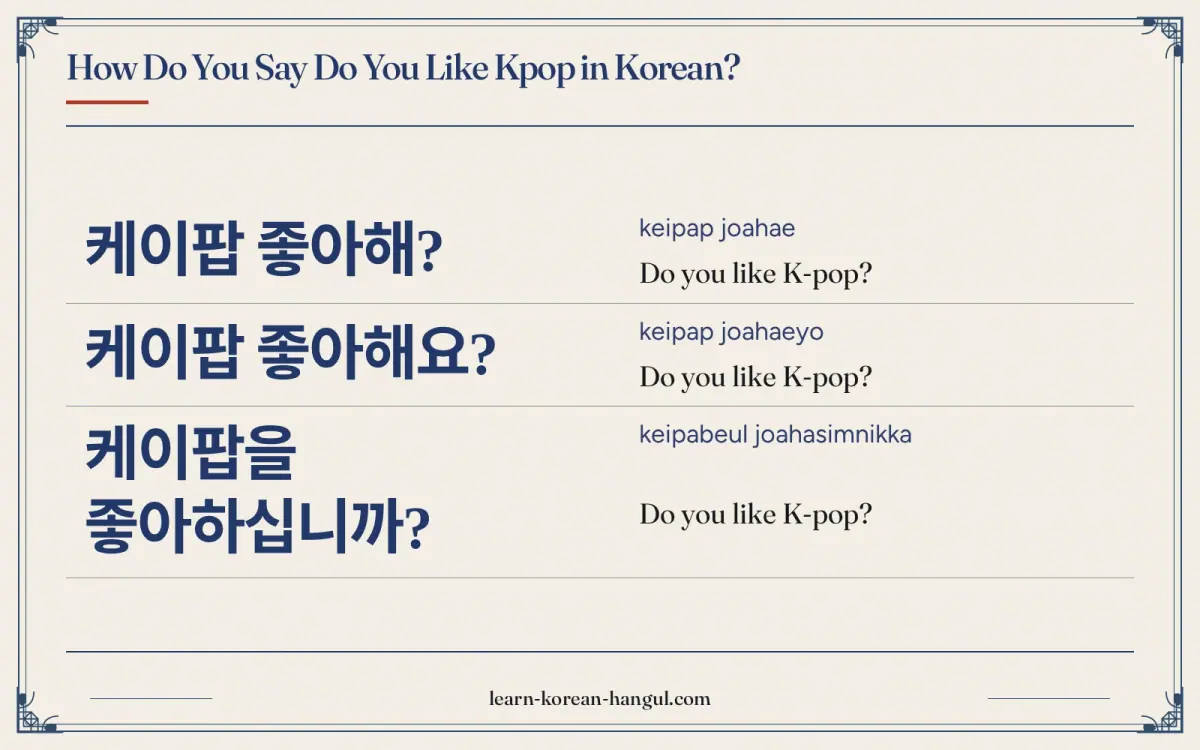
The standard way to say do you like kpop in Korean is 케이팝 좋아해요?, from 케이팝 (K-pop) and 좋아해요 (do you like). In speech, Koreans usually drop the object particle 을, so it is short. The table shows the choices.
| Listener | Korean | Romanization | Meaning |
|---|---|---|---|
| Friend, sibling, younger person | 케이팝 좋아해? | keipap joahae | Do you like K-pop? |
| Coworker, classmate, stranger | 케이팝 좋아해요? | keipap joahaeyo | Do you like K-pop? |
| Older person, formal setting | 케이팝을 좋아하십니까? | keipabeul joahasimnikka | Do you like K-pop? |
| Next question | 어떤 가수를 좋아해요? | eotteon gasureul joahaeyo | Which singer do you like? |
| Telling someone | 저는 팬이에요 | jeoneun paenieyo | I'm a fan |
Revised Romanization (the South Korean government standard of 2000) is a reading aid here. Learn the Hangul first. The next section explains each phrase.
What Are the Polite Ways to Say Do You Like Kpop?
Do you like kpop has four useful phrases, and all of them are polite. They move from a first question to a deeper one, so you can use them in order.
Polite: 케이팝 좋아해요? (keipap joahaeyo)
Polite · 해요체케이팝 좋아해요? is the opener. It is a yes or no question, so the pitch rises on the last syllable. A natural answer is 네, 좋아해요 ("yes, I like it") or 아니요, 잘 몰라요 ("no, I don't know it well").
케이팝 좋아해요? 저는 정말 좋아해요.
keipap joahaeyo? jeoneun jeongmal joahaeyo
Do you like K-pop? I really like it.
For a formal setting, the full form with the object marker is 케이팝을 좋아하십니까?, but this is rare in everyday talk.
With friends, the casual 케이팝 좋아해? drops the ending.
Polite: 어떤 가수를 좋아해요? (eotteon gasureul joahaeyo)
Polite · 해요체어떤 가수를 좋아해요? asks "which singer do you like?". 어떤 means "which kind of" and 가수 means singer. Because it has a question word, the main stress falls on 어떤 and the pitch usually falls or rise-falls instead of rising.
어떤 가수를 좋아해요? 저는 여러 가수를 좋아해요.
eotteon gasureul joahaeyo? jeoneun yeoreo gasureul joahaeyo
Which singer do you like? I like several singers.
Polite: 저는 팬이에요 (jeoneun paenieyo)
Polite · 해요체저는 팬이에요 means "I am a fan". 팬 is borrowed from English, and 이에요 is the polite form of "to be" after a consonant. Add the name of the singer or group before 팬.
저는 팬이에요. 노래를 매일 들어요.
jeoneun paenieyo. noraereul maeil deureoyo
I am a fan. I listen to the songs every day.
Polite: 최애가 누구예요? (choeaega nuguyeyo)
Polite · 해요체최애 is fan slang for the one member or artist you like best, like "bias" in English. 최애가 누구예요? asks "who is your favorite?". The question word 누구 (who) means the tone falls instead of rising sharply.
최애가 누구예요? 저는 막내를 좋아해요.
choeaega nuguyeyo? jeoneun mangnaereul joahaeyo
Who is your favorite? I like the youngest member.
Four phrases cover most K-pop small talk. Next, the sounds, because one silent letter appears in the main phrase.
How Do You Pronounce 케이팝 좋아해요?
케이팝 좋아해요? is pronounced [케이팝 조아해요], ke-i-pap jo-a-hae-yo, in seven syllables. The question mark in writing matches a rising pitch in speech.
- 케 (ke) 이 (i) 팝 (pap): "kei-pap", with a final "p" that is not released.
- 좋 (joh) → 조 (jo): the ㅎ is silent before the vowel of 아.
- 아 (a): a clear "a".
- 해 (hae): "heh", with the ㅎ said lightly between vowels.
- 요 (yo): a short "yo", with the pitch rising for a question.
Sound Changes to Listen For
Three features shape this phrase and its relatives:
- Silent ㅎ before a vowel. The ㅎ of 좋 is not pronounced when a vowel follows, so 좋아해요 is [조아해요]. The rule is covered in ㅎ weakening. Revised Romanization writes joahaeyo.
- Liaison with the object marker. With 을, the final ㅂ of 팝 moves onto the vowel, so 케이팝을 is [케이파블].
- Linking in 팬이에요. The ㄴ of 팬 moves onto 이, so 팬이에요 is [패니에요].
Say [조아해요] three times. Then notice how the next section depends on a spelling difference.
What Is the Difference between 좋아해요 and 좋아요?
좋아해요 means "I like it" or "do you like it", and 좋아요 means "it is good". The difference is the verb 좋아하다 (to like) and the adjective 좋다 (to be good).
| Korean | Type | Meaning | Example |
|---|---|---|---|
| 좋아해요 | verb | I like / do you like | 케이팝 좋아해요? |
| 좋아요 | adjective | it is good, okay | 이 노래 좋아요 |
Use 좋아해요 with an object that you like (케이팝을 좋아해요). Use 좋아요 when you describe something that is good (이 노래 좋아요, "this song is good"). 좋다 can also express liking when the liked thing takes 이/가 (저는 케이팝이 좋아요, "I like K-pop"), so 케이팝 좋아요? is not wrong. Without context, though, it can sound like "is K-pop good?", so 케이팝 좋아해요? is the clearer question.
When Should You Use 케이팝 좋아해요?, and When Should You Not?
Use 케이팝 좋아해요? to start a friendly conversation with someone you already talk to. Avoid it as a test, because the question assumes shared interest.
Situations Where It Fits
- A classmate or coworker mentions a concert. 케이팝 좋아해요?
- A fan meetup or a concert queue. 어떤 가수를 좋아해요?
- Showing your interest. 저는 팬이에요.
- A close friend. 케이팝 좋아해?
Situations to Avoid
- A stranger who looks busy. The question is small talk, so wait for a natural moment.
- A much older person, with the casual form. Ask 케이팝 좋아하세요? with the honorific. Some older listeners prefer other genres, such as trot (트로트, teuroteu), so listen to their answer before you talk more.
- A real disagreement. If someone says they dislike K-pop, do not push the topic.
Three short dialogues show how fan talk sounds.
What Does Do You Like Kpop Sound Like in a Real Conversation?
K-pop small talk usually moves from a yes or no question to a name. Listen for the rising tone on the first question and the falling tone on the follow-ups.
Two Strangers at a Fan Event
Min-Ji
케이팝 좋아해요?
keipap joahaeyo
Do you like K-pop?
Tom
네, 정말 좋아해요! 어떤 가수를 좋아해요?
ne, jeongmal joahaeyo! eotteon gasureul joahaeyo
Yes, I really like it! Which singer do you like?
Min-Ji
저는 이 그룹 팬이에요.
jeoneun i geurup paenieyo
I'm a fan of this group.
What to notice: Tom answers the yes or no question first, and then asks a follow-up with 어떤.
Asking for a Favorite
Ara
최애가 누구예요?
choeaega nuguyeyo
Who is your favorite?
Dae-Ho
제 최애는 막내예요.
je choeaeneun mangnaeyeyo
My favorite is the youngest member.
Ara
저도 막내 좋아해요!
jeodo mangnae joahaeyo
I like the youngest too!
What to notice: 막내 (mangnae, often spelled maknae in K-pop) is pronounced [망내], and 저도 means "me too".
Two Friends
Ji-An
케이팝 좋아해?
keipap joahae
Do you like K-pop?
Hyeon-U
응, 완전 좋아해. 콘서트도 가고 싶어.
eung, wanjeon joahae. konseoteudo gago sipeo
Yeah, I really like it. I want to go to a concert too.
Ji-An
나도! 같이 가자.
nado! gachi gaja
Me too! Let's go together.
What to notice: between friends, every ending drops the polite -요, and 같이 가자 is a casual invitation.
What Should You Know about the Culture behind Do You Like Kpop?
K-pop talk has its own vocabulary, and a few words make you sound like a real fan. Use them when the other person uses them first.
- 최애 and 차애. 최애 (choeae) is your top favorite, and 차애 (chaae) is your second favorite.
- 덕질 and 입덕. 덕질 (deokjil, said [덕찔]) means fan activities such as watching videos. 입덕 (ipdeok, said [입떡]) means becoming a fan.
- 아이돌. 아이돌 (aidol) means an idol singer or group, and 가요 (gayo) is the general word for Korean pop songs.
- 응원봉. 응원봉 (eungwonbong) is the light stick that fans hold at concerts.
An expert insight: fans often go straight to the singer's name, so 어떤 가수를 좋아해요? works even without a first question. The mistakes below come from translating the English verb "like" too directly.
What Mistakes Do Learners Make with Do You Like Kpop in Korean?
Most mistakes involve 좋아해요 and 좋아요 and the strength of the verb.
| Mistake | Why it is a problem | Fix |
|---|---|---|
| 케이팝 좋아요? to ask about taste | Can sound like "is K-pop good?" | Say 케이팝 좋아해요? |
| 사랑해요 for music | "I love you" is too strong | Say 좋아해요 |
| Saying [좋아해요] with a sounded ㅎ | Misses the silent ㅎ | Say [조아해요] |
| Flat tone on 좋아해요 | Sounds like a statement | Raise the last syllable |
| Casual 좋아해? to an elder | Too familiar | Say 좋아하세요? |
Learners often assume 좋아하다 and 좋다 are interchangeable, but they take different particles: 좋아하다 takes an object with 을/를 (케이팝을 좋아해요), while 좋다 takes 이/가 (케이팝이 좋아요).
Is It the Same as Kpop, Favorite Singer, Fan and Bias in Korean?
Not exactly. Each search points to a nearby word, and the short answers below separate them. The pages on fan in Korean and bias in Korean go further.
- Kpop / k-pop in Korean: 케이팝 (keipap), the Korean spelling of the English term.
- Favorite singer in Korean: 제일 좋아하는 가수 (jeil joahaneun gasu), or ask 어떤 가수를 좋아해요?
- Fan in Korean: 팬 (paen), as in 저는 팬이에요.
- Bias in Korean: 최애 (choeae), your favorite member.
Now practise the question with your own voice.
Practice: Say It Aloud
Play the slow clip and repeat 케이팝 좋아해요? three times, saying [조아해요] and raising the last syllable. Then choose the right phrase. Answers follow.
- You want to ask a coworker if they like K-pop.
- You want to ask who their favorite member is.
- You want to say that you are a fan.
- Which form is the adjective that describes something as good?
Answers
- 케이팝 좋아해요?
- 최애가 누구예요?
- 저는 팬이에요.
- 좋아요
The phrase flashcards drill these phrases with audio.
Related Phrases to Learn Next
Do you like kpop connects to other K-pop fan phrases.
- Saranghae in Korean: the word fans see in lyrics and fan messages.
- Oppa in Korean: the address fans often use for male idols.
- Borahae in Korean: a fan phrase that means "I purple you".
This guide belongs to the K-pop fan phrases collection. What this page does not cover: the names of groups and lyrics. Rise on 좋아해요, follow with 어떤 가수를 좋아해요?, and you can say do you like kpop in Korean and keep the chat going.
Frequently Asked Questions
How do you say do you like kpop in Korean?
Say 케이팝 좋아해요? (keipap joahaeyo) with a rising tone. To a friend, say 케이팝 좋아해? To ask more, say 어떤 가수를 좋아해요? ("which singer do you like?"). In Korean you can drop the object marker 을 in speech, so 케이팝 좋아해요 sounds natural.
How do you pronounce 케이팝 좋아해요?
Say ke-i-pap jo-a-hae-yo, written [케이팝 조아해요]. The ㅎ of 좋 is silent before the vowel of 아, so 좋아 sounds like 조아. With the object marker, 케이팝을 is said [케이파블], because the final ㅂ moves onto the vowel. Raise your pitch on the last syllable to ask.
What is the difference between 케이팝 좋아해요? and 어떤 가수를 좋아해요?
케이팝 좋아해요? is a yes or no question about the genre, so it rises. 어떤 가수를 좋아해요? asks "which singer?" with the question word 어떤, so it usually falls or rise-falls instead of rising sharply. Ask the first to start a chat and the second to continue it.
Can I use 케이팝 좋아해요? with friends, elders and strangers?
Yes. It is polite, so it works with strangers, coworkers and people a little older. With close friends, drop the ending: 케이팝 좋아해? With a much older person, add the honorific and ask 케이팝 좋아하세요? Some older listeners prefer other genres, so listen to their answer.
What is the difference between 좋아해요 and 좋아요?
좋아해요 is a verb that means "I like (something)" and needs an object, such as 케이팝을 좋아해요. 좋아요 is an adjective that means "it is good" or "okay". With 이/가, 좋아요 can also express liking (저는 케이팝이 좋아요, "I like K-pop"), so 케이팝 좋아요? is not wrong. Without context, though, it can sound like "is K-pop good?", while 케이팝 좋아해요? clearly asks "do you like K-pop?"
What is the most common mistake with do you like kpop in Korean?
Asking 케이팝 좋아요? when you mean "do you like it?". It is not wrong, but it can sound like "is K-pop good?", so 케이팝 좋아해요? is clearer. A second mistake is saying 사랑해요 ("I love you") for liking music, which sounds too strong. A third is saying [좋아해요] with a sounded ㅎ, instead of [조아해요].