
사랑해
사랑해
What you'll learn
- Say 사랑해 aloud and spell it in Hangul without writing "saranghe".
- Choose between 사랑해, 사랑해요 and 사랑합니다 for a partner, a parent and an audience.
- Explain why 사랑합니다 is pronounced [사랑함니다].
- Avoid the situations where I love you is the wrong phrase, such as praising food or a song.
Before you start: knowing hello in Korean helps, because saranghae uses the same polite and casual endings. Time: about 12 minutes. Audio plays only when you press a button.
How Do You Say Saranghae in Korean?
The standard way to say saranghae in Korean is 사랑해, written in Hangul as three syllables: 사 (sa), 랑 (rang) and 해 (hae). It is built from 사랑 (sarang), the noun "love", plus 하다 (hada), "to do", which together make the verb 사랑하다, "to love". The ending 해 is the casual form, so 사랑해 fits people you are close to.
| Form | Romanization | Register | Say it to |
|---|---|---|---|
| 사랑해 | saranghae | Casual (해체) | Partners, close friends, family, children |
| 사랑해요 | saranghaeyo | Polite (해요체) | Parents, grandparents, older relatives, people you speak politely to |
| 사랑합니다 | saranghamnida | Formal (합쇼체) | Fans, audiences, speeches, formal letters |
| 사랑해 ❤ | saranghae | Casual, written style | Texts, cards, fan signs |
Korean does not need a word for "I" or "you" here, so one word already means "I love you". Add 정말 (jeongmal, really) or 많이 (mani, a lot) for emphasis: 정말 사랑해, 많이 사랑해요. The next section gives each form its own listener and example.
What Are the Formal, Polite and Casual Ways to Say Saranghae?
Saranghae follows the Korean speech levels, the sentence endings that change with the listener, explained in the guide to Korean speech levels. The word 사랑 stays the same. Only the ending moves from casual to polite to formal.
Casual: 사랑해 (saranghae)
Casual · 반말사랑해 is the everyday casual form. Couples, best friends, siblings, grandparents talking to grandchildren and parents talking to young children use it. It is the form in most love songs, which is why learners meet it first.
항상 고마워, 사랑해.
hangsang gomawo, saranghae
Thank you for always being there, I love you.
Polite: 사랑해요 (saranghaeyo)
Polite · 해요체사랑해요 adds the polite ending -요 (yo). It is the safe choice when the listener is older or when you are not sure how casual to be: children to parents, grandchildren to grandparents, and fans to idols in short messages. It is also the form fans write most often on banners and slogans.
아빠, 늘 건강하세요. 사랑해요.
appa, neul geonganghaseyo. saranghaeyo
Dad, stay healthy always. I love you.
Formal: 사랑합니다 (saranghamnida)
Formal · 합쇼체사랑합니다 uses the formal ending -ㅂ니다. You hear it when one person speaks to many people: an idol thanking an audience, a speaker at a ceremony or a wedding toast, or a written message to a crowd. In private it can sound stiff, so a partner is unlikely to hear it at home.
여러분을 진심으로 사랑합니다.
yeoreobuneul jinsimeuro saranghamnida
I sincerely love you all.
Casual, Written: 사랑해 ❤ (saranghae)
Casual · 반말사랑해 ❤ is not a separate word. It is the casual 사랑해 written with a heart, as in texts, cards and fan signs. Fans often write 사랑해요 with a heart too, so the heart style can be casual or polite. The audio is the same as the plain spoken form.
오늘 콘서트 최고였어요. 사랑해요!
oneul konseoteu choegoyeosseoyo. saranghaeyo
Today's concert was the best. I love you!
Four forms reduce to one decision: who is listening. The next section shows how they sound, so you can say each one clearly.
How Do You Pronounce 사랑해?
사랑해 is pronounced [사랑해], sa-rang-hae, in three even syllables with the stress spread evenly. Korean has no strong stress on one syllable, so keep all three the same length.
- 사 (sa): a soft s and "ah".
- 랑 (rang): a quick tap of the tongue for ㄹ, then "ahng" ending in the "ng" of "sing".
- 해 (hae): ㅎ plus ㅐ, close to the "e" of "bed" with a short, clear h.
Sound Changes to Listen For
Three details from the National Institute of Korean Language Standard Pronunciation Rules (표준 발음법) and natural speech matter here.
- Nasalization in 사랑합니다. ㅂ before ㄴ becomes ㅁ, so 사랑합니다 is [사랑함니다]. The rule is explained in ㅂ-to-ㅁ nasalization.
- A weak ㅎ. After the ng sound of ㅇ, ㅎ is often said very lightly, so 사랑해 can sound close to "sa-rang-ae" in fast speech. This is natural speech, not a spelling rule, so keep a soft h when you speak slowly.
- ㅐ and ㅔ. The standard rules (Article 4) still list ㅐ and ㅔ as two vowels, but most Seoul speakers today pronounce them the same. That is why "saranghe" and "saranghae" sound alike, even though only 사랑해 is spelled correctly.
Knowing the sounds is only half of it. The next section covers who you can say it to.
When Should You Use 사랑해, and When Should You Not?
Use 사랑해 with people you are close to, 사랑해요 with people you respect, and 사랑합니다 when you address a group. Do not use it for things you simply like, because Korean keeps love for people and strong feelings.
Situations Where It Fits
- A partner at the end of a call. 잘 자, 사랑해. (Sleep well, I love you.)
- A parent, with the polite form. 엄마, 사랑해요. (Mum, I love you.)
- A child, with the casual form. 우리 아기, 사랑해. (My baby, I love you.)
- A fan message or concert banner. 사랑해요 with a heart.
Situations to Avoid
- Food, songs or hobbies. "I love this song" is 이 노래 너무 좋아요 (I like this song very much), not 사랑해요.
- A new acquaintance or a coworker. The casual form is too intimate. Use 좋아해요 (I like you) only when you mean romance, and otherwise say thank you.
- A teacher or boss. 사랑해 here sounds childish or inappropriate. Say 감사합니다 (thank you).
- Early in dating. Many learners hear 좋아해요 (I like you) as the usual first step, and 사랑해요 as a later one.
The short scenes below show the three main forms in conversation.
What Does Saranghae Sound Like in a Real Conversation?
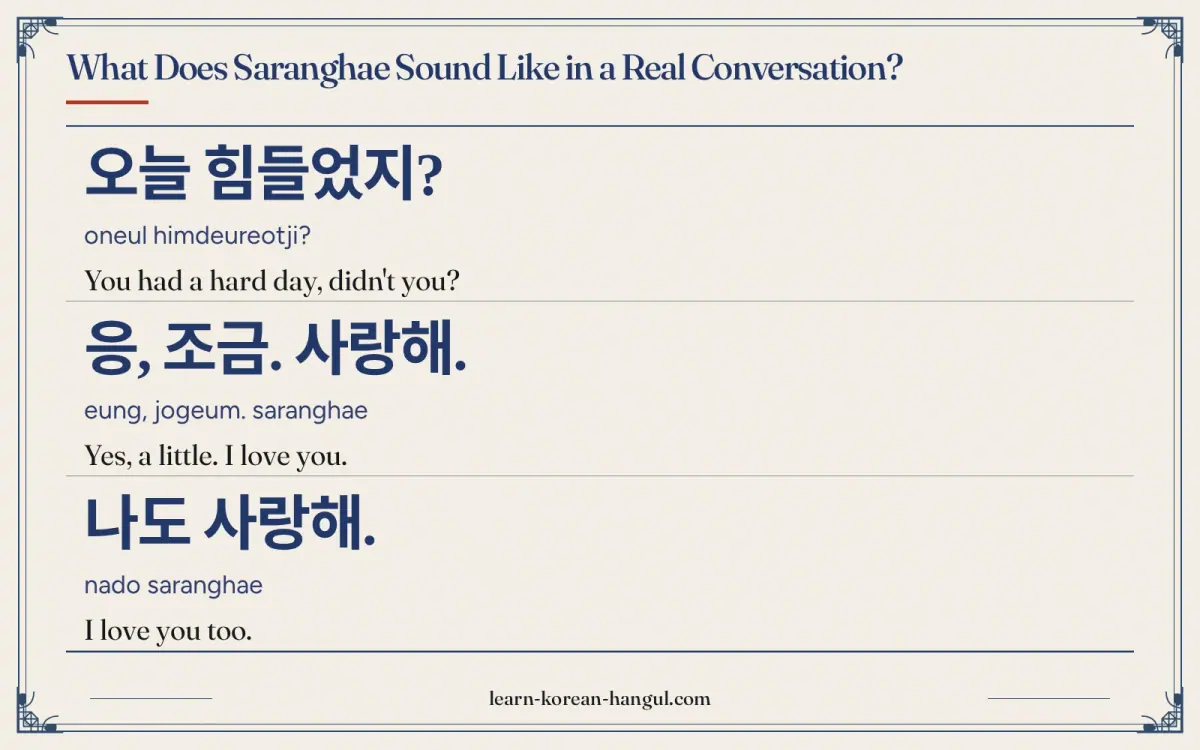
A Korean love phrase is short, and the reply is usually the same phrase back. Notice how each speaker matches the other's style.
A Couple at Night
Minho
오늘 힘들었지?
oneul himdeureotji?
You had a hard day, didn't you?
Jiu
응, 조금. 사랑해.
eung, jogeum. saranghae
Yes, a little. I love you.
Minho
나도 사랑해.
nado saranghae
I love you too.
What to notice: both speakers use the casual form, and 나도 (nado, me too) turns the reply into "I love you too".
A Call with Mum
Daughter
엄마, 사랑해요.
eomma, saranghaeyo
Mum, I love you.
Mother
갑자기 왜? 나도 사랑해.
gapjagi wae? nado saranghae
Why so suddenly? I love you too.
What to notice: the daughter uses the polite form, and the mother answers casually. Many Korean families speak this way, though some use casual speech both ways.
After a Fan Meeting
Idol
오늘 와 주셔서 감사합니다. 사랑합니다!
oneul wa jusyeoseo gamsahamnida. saranghamnida!
Thank you for coming today. I love you all!
Fan
사랑해요!
saranghaeyo!
I love you!
What to notice: the idol uses the formal form for the whole crowd, and the fan answers with the polite form. Culture around this phrase is next.
What Should You Know about the Culture behind Saranghae?
In Korean, saying I love you out loud carries more weight than the same words in many English-speaking settings, so the form and the moment both matter.
- Fans say it first. K-pop fans often learn 사랑해요 before any other Korean, and idols commonly end concerts and livestreams with it.
- Actions can carry the message. Many families show love by asking 밥 먹었어? (have you eaten?) or by cooking, and say 사랑해 less often. This is a tendency, not a rule.
- The verb is flexible. 사랑하다 takes other endings like any verb: 사랑하는 사람 (saranghaneun saram, the person I love).
- Fan wordplay. 보라해 (borahae) mixes 보라 (purple) with 사랑해 and is a fan phrase popularised by BTS; it is covered in borahae in Korean.
An expert insight: learners often choose 사랑합니다 because it sounds more serious, but between two people it is usually too stiff. The warm, normal choice for a partner is 사랑해, and for a parent it is 사랑해요. Formal 사랑합니다 belongs to speeches and written messages to many readers, such as a fan letter signed by a whole fan club. The common mistakes below come from mixing these up.
What Mistakes Do Learners Make with Saranghae in Korean?
Most mistakes with saranghae are about spelling and about choosing too formal or too casual an ending.
| Mistake | Why it is a problem | Fix |
|---|---|---|
| Writing "saranghe" or 사랑헤 | The vowel is ㅐ; 사랑헤 is not a word | Write 사랑해 (saranghae) |
| Pronouncing 합 with a b: "sarang-hab-nida" | ㅂ becomes ㅁ before ㄴ | Say [사랑함니다] |
| Saying 사랑해 to a teacher, boss or elder you do not know well | The casual ending is too intimate | Use 사랑해요 only for family, or say 감사합니다 |
| Using 사랑합니다 for a partner in private | Sounds like a speech | Use 사랑해 |
| Saying 사랑해요 about food or music | Koreans usually keep 사랑해 for people | Say 좋아해요 or 너무 맛있어요 |
Learners often assume that adding 요 to 사랑해 makes it "formal". Actually, 사랑해요 is only polite. The formal ending is -ㅂ니다, as in 사랑합니다, and the two serve different listeners: one person you respect versus a group or an audience.
Is It the Same as Saranghae Meaning?
Yes. The short answers below cover the other ways people search for this phrase.
- Saranghae meaning / what does saranghae mean in Korean: "I love you". 사랑 (sarang) is the noun love, and 해 (hae) is the casual ending of 하다.
- Saranghaeyo in Korean: 사랑해요, the polite I love you.
- Saranghamnida in Korean: 사랑합니다, the formal I love you, said as [사랑함니다].
- Saranghae Korean: the Hangul spelling is 사랑해, and the Revised Romanization is saranghae.
- Other ways to say I love you: the full range is in I love you in Korean.
The next section turns these forms into a short practice routine.
Practice: Say It Aloud
Play the slow clip of 사랑해 and repeat it three times, then try 사랑해요 and 사랑합니다. Then choose the form for each listener. Answers follow.
- You say goodnight to your partner on the phone.
- You write to your grandmother on her birthday.
- You are an idol thanking a stadium crowd.
- You love a song and want to tell a friend. Is 사랑해 right?
Answers
- 잘 자, 사랑해.
- 할머니, 생신 축하드려요. 사랑해요.
- 사랑합니다!
- No. Say 이 노래 너무 좋아.
The phrase flashcards drill the three forms with audio.
Related Phrases to Learn Next
Saranghae sits beside the other phrases fans and couples use.
- I love you in Korean: every way to say it, from casual to formal.
- Borahae in Korean: the purple-heart fan phrase.
- Oppa in Korean: how fans and girlfriends address an older male.
- Fighting in Korean: the cheer fans shout for their idols.
This guide belongs to the K-pop fan phrases collection. What this page does not cover: song lyrics, long love letters and romantic etiquette in depth. Choose 사랑해 for people close to you, 사랑해요 for people you respect, and 사랑합니다 for a crowd, and you can say saranghae in Korean with the right warmth.
Frequently Asked Questions
What is the difference between 사랑해 and 사랑해요?
사랑해 is casual and 사랑해요 is polite. Both mean "I love you" and use the same word 사랑. Use 사랑해 with a partner, a close friend or a child, and 사랑해요 with parents, grandparents or anyone you would normally address politely. The polite form is also the safer choice in fan messages.
Is 사랑해 formal or casual?
사랑해 is casual. It belongs to the intimate style (해체), used between people who are close in age or relationship. The polite version is 사랑해요, and the formal version is 사랑합니다. If you are unsure who will read your message, choose 사랑해요 first, because it rarely sounds wrong.
Can I use 사랑해 with friends, elders and strangers?
With close friends, yes, usually playfully. With elders in your family, use 사랑해요. With strangers and acquaintances, do not use it at all; it is intimate and would feel strange. When you want to show warmth to someone you do not know well, say thank you with 감사합니다 instead.
Can I say saranghae to a K-pop idol in a fan letter?
Yes, but write 사랑해요 or 사랑합니다 rather than 사랑해. The polite and formal forms show respect for someone who is a public figure and often older or senior to you. Adding the idol name and a short thank-you line, such as 항상 응원해요 (I always support you), makes the message warmer.
How do you say I love you more in Korean?
Add 정말 or 많이 before the verb: 정말 사랑해 (I really love you) or 많이 사랑해요 (I love you a lot). Another common pattern is 너무 사랑해, "I love you so much". All three keep the same ending, so choose casual, polite or formal as you would for plain saranghae.