행운을 빌어요
행운을 빌어요
What you'll learn
- Say 행운을 빌어요 aloud as [행우늘 비러요], with the sounds linked.
- Choose between 행운을 빌어요, 잘되길 바라요, 파이팅 and 행운을 빕니다 for a friend, a colleague and a boss.
- Wish someone luck on an exam or interview the way Koreans do.
- Avoid sounding cheeky when you wish a senior well.
Before you start: you need to read Hangul; romanization is shown as an aid and can be hidden. Time: about 9 minutes. Audio plays only when you press a button.
How Do You Say Good Luck in Korean?
The direct way to say good luck in Korean is 행운을 빌어요, from 행운 (good fortune) and 빌다 (to wish or pray). Koreans also use several other phrases, and the best one depends on the listener and the situation.
| Form | Romanization | Register | Use it for |
|---|---|---|---|
| 행운을 빌어요 | haenguneul bireoyo | Polite | General luck, travel, new chapters |
| 잘되길 바라요 | jaldoegil barayo | Polite | Jobs, moves, plans, new businesses |
| 파이팅 | paiting | Casual cheer | Friends, teams, exams |
| 행운을 빕니다 | haenguneul bimnida | Formal | Speeches, cards, announcements |
| 시험 잘 보세요 | siheom jal boseyo | Polite | Exams and tests (면접 for interviews) |
The table shows the shape of each wish. The next section shows each one in a sentence, with the Korean speech levels that set its tone.
What Are the Formal, Polite and Casual Ways to Say Good Luck?
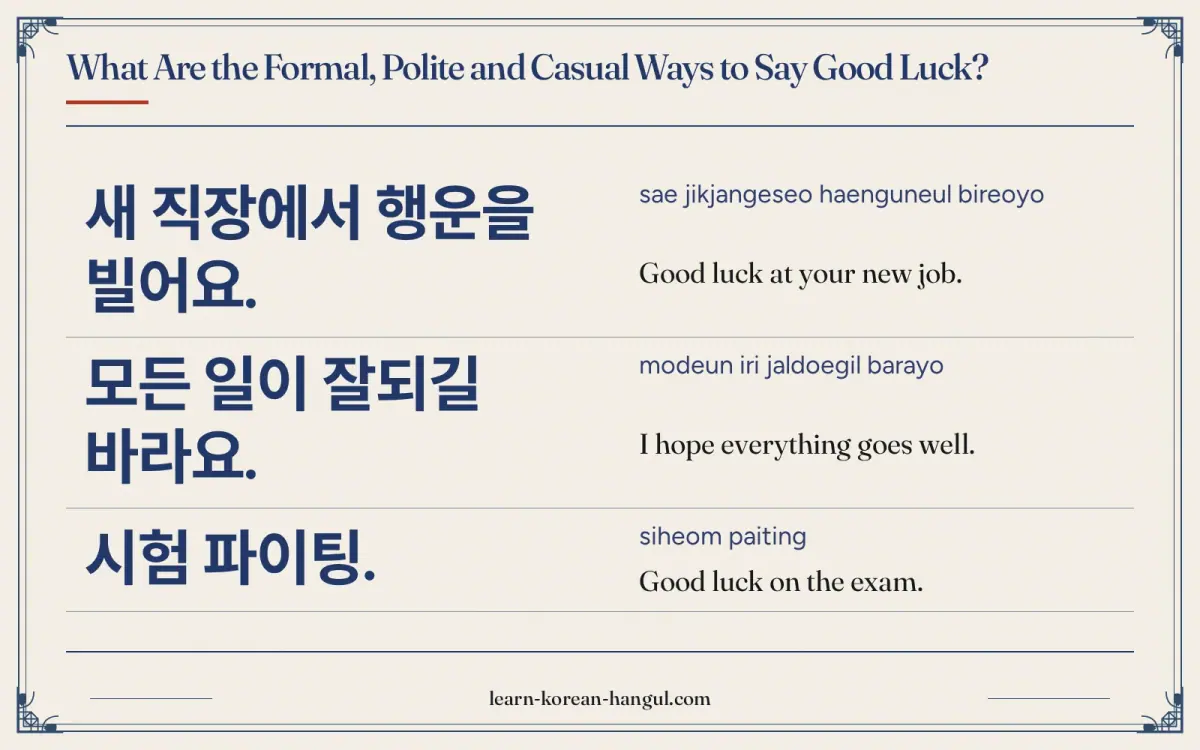
Good luck follows the Korean speech levels, the endings that change with the listener's age, status and closeness, explained in the guide to Korean speech levels. The wish stays the same while the ending shifts.
Polite: 행운을 빌어요 (haenguneul bireoyo)
Polite · 해요체행운을 빌어요 is the closest match to English "good luck". It suits colleagues, acquaintances and travellers. In casual chats, it can sound a little like a translation, so many Koreans pick 잘되길 바라요 instead.
새 직장에서 행운을 빌어요.
sae jikjangeseo haenguneul bireoyo
Good luck at your new job.
Polite: 잘되길 바라요 (jaldoegil barayo)
Polite · 해요체잘되길 바라요 means "I hope it goes well". It is warm and personal, so it fits a friend opening a shop, a coworker changing jobs or a classmate applying abroad. With friends, drop the -요: 잘되길 바라.
모든 일이 잘되길 바라요.
modeun iri jaldoegil barayo
I hope everything goes well.
Casual: 파이팅 (paiting)
Casual · 반말파이팅 is a cheer, "go for it", borrowed from English. It is the casual favourite among friends before exams, games and interviews. The page on fighting in Korean covers it in depth.
시험 파이팅.
siheom paiting
Good luck on the exam.
Formal: 행운을 빕니다 (haenguneul bimnida)
Formal · 합쇼체행운을 빕니다 uses the formal ending -ㅂ니다. It sounds public, so it suits a speech to graduates, a company announcement or a written card.
여러분의 행운을 빕니다.
yeoreobunui haenguneul bimnida
I wish you all good luck.
All four forms wish someone well. The main phrase links its sounds in a way worth practising, so pronunciation comes next.
How Do You Pronounce 행운을 빌어요?
행운을 빌어요 is pronounced [행우늘 비러요], haenguneul bireoyo. The final consonants move forward onto the next syllable, so the two words sound smooth and connected.
- 행 (haeng): a soft h, the vowel of "bed", then ng.
- 우늘 (uneul): written 운을, said "oo-neul", because ㄴ slides onto 을.
- 비러요 (bireoyo): written 빌어요, said "bee-ruh-yo", because ㄹ slides onto 어.
Sound Changes to Listen For
Two rules from the Standard Pronunciation rules (표준 발음법) shape the forms of good luck, and a third point concerns how ㄹ sounds:
- Liaison (연음). A final consonant moves to the next syllable when that syllable starts with a silent ㅇ. So 행운을 is [행우늘] and 빌어요 is [비러요].
- Nasalization in 빕니다. When ㅂ meets ㄴ, it becomes ㅁ, so 빕니다 is [빔니다].
- ㄹ between vowels. In [비러요], ㄹ is a light tap, close to the d in "ladder".
Revised Romanization, the official system for writing Korean in Latin letters, follows the linked sound: haenguneul bireoyo. Knowing which wish fits the moment matters even more, as the next section shows.
When Should You Say 행운을 빌어요, and When Should You Not?
Use 행운을 빌어요 for general good wishes, such as a trip, a move or a new job. For exams and interviews, name the task instead, and for seniors choose a respectful phrase with the honorific -시-.
Situations Where It Fits
- A colleague leaving for a new job. 행운을 빌어요, or 잘되길 바라요.
- A friend opening a business. 잘되길 바라요, or the lively 대박 나세요 (may it be a big hit).
- A traveller setting off. 행운을 빌어요, often with 조심히 다녀오세요 (travel safely).
Situations to Avoid
- Right before an exam. Say 시험 잘 봐요; 행운을 빌어요 sounds like luck matters more than study.
- Your boss or a teacher. 파이팅 can sound cheeky; say 잘되시길 바랍니다.
- Serious illness. Luck sounds too light; say 쾌유를 빕니다 (I wish you a speedy recovery) or 힘내세요.
These choices are easier to feel in real exchanges, so here are three.
What Does Good Luck Sound Like in a Real Conversation?
A Korean good-luck wish usually follows news about a plan, and it often names that plan. Listen for which phrase each speaker picks.
A Colleague Shares News of a New Job
Colleague
내일부터 새 회사 가요.
naeilbuteo sae hoesa gayo
I start at a new company tomorrow.
You
그래요? 행운을 빌어요.
geuraeyo? haenguneul bireoyo
Really? Good luck.
What to notice: a general fresh start fits 행운을 빌어요.
A Friend before the National Exam
Jisu
내일 수능이야.
naeil suneungiya
The college entrance exam is tomorrow.
Friend
시험 잘 봐. 파이팅.
siheom jal bwa. paiting
Do well on the exam. Go for it.
What to notice: the friend names the exam and adds 파이팅, rather than wishing luck.
Seeing off a Manager on a Business Trip
Employee
부장님, 출장 잘 다녀오세요. 잘되시길 바랍니다.
bujangnim, chuljang jal danyeooseyo. jaldoesigil baramnida
Have a good business trip, (Manager). I hope it all goes well for you.
Manager
고마워요.
gomawoyo
Thank you.
What to notice: the employee uses the honorific -시- and the formal ending for a senior. These habits connect to Korean customs around luck.
What Should You Know about the Culture behind Good Luck?
Koreans often wish success through effort and through small, symbolic gifts, especially before exams. Luck matters, but the phrases tend to focus on the task going well.
- Sticky gifts for exams. Before the college entrance exam (수능), people give 엿 (taffy) and 찹쌀떡 (sticky rice cakes), because 붙다 means both "to stick" and "to pass".
- Foods to avoid. Seaweed soup (미역국) is avoided before exams, since slippery seaweed suggests 미끄러지다, "to slip", which also means "to fail".
- Big-hit wishes. For a new shop or the New Year, 대박 나세요 wishes huge success.
- Effort over luck. Many wishes praise effort, such as 열심히 했으니까 잘될 거예요 (you worked hard, so it will go well).
An expert insight: learners often reach for 행운을 빌어요 because it matches the English word for word. Actually, Koreans more often name the task (시험 잘 봐요, 면접 잘 보세요) or wish that it goes well (잘되길 바라요), which sounds warmer and more natural. The common mistakes below come from this.
What Mistakes Do Learners Make with Good Luck in Korean?
Most good-luck mistakes come from literal translation, from the listener's status, or from linking.
| Mistake | Why it is a problem | Fix |
|---|---|---|
| 행운을 빌어요 right before an exam | Sounds as if only luck matters | Say 시험 잘 봐요 |
| 파이팅 to a boss in a formal setting | Can sound cheeky | Say 잘되시길 바랍니다 |
| 굿럭 in a polite message | Casual slang | Say 잘되길 바라요 |
| Saying haeng-un-eul with breaks | Liaison links the sounds | Say [행우늘] |
| Wishing luck to someone who is ill | Too light | Say 쾌유를 빕니다 |
Learners often assume the formal 행운을 빕니다 is always the most respectful choice. Actually, for a boss, 잘되시길 바랍니다 shows more respect, because the honorific -시- lifts the person, not only the sentence.
Other Ways People Search for Good Luck in Korean
People search for good luck in Korean in a few forms. The short answers below cover each one.
- Good luck formal in Korean: 행운을 빕니다, or 잘되시길 바랍니다 for a senior.
- Best of luck in Korean: 행운을 빌어요, or 꼭 잘되길 바라요 (I really hope it goes well).
- Wish you luck in Korean: 행운을 빌어요; 빌다 itself means "to wish".
- Good luck romanized: haenguneul bireoyo, following the Revised Romanization of Korean; romanization is an aid, not the real spelling.
- Good luck you can do it: 할 수 있어요, covered in you can do it in Korean.
Reading the forms is one thing; producing them on cue is another, so practise now.
Practice: Say It Aloud
Play the slow clip of 행운을 빌어요, repeat it three times with the links [행우늘 비러요], then try 잘되길 바라요. Then choose a phrase for each situation. Answers follow.
- Your classmate has a job interview tomorrow.
- Your friend is opening a café.
- Your team leader is leaving for an important meeting.
Answers
- 면접 잘 보세요, or 면접 파이팅 if you are close.
- 잘되길 바라, or 대박 나.
- 잘되시길 바랍니다.
Drill these wishes with the phrase flashcards, which include audio for each form.
Related Phrases to Learn Next
Good luck sits among the phrases Koreans use to encourage each other.
- Fighting in Korean: 파이팅, the casual cheer; learn it next.
- You can do it in Korean: 할 수 있어요, encouragement through belief.
This guide belongs to the Korean feelings phrases collection. What this page does not cover: New Year greetings in full and written card formulas. Name the task when you can, say 잘되길 바라요 for new starts, and you will say good luck in Korean the way Koreans do.
Frequently Asked Questions
What is the difference between 행운을 빌어요 and 잘되길 바라요?
행운을 빌어요 wishes someone luck, a chance that things fall their way. 잘되길 바라요 hopes that something goes well, so it sounds more personal and supportive. Koreans use 잘되길 바라요 more in everyday talk, especially for jobs, moves and new businesses. 행운을 빌어요 can sound slightly translated in casual chats.
How do you say good luck on your exam in Korean?
Name the exam and use 잘 보다, to do well on a test. To a friend, say 시험 잘 봐 or 시험 파이팅. Politely, say 시험 잘 보세요. Before an interview, say 면접 잘 보세요. These phrases sound far more natural than 행운을 빌어요 before a test.
Can I say good luck to my boss in Korean?
Yes, but choose a respectful phrase. 행운을 빌어요 and 파이팅 can sound too casual or even cheeky toward a senior. Say 잘되시길 바랍니다 (I hope it goes well for you), with the honorific -시-, or for a business trip, 잘 다녀오세요 (have a good trip). These show support without sounding like you are judging their chances.
Is 굿럭 used in Korean?
Yes, 굿럭 (good luck, borrowed from English) is heard among young people and friends, often jokingly or in chats. It is casual slang, so it does not suit elders, teachers or formal messages. Use 잘되길 바라요 or 행운을 빌어요 instead when you want to sound polite.
What is the most common mistake with good luck in Korean?
The most common mistake is using 행운을 빌어요 for every situation. Before exams and interviews, Koreans name the task: 시험 잘 보세요, 면접 잘 보세요. The second mistake is wishing a senior luck with casual 파이팅. A third is pronouncing 행운을 as haeng-un-eul with breaks; it flows as [행우늘].