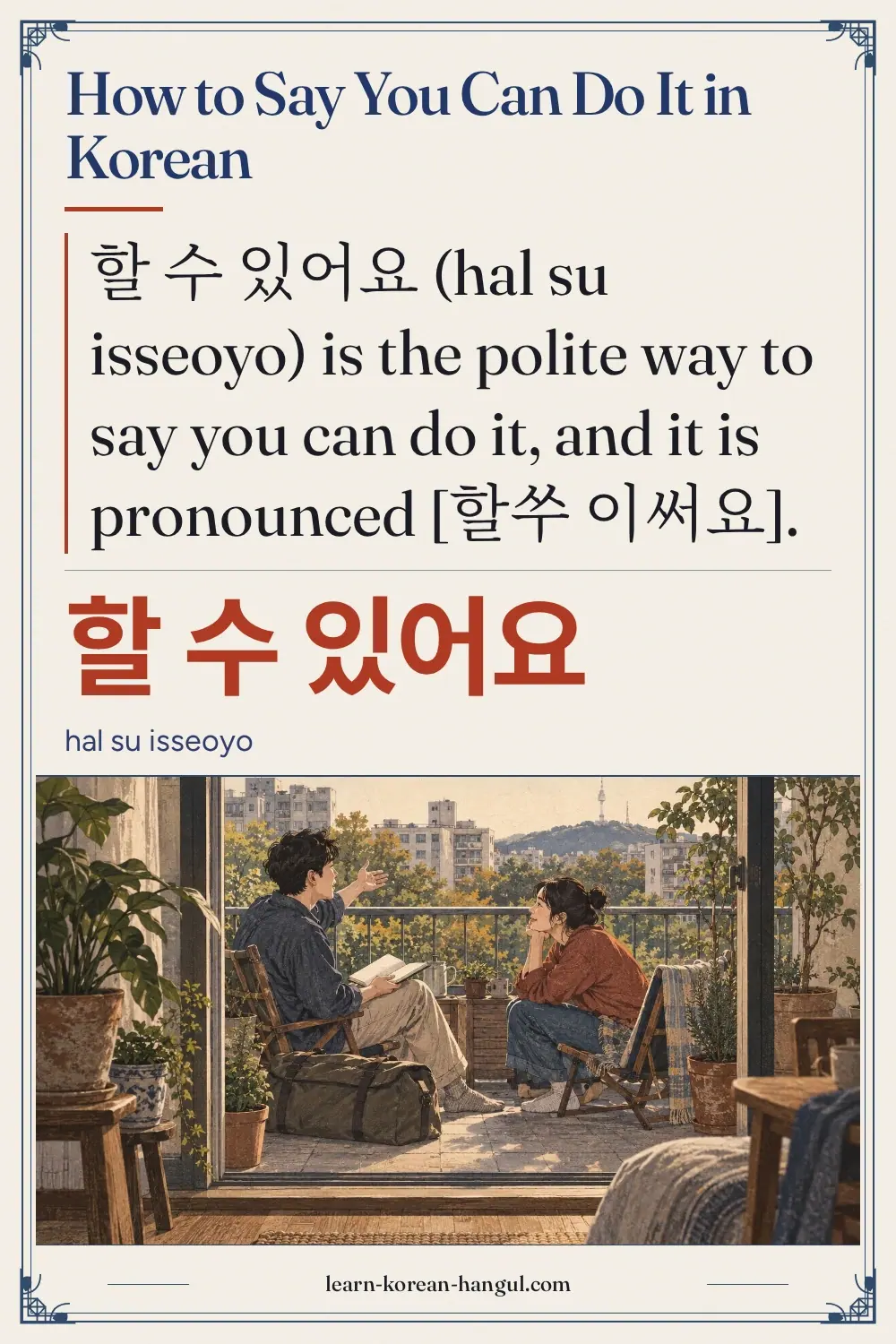
할 수 있어요
할 수 있어요
What you'll learn
- Encourage someone with 할 수 있어요, 할 수 있어 or 잘할 수 있을 거예요, depending on the listener.
- Understand the -(으)ㄹ 수 있다 pattern for "can".
- Cheer with 힘내 and 힘내세요.
- Pronounce 할 수 as [할쑤].
Before you start: you only need to read Hangul. This page fits with fighting in Korean, the cheer you hear most often. Time: about 10 minutes. Audio plays only when you press a button.
How Do You Say You Can Do It in Korean?
The standard answer is 할 수 있어요. Read it in three parts. 할 is the verb 하다 (to do) with the ending -ㄹ, which makes it a modifier. 수 (su) is a word meaning "way" or "possibility". 있어요 means "there is". So the phrase literally means "there is a way to do it", which is Korean for "can do it".
Korean drops the subject, so 할 수 있어요 can mean "I can do it", "you can do it" or "they can do it". The situation tells you which one. When you cheer someone on, name the person or add 넌 (neon, "you"): 지은 씨는 할 수 있어요, 넌 할 수 있어.
| Situation | Best form | Romanization | Why |
|---|---|---|---|
| Encouraging a coworker or acquaintance | 할 수 있어요 | hal su isseoyo | Polite |
| Encouraging a close friend | 할 수 있어 | hal su isseo | Casual |
| Promising success | 잘할 수 있을 거예요 | jalhal su isseul geoyeyo | "You will do well" |
| A short cheer | 힘내 | himnae | "Come on" |
| A formal talk or interview | 할 수 있습니다 | hal su isseumnida | Formal |
The next section sorts the forms by listener.
What Are the Formal, Polite and Casual Ways to Say You Can Do It?
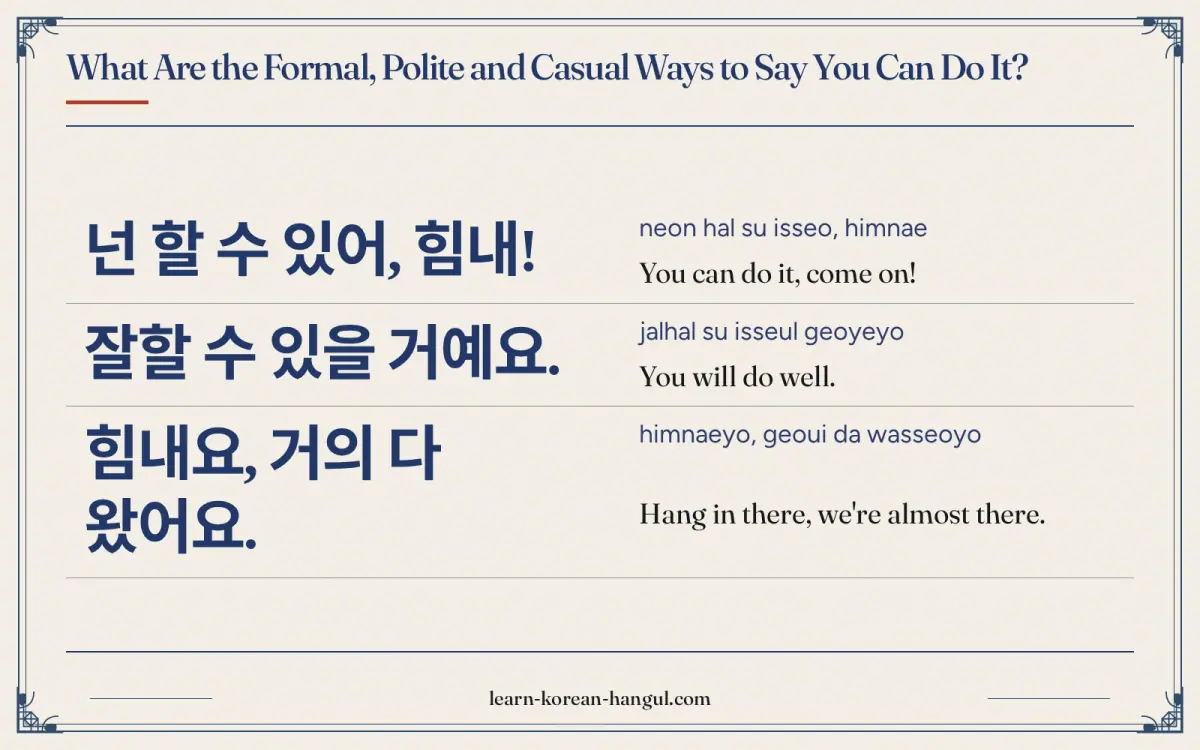
The forms follow the Korean speech levels, the endings that change with the listener. The guide to Korean speech levels explains each level. For this phrase, the pattern 할 수 있- stays the same, and the ending changes.
Polite: 할 수 있어요 (hal su isseoyo)
Polite · 해요체할 수 있어요 is the form to learn first. It suits coworkers, classmates, acquaintances and friends you address politely. It is calm, steady encouragement for someone who faces a task. Add 충분히 (chungbunhi, fully, more than enough) to make it stronger.
지은 씨는 충분히 할 수 있어요.
jieun ssineun chungbunhi hal su isseoyo
Jieun, you can definitely do it.
Casual: 할 수 있어 (hal su isseo)
Casual · 반말할 수 있어 drops the polite ending. Use it with close friends, siblings, younger people and children. The short word 넌 (neon) is "you" (너는) in casual speech. Pair it with 힘내 for a warm cheer.
넌 할 수 있어, 힘내!
neon hal su isseo, himnae
You can do it, come on!
Polite: 잘할 수 있을 거예요 (jalhal su isseul geoyeyo)
Polite · 해요체This is a prediction: "you will be able to do it well". 잘 (jal) means "well", and -(으)ㄹ 거예요 means "will" or "probably". It sounds confident and kind, and it is safer than a flat 할 수 있어요 when you speak to someone older, because it is a gentle guess, not a judgment. It is pronounced [잘할쑤 이쓸꺼예요].
잘할 수 있을 거예요.
jalhal su isseul geoyeyo
You will do well.
Polite: 힘내요 (himnaeyo) and 힘내세요 (himnaeseyo)
Polite · 해요체힘내다 (himnaeda) means "to cheer up" or "to keep your strength up". 힘내 is casual, 힘내요 is polite, and 힘내세요 adds the honorific for an elder or a customer. It is a friendly cheer when someone is tired or sad, not a statement of ability.
힘내요, 거의 다 왔어요.
himnaeyo, geoui da wasseoyo
Hang in there, we're almost there.
Before the sounds, a short look at the grammar.
How Does 할 수 있어요 Work?
The pattern -(으)ㄹ 수 있다 (-(eu)l su itda) means "can" or "to be able to". You attach it to a verb stem. If the stem ends in a vowel, add ㄹ. If it ends in a consonant, add 을. Then add the word 수 and 있어요.
- 하다 → 할 수 있어요 (hal su isseoyo): can do
- 가다 → 갈 수 있어요 (gal su isseoyo): can go
- 먹다 → 먹을 수 있어요 (meogeul su isseoyo): can eat
- 만들다 → 만들 수 있어요 (mandeul su isseoyo): can make (the stem already ends in ㄹ)
For "cannot", replace 있어요 with 없어요: 할 수 없어요 (hal su eopseoyo), "I cannot do it". The full lesson is in the guide to the -(으)ㄹ 수 있다 pattern. Now the sounds.
How Do You Pronounce 할 수 있어요?
할 수 있어요 is pronounced [할쑤 이써요], hal ssu i-sseo-yo, in five syllables. The spelling is regular, but two sounds change.
- 할 (hal): "hal", with a light l.
- 수 (su) → [쑤] (ssu): a tense ㅆ. Press your tongue against your lower teeth, build a little pressure, and hiss without a puff.
- 있어요 (isseoyo) → [이써요]: the ㅆ of 있 moves to the next syllable.
The ㅓ in 어 is unrounded: keep your lips relaxed and open, like "uh", and do not round them as for "oh".
Sound Changes to Listen For
These notes follow the National Institute of Korean Language standard pronunciation rules (표준 발음법):
- 수 becomes [쑤]. After the modifier ending -ㄹ, a plain ㄱ, ㄷ, ㅂ, ㅅ or ㅈ becomes tense (Article 27). So 할 수 is [할쑤], 갈 수 is [갈쑤], and 먹을 수 is [머글쑤]. Revised Romanization shows hal su because it does not mark tensing caused by a neighbouring sound. See Korean tensification.
- 있어요 is [이써요]. The final ㅆ moves to the next syllable (Article 13).
- 잘할 수 있을 거예요 is [잘할쑤 이쓸꺼예요]. After 있을, the ㄱ of 거 is tense too, again because of the -ㄹ ending.
- 할 수 있습니다 is [할쑤 읻씀니다]. The ㅆ of 있 is said as [ㄷ] before ㅅ, the ㅅ is tense, and the ㅂ before ㄴ becomes ㅁ.
With the sounds clear, the next question is when to use each form.
When Should You Use 할 수 있어요, and When Should You Not?
Use 할 수 있어요 when someone faces a challenge and you believe in them. It is calm, steady encouragement. Do not use it to push someone who is already exhausted.
Situations Where It Fits
- Before a test or an interview. 지은 씨는 충분히 할 수 있어요 is kind and clear.
- During a hard task. 거의 다 왔어요, 할 수 있어요 (we're almost there, you can do it).
- Cheering a friend. 넌 할 수 있어 gives a quick boost.
Situations to Avoid
- Someone in real distress. Say 힘내세요 or ask 괜찮으세요? (are you okay?) first.
- A flat 해요. It only means "do it", which sounds like an order.
- A senior in a formal setting. Use 잘하실 수 있을 거예요 (jalhasil su isseul geoyeyo), which is respectful and gentle.
Two short conversations show how it sounds.
What Does You Can Do It Sound Like in a Real Conversation?
Encouragement is short and warm. The answer is often a thank-you and a bit of energy.
Before an Interview
Jiwon
내일 면접이 너무 떨려요.
naeil myeonjeobi neomu tteollyeoyo
I'm so nervous about tomorrow's interview.
Hyunwoo
괜찮아요. 지원 씨는 잘할 수 있을 거예요.
gwaenchanayo. jiwon ssineun jalhal su isseul geoyeyo
It's okay. Jiwon, you will do well.
Jiwon
고마워요. 힘이 나요.
gomawoyo. himi nayo
Thank you. That gives me strength.
Hyunwoo
파이팅!
paiting
You've got this!
What to notice: Hyunwoo uses a prediction, not a flat 할 수 있어요, which is gentler. 힘이 나요 literally means "strength comes out", a common reply to encouragement.
Between Friends
Doyun
나 마라톤 완주할 수 있을까?
na maraton wanjuhal su isseulkka
Do you think I can finish the marathon?
Seoyun
넌 할 수 있어! 열심히 했잖아.
neon hal su isseo! yeolsimhi haetjana
You can do it! You've worked hard.
Doyun
고마워. 힘이 난다.
gomawo. himi nanda
Thanks. That gives me strength.
What to notice: Doyun asks with -(으)ㄹ 수 있을까?, a thinking-aloud question ("could I ...?"). Seoyun answers with the casual 할 수 있어, and the ending -잖아 reminds him of a fact they both know. 열심히 했잖아 is pronounced [열씸히 핻짜나].
What Should You Know about the Culture behind You Can Do It?
Koreans cheer with 파이팅 (paiting), borrowed from the English "fighting", and with 힘내 and 아자 아자 (aja aja). The guide to fighting in Korean explains the cheer. For a quiet word of comfort instead, don't give up in Korean and good luck in Korean cover the next steps.
- Exam days. Before big exams, family and friends traditionally give sticky sweets such as 엿 (yeot, taffy) or 찹쌀떡 (chapssaltteok, sticky rice cake). Something that sticks stands for passing, a play on the idea of "sticking" to the school.
- Shared effort. Encouragement often comes with an offer: 같이 해요 (let's do it together).
- Modesty. The person encouraged may answer 감사합니다, 노력해 볼게요 (thank you, I'll try my best).
Calm encouragement works best when it comes with a reason. 열심히 했으니까 할 수 있어요 (you worked hard, so you can do it) sounds more believable than a bare cheer.
What Mistakes Do Learners Make with You Can Do It in Korean?
Most mistakes come from the pattern or from the wrong listener.
| Mistake | Why it is a problem | Fix |
|---|---|---|
| 해요 | It only means "do it" or "I do" | Say 할 수 있어요 |
| 할수있어요 | 수 is a separate word | Write 할 수 있어요 with spaces |
| 먹 수 있어요 | A stem that ends in a consonant needs 을 | Say 먹을 수 있어요 |
| [할수 이써요] with a plain ㅅ | The tense [쑤] is the standard sound | Say [할쑤 이써요] |
| 할 수 있어 to an elder | Too casual | Say 할 수 있어요 or 잘하실 수 있을 거예요 |
The most important row is the first one. Korean does not use the verb 하다 alone to mean ability. The word 수 is what creates "can". If you only want to cheer, 힘내요 and 파이팅 do not need 수 at all.
Is It the Same as You Can Do This or Believe in Yourself?
Almost. The searches folded into this page each have a short answer.
- You can do this in Korean: 할 수 있어요. Both "this" and "it" are dropped in Korean. To point, say 이거 할 수 있어요 (igeo hal su isseoyo).
- You can do it (casual): 넌 할 수 있어.
- Believe in yourself in Korean: 자신을 믿어요 (jasineul mideoyo). A natural cheer is 자신감을 가지세요 (jasingameul gajiseyo, have confidence) or 너 자신을 믿어 (neo jasineul mideo).
- You will do well in Korean: 잘할 수 있을 거예요.
- I can do it in Korean: the same sentence, 할 수 있어요, when you say it about yourself.
Now say them aloud.
Practice: Say It Aloud
Play the slow clip of 할 수 있어요 three times and make 수 a tense [쑤]. Then choose a phrase. Answers follow.
- You cheer a close friend, casually.
- You calmly encourage a coworker.
- You tell an older person they will do well.
- You say a short "come on" to a friend.
Answers
- 넌 할 수 있어.
- 할 수 있어요.
- 잘하실 수 있을 거예요.
- 힘내!
The phrase flashcards drill these lines with audio.
Related Phrases to Learn Next
Encouragement leads to other kinds of support.
- Fighting in Korean: 파이팅 for a cheer.
- Good luck in Korean: 행운을 빌어요 for the wish before a test.
- Don't give up in Korean: 포기하지 마세요 for a hard moment.
- Good job in Korean: 잘했어요 for the praise after.
This guide belongs to the Korean feelings phrases collection. What this page does not cover: the full -(으)ㄹ 수 있다 grammar lesson, ability with irregular verbs, and polite requests. Use 수 for "can", pick the level for the listener, and you can say you can do it in Korean with confidence.
Frequently Asked Questions
How do you say you can do it in Korean?
Say 할 수 있어요 (hal su isseoyo) in polite speech and 할 수 있어 (hal su isseo) to a close friend. Korean drops the subject, so name the person or add 넌 (neon, you) to make it clear: 지은 씨는 할 수 있어요, 넌 할 수 있어. For a cheer, add 힘내 (come on) or 파이팅.
How do you pronounce 할 수 있어요?
It is pronounced [할쑤 이써요]. After the ending -ㄹ, the ㅅ of 수 becomes a tense ㅆ (Article 27), and the ㅆ of 있 moves to the next syllable. The ㅓ in 어 is unrounded. Revised Romanization shows hal su isseoyo, with the tense ㅆ of 있 written as ss but not the tensing of 수.
What is the difference between 할 수 있어요 and 할 수 있어?
They mean the same thing, but 할 수 있어요 is polite and 할 수 있어 is casual. Use the polite form with coworkers, acquaintances and people older than you, and the casual form with close friends, siblings and children. With an older person, 힘내세요 (himnaeseyo) is a respectful alternative.
Is 할 수 있어요 formal or casual?
It is polite, in the middle. The ending -요 suits most situations. The formal form is 할 수 있습니다 (hal su isseumnida), pronounced [할쑤 읻씀니다], which you hear in speeches and interviews. The casual form is 할 수 있어.
Can I use 할 수 있어요 with friends, elders and strangers?
Yes with friends, in the casual or polite form. With a stranger, the polite form is fine, but it can sound like a statement of ability, so add a name or 충분히 (chungbunhi, fully): 충분히 할 수 있어요. With an elder, prefer 잘하실 수 있을 거예요 or 힘내세요.
What is the most common mistake with you can do it in Korean?
Learners say 해요, which only means 'do it' or 'I do'. To say 'can', use the -(으)ㄹ 수 있다 pattern: 할 수 있어요. A second mistake is leaving out the space in 할 수 있어요. The word 수 is a separate word in the pattern, so write it with spaces: 할 수 있어요, 갈 수 있어요.