파이팅
파이팅
What you'll learn
- Say 파이팅 aloud with Korean sounds: ㅍ for the English f, and a crisp 팅.
- Choose between 파이팅, 화이팅, 힘내세요 and 아자아자 파이팅 for a friend, a team and an elder.
- Attach the cheer to a goal, as in 시험 파이팅.
- Avoid the situations where 파이팅 sounds too light.
Before you start: you need to read Hangul; romanization is shown as an aid and can be hidden. Time: about 10 minutes. Audio plays only when you press a button.
How Do You Say Fighting in Korean?
The standard way to say fighting in Korean is 파이팅, an interjection of encouragement borrowed from the English word. It works like "go for it", "good luck" or "let's do this", and it comes in a few forms.
| Form | Romanization | Register | Use it for |
|---|---|---|---|
| 파이팅 | paiting | Casual cheer | Friends, teammates, classmates, yourself |
| 화이팅 | hwaiting | Casual cheer | The same, in a common variant spelling |
| 힘내세요 | himnaeseyo | Polite | Elders, customers, people in hard times |
| 아자아자 파이팅 | ajaaja paiting | Casual, playful | Pep talks, group cheers, self-motivation |
파이팅 has no verb ending, so it does not change for politeness by itself. Politeness comes from choosing a different phrase, such as 힘내세요, which uses the honorific -세요. The next section shows each form in a sentence.
What Are the Casual and Polite Ways to Say Fighting?
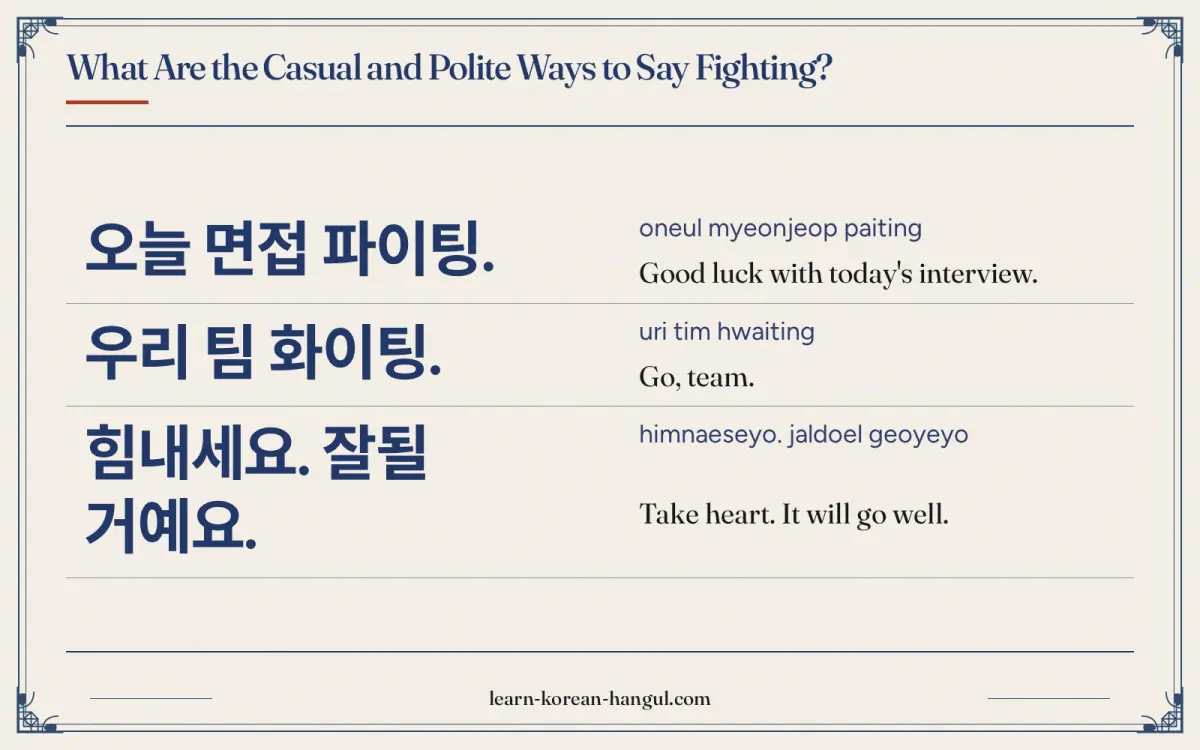
Fighting in Korean sits mostly at the casual end of the Korean speech levels, the endings that change with the listener's age, status and closeness, explained in the guide to Korean speech levels. For respect, switch to 힘내세요.
Casual: 파이팅 (paiting)
Casual · 반말파이팅 is the core cheer. Put a noun in front to name the goal or the group: 시험 파이팅 (exam, go), 면접 파이팅 (interview, go), 우리 팀 파이팅 (go team). You can also say it to yourself before a hard task.
오늘 면접 파이팅.
oneul myeonjeop paiting
Good luck with today's interview.
Casual: 화이팅 (hwaiting)
Casual · 반말화이팅 is the same cheer in a different spelling. The Korean loanword rules (외래어 표기법) write English f as ㅍ, which makes 파이팅 the standard form, but 화이팅 is extremely common on banners, in chats and in speech.
우리 팀 화이팅.
uri tim hwaiting
Go, team.
Polite: 힘내세요 (himnaeseyo)
Polite · 해요체힘내세요 means "please take heart" or "cheer up", from 힘 (strength) and 내다 (to bring out). The honorific -세요 makes it suitable for elders, customers and anyone going through a tough time. The casual form is 힘내.
힘내세요. 잘될 거예요.
himnaeseyo. jaldoel geoyeyo
Take heart. It will go well.
Casual: 아자아자 파이팅 (ajaaja paiting)
Casual · 반말아자 is a native shout of effort, a little like "come on". Doubling it before 파이팅 makes a playful pep-rally cheer, often with both fists pumped. You hear it in dramas and variety shows when a character psyches themselves up.
아자아자 파이팅
ajaaja paiting
Come on, let's do this.
All four forms encourage someone. Saying 파이팅 with Korean sounds is the next step.
How Do You Pronounce 파이팅?
파이팅 is pronounced [파이팅], paiting, in three syllables. Korean has no f sound, so the word starts with ㅍ, a p with a strong puff of air, and it ends with 팅, a t with a puff of air followed by ng.
- 파 (pa): a strong, breathy p, then "ah".
- 이 (i): "ee", short.
- 팅 (ting): a breathy t, "ee", and ng, as at the end of "sing".
Sound Changes to Listen For
파이팅 has no sound change inside the word, but the borrowing itself reshapes the English sounds:
- f becomes ㅍ or ㅎ. Standard spelling uses ㅍ (파이팅); many speakers use ㅎ plus w (화이팅). Both are heard every day.
- Three syllables, not two. "Fighting" is two syllables in English; Korean splits the diphthong into 파 and 이, giving three even beats.
- The final ng. English -ing becomes Korean ㅇ at the end of 팅, a clean ng with no g released.
Revised Romanization, the official system for writing Korean in Latin letters, gives paiting and hwaiting. Fans often write "fighting" or "hwaiting", which explains the many searches. Knowing when to cheer matters more than the spelling, as the next section shows.
When Should You Say 파이팅, and When Should You Not?
Say 파이팅 to friends, teammates, classmates and yourself before a challenge. Switch to 힘내세요 with elders and seniors, and drop the cheer altogether when someone is grieving or seriously ill.
Situations Where It Fits
- Before an exam or interview. 시험 파이팅, 면접 파이팅.
- Team huddles. Players stack hands and shout 파이팅 together.
- Work kick-offs. A team leader may say 다 같이 파이팅합시다 (let's all give it our best).
- Self-talk. People mutter 파이팅 before a hard task, alone.
Situations to Avoid
- At a funeral or with someone grieving. It sounds too light; offer condolences instead.
- To a senior manager in a formal meeting. A respectful 잘 부탁드립니다 or 힘내세요 fits better.
- Describing a real fight. Use 싸움 or 싸우다.
These choices are easier to feel in real exchanges, so here are three.
What Does Fighting Sound Like in a Real Conversation?
파이팅 is usually short and comes at the end of a conversation, like a send-off. Listen for who says it and to whom.
A Friend before an Exam
Sua
내일 시험이지? 파이팅.
naeil siheomiji? paiting
Your exam is tomorrow, right? Go for it.
Minsu
고마워. 열심히 할게.
gomawo. yeolsimhi halge
Thanks. I'll do my best.
What to notice: Minsu answers the cheer with thanks and a promise, the usual reply.
A Team Leader Starts a Project
Team Leader
이번 프로젝트, 다 같이 파이팅합시다.
ibeon peurojekteu, da gachi paitinghapsida
Let's all give this project our best.
Team
파이팅.
paiting
Let's go.
What to notice: the leader turns 파이팅 into a verb with -합시다 (let's), and the team echoes the cheer.
A Granddaughter before Her Grandmother's Surgery
Granddaughter
할머니, 수술 잘 받으세요. 힘내세요.
halmeoni, susul jal badeuseyo. himnaeseyo
Grandma, I hope the surgery goes well. Stay strong.
Grandmother
그래, 고맙다.
geurae, gomapda
All right, thank you.
What to notice: with an elder facing something serious, the granddaughter chooses 힘내세요, not 파이팅. These choices grow out of how Koreans use the cheer.
What Should You Know about the Culture behind Fighting?
파이팅 is a piece of Konglish, an English-based word used in its own Korean way. It became a standard cheer in sports, schools and offices, and it now appears in K-pop, dramas and fan culture around the world.
- Collective energy. Group cheers before games, performances and big projects build team spirit, and 파이팅 is the usual word.
- Hands and fists. The cheer often comes with a raised fist or hands stacked in a circle.
- Language advice. The National Institute of Korean Language (국립국어원) has suggested native alternatives such as 힘내자 and 아자, but 파이팅 remains far more common.
- Global spread. K-pop idols say 파이팅 to fans, which is why many non-Koreans know the word before they study Korean.
An expert insight: learners often treat 파이팅 as a universal "good luck" for any situation. Actually, it is energetic and informal, so it fits challenges you can work at, such as exams and games, but not misfortune, such as illness or loss. For those moments, quieter phrases such as 힘내세요 carry the right weight. The common mistakes below come from this.
What Mistakes Do Learners Make with Fighting in Korean?
Most fighting mistakes come from tone, from the listener's status, or from the English meaning.
| Mistake | Why it is a problem | Fix |
|---|---|---|
| Saying 파이팅 at a funeral | Too light for grief | Offer condolences, or stay quiet |
| Saying 파이팅 to a senior in a formal meeting | Can sound cheeky | Say 힘내세요 or 잘 부탁드립니다 |
| Using 파이팅 for a real fight | It is only a cheer | Say 싸움 or 싸우다 |
| Pronouncing an English f | Korean uses ㅍ or ㅎ | Say [파이팅] or [화이팅] |
| Saying "fight-ing" in two beats | Korean has three syllables | Say 파-이-팅 |
Learners often assume 화이팅 is a misspelling to avoid. Actually, it is the variant many Koreans prefer in speech; only in formal writing does the standard 파이팅 matter.
Other Ways People Search for Fighting in Korean
People search for fighting in Korean in many spellings. The short answers below cover each one.
- Hwaiting in Korean: 화이팅, the common variant of 파이팅.
- Paiting in Korean: 파이팅, romanized paiting in the Revised Romanization of Korean; romanization is an aid, not the real spelling.
- Fighting korean / fighting meaning: a cheer meaning "go for it" or "you can do it".
- Aja aja in Korean: 아자아자, a native shout of effort, often before 파이팅.
- Good luck in Korean: a related wish, covered in good luck in Korean, where 파이팅 also appears.
Reading the forms is one thing; producing them on cue is another, so practise now.
Practice: Say It Aloud
Play the slow clip of 파이팅, repeat it three times, then try 화이팅 and 힘내세요. Then choose a phrase for each situation. Answers follow.
- Your friend has a driving test tomorrow.
- Your football team stacks hands before a match.
- Your grandfather is starting a long hospital stay.
- You are about to give a presentation and want to psych yourself up.
Answers
- 운전면허 시험 파이팅 (Go for it on your driving test).
- 파이팅, all together.
- 할아버지, 힘내세요.
- 아자아자 파이팅, to yourself.
Drill 파이팅 and the related phrases with the phrase flashcards, which include audio for each form.
Related Phrases to Learn Next
파이팅 belongs to a small family of encouraging phrases.
- Good luck in Korean: 행운을 빌어요 and 잘되길 바라요; learn it next.
- You can do it in Korean: 할 수 있어요, a fuller sentence of encouragement.
- Cheer up in Korean: 힘내 and 기운 내, for someone who is down.
- Don't give up in Korean: 포기하지 마, for long struggles.
This guide belongs to the Korean feelings phrases collection. What this page does not cover: sports chants in full, cheering songs and slogans. Shout 파이팅 with friends and teams, say 힘내세요 to elders, and you will use fighting in Korean the way Koreans do.
Frequently Asked Questions
Is it 파이팅 or 화이팅?
Both are used, and they mean the same cheer. 파이팅 is the standard spelling, because the Korean loanword rules write English f as ㅍ. 화이팅 is a popular variant that many people prefer in speech and on signs. In formal writing, such as news headlines, choose 파이팅; in chats, either is fine.
Is it rude to say 파이팅 to elders?
Not rude, but it can sound too casual or cheeky toward a grandparent, teacher or senior manager. With them, say 힘내세요 (please take heart) or 잘되실 거예요 (it will go well for you). In a team setting, a boss may lead the 파이팅 personally, and then everyone joins in.
Does fighting in Korean mean a fight?
No. In Korean, 파이팅 is only a cheer of encouragement. To talk about an actual fight, use 싸움 (a fight) or the verb 싸우다 (to fight), as in 친구랑 싸웠어요 (I had a fight with a friend). English speakers sometimes find the cheer surprising, but Koreans hear no aggression in it.
How do you reply when someone says 파이팅 to you?
Thank them and promise to do your best. With friends, say 고마워, 열심히 할게 (thanks, I'll work hard). Politely, say 감사합니다, 열심히 할게요. In a team huddle, people simply shout 파이팅 back together. A smile and a raised fist also work as a reply.
How do you write fighting in Hangul?
Fighting is written 파이팅 in Hangul, three blocks: 파, 이 and 팅. The first block uses ㅍ, the aspirated p, because Korean has no f sound. The variant 화이팅 starts with 화 instead. The middle block 이 begins with a silent ㅇ, and 팅 ends in ㅇ, pronounced ng.
What is the most common mistake with fighting in Korean?
The most common mistake is saying 파이팅 to someone who is grieving or seriously ill, where it sounds too light; say 힘내세요 or simply listen. The second is shouting 파이팅 to a senior in a formal setting. A third is using it to describe an actual fight, which needs 싸움.