생일 축하해요
생일 축하해요
What you'll learn
- Say 생일 축하해요 aloud as [생일 추카해요].
- Choose between 생일 축하해요, 생일 축하합니다, 생일 축하해 and 생신 축하드립니다 for a coworker, a friend and a grandparent.
- Explain why Korean uses 생신 for elders and what 축하 really means.
- Add a short birthday wish after the greeting.
Before you start: knowing Korean speech levels helps, because birthday greetings use the same polite, formal and casual endings. Time: about 13 minutes.
How Do You Say Happy Birthday in Korean?
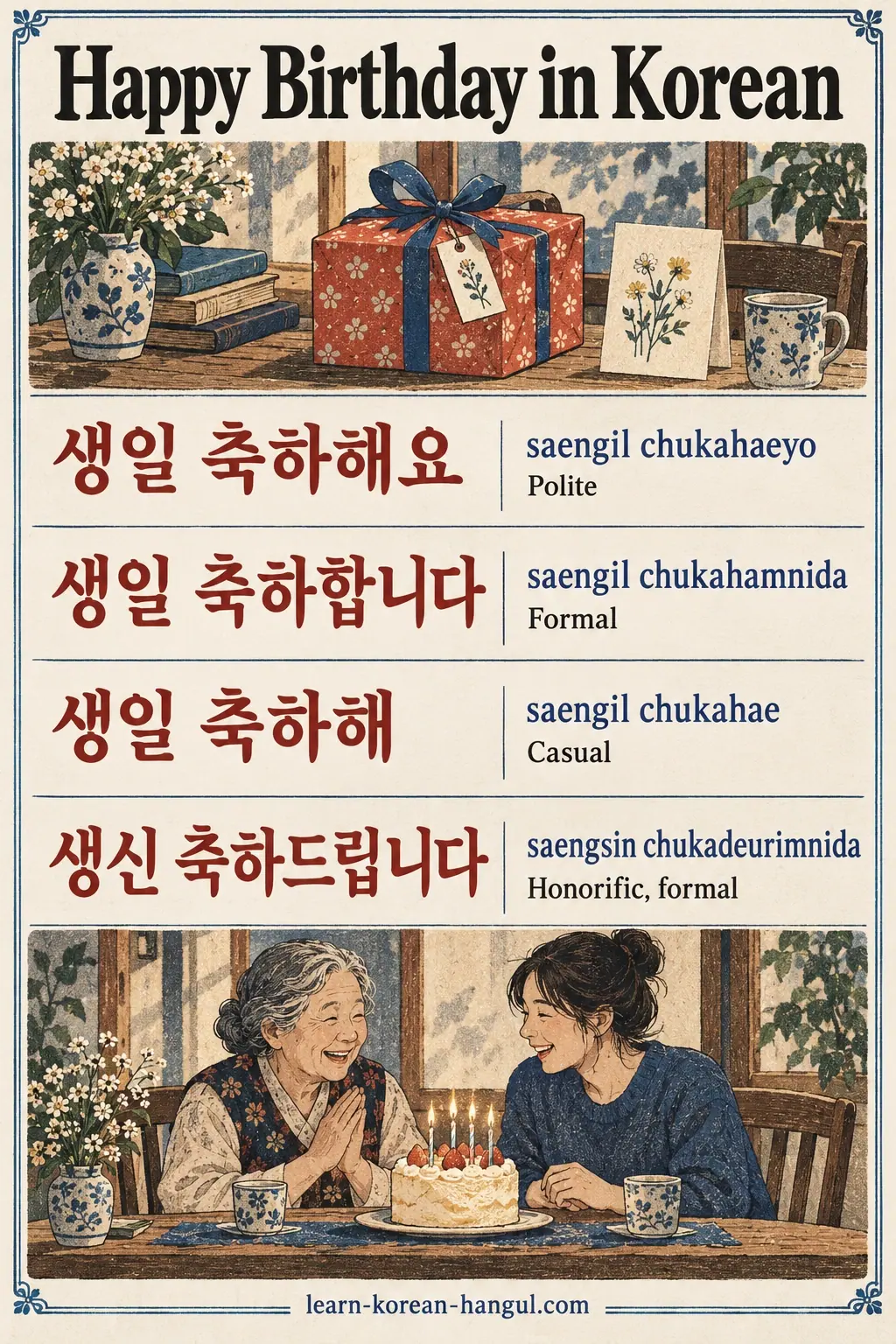
The standard way to say happy birthday in Korean is 생일 축하해요 (saengil chukahaeyo). It joins 생일 (saengil, birthday) and 축하해요 (chukahaeyo, I congratulate you), so the Korean literally says "congratulations on your birthday". Four forms cover nearly every listener.
| Form | Romanization | Register | Say it to |
|---|---|---|---|
| 생일 축하해요 | saengil chukahaeyo | Polite (해요체) | Coworkers, acquaintances, neighbours |
| 생일 축하합니다 | saengil chukahamnida | Formal (합쇼체) | Speeches, the birthday song, customers |
| 생일 축하해 | saengil chukahae | Casual (반말) | Close friends, siblings, younger people |
| 생신 축하드립니다 | saengsin chukadeurimnida | Honorific, formal | Grandparents, parents, respected elders |
The first three forms differ only in their ending. The fourth also changes the noun and the verb, which is the most useful detail on this page. The sections below take each form in turn.
What Are the Formal, Polite and Casual Ways to Say Happy Birthday?
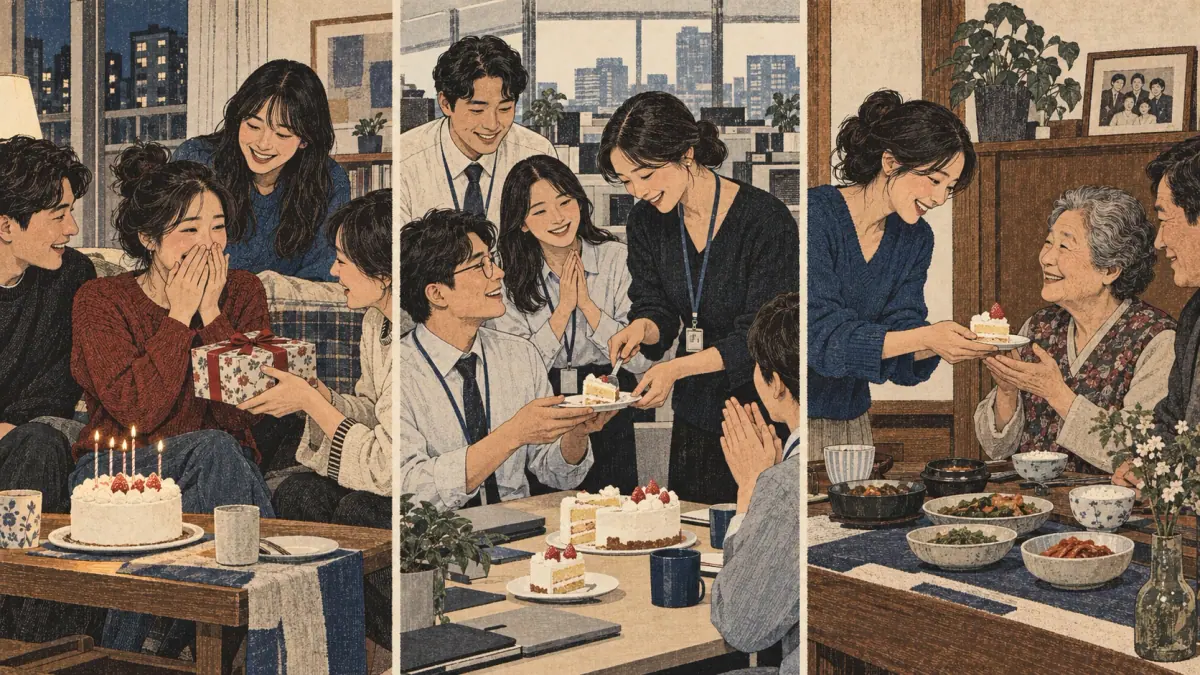
Birthday greetings follow the Korean speech levels, the endings that change with the listener, explained in the guide to Korean speech levels. The core 축하 never changes, so you only adjust the ending, and with elders, the nouns.
Polite: 생일 축하해요 (saengil chukahaeyo)
Polite · 해요체생일 축하해요 is the default. It is warm and respectful enough for a coworker, a classmate you are not close to, a neighbour or a friend's parent. When you are unsure which form to use, this is the safe middle.
지민 씨, 생일 축하해요.
jimin ssi, saengil chukahaeyo
Jimin, happy birthday.
Formal: 생일 축하합니다 (saengil chukahamnida)
Formal · 합쇼체생일 축하합니다 uses the formal ending -ㅂ니다. It is what a host says in front of a group, what staff say to a customer celebrating a birthday and what everyone sings. Its repeating role in the song has its own page, happy birthday song in Korean.
민수 씨, 생일 축하합니다.
minsu ssi, saengil chukahamnida
Minsu, happy birthday (formal).
Casual: 생일 축하해 (saengil chukahae)
Casual · 반말생일 축하해 is the casual form, in 반말 (banmal, intimate speech). Use it with close friends, siblings, partners and younger people. With an older person or someone you have just met, it sounds too familiar.
민아야, 생일 축하해. 선물 가져왔어.
minaya, saengil chukahae. seonmul gajyeowasseo
Mina, happy birthday. I brought a present.
Honorific: 생신 축하드립니다 (saengsin chukadeurimnida)
Formal · 합쇼체생신 축하드립니다 is the greeting for an elder. 생신 is the respectful noun for an older person's birthday, and 드립니다 is the humble form of "give". Together they say "I respectfully offer congratulations on your birthday". Use it with grandparents, parents, teachers and bosses who are much older than you. For the softer polite version, say 생신 축하드려요.
할머니, 생신 축하드립니다. 건강하세요.
halmeoni, saengsin chukadeurimnida. geonganghaseyo
Grandma, happy birthday. Please stay healthy.
Four forms reduce to one decision: how close and how senior is the listener. The sounds come next.
How Do You Pronounce 생일 축하해요?
생일 축하해요 is pronounced saeng-il chu-ka-hae-yo, and the biggest surprise is that 축하 sounds like "chu-ka" without any h.
- 생 (saeng): s plus the "e" of "bed", ending in "ng" as in "sing".
- 일 (il): "eel" with a short l at the end.
- 축 (chuk): the final ㄱ is a held, unreleased k.
- 하 (ha): joins the k, so together they sound "ka".
- 해 (hae): "heh".
- 요 (yo): "yo" as in "yoga".
Sound Changes to Listen For
Two details follow the National Institute of Korean Language (국립국어원) Standard Pronunciation rules (표준 발음법):
- ㄱ + ㅎ becomes ㅋ. The final ㄱ of 축 meets the ㅎ of 하, and they merge into an aspirated k, so 축하 is [추카]. The pattern is explained in Korean aspiration. Saying "chuk-ha" with a clear h sounds stilted.
- ㅂ + ㄴ becomes ㅁ + ㄴ. In 축하합니다, the ㅂ of 합 before ㄴ turns into ㅁ, so it is said [추카함니다]. See ㅂ-to-ㅁ nasalization for the rule.
Even with perfect sounds, the wrong form can embarrass you, so the next section covers who gets which greeting.
When Should You Use 생일 축하해요, and When Should You Not?

Use 생일 축하해요 with people you speak politely with, and move to 생일 축하해 with close friends or 생신 축하드립니다 with elders. The formal 생일 축하합니다 belongs to group moments and the song.
Situations Where It Fits
- A coworker's birthday. 생일 축하해요 with a card or a small cake.
- A friend's parent. 생신 축하드려요, if the parent is clearly older and respected.
- A message to a classmate. 생일 축하해요 with a smile emoji, or 생일 축하해 if you are close.
- A party. Everyone sings 생일 축하합니다, then wishes the person individually.
Situations to Avoid
- A grandparent with 생일. Say 생신, because 생일 alone sounds too plain.
- A boss with 생일 축하해. Casual speech is rude to a senior.
- A stranger with 생일 축하합니다. It sounds like a formal announcement.
- A serious situation. If someone is ill or grieving, a cheerful greeting may not fit.
The short conversations below show the choices at work.
What Does Happy Birthday Sound Like in a Real Conversation?
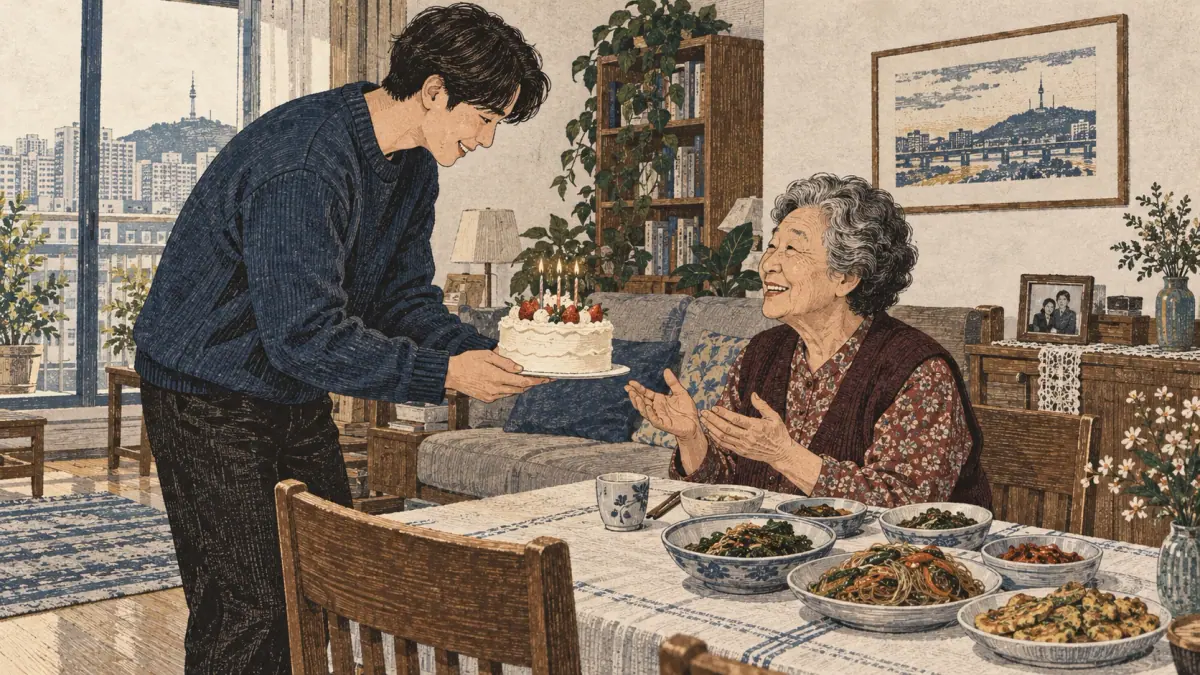
A birthday exchange is a greeting, a thank-you and, often, a small wish. Notice how each speaker's form matches the other's status.
A Coworker at the Office
Colleague
팀장님, 생일 축하드려요.
timjangnim, saengil chukadeuryeoyo
Team leader, happy birthday.
Team Leader
고맙습니다. 케이크 같이 드세요.
gomapseumnida. keikeu gachi deuseyo
Thank you. Please have some cake with us.
What to notice: a junior at work adds 드려요 to the polite ending, which gives a respectful tone without the stiffness of 생신.
Grandmother
Grandchild
할머니, 생신 축하드립니다.
halmeoni, saengsin chukadeurimnida
Grandma, happy birthday.
Grandmother
고맙다. 와 줘서 고맙구나.
gomapda. wa jwoseo gomapguna
Thank you. I'm glad you came.
What to notice: the grandchild uses the honorific form, and the grandmother answers in plain, warm speech because she is the elder. Both are normal. The words follow a Korean idea about age and respect.
What Should You Know about Birthdays and 축하 in Korea?

Korean birthday greetings say "congratulations", not "happy". 축하 (祝賀) is a Sino-Korean word meaning "congratulation", which is why the same 축하해요 also works for graduations and promotions.
- Seaweed soup. On their birthday, many Koreans eat 미역국 (miyeokguk), a soup of seaweed. It is also the soup mothers eat after giving birth, so it is often described as a way to remember one's mother.
- Elders and the lunar calendar. Some older Koreans celebrate according to the lunar calendar, so ask which date they use before you greet them.
- Milestone birthdays. A baby's first birthday is celebrated as 돌, and the 60th birthday has the traditional name 환갑 (hwangap).
- Messaging. Birthday messages travel by phone, and apps such as KakaoTalk show friends' birthdays, so a text with 생일 축하해요 is common.
An expert insight: learners often add an English-style exclamation or "happy" to the Korean. Korean birthday greetings rarely need a word for "happy"; the 축하 already carries the warmth, so a short wish after it is the better upgrade. The common mistakes below follow from the same idea.
What Mistakes Do Learners Make with Happy Birthday in Korean?
Most mistakes come from the wrong register for the listener, or from using 생일 for elders.
| Mistake | Why it is a problem | Fix |
|---|---|---|
| Saying 생일 to a grandparent | 생일 is the plain noun for a birthday | Say 생신 |
| Saying 생일 축하해 to a boss | Casual speech is rude to a senior | Say 생일 축하드려요 or 생신 축하드립니다 |
| Saying 생일 축하합니다 to a stranger | Sounds like an announcement | Say 생일 축하해요 |
| Saying "chuk-ha" with a clear h | The ㄱ and ㅎ merge into k | Say [추카] |
| Using only 축하해요 in a text | The occasion is not stated | Write 생일 축하해요 |
| Mixing 해피 버스데이 into formal cards | The English phrase is playful | Write 생일 축하드립니다 |
Learners often assume that adding -요 to a casual greeting makes it safe for elders. Actually, 생일 축하해요 is polite in form but uses the plain noun 생일, so a grandparent still expects 생신. The next section collects the other ways people search for this phrase.
Is It the Same as Birthday?
No. 생일 (saengil) is the noun "birthday", and 생일 축하해요 is the whole greeting. The short answers below cover the other searches.
- Birthday in Korean: 생일 (saengil). The single-word page is birthday in Korean.
- Happy birthday formal in Korean: 생일 축하합니다, or 생신 축하드립니다 for elders.
- Happy birthday casual in Korean: 생일 축하해, or just 축하해.
- Happy birthday to you in Korean: sung as 생일 축하합니다 in the Korean song; see happy birthday song in Korean.
- Birthday wishes in Korean: add a line after the greeting, such as 항상 건강하고 행복하세요 (always be healthy and happy) or 올해도 좋은 일만 가득하길 바라요 (I hope this year is full of good things).
- Happy birthday Korean: 생일 축하해요 is the answer in any form.
Now practise saying the greeting.
Practice: Say It Aloud

Play the slow clip of 생일 축하해요 and repeat it three times, then try 생일 축하해 and 생신 축하드립니다. Next choose the form for each case. Answers follow.
- Your coworker, who is your age, has a birthday today.
- Your best friend turns 25.
- Your grandfather turns 80.
- You sing in a group, and the whole table says it together.
Answers
- 생일 축하해요.
- 생일 축하해.
- 할아버지, 생신 축하드립니다.
- 생일 축하합니다.
The phrase flashcards drill all four forms with audio.
Related Phrases to Learn Next
Birthday greetings sit beside other phrases for celebrations and parties.
- Happy birthday song in Korean: the lyrics and how to sing along.
- Congratulations in Korean: 축하해요 for other occasions.
- Cheers in Korean: 건배 for toasts.
- Happy New Year in Korean: the next greeting of the year.
This guide belongs to the Korean celebration phrases collection. What this page does not cover: gift etiquette, party planning and birthday customs in detail. Choose 생일 축하해요 for most people, 생일 축하해 for close friends and 생신 축하드립니다 for elders, and you can say happy birthday in Korean with the right tone.
Frequently Asked Questions
How do you say happy birthday to a friend in Korean?
Say 생일 축하해 (saengil chukahae) to a close friend of your age or younger. If you are not very close yet, 생일 축하해요 is safer and still warm. Add the name first, as in 민아야, 생일 축하해, and a message such as 오늘 즐거운 하루 보내 (have a fun day today) if you like.
How do you say happy birthday to your parents or grandparents in Korean?
Use the honorific 생신 축하드립니다 (saengsin chukadeurimnida), or the softer 생신 축하드려요. The noun 생신 is the respectful word for an elder's birthday, and 드리다 is the humble verb for giving. Many families also say 어머니, 생신 축하드려요 with the person's title, followed by 건강하세요 (please stay healthy).
Can I just say 축하해요 without 생일?
축하해요 (chukahaeyo) means congratulations, so it works for a birthday if the context is clear, but 생일 축하해요 is more precise. Use 축하해요 alone for a graduation, a promotion or a wedding. A birthday message with 생일 included is the safest form, especially in text messages or cards.
Is 해피 버스데이 used in Korea?
해피 버스데이 (haepi beoseudei) is the English phrase written in Hangul. Koreans understand it, and friends use it playfully in messages and on cakes. It is not the standard Korean wording, so use 생일 축하해요 or 생일 축하해 when you want to sound natural, and keep 해피 버스데이 for fun.
What do Koreans say after happy birthday?
People often add a wish: 항상 건강하고 행복하세요 (hangsang geonganghago haengbokaseyo, always be healthy and happy) or 올해도 좋은 일만 가득하길 바라요 (may this year be full of good things). The birthday person replies 고마워요 (thank you) or 고마워 with friends.