여보세요
여보세요
What you'll learn
- Say 여보세요, 안녕하세요 and 네, ...입니다 and match each one to the person on the line.
- Pronounce 여보세요 and the nasal sound in 입니다 [임니다].
- Answer and start a call in three situations: a workplace, a friend's phone and an unknown caller.
- Avoid the most common mistake, which is using 여보세요 face to face.
Before you start: you only need basic Hangul. When the call is over, bye on the phone in Korean teaches the closing lines. Time: about 12 minutes. Audio plays only when you press a button.
How Do You Say Hello on the Phone in Korean?
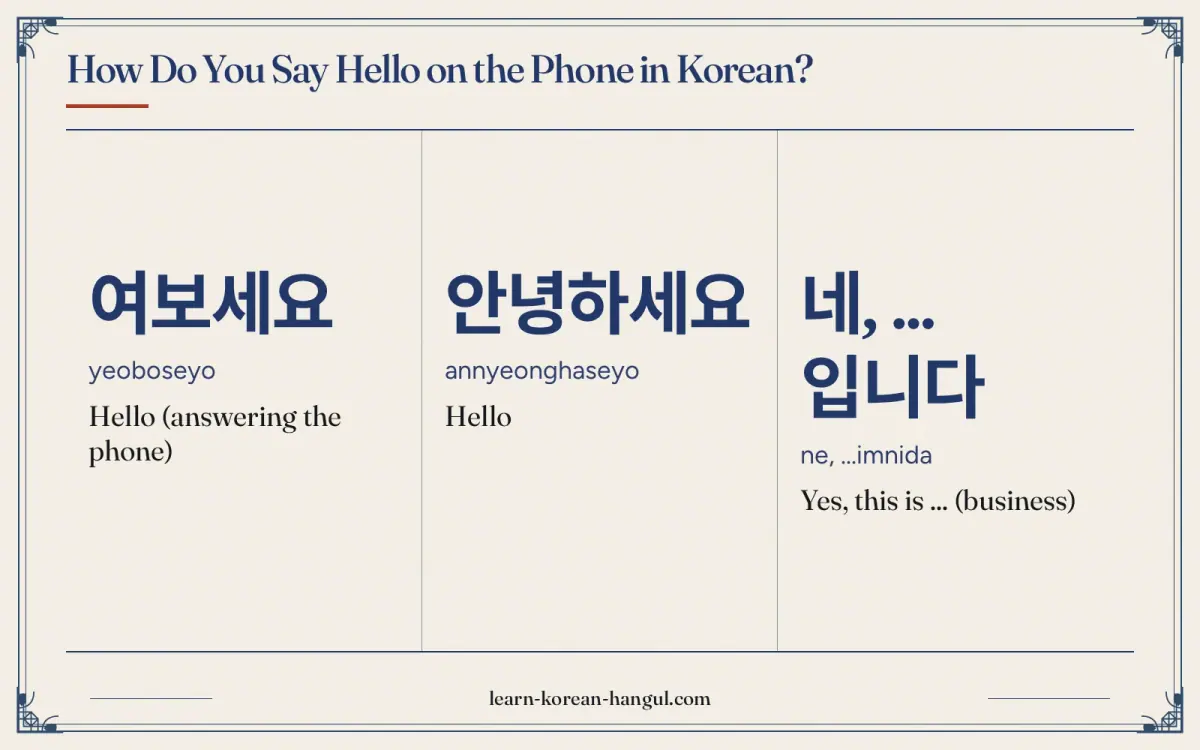
The most useful way to say hello on the phone in Korean is 여보세요. It is the word the person who picks up says, and it is used only on the phone. The caller usually follows with 안녕하세요 and then states who they are. A company or an office answers in a more formal way, with the name and 입니다.
| Korean | Romanization | Meaning | Where you hear it |
|---|---|---|---|
| 여보세요 | yeoboseyo | Hello (answering the phone) | Most personal calls, unknown numbers |
| 안녕하세요 | annyeonghaseyo | Hello | The caller, once the line connects |
| 네, ...입니다 | ne, ...imnida | Yes, this is ... (business) | Offices, shops, work phones |
Revised Romanization (the South Korean government standard of 2000) is only a reading aid here. Learn the Hangul first. The next section shows how to choose between the forms.
What Are the Formal and Polite Ways to Say Hello on the Phone?
Hello on the phone in Korean has polite and formal choices, and the setting decides. A phone call has only voices, so the first words carry the whole impression of respect.
Polite: 여보세요 (yeoboseyo)
Polite · 해요체여보세요 is the safe default. It is usually said with a gently rising tone, as if asking "is someone there?". After it, people often invite the caller to speak with 말씀하세요 (malsseumhaseyo, "please go ahead").
여보세요? 네, 말씀하세요.
yeoboseyo? ne, malsseumhaseyo
Hello? Yes, please go ahead.
Polite: 안녕하세요 (annyeonghaseyo)
Polite · 해요체안녕하세요 is the usual opening for the caller. After it, people name the person they want to reach. Add 씨 (ssi, a polite title written as a separate word) after a first name, and use 계세요 (gyeseyo, the honorific "to be") to ask if someone is there.
안녕하세요. 민수 씨 계세요?
annyeonghaseyo. minsu ssi gyeseyo
Hello. Is Min-su there?
To say who you are, use the soft ending 인데요 (indeyo), which says "this is ... (and I'm calling about something)".
안녕하세요, 저 지현인데요.
annyeonghaseyo, jeo jihyeonindeyo
Hello, this is Ji-hyeon.
Formal: 네, ...입니다 (ne, ...imnida)
Formal · 합쇼체At work, people answer with 네 ("yes") and then their name plus 입니다 ("this is"). The style is formal (합쇼체), and it tells the caller they have reached the right place.
네, 김민수입니다.
ne, gimminsuimnida
Yes, this is Kim Min-su.
Casual: 어, 왜? (eo, wae)
Casual · 반말With a friend whose name appears on your screen, there is no need for a formal greeting. People say 어 (eo, "yeah") or 응 (eung, "uh-huh"), and often add 왜? (wae, "what's up?") in a relaxed way.
어, 왜?
eo, wae
Yeah, what's up?
The forms differ by listener, but the sounds matter too. The next section breaks down 여보세요 and 입니다.
How Do You Pronounce 여보세요?
여보세요 is pronounced [여보세요], in four syllables. The spelling and the sound match, so the work is in the vowels. Play the slow clip and follow along.
- 여 (yeo): a quick y glide, then ㅓ with relaxed, unrounded lips and a half-open jaw.
- 보 (bo): a plain b between vowels, then a rounded ㅗ.
- 세 (se): a clean s and the vowel ㅔ, like the "e" in "set".
- 요 (yo): a short y glide and ㅛ. When answering, many speakers lift the pitch here, as if asking "hello?".
Sound Changes to Listen For
- Nothing changes in 여보세요. Every syllable is said as written, and the ㅂ is a soft "b" because it sits between two vowels.
- Nasal sound in 입니다. The ㅂ at the end of 입 turns into ㅁ before ㄴ, so 입니다 is pronounced [임니다] (Standard Pronunciation Rules, Article 18). Revised Romanization writes imnida to show this.
- Linking in 김민수입니다. The last syllable 수 flows straight into 입, so the whole name sounds like one word: [김민수임니다].
- Rising tone. A rise on 요 turns 여보세요 into a small question. In a calm, flat voice it sounds more like a statement. Both are fine.
The most common slip is to say the ㅂ of 입니다 as a plain "b". Say [임니다], with the lips closed on the nasal sound. Once the sound is right, the next question is when to use each phrase.
When Should You Use 여보세요, and When Should You Not?
Use 여보세요 when you pick up a call from a number you do not know, from an older person or from someone you do not know well. Use 네, ...입니다 when you answer a work phone. Use 안녕하세요 when you are the caller. The key difference is who you are talking to: the answer is for the person picking up, and the opening is for the caller.
Situations Where It Fits
- An unknown number. You do not know who is calling, so 여보세요 is the standard answer.
- A call with an older relative. The polite style is expected, and 여보세요 fits it.
- A call to a shop or an office. As the caller, start with 안녕하세요 and ask for the person you need.
- A work phone. Answer 네, 김민수입니다 so the caller knows they reached the right person.
Situations to Avoid
- Face to face. 여보세요 sounds odd in person. To get attention, use 저기요 (jeogiyo) instead.
- A stiff answer to a close friend. Between friends, a flat 여보세요 can sound like you did not see their name. Say 어 or 응.
- Silence. If you pick up and say nothing, the caller cannot tell the line is open. Say at least 네 or 여보세요.
Short scenes make these choices clearer. The next section shows three real calls.
What Does Hello on the Phone Sound Like in a Real Conversation?
Korean calls usually start with a short exchange of two or three lines. Listen for the opening words in each dialogue.
A Colleague Calls a Work Phone
Min-Su
네, 김민수입니다.
ne, gimminsuimnida
Yes, this is Kim Min-su.
Ji-Hyeon
안녕하세요, 지현입니다. 지금 통화 괜찮으세요?
annyeonghaseyo, jihyeonimnida. jigeum tonghwa gwaenchaneuseyo
Hello, this is Ji-hyeon. Is it a good time to talk?
Min-Su
네, 괜찮아요.
ne, gwaenchanayo
Yes, it's fine.
What to notice: both speakers say their names with 입니다, so the call is formal from the start. 통화 (tonghwa) means "a phone call", and 괜찮으세요? is the honorific way to ask if it is all right.
An Unknown Caller Asks for Someone
Mi-Na
여보세요?
yeoboseyo
Hello?
Caller
안녕하세요. 민수 씨 계세요?
annyeonghaseyo. minsu ssi gyeseyo
Hello. Is Min-su there?
Mi-Na
네, 바꿔 드릴게요.
ne, bakkwo deurilgeyo
Yes, I'll put him on.
What to notice: Mi-na answers with 여보세요 because she does not know the number, and the caller answers with 안녕하세요. The ending 드릴게요 is humble (it comes from 드리다, "to give"), which shows respect to the caller.
Two Friends on the Phone
Su-Bin
어, 왜?
eo, wae
Yeah, what's up?
Ji-Ho
나 지금 도착했어.
na jigeum dochakaesseo
I just arrived.
Su-Bin
응, 금방 나갈게.
eung, geumbang nagalge
Okay, I'll be out soon.
What to notice: neither friend says 여보세요 or 안녕하세요, and no line has the ending 요. 도착했어 is pronounced [도차캐써], because the ㄱ at the end of 착 joins the ㅎ of 했 to make a ㅋ sound.
What Should You Know about the Culture behind Hello on the Phone?
A Korean call has its own small customs. These are general habits, and people differ by age and workplace.
- Origin. 여보세요 is usually explained as a shortened form of 여기 보세요 ("look here"), a call for attention that became the standard phone greeting. The explanation is common, though not every source agrees on it.
- Caller ID. Because phones show who is calling, friends often skip the greeting. 여보세요 stays standard for unknown numbers and for older speakers.
- Introducing yourself. The caller is usually expected to say who they are early on, with a phrase like 저 지현인데요.
- At work. Many people answer a work phone with 네, then their name. Some companies also expect a longer greeting, so follow what your workplace does.
An expert tip: say your name early, even in a short call. Because Korean puts respect in the ending, a clear 네, 김민수입니다 or 저 지현인데요 matters more than speed. For the structure behind the endings, see Korean speech levels, which explains why 요 and 입니다 sound different.
What Mistakes Do Learners Make with Hello on the Phone in Korean?
Most mistakes on the phone come from picking the wrong register or using a phone word in the wrong place.
| Mistake | Why it is a problem | Fix |
|---|---|---|
| Saying 여보세요 face to face | It is a phone word | Use 저기요 or 실례합니다 |
| Confusing 여보세요 with 여보 | 여보 is what married couples call each other | Say all four syllables |
| Saying the ㅂ of 입니다 as "b" | The sound is a nasal ㅁ | Say [임니다] |
| Using 어, 왜? with a boss | It is casual | Use 네, ...입니다 or 여보세요 |
| Giving no name at work | The caller cannot tell who they reached | Add 네, 김민수입니다 |
Learners often think one hello fits every call. In practice the phrase follows the person, so learn one polite and one formal opening first.
Is It the Same as Phone Hello or Answer Phone in Korean?
Mostly yes. These searches all point to the same small set of phrases.
- Phone hello in Korean: 여보세요 for answering and 안녕하세요 for the caller.
- Answer phone in Korean: the verb phrase is 전화를 받다 (jeonhwareul batda, "to receive a call"). 전화를 받아요 (jeonhwareul badayo) means "I answer the phone". To ask someone to answer, say 전화 받으세요 (jeonhwa badeuseyo, "please answer the phone").
Practice: Say It Aloud
Play the slow clip and repeat 여보세요 three times, then choose the best opening for each call. Answers follow.
- You pick up a call from a number you do not know.
- You answer the phone at your office.
- A friend's name shows on your screen.
- How is 입니다 pronounced, and why?
Answers
- 여보세요?
- 네, 김민수입니다.
- 어, 왜?
- [임니다]: the ㅂ turns into ㅁ before ㄴ.
The phrase flashcards drill these openings with audio.
Related Phrases to Learn Next
Starting a call connects to several phone phrases.
- who is this in Korean: how to ask the caller to identify themselves.
- wait a moment in Korean: what to say when you need to put the caller on hold.
- bye on the phone in Korean: how to close the same call.
This guide belongs to the korean phone phrases collection. What this page does not cover: business call scripts, voicemail wording and video calls. Learn 여보세요 for answering and 네, ...입니다 for work, and you can say hello on the phone in Korean to anyone.
Frequently Asked Questions
How do you say hello on the phone in Korean?
Say 여보세요 (yeoboseyo) when you pick up the phone, especially if you do not know who is calling. At a company, say 네, followed by your name and 입니다, such as 네, 김민수입니다. As the caller, you can start with 안녕하세요 and then say who you are. Friends with caller ID often say 어, 왜?
How do you pronounce 여보세요?
It is pronounced [여보세요], in four syllables: yeo-bo-se-yo. The first syllable starts with a y glide and the vowel ㅓ, with relaxed, unrounded lips. The tone often rises on the last syllable when you answer, because it works like a small question. Revised Romanization writes yeoboseyo.
What is the difference between 여보세요 and 안녕하세요?
여보세요 is used only on the phone, and it is what the person who picks up usually says. 안녕하세요 is the all-purpose hello, and the caller often uses it once the line is connected. Both are polite. You can answer with 여보세요 and then follow with 안녕하세요 when you hear who it is.
Is 여보세요 formal or casual?
여보세요 is polite and neutral. The ending 요 makes it fit most adults. It is not the most formal answer. A business call is usually answered with 네, then a name and 입니다, which is a formal style. With close friends, people skip 여보세요 and say 어 or 응.
Can I use 여보세요 with friends, elders and strangers?
Yes for strangers and elders, because it is polite and standard. With a close friend who is calling from a saved number, it can sound a little stiff, and people say 어 or 응 or 왜 instead. If you do not know the number, 여보세요 is the safe choice with anyone.
What is the most common mistake with hello on the phone in Korean?
Using 여보세요 face to face to get someone's attention. In person it sounds odd, so use 저기요 or 실례합니다 instead. A second slip is mixing it up with 여보 (yeobo), which is a word married couples use to call each other, close to "honey".