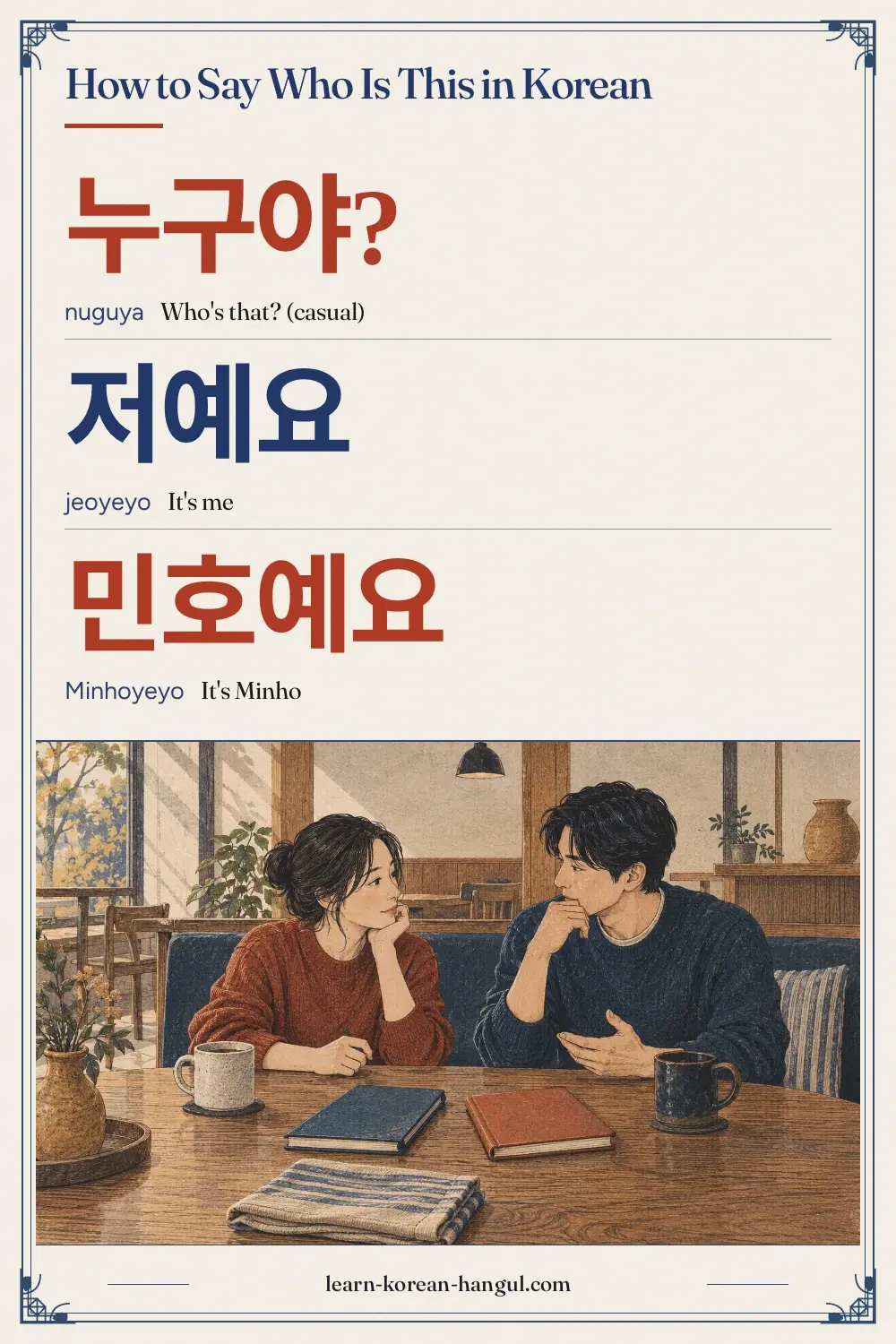
누구세요?
누구세요?
What you'll learn
- Ask who someone is in a polite, a formal and a casual way.
- Choose the right form for a stranger, a senior and a friend.
- Answer the question yourself with 저예요 and similar replies.
- Say 누구십니까 as [누구심니까], and avoid the casual 누구야 with people you do not know.
Before you start: the question often follows a phone greeting, so see hello on the phone in Korean. Time: about 15 minutes. Audio plays only when you press a button.
How Do You Say Who Is This in Korean?
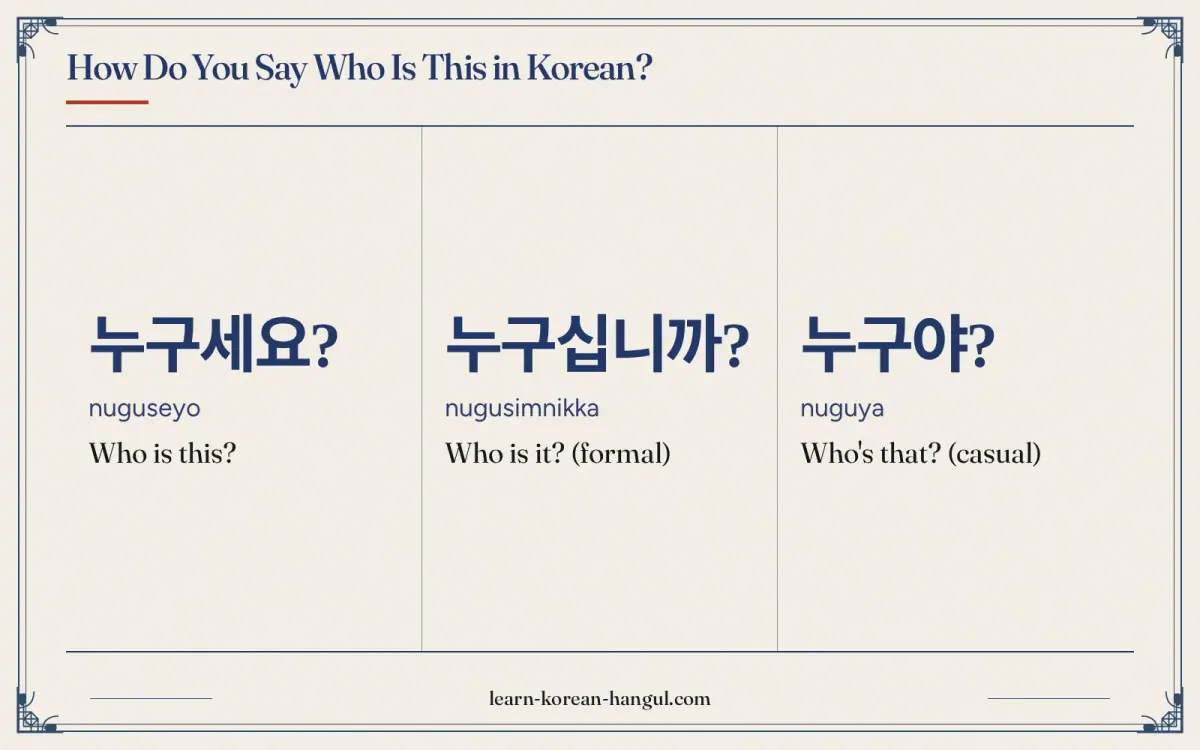
The standard question is 누구세요?, and three partners cover other listeners. Learn them together, because the same words can sound friendly or rude depending on the ending.
| Level | Korean | Revised Romanization | Meaning |
|---|---|---|---|
| Polite | 누구세요? | nuguseyo | Who is this? |
| Formal | 누구십니까? | nugusimnikka | Who is it? (formal) |
| Casual | 누구야? | nuguya | Who's that? (casual) |
| Polite, softer | 실례지만 누구세요? | sillyejiman nuguseyo | Excuse me, who is this? |
The word 누구 means "who". The ending -세요 comes from the honorific -(으)시- joined to -어요, so it is polite and also raises the person you are asking about. The next section shows each form in a sentence.
What Are the Polite, Formal and Casual Ways to Say Who Is This?
Korean marks the listener with speech levels, the sentence endings explained in the guide to Korean speech levels. Pick the form by who is on the other side of the door or the phone.
Polite: 누구세요? (nuguseyo)
Polite · 해요체This is the default. Use it with strangers, neighbours, delivery staff and callers you do not know. It is short, correct and respectful.
누구세요?
nuguseyo?
Who is it?
Formal: 누구십니까? (nugusimnikka)
Formal · 합쇼체The formal ending -ㅂ니까 suits a reception desk, an office switchboard or a customer service line. It is correct and polished, but it sounds stiff at a home door.
실례합니다. 누구십니까?
sillyehamnida. nugusimnikka?
Excuse me. Who are you? (formal)
Casual: 누구야? (nuguya)
Casual · 반말Among close friends and family of your age or younger, drop the honorific and say 누구야. It can sound rude to a stranger because it is the intimate style, so keep it for people you know well.
누구야? 전화 왔어?
nuguya? jeonhwa wasseo?
Who's that? Did a call come?
Polite: 실례지만 누구세요? (sillyejiman nuguseyo)
Polite · 해요체실례지만 means "excuse me, but" and softens the question. Use it when you meet an unfamiliar person in a building or when a call comes from an unknown number. It is the safest choice for a first contact.
실례지만 누구세요?
sillyejiman nuguseyo?
Excuse me, who is this?
Polite and Gentle: 누구시죠? (nugusijyo)
Polite · 해요체The ending -죠 adds a soft "I wonder". 누구시죠? sounds like "and who might you be?" and is very common in offices and on business calls. It is gentler than 누구세요?.
실례지만 누구시죠?
sillyejiman nugusijyo?
Excuse me, who might you be?
Asking is only half the exchange, so the next section covers how people answer.
What Will People Answer When You Ask?
Most answers name the speaker or the reason for the visit, so learn six replies. The ending -예요 or -이에요 means "it is".
| Korean | Revised Romanization | Meaning |
|---|---|---|
| 저예요 | jeoyeyo | It's me |
| 민호예요 | Minhoyeyo | It's Minho |
| 택배예요 | taekbaeyeyo | It's a delivery |
| 옆집이에요 | yeopjibieyo | It's the neighbour from next door |
| 관리실이에요 | gwallisirieyo | It's the building office |
| 엄마예요 | eommayeyo | It's Mom |
The choice between 예요 and 이에요 depends on the last sound: use 예요 after a vowel (저, 민호, 엄마) and 이에요 after a consonant (옆집, 관리실). 택배 sounds like [택빼], with a tense ㅃ. Knowing the answers prepares you for the sounds in the question itself.
How Do You Pronounce 누구세요?
누구세요? is pronounced [누구세요], nu-gu-se-yo, in four syllables, with no sound change.
- 누 (nu): the vowel ㅜ is rounded, like "oo" in "moon".
- 구 (gu): a soft g and the same rounded "oo".
- 세 (se): an s with the vowel ㅔ, like "seh".
- 요 (yo): "yo", said lightly.
Say the whole word at an even pace. Because it is a wh-question, let the pitch fall or rise-fall at the end; a sharp final rise can turn 누구 into "someone" and change the meaning.
Sound Changes to Listen For
Four points matter in this family of questions:
- Nasalization in 누구십니까. ㅂ before ㄴ becomes ㅁ, so the question sounds like [누구심니까]. The National Institute of Korean Language (국립국어원) Standard Pronunciation rules (표준 발음법) set this in Article 18. See ㅂ-to-ㅁ nasalization.
- Doubled ㄹ in 실례. The ㄹ of 실 and the ㄹ of 례 join in a long l sound, so 실례지만 is [실례지만]. Revised Romanization writes this as sillye.
- Tensing in 택배. After a final ㄱ, the ㅂ is said tense, so 택배 sounds like [택빼]. Revised Romanization writes taekbae, because it does not show tensing caused by a neighbouring sound. See Korean tensification.
- -죠 is said as written. 누구시죠 is pronounced [누구시죠]; some speakers make the ㅈ firmer in fast speech, but the plain sound is the standard.
With the sounds in place, the next step is knowing when each form fits.
When Should You Use 누구세요?, and When Should You Not?
Use 누구세요? whenever you do not know the person and want to be respectful. Use 누구십니까? only when the setting is formal, and use 누구야? only with people very close to you.
Situations Where It Fits
- At the door. Ask through the intercom before you open.
- On the phone. Ask an unknown caller after you answer with 여보세요.
- In an office or a building. Add 실례지만 when you meet an unfamiliar person.
Situations to Avoid
- Casual form with a stranger. 누구야? sounds rude when the person is older or unknown.
- To your boss or a customer. Use 누구십니까? or 누구시죠? instead.
- When you want a name. If you only want the person's name in a calm setting, ask 이름이 뭐예요? ("what is your name?").
Short exchanges show how the question sounds in real life.
What Does Asking Who Is This Sound Like in a Real Conversation?
Three short exchanges cover the usual cases: a delivery, an unknown caller and a sibling at home. Listen for the question word and the answer.
A Delivery at the Door
Resident
누구세요?
nuguseyo?
Who is it?
Courier
택배예요.
taekbaeyeyo
It's a delivery.
Resident
네, 잠시만 기다려 주세요.
ne, jamsiman gidaryeo juseyo
Yes, please wait a moment.
What to notice: the courier answers with just the role and 예요. 기다려 주세요 is a polite request, "please wait".
An Unknown Caller
Jisu
여보세요. 실례지만 누구세요?
yeoboseyo. sillyejiman nuguseyo?
Hello. Excuse me, who is this?
Minho
저 민호예요. 어제 만났어요.
jeo Minhoyeyo. eoje mannasseoyo
It's Minho. We met yesterday.
Jisu
아, 민호 씨. 안녕하세요.
a, Minho ssi. annyeonghaseyo
Oh, Minho. Hello.
What to notice: Jisu starts with 여보세요 and softens the question with 실례지만. Minho gives his name and a reminder. 씨 is a polite way to address a person after the name.
A Call at Home
Jisu
누구야?
nuguya?
Who is it?
Minho
엄마야. 잠깐만.
eommaya. jamkkanman
It's Mom. Hang on.
What to notice: between siblings the casual 누구야 is natural, and the answer 엄마야 uses the casual 야 ending. Door and phone habits matter too.
What Should You Know about the Culture behind Asking Who Is This?
Asking who is at the door is normal, and a few habits help you sound natural.
- Apartment intercoms. Many Korean homes are apartments with a door intercom, called 인터폰 (inteopon), so people ask 누구세요? before opening.
- Answering simply. Visitors answer with a role, such as 택배예요 or 관리실이에요, or with 저예요 when the resident knows the voice.
- Business calls. Staff often say the company name first and then ask 누구시죠? or 실례지만 어디시죠? ("excuse me, where are you from?"). Both are gentler than a bare 누구세요?.
- Honorifics for the listener. Even a short question is shaped by the person you ask. The -시- in 누구세요 raises that person, so it is the habit to use with anyone you do not know.
An expert insight: many learners think the extra 시 is optional. Actually, leaving it out gives 누구예요?, which is fine for asking about a third person but is less respectful when you mean "who are you?". The next section lists the mistakes that cause the most confusion.
What Mistakes Do Learners Make with Who Is This in Korean?
Most mistakes come from the ending and the pitch.
| Mistake | Why it is a problem | Fix |
|---|---|---|
| 누구야? to a stranger | It is the casual style and sounds rude | Say 누구세요? |
| 누구예요? to the listener | It lacks the honorific -시- | Say 누구세요? |
| Reading 누구십니까 as [누구십니까] | The ㅂ should become ㅁ | Say [누구심니까] |
| A sharp rise at the end | 누구 can sound like "someone" | Let the pitch fall or rise-fall |
| 이름이 뭐예요 at the door | It asks for a name, not a role | Say 누구세요? |
Learners often assume 누구세요 is only a phone phrase. In fact it works in any setting where you meet an unknown person, such as a door, a hallway or a call, and it is the standard way to ask. Several other English queries fold into this page.
Is It the Same as Who Is It, Who Are You or Who's Calling?
Mostly yes. Each English phrase maps onto the same few Korean questions, with small differences in politeness.
- Who is it in Korean: 누구세요? at a door, or 누구예요? when you point at a third person.
- Who are you in Korean: 누구세요? is the polite form. The casual 너 누구야? is blunt and can sound hostile.
- Who's calling in Korean: 누구시죠? or 실례지만 누구세요? on the phone. To ask who called you earlier, say 누가 전화했어요? (nuga jeonhwahaesseoyo), which uses the subject form 누가.
- Who is this in Korean: 누구세요? is the exact question.
Now practise the question until it feels automatic.
Practice: Say It Aloud
Play the slow clip of 누구세요? three times and repeat it. Then choose a form for each situation. Answers follow.
- Someone knocks on your apartment door.
- You are at a reception desk and want the formal form.
- You hear your friend's phone ring and ask casually.
- You answer an unknown number and want to be gentle.
Answers: 1. 누구세요? 2. 누구십니까? 3. 누구야? 4. 실례지만 누구세요?
Use the phrase flashcards to drill the question with audio.
Related Phrases to Learn Next
- Hello on the phone in Korean: 여보세요 to open a call.
- Wrong number in Korean: the phrase for when the caller has the wrong person.
- Wait a moment in Korean: 잠깐만요 to ask the other person to hold on.
This guide belongs to the Korean phone phrases collection. What this page does not cover: business phone etiquette and the full set of intercom vocabulary, which deserve their own lessons. Master 누구세요? and its three partners, and you can say who is this in Korean to anyone you meet.
Frequently Asked Questions
How do you say who is this in Korean?
Say 누구세요? (nuguseyo). The word 누구 means "who", and the ending -세요 makes the question polite and respectful. It works at a door, on the phone and when you meet an unfamiliar person. For a softer opening, add 실례지만 ("excuse me, but") before it.
How do you pronounce 누구세요?
It sounds like nu-gu-se-yo, with four syllables and no sound change. The vowel ㅜ is rounded, like "oo" in "moon", and ㅔ sounds like "seh". Because it is a wh-question, let the pitch fall or rise-fall at the end instead of rising sharply, and say the last syllable lightly.
What is the difference between 누구세요? and 누구십니까?
Both are respectful questions with the same meaning. 누구세요? is polite and fits everyday life, such as a door or a phone. 누구십니까? is formal and fits a reception desk, a company line or a ceremony. The formal one is pronounced [누구심니까], because ㅂ becomes ㅁ before ㄴ.
Is 누구세요? formal or casual?
It is polite, not formal and not casual. It uses the polite ending -요 and the honorific -시-, so it shows respect without being stiff. Use it with strangers, neighbours and elders. The formal level is 누구십니까?, and the casual level, 누구야?, is only for close friends and family.
Can I use 누구세요? with friends, elders and strangers?
Yes for strangers and elders, because the ending shows respect. With close friends of your age or younger you can drop it and say 누구야?. With a boss or a customer, 누구십니까? or 누구시죠? is also fine. Avoid the casual form with anyone you do not know well.
What is the most common mistake with who is this in Korean?
Using 누구야? with a stranger. It is the casual style, so it sounds rude to someone you do not know or someone older. Say 누구세요? instead. The second most common mistake is ending with a sharp rise, which can make 누구 sound like "someone" rather than "who".