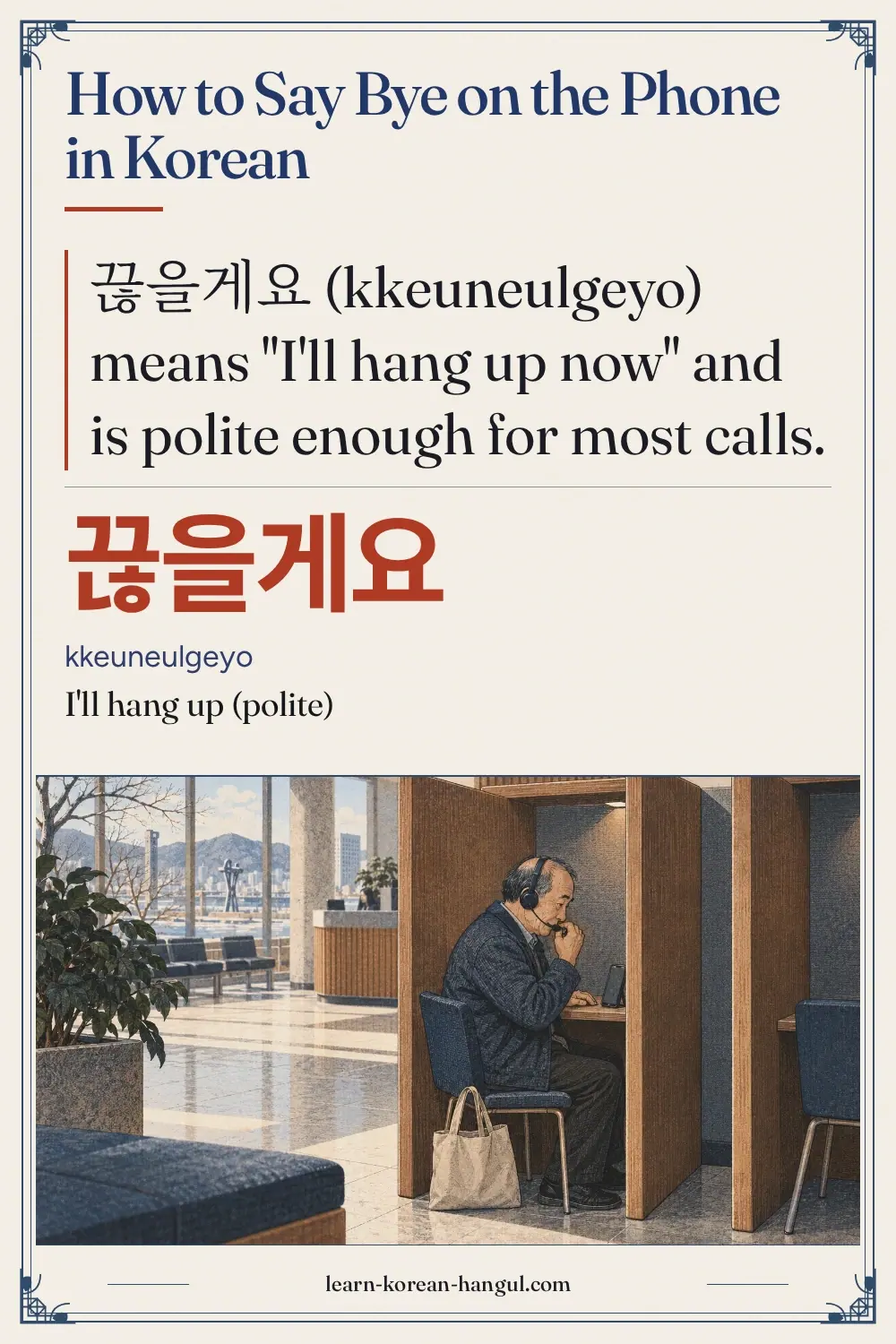
끊을게요
끊을게요
What you'll learn
- Say 끊을게요, 안녕히 계세요, 들어가세요 and 끊어 and match each one to the person on the line.
- Pronounce 끊을게요 as [끄늘께요], including the silent ㅎ and the tense 께.
- End a call in three situations: a shop, a colleague and a friend.
- Avoid the most common mistake, which is using 안녕히 가세요 on a phone call.
Before you start: the opening of a call comes first, so see hello on the phone in Korean if you have not learned how to answer. Time: about 12 minutes. Audio plays only when you press a button.
How Do You Say Bye on the Phone in Korean?
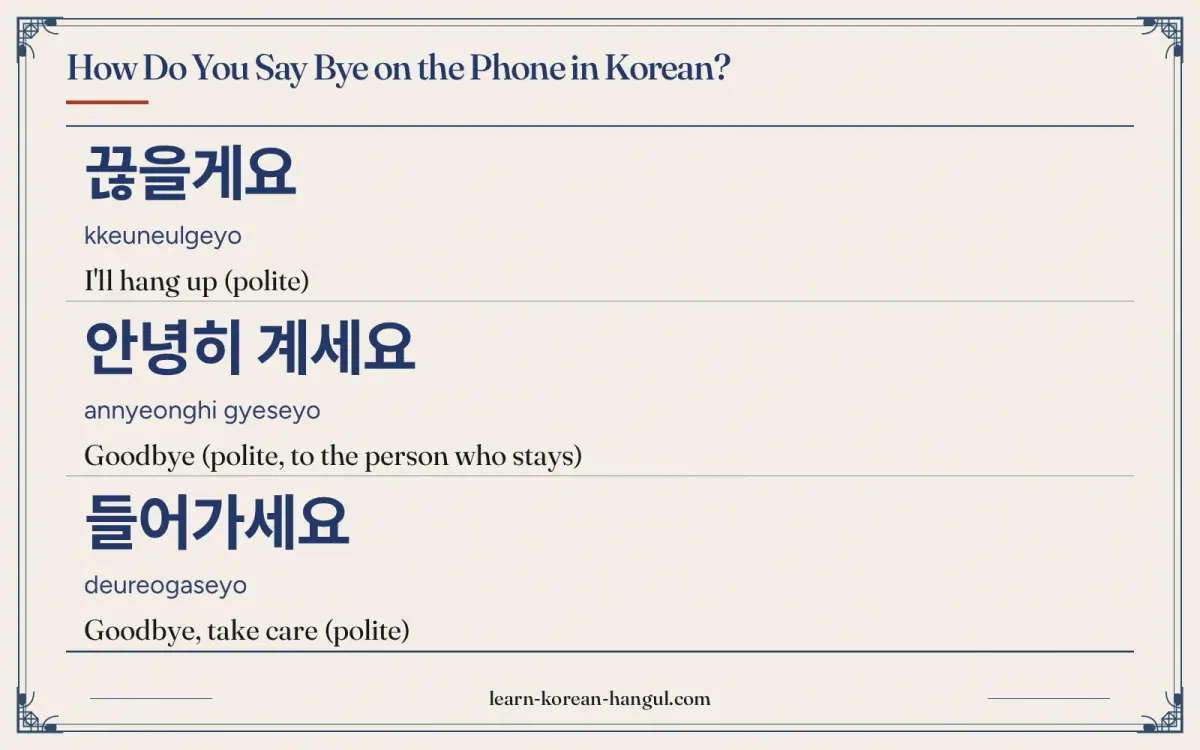
The most useful way to say bye on the phone in Korean is 끊을게요. It comes from the verb 끊다 (kkeunta, to cut off), and the ending -ㄹ게요 means "I will do it". So the whole word says "I'll hang up". It sounds like a polite announcement, not a command, which is why it is safe with strangers and colleagues.
| Korean | Romanization | Meaning | Where you hear it |
|---|---|---|---|
| 끊을게요 | kkeuneulgeyo | I'll hang up (polite) | Colleagues, strangers, most calls |
| 안녕히 계세요 | annyeonghi gyeseyo | Goodbye (polite, to the person who stays) | Shops, offices, elders |
| 들어가세요 | deureogaseyo | Goodbye, take care (polite) | Adults, friendly closings |
| 끊어 | kkeuneo | Hanging up (casual) | Friends, family |
Revised Romanization (the South Korean government standard of 2000) is only a reading aid here. Learn the Hangul first. The next section shows how to choose between the four forms.
What Are the Polite and Casual Ways to Say Bye on the Phone?
Bye on the phone in Korean has polite and casual choices, and the listener decides. A phone call is a speech event with only voices, so the ending carries the whole feeling of respect.
Polite: 끊을게요 (kkeuneulgeyo)
Polite · 해요체끊을게요 is the safe default. Use it when you are the one finishing the call and the other person is a colleague, a customer or someone you do not know well. It announces what you are about to do, so the other side is not surprised by the click. On a formal business call, the formal ending gives 끊겠습니다 (kkeunketseumnida), usually as 이만 끊겠습니다 ("I'll end the call here").
네, 알겠어요. 그럼 끊을게요.
ne, algesseoyo. geureom kkeuneulgeyo
Yes, I understand. Then I'll hang up.
Polite: 안녕히 계세요 (annyeonghi gyeseyo)
Polite · 해요체안녕히 계세요 is the polite goodbye to the person who is staying where they are. Say it to a shop, a clinic, an office or an elder at the end of a call. The word 안녕히 means "in peace" and 계세요 is the honorific of "to be".
감사합니다. 안녕히 계세요.
gamsahamnida. annyeonghi gyeseyo
Thank you. Goodbye.
Polite: 들어가세요 (deureogaseyo)
Polite · 해요체들어가세요 literally means "please go in". Adults say it as a warm goodbye, because it wishes the other person a good evening at home. It sounds friendlier than 안녕히 계세요, so it fits co-workers and neighbours.
네, 알겠습니다. 들어가세요.
ne, algetseumnida. deureogaseyo
Yes, understood. Take care.
Casual: 끊어 (kkeuneo)
Casual · 반말끊어 drops the polite ending 요, so it is only for friends and family. It can mean "I'm hanging up" or "go ahead and hang up", depending on who says it. Alone it can sound abrupt, so friends often soften it with 그럼 끊을게 ("then I'll hang up").
나 이제 끊어. 내일 봐.
na ije kkeuneo. naeil bwa
I'm hanging up now. See you tomorrow.
Choosing a form is half the job. The other half is saying 끊을게요 with the right sounds, which the next section breaks down.
How Do You Pronounce 끊을게요?
끊을게요 is pronounced [끄늘께요], in four syllables. The spelling and the sound differ, so it helps to take it slowly. Play the slow clip and follow along.
- 끊 (kkeun): a tense ㄲ, which is tighter than ㄱ and has no puff of air, then ㅡ (unrounded, lips spread flat) and ㄴ.
- 을 (eul): the ㅡ vowel again, with the lips flat, and a light ㄹ.
- 게 (ge): written with a plain ㄱ but spoken with a tense sound, so it comes out as 께.
- 요 (yo): a short, light ending.
Sound Changes to Listen For
- Silent ㅎ. The letter 끊 ends in ㄴ plus ㅎ. Before a vowel such as the 을, the ㅎ is not pronounced, so you hear [끄늘], not [끈흘].
- Linking ㄴ. The ㄴ moves to the next syllable and becomes the start of 늘. So 끊을 sounds like "kkeu-neul".
- Tense ㄱ. After an ending that finishes in -ㄹ, a plain ㄱ, ㄷ, ㅂ, ㅅ or ㅈ becomes tense (Standard Pronunciation Rules, Article 27). That turns 게 into 께: [끄늘께요]. Revised Romanization does not show this change and writes kkeuneulgeyo. See Korean tensification for the full rule.
- Plain form 끊어. Here the ㄴ links the same way: 끊어 is [끄너].
The most common slip is to say the ㅎ aloud, as in "kkeun-heul-ge-yo". Remember that the ㅎ disappears. Once the sound is right, the next question is when to use the phrase at all.
When Should You Use 끊을게요, and When Should You Not?
Use 끊을게요 when you are the one who ends the call and the listener is not a close friend. Use 안녕히 계세요 or 들어가세요 when you are answering the other person's closing line. The difference is who ends the call: 끊을게요 says what you will do, while the other two wish the listener well.
Situations Where It Fits
- A work call. You finish a quick question with a colleague and say 네, 그럼 끊을게요.
- A call to a shop or clinic. After you book a time, say 감사합니다. 안녕히 계세요.
- A call with a neighbour or an older relative. 들어가세요 gives a warm, respectful finish.
Situations to Avoid
- 끊어 with an elder or a stranger. It drops the polite ending and sounds like an order.
- 안녕히 가세요 on a call. That phrase is for a person who is leaving while you stay. On a call both sides leave, so it sounds off.
- Hanging up with no closing line. After a thank-you, a silent click can feel cold. Add one short phrase first.
Short scenes make these choices clearer. The next section shows three real endings, from the most formal to the most casual.
What Does Bye on the Phone Sound Like in a Real Conversation?
Korean calls usually end with a short exchange of two or three lines. Listen for the closing phrase in each dialogue.
Ending a Call with a Shop
Customer
네, 알겠습니다. 감사합니다. 안녕히 계세요.
ne, algetseumnida. gamsahamnida. annyeonghi gyeseyo
Yes, understood. Thank you. Goodbye.
Staff
네, 안녕히 계세요.
ne, annyeonghi gyeseyo
Yes, goodbye.
What to notice: both speakers use 안녕히 계세요, because each one stays where they are. The formal 습니다 style keeps the tone businesslike.
Two Colleagues Finish a Call
Min-Su
네, 그럼 내일 봐요. 들어가세요.
ne, geureom naeil bwayo. deureogaseyo
Yes, see you tomorrow then. Take care.
Ha-Na
네, 들어가세요.
ne, deureogaseyo
Yes, take care.
What to notice: 들어가세요 is repeated back to the speaker. That echo is normal, and it makes the goodbye feel balanced.
Two Friends Say Bye Late at Night
Ji-Ho
나 이제 끊을게. 내일 봐.
na ije kkeuneulge. naeil bwa
I'll hang up now. See you tomorrow.
Su-Bin
응, 끊어. 잘 자.
eung, kkeuneo. jal ja
Okay, hang up. Sleep well.
What to notice: Ji-ho uses the casual 끊을게 to announce the end, and Su-bin answers with 끊어 to mean "go ahead". Neither line has 요, because they are close friends.
What Should You Know about the Culture behind Bye on the Phone?
A Korean call has its own small customs. These are general habits, and people differ by age and workplace.
- Go in. 들어가세요 literally means "please go in" and is a standard goodbye to someone heading home or indoors. That is why it also ends calls.
- Who hangs up. Many speakers let the older or more senior person end the call first. If you are the junior, say your closing line and let the other person hang up first.
- Repeating the goodbye. People often say the closing line twice, once each. It is a courtesy, not a sign of confusion.
- Texts. For quick notes, many people now send a message instead of calling, so a short voice goodbye is mostly for real conversations.
An expert tip: say the closing phrase first and then hang up. Because Korean puts respect in the ending, a clear 안녕히 계세요 or 들어가세요 matters more than speed. For the structure behind the endings, see Korean speech levels, which explains why 요 makes a sentence polite.
What Mistakes Do Learners Make with Bye on the Phone in Korean?
Most mistakes on the phone come from picking the wrong register or the wrong goodbye, not from pronunciation.
| Mistake | Why it is a problem | Fix |
|---|---|---|
| Saying 안녕히 가세요 on a call | It is the goodbye to someone who leaves while you stay, and on a call nobody leaves | Use 들어가세요 or 끊을게요 |
| Using 끊어 with a senior | Dropping 요 sounds like a command | Use 끊을게요 or 안녕히 계세요 |
| Saying the ㅎ in 끊을게요 | Spelling and sound differ | Say [끄늘께요] |
| Using 끊을게 with a stranger | It is the casual form | Add 요: 끊을게요 |
| Hanging up right after "thank you" | No closing line feels cold | Add one short farewell |
Learners often think they need one "bye" for every call. In practice the phrase follows the person, so learn one polite and one casual option first.
Is It the Same as Bye on Phone, Hang up or Ending a Call?
Mostly yes. These searches all point to the same small set of phrases, with a few differences in the verb.
- Bye on phone in Korean: 안녕히 계세요 or 들어가세요, depending on the listener.
- Hang up in Korean: the verb is 끊다 (kkeunta, pronounced [끈타]). 전화를 끊어요 (jeonhwareul kkeuneoyo) means "I hang up the phone".
- Ending a call in Korean: 통화를 마치다 (tonghwareul machida) is the neutral phrase for finishing a call, as in 통화를 마칠게요 (tonghwareul machilgeyo, "I'll finish the call").
Practice: Say It Aloud
Play the slow clip and repeat 끊을게요 three times, then choose the best goodbye for each scene. Answers follow.
- You finish a call with a bank clerk.
- Your friend calls late and you are tired.
- A neighbour who is older than you says goodbye first.
- How is 끊을게요 pronounced, and why?
Answers
- 안녕히 계세요.
- 나 이제 끊을게.
- 네, 들어가세요.
- [끄늘께요]: the ㅎ is silent, the ㄴ links forward and 게 becomes tense after -ㄹ.
The phrase flashcards drill these closings with audio.
Related Phrases to Learn Next
Ending a call connects to several phone and greeting phrases.
- goodbye in Korean: the general goodbye for people leaving face to face.
- hello on the phone in Korean: how to open the same call.
- i'll call you back in Korean: what to say when the call must stop but the talk is not finished.
This guide belongs to the korean phone phrases collection. What this page does not cover: business call scripts, voicemail wording and video calls. Learn one polite and one casual closing, and you can say bye on the phone in Korean to anyone.
Frequently Asked Questions
How do you say bye on the phone in Korean?
Say 끊을게요 (kkeuneulgeyo) to mean "I'll hang up now". For a polite goodbye to someone who stays, say 안녕히 계세요. For a warm goodbye between adults, say 들어가세요. With close friends, use 끊어 or 그럼 끊을게. Pick the form that matches how well you know the listener.
How do you pronounce 끊을게요?
It is pronounced [끄늘께요]. The ㅎ at the end of 끊 is silent before a vowel, the ㄴ links to the next syllable, and the ㄱ of 게 becomes tense after the -ㄹ ending. Revised Romanization writes kkeuneulgeyo and does not show the tense sound.
What is the difference between 끊을게요 and 안녕히 계세요?
끊을게요 says what you will do: you will hang up. 안녕히 계세요 wishes the other person well and means goodbye. Use 끊을게요 when you end the call, and 안녕히 계세요 as a closing line to a shop, an office or an elder. Many speakers use both in one call.
Is 끊을게요 formal or casual?
끊을게요 is polite. The ending 요 makes it fit most adults, including strangers and colleagues. It is not the most formal form. On a formal business call, say 이만 끊겠습니다 (iman kkeunketseumnida, "I'll end the call here"), often followed by 안녕히 계세요. The casual version is 끊을게, which is for friends and family only.
Can I use 끊을게요 with friends, elders and strangers?
Yes for strangers and colleagues, and it is acceptable for elders, though 안녕히 계세요 shows more respect. With close friends, drop the 요 and say 끊을게. A good rule is to use the polite form first and move to the casual form only when the other person does.
What is the most common mistake with bye on the phone in Korean?
Using 안녕히 가세요 on a call. That phrase tells someone who is leaving to go safely while you stay behind, but on a call both people leave. Use 들어가세요 or 끊을게요 instead. A second slip is saying the silent ㅎ in 끊을게요 aloud.