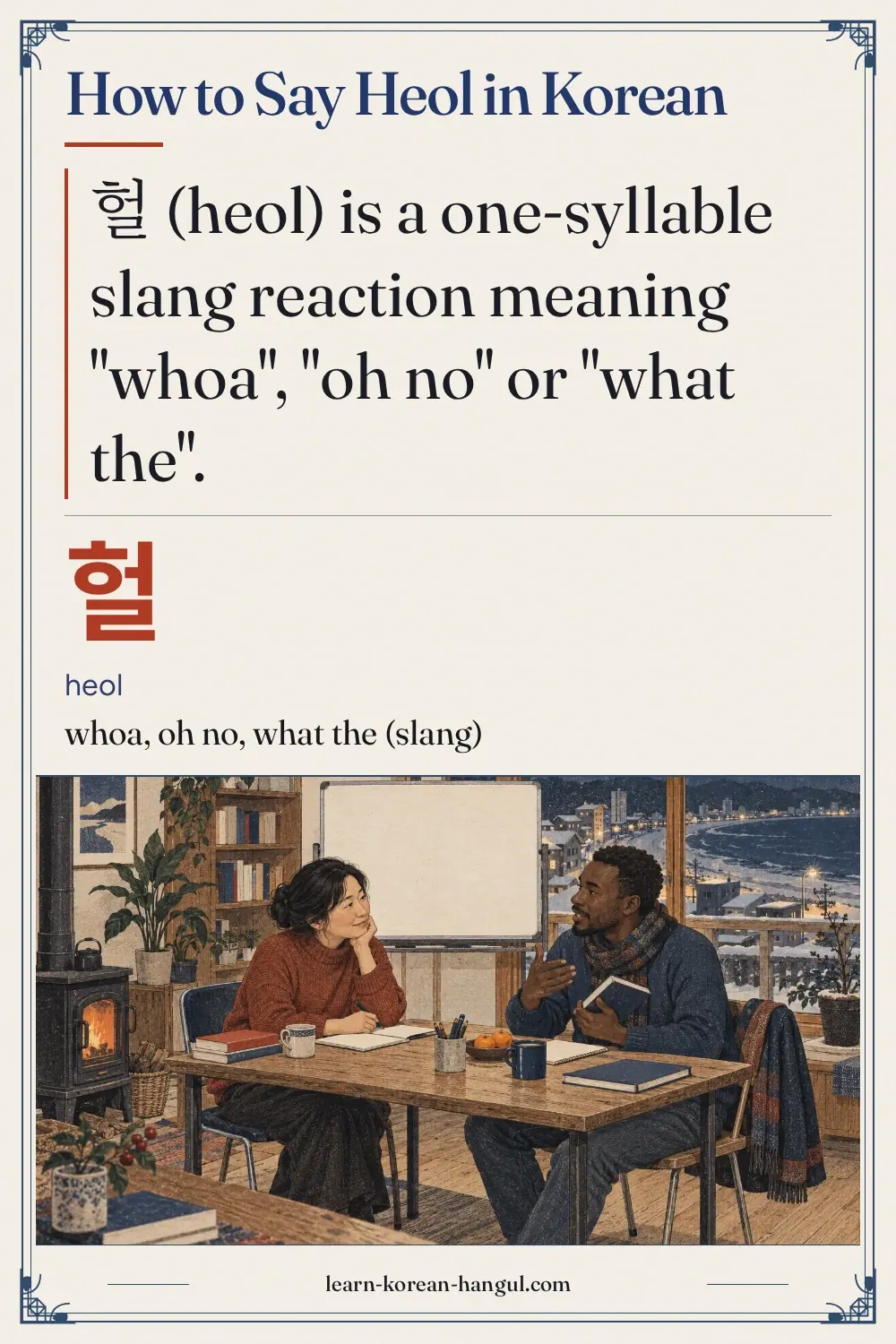
헐
헐
What you'll learn
- Say 헐, 헐 대박 and 헐 진짜? and match each one to a feeling.
- Pronounce 헐 with an unrounded ㅓ and a light final ㄹ.
- Know when this slang is safe (friends, chats) and when it is not (elders, school).
- Replace 헐 with a polite reaction when the listener is not your friend.
Before you start: you only need to read basic Hangul. If you want the wider cluster, the kdrama korean phrases collection lists the other reactions you hear in dramas. Time: about 12 minutes. Audio plays only when you press a button.
How Do You Say Heol in Korean?
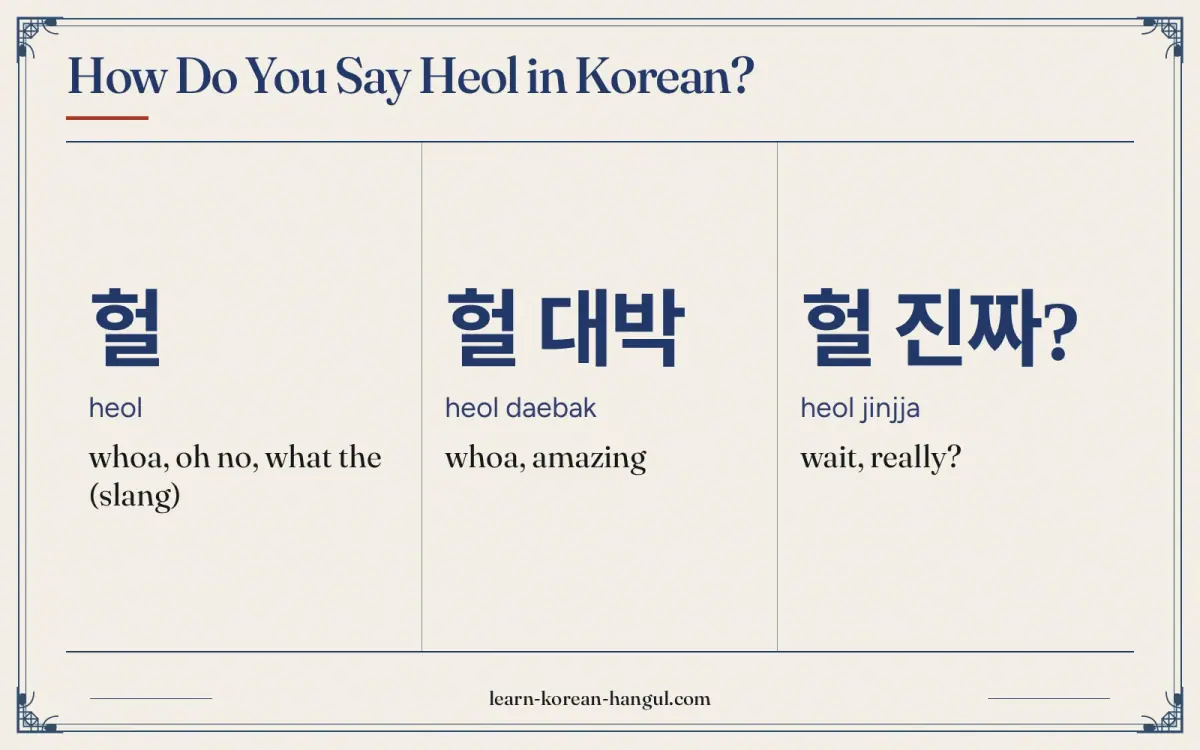
The short answer is 헐. It is spelled ㅎ + ㅓ + ㄹ, written as one block, and romanized as heol. There is no verb and no ending, so there is nothing to conjugate. You just say it, often with a long vowel and a drop in pitch, as in "heo-o-ol".
| Korean | Romanization | Meaning | Where you hear it |
|---|---|---|---|
| 헐 | heol | whoa, oh no, what the (slang) | Chats and talk between friends |
| 헐 대박 | heol daebak | whoa, amazing | Good news, big surprises |
| 헐 진짜? | heol jinjja | wait, really? | Checking if news is true |
Revised Romanization (the South Korean government standard of 2000) is only a reading aid. Learn the Hangul first. The next section explains which form fits which moment.
What Are the Casual Ways to Say Heol?
Heol has only casual forms. In Korean, the level of politeness is called a speech level, and 헐 sits in the lowest, most relaxed one. Between friends of the same age it is normal. Anywhere else it is risky.
Casual: 헐 (heol)
Casual · 반말헐 on its own shows shock, disbelief or a small cringe. It does not say whether the news is good or bad. The words and the tone around it do that. People often drag the vowel out when the surprise is bigger.
헐, 나 휴대폰 두고 왔어.
heol, na hyudaepon dugo wasseo
Oh no, I left my phone behind.
Casual: 헐 대박 (heol daebak)
Casual · 반말Adding 대박 (daebak, "jackpot", "awesome") pushes the feeling toward "amazing". Use it when you are impressed by a great result, a surprise gift or a skill. It can also be ironic, but that depends on your voice.
헐 대박, 이거 네가 만들었어?
heol daebak, igeo nega mandeureosseo
Whoa, amazing, you made this?
Casual: 헐 진짜? (heol jinjja)
Casual · 반말진짜 (jinjja) means "real" or "really". So 헐 진짜? is "wow, is that true?". It is a yes/no question, and it ends with a rising tone.
헐 진짜? 시험이 내일이야?
heol jinjja? siheomi naeiriya
Wait, really? The exam is tomorrow?
Choosing a form is easy: one syllable for a small shock, 대박 for a big good surprise, 진짜? when you want a confirmation. The next section looks at the sound itself.
How Do You Pronounce 헐?
헐 is pronounced [헐], and it has just one syllable. The spelling and the sound match, so the work is in the vowel and the final consonant. Play the slow clip and copy it.
- ㅎ (h): a soft breathy h, like the start of "hat".
- ㅓ (eo): the mouth is open about halfway and the lips are relaxed, not rounded. Do not round them as for "o".
- ㄹ (l): at the end of a syllable, touch the tip of your tongue to the ridge behind your upper teeth, lightly.
Sound Changes to Listen For
- No change by itself. 헐 has no neighbour that changes it, so the sound is the same as the spelling.
- Closer to "hull" than to "hell". English "hell" has a front vowel. ㅓ is further back and unrounded, so a good approximation is the vowel of "hull". Most learners round ㅓ into "o", which makes it sound like 홀 (hol).
- Final ㄹ. Do not add a vowel after it. Say [헐], not "heo-ru".
- Stretching. Speakers lengthen the vowel to show a bigger shock. The tone is often drawn out and falling.
- Revised Romanization. It writes heol. Learners who read "heol" as "heel" make a different sound, so use the Hangul as your guide.
The most common slip is rounding the vowel. Once the sound is right, the real question is when to say it.
When Should You Use 헐, and When Should You Not?
Use 헐 in chats and in talk with friends of your own age, to show shock, disbelief or a small cringe. Do not use it with teachers, bosses, elders or people you have just met, because it is slang and there is no polite ending to soften it.
Situations Where It Fits
- A KakaoTalk chat. A friend sends surprising news, and you reply 헐 before anything else.
- Reacting to a story. A classmate tells you about a missed bus, and you say 헐 진짜?
- A dramatic moment with friends. You see a price, a score or a photo and say 헐 대박.
- A small cringe. Someone says something awkward, and a quiet 헐 shows it.
Situations to Avoid
- With teachers or bosses. It sounds careless. Say 정말요? instead.
- In school writing or a formal message. It reads as slang.
- With a stranger or an elder. It can sound rude even if you are only surprised.
If you need a polite reaction, these work for most listeners:
| Polite reaction | Romanization | Feel |
|---|---|---|
| 정말요? | jeongmaryo | Really? (polite; in common speech often pronounced [정말료]) |
| 진짜요? | jinjjayo | Really? (polite, a little friendlier) |
| 어머 | eomeo | Oh my (often said by women) |
| 세상에 | sesange | Oh my goodness (literally "in the world") |
Short scenes make this clearer. The next section shows three of them.
What Does Heol Sound Like in a Real Conversation?
Real chats use 헐 as a one-word reaction. Listen for it at the start of the reply.
A Friend Oversleeps
Su-Bin
나 오늘 늦잠 잤어.
na oneul neutjam jasseo
I overslept today.
Ji-Ho
헐, 수업은?
heol, sueobeun
Oh no, what about class?
Su-Bin
다행히 휴강이었어.
dahaenghi hyugangieosseo
Luckily it was cancelled.
Ji-Ho
헐 대박! 완전 운 좋다.
heol daebak! wanjeon un jota
Whoa, amazing! You're so lucky.
What to notice: the first 헐 shows worry, and the second one (with 대박) shows delight. The same word carries two feelings. 완전 (wanjeon) means "totally" in casual speech.
Surprising News
Min-Su
나 내일 일본 가.
na naeil ilbon ga
I'm going to Japan tomorrow.
Ha-Na
헐 진짜? 왜 말 안 했어?
heol jinjja? wae mal an haesseo
Wait, really? Why didn't you tell me?
Min-Su
어제 갑자기 정해졌어.
eoje gapjagi jeonghaejyeosseo
It was decided suddenly yesterday.
What to notice: 헐 진짜? rises because it asks for a yes or no. The next question, 왜 말 안 했어?, uses the question word 왜 (wae, "why"), and wh-questions usually fall or rise-fall instead of ending in a sharp rise.
The Same Surprise with a Teacher
Teacher
내일은 수업이 없어요.
naeireun sueobi eopseoyo
There is no class tomorrow.
Student
정말요? 와, 감사합니다!
jeongmaryo? wa, gamsahamnida
Really? Wow, thank you!
What to notice: the student feels the same surprise as in the first scene, but says 정말요? instead of 헐. That one swap keeps the talk polite.
What Should You Know about the Culture behind Heol?
헐 belongs to online and chat language. Many speakers first met it in text, where it works as a stand-alone reaction, often followed by 대박 or 진짜? Younger people use it most. Because it is slang, how common it feels depends on age, region and group, and new slang changes quickly.
- A reaction, not a sentence. 헐 needs no subject or verb. It answers what someone just said.
- Tone decides the meaning. It can show worry, delight, disbelief or a mild cringe, and your voice and the next words tell the listener which one.
- Age matters. Older speakers know it but may find it childish or rude in speech aimed at them.
- Text habits. In a chat, people often type 헐 alone on one line to show a beat of silence before the next message.
An expert tip: if you are unsure, listen first. When your friends use 헐, join in. When you hear 어머 or 세상에 from older people, copy those instead. For the structure behind politeness levels, see Korean speech levels, which explains why 요 makes a sentence polite and why 헐 has no such ending.
What Mistakes Do Learners Make with Heol in Korean?
Most mistakes come from the register, not the sound.
| Mistake | Why it is a problem | Fix |
|---|---|---|
| Saying 헐 to a teacher or boss | It is slang with no polite ending | Say 정말요? or 어머 |
| Writing 헐 in a school essay | It reads as chat language | Use 놀랐다 or a plain sentence |
| Rounding the vowel: "hol" | ㅓ is unrounded | Relax the lips: [헐] |
| Treating it as only negative | It can be good or bad | Add 대박 for good news |
| Adding a vowel: "heo-ru" | The ㄹ ends the syllable | Stop with the tongue tip up |
Learners often want one fixed translation. Heol has none: it is a feeling, so translate the feeling and not the word.
Is It the Same as Heol Meaning?
Yes. These searches all point to the same small word, and one short answer covers each.
- Heol meaning: a slang exclamation of surprise, shock or disbelief, similar to "whoa" or "what the".
- What does heol mean in Korean: the same thing. It reacts to news, good or bad, and it fits casual talk with friends.
Heol is not a word you can translate with one English word. "Wow", "oh no", "seriously?" and "what the" each fit one situation.
Practice: Say It Aloud
Play the slow clip and repeat 헐 three times, then pick the best reaction. Answers follow.
- A friend tells you they won a prize.
- Your teacher says the test is moved to tomorrow.
- You want to check if a rumor is true.
- How is 헐 pronounced?
Answers
- 헐 대박!
- 정말요? (polite, not 헐)
- 헐 진짜?
- [헐], one syllable with an unrounded ㅓ and a light final ㄹ.
The phrase flashcards drill these reactions with audio.
Related Phrases to Learn Next
Heol sits next to a few other casual reactions.
- omg in Korean: the wider set of "oh my gosh" phrases.
- daebak in Korean: the word that turns 헐 into 헐 대박.
- jinjja in Korean: the word behind 헐 진짜? and the reply you will hear back.
This guide belongs to the kdrama korean phrases collection. What this page does not cover: other slang from chat language, regional variants and the full history of the word. Learn 헐 for friends and 정말요? for everyone else, and you can say heol in Korean at the right time.
Frequently Asked Questions
How do you say heol in Korean?
Write and say 헐 (heol). It is a one-syllable reaction that means "whoa", "oh no" or "you're kidding". For a bigger reaction, say 헐 대박 (heol daebak). To ask if something is true, say 헐 진짜? (heol jinjja). All three are casual slang for friends of similar age.
How do you pronounce 헐?
It is pronounced [헐] and has one syllable. Start with a clear h, say the vowel ㅓ with relaxed, unrounded lips and an open jaw, and finish with a light ㄹ by touching your tongue tip behind your upper teeth. It sounds closer to English "hull" than to "hell".
What is the difference between 헐 and 헐 대박?
헐 alone is a short shock or disbelief reaction and can be good or bad. 헐 대박 adds 대박 (daebak, "jackpot" or "amazing"), so it usually shows that you are impressed. Use 헐 for a small surprise and 헐 대박 for a big, usually positive, surprise.
Can I use 헐 with friends, elders and strangers?
Use it with friends and people of your own age in chats and relaxed talk. Do not use it with teachers, bosses, elders or strangers, because it is slang and has no polite ending. Say 정말요? or 어머 instead, which show the same surprise politely.
What is the most common mistake with heol in Korean?
Using 헐 with an elder or in school writing, where it reads as slang. A second slip is treating it as always negative. 헐 only shows surprise, so the tone and the words after it decide whether you are shocked, impressed or annoyed.
What does heol mean in Korean?
Heol (헐) is a slang exclamation of surprise, shock or disbelief, close to "whoa", "what the" or "oh my gosh". It can react to good news, bad news or something awkward. It is used mostly by young people in chats and casual speech.