진짜
진짜
What you'll learn
- Say 진짜 with the correct tense ㅉ and tell it apart from 진자.
- Choose between 진짜, 진짜요?, 진짜야?, 완전 진짜 and 정말 for a stranger, a senior and a friend.
- Use 진짜 before adjectives to mean "really" or "very".
- Avoid the two usual mistakes: the spelling jinja and a bare 진짜? to someone senior.
Before you start: you need to read Hangul; romanization is shown as an aid and can be hidden. Time: about 8 minutes.
Key facts
- 진짜 (jinjja) means "real" as a noun and "really, truly" as an adverb, and it works as a one-word reaction.
- 진짜요? (jinjjayo) is the polite "really?"; 진짜야? (jinjjaya) is the casual form for close friends.
- The ㅉ is a tense consonant written in the spelling, so the word is [진짜], never [진자].
How Do You Say Jinjja in Korean?
The standard way to say jinjja in Korean is 진짜, written with two Hangul blocks: 진 (jin) and 짜 (jja). It is a flexible word, and the same spelling does three jobs, so the table below lists the forms you will meet first.
| Form | Romanization | Meaning | Register |
|---|---|---|---|
| 진짜 | jinjja | really, truly, for real | Casual, also common in everyday polite sentences |
| 진짜요? | jinjjayo | Really? | Polite |
| 진짜야? | jinjjaya | Is it real? Really? | Casual (반말) |
| 완전 진짜 | wanjeon jinjja | Totally for real | Casual slang |
| 정말 | jeongmal | Truly, really | Neutral, safe with most listeners |
| 정말입니까? | jeongmarimnikka | Is that true? | Formal |
The three jobs of 진짜 are easy to hear once you know them:
- A noun. 진짜 means "the real thing". 이거 진짜예요 (igeo jinjjayeyo) means "This is real", and its opposite is 가짜 (gajja), "fake".
- An adverb. 진짜 goes in front of an adjective or verb to mean "really": 진짜 맛있어요 (jinjja masisseoyo), "It's really tasty".
- A reaction. Said alone with a rising tone, 진짜? means "Really?" and invites the other person to say more.
The reaction is the form people search for most, so the next section sorts the forms by listener.
What Are the Polite and Casual Ways to Say Jinjja?
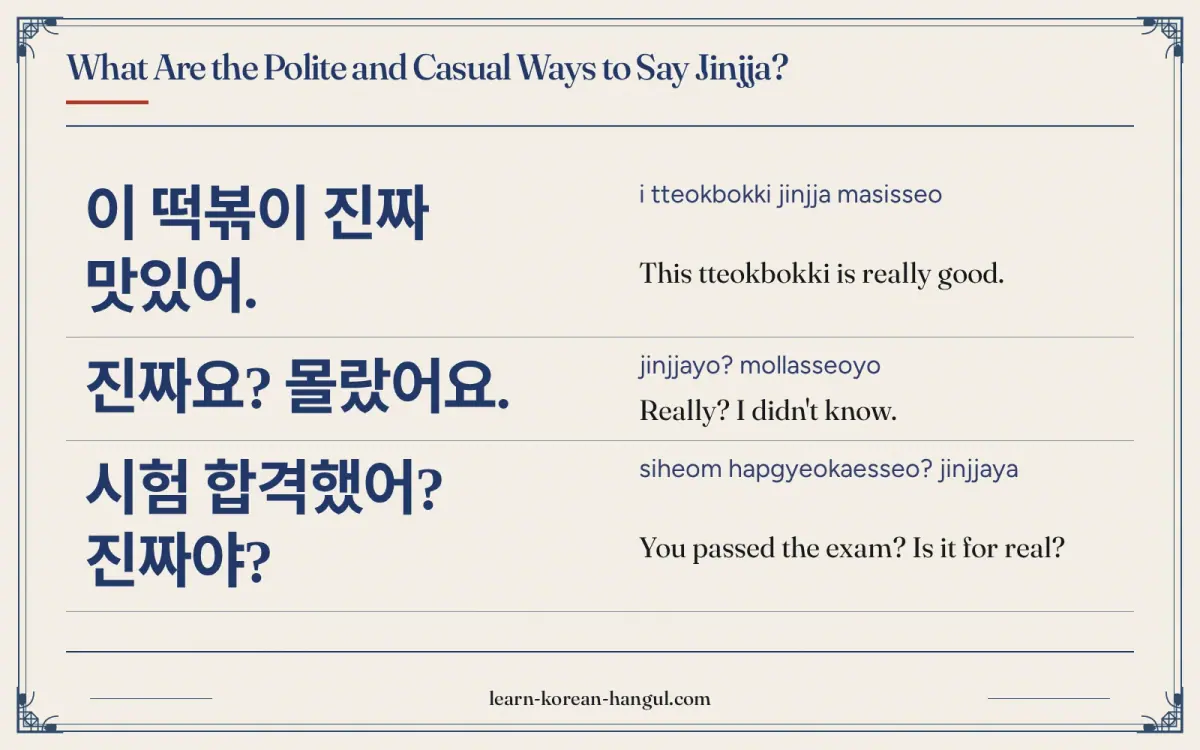
Jinjja changes with the Korean speech levels, the endings that shift with the listener's age, status and closeness, explained in the guide to Korean speech levels. The meaning stays "really" while the ending moves the word up or down in politeness.
Casual: 진짜 (jinjja)
Casual · 반말Bare 진짜 is what friends, siblings and classmates say. It can sit in front of a casual sentence as an intensifier, or stand alone as a reaction. Many people also put it before polite sentences, such as 진짜 좋아요, in relaxed everyday speech.
이 떡볶이 진짜 맛있어.
i tteokbokki jinjja masisseo
This tteokbokki is really good.
Polite: 진짜요? (jinjjayo)
Polite · 해요체진짜요? is the polite "really?". The ending -요 is the polite particle that turns a bare word into polite speech, and it can be attached to a noun like 진짜. Use it when a coworker, teacher, shop owner or older acquaintance tells you something surprising.
진짜요? 몰랐어요.
jinjjayo? mollasseoyo
Really? I didn't know.
Casual: 진짜야? (jinjjaya)
Casual · 반말진짜야? is the full casual question, "Is it real?". Here 야 is the casual form of the "to be" ending, so the sentence says "Is this true?" and asks for confirmation. Friends use it when the news is big, such as a surprise visit or a prize.
시험 합격했어? 진짜야?
siheom hapgyeokaesseo? jinjjaya
You passed the exam? Is it for real?
Casual: 완전 진짜 (wanjeon jinjja)
Casual · 반말완전 means "completely", and young speakers use it as a casual intensifier. 완전 진짜 stacks two intensifiers for "totally for real". It belongs to friends, group chats and variety shows, not to a meeting.
완전 진짜야, 거짓말 아니야.
wanjeon jinjjaya, geojinmal aniya
It's totally true, I'm not lying.
Neutral: 정말 (jeongmal)
Polite · 해요체정말 also means "truly" and carries less slang than 진짜. 정말요? (jeongmaryo) is a safe polite "really?" for anyone, and 정말 감사합니다 means "thank you very much". In 정말요, an extra sound is added before 요, and after ㄹ it surfaces as another ㄹ, so the word is spoken [정말료]; this is why it is romanized jeongmaryo. Copy the audio if the sound feels unfamiliar.
Formal: 정말입니까? (jeongmarimnikka)
Formal · 합쇼체In speeches, interviews and news, the formal question is 정말입니까?, "Is that true?". It uses the formal ending -ㅂ니까 and is rare in daily talk. Learners need to recognise it more than to use it.
Each form carries the same idea at a different distance from the listener. The sounds are the next job, because one letter in 진짜 causes most pronunciation errors.
How Do You Pronounce 진짜?
진짜 is pronounced [진짜]. The word has two syllables, and the second one holds the sound learners miss. Follow these steps:
- Say 진 (jin): a light "jeen", with a plain ㅈ and a short vowel, followed by ㄴ.
- Say 짜 (jja): put the tongue against the roof of the mouth, hold it tight, and release without a puff of air.
- Keep both syllables short and even. The stress is not strong on either one.
- For the question 진짜요?, raise the pitch on the last syllable.
Sound Changes to Listen For
The ㅉ in 진짜 is a tense consonant (경음, a double letter pronounced with tight muscles and no breath). It is part of the spelling, so it is not a sound change. The official standard pronunciation rules (표준 발음법) list ㅉ among the 19 consonants, with plain ㅈ and aspirated ㅊ as its partners. The learner effect is practical: ㅈ, ㅉ and ㅊ give three different words, and 진짜 needs the middle one. The separate rule of tensification (경음화) turns plain sounds tense after some final consonants, as in 학교 [학꾜], and it is covered in Korean tensification. The three-way contrast is explained in the guide to j, jj and ch.
Now compare the real word with the common mistake. 진자 (jinja, with a plain ㅈ) is a different word, a pendulum.
Revised Romanization, the official system for writing Korean in Latin letters, writes ㅉ as jj, which is why the standard spelling is jinjja and not jinja. Romanization is only a guide; the Hangul is the real spelling. Pronunciation is half the picture, and the other half is choosing when to say it.
When Should You Use 진짜, and When Should You Not?
Use 진짜 when you want to show surprise, agree strongly or add emphasis to an adjective. Use 진짜요? when you want to react politely to news. Use 정말 when you need something neutral, and keep 완전 진짜 for friends.
Situations Where It Fits
- Reacting to news. A friend says they got a new job and you answer 진짜? (Really?), with a rising tone.
- Adding emphasis. 진짜 보고 싶어 means "I really miss you", with 진짜 doing the work of "really".
- Checking facts politely. A coworker says the meeting moved to Friday, and you reply 진짜요?.
- Agreeing. "It's cold today." "진짜 추워요." (It's really cold.)
Situations to Avoid
- A bare 진짜? to a boss, teacher or older stranger. Add -요, or choose 정말요?.
- Formal writing or speeches. 진짜 is colloquial; write 정말 or 매우 (very) instead.
- Doubting an elder's story. 진짜요? can sound disbelieving if your tone drops. Keep it light and rising.
These cases come to life in real exchanges, so here are three.
What Does Jinjja Sound Like in a Real Conversation?
In real talk, 진짜 is rarely alone. A reaction like 진짜요? is usually followed by a comment, a question or a laugh. Listen for what comes after.
News from a Coworker
Coworker
저 이번 주에 승진했어요.
jeo ibeon jue seungjinhaesseoyo
I got promoted this week.
You
진짜요? 축하해요.
jinjjayo? chukahaeyo
Really? Congratulations.
What to notice: 진짜요? keeps the conversation polite, and the congratulations follow right away.
Big News between Friends
Minsu
나 복권에 당첨됐어.
na bokgwone dangcheomdwaesseo
I won the lottery.
Sua
진짜야? 대박.
jinjjaya? daebak
Is it for real? Wow.
What to notice: friends drop -요 and chain short reactions. The second reaction, 대박 (daebak), is covered in daebak in Korean.
A Secret Revealed in a Drama Scene
Hana
너 진짜 몰랐어?
neo jinjja mollasseo
Did you really not know?
Jun
응, 진짜 몰랐어.
eung, jinjja mollasseo
No, I really didn't know.
What to notice: 진짜 sits in the middle of the sentence here as an adverb, and the answer repeats it. This habit of repeating the key word is common in Korean TV scenes, which brings us to the culture behind the word.
What Should You Know about the Culture behind Jinjja?
진짜 is among the most common casual intensifiers in everyday Korean, and young speakers use it constantly in conversation, in chats and on TV. It is a short, warm word that signals interest, so a listener who says 진짜? is usually showing engagement, not doubt.
Three related words differ in feel:
| Word | Feel | Typical place |
|---|---|---|
| 진짜 | Casual, lively | Friends, family, drama dialogue |
| 정말 | Neutral, a little more careful | Work, service, polite writing |
| 완전 | Trendy, informal slang | Young people, variety shows, chats |
The pair 진짜 and 가짜 (gajja, fake) appears in everyday life: 진짜 가죽 means "real leather" and 가짜 뉴스 means "fake news". The same word turns up in K-drama dialogue because it expresses surprise in one beat, which is why learners meet it in the first episode.
An expert insight: learners often treat 진짜요? as a doubt, as in "I don't believe you". Actually, in Korean the question is mostly an invitation. A rising 진짜요? says "tell me more", while a flat or falling 진짜... says disbelief. Pitch decides the meaning, so copy it from the audio.
What Mistakes Do Learners Make with Jinjja in Korean?
Most jinjja mistakes come from the spelling, the sound or the missing -요.
| Mistake | Why it is a problem | Fix |
|---|---|---|
| Writing jinja or saying [진자] | Loses the tense ㅉ and gives a different word | Write jinjja and say [진짜] |
| Saying a bare 진짜? to a boss | Too casual for a senior | Say 진짜요? or 정말요? |
| Using 진짜 in a formal speech | Colloquial in tone | Use 정말 or 매우 |
| Adding a puff of air to ㅉ | Turns it into aspirated ㅊ, giving 진차 | Keep the air small and the tongue tight |
| Saying 진짜 flat when you mean "Really?" | Sounds like disbelief | Raise the pitch on the last syllable |
Learners often assume that a loud 진짜 shows more interest. In fact, Korean speakers show interest with a slightly raised pitch and a nod, and a shout can sound like disbelief. When the word is clear and warm, listeners understand your meaning.
Other Ways People Search for Jinjja in Korean
People ask about jinjja in several forms. The short answers below cover each one.
- Jinja in Korean: the single-j spelling is a common typing slip. The word is spelled jinjja in Revised Romanization and 진짜 in Hangul. Jinja read as [진자] is a different word.
- Jinjja meaning: "really", "truly", "for real", or as a noun "the real thing". As a question, 진짜? means "Really?".
- Jinjja Korean: 진짜 is the Korean word, and it is used as a reaction, an intensifier and a noun. See the table above for its forms.
Knowing the forms is the first step; saying them on cue is the next, so practise now.
Practice: Say It Aloud
Play the slow clip of 진짜, repeat it three times with a tight ㅉ, then say 진짜요? with a rising tone. Then choose a form for each situation. Answers follow.
- Your coworker says the client approved the plan.
- Your best friend says she is moving to Busan.
- A shop owner says the shoes are on sale today, and you want to sound careful.
- You want to tell a friend that the soup is really good.
Answers
- 진짜요? (polite, coworker).
- 진짜야? or just 진짜? (casual, close friend).
- 정말요? (neutral and polite).
- 이 국 진짜 맛있어. (casual, with 진짜 as the intensifier).
Drill 진짜 and the related phrases with the phrase flashcards, which include audio for each form.
Related Phrases to Learn Next
Jinjja sits among a small group of reactions that fill Korean conversation.
- Really in Korean: the wider family of words for "really", beyond 진짜.
- Daebak in Korean: 대박, the reaction you often hear right after 진짜?.
- Wow in Korean: short exclamations of surprise and delight.
- Omg in Korean: 어머, the surprised reaction heard in dramas.
This guide belongs to the kdrama korean phrases collection. What this page does not cover: regional variants, texting spellings, and the full grammar of the copula 이다. Use 진짜요? with seniors, 진짜야? with friends and 정말 when in doubt, and you can say jinjja in Korean with the right tone for each listener.
Frequently Asked Questions
How do you say jinjja in Korean?
Write it 진짜 in Hangul. It is two blocks, 진 and 짜, and it means really, truly or for real. Say it alone as a reaction, put it before an adjective as in 진짜 맛있어요 (really tasty), or add -요 to ask the polite question 진짜요? (jinjjayo, really?). With a close friend, ask 진짜야? (jinjjaya).
How do you pronounce 진짜?
Say jin, then a tight, held jja. The second block 짜 uses ㅉ, a tense consonant, so the tongue presses against the roof of the mouth and the air does not puff out. The word is pronounced [진짜]. A relaxed j, as in the English word jam, gives 진자, which is a different word.
What is the difference between 진짜 and 진짜요?
진짜 is the casual form, said to friends, family and younger people. 진짜요? adds the polite particle -요, so it fits coworkers, teachers, shop staff and elders. The meaning does not change: both react to news with "really?". Dropping -요 is what moves the word from polite to casual speech.
Is 진짜 formal or casual?
진짜 on its own is casual, and many Koreans also use it in everyday polite sentences such as 진짜 좋아요. It is not a formal word. For formal speech, choose 정말 with a formal ending, for example 정말입니까? (jeongmarimnikka, is that true?), in speeches, interviews and news.
Can I use 진짜 with friends, elders and strangers?
With friends, use 진짜 and 진짜야? freely. With elders and strangers, add -요 and say 진짜요?, or choose 정말요?. A bare 진짜? to a boss or an older stranger sounds too familiar. If you are unsure about the relationship, use 진짜요? with a smile, because it is safe almost everywhere.
What is the most common mistake with jinjja in Korean?
The most common mistake is the spelling jinja and the sound [진자]. That drops the tense ㅉ and turns the word into 진자, a different word meaning a pendulum. The second mistake is dropping -요 when speaking to a boss or teacher, which makes a polite reaction sound casual.