빨리 와요
빨리 와요
What you'll learn
- Say 빨리 와요, 서둘러 주세요, 빨리빨리 and 빨리 가자 and match each to the listener.
- Tell the difference between 빨리 (quickly) and 서두르다 (to hurry).
- Say the long double ㄹ in 빨리 and 서둘러 clearly.
- Ask someone to slow down with 서두르지 마세요.
Before you start: the lesson on Korean speech levels explains the endings used below. Time: about 11 minutes. Audio plays only when you press a button.
How Do You Say Hurry up in Korean?
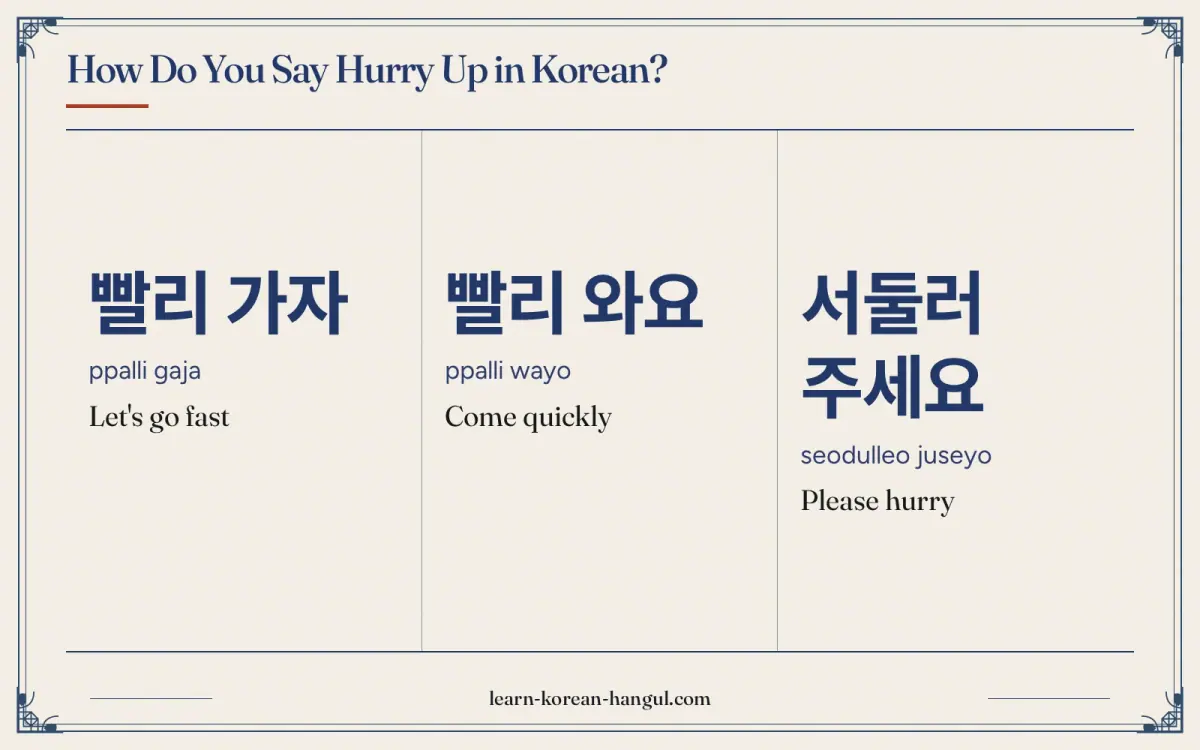
The most direct way to say hurry up in Korean is 빨리 (ppalli), the adverb for "quickly", joined to a verb. 빨리 와요 uses the verb 오다 (to come), so it means "come quickly". To urge any other action, put 빨리 in front of that verb, such as 빨리 하세요 (ppalli haseyo), "do it quickly".
| Listener | Korean | Romanization | Meaning |
|---|---|---|---|
| Friend, sibling | 빨리 가자 | ppalli gaja | Let's go fast |
| Coworker, acquaintance | 빨리 와요 | ppalli wayo | Come quickly |
| Stranger, driver, staff | 서둘러 주세요 | seodulleo juseyo | Please hurry |
| Friends, in a lively tone | 빨리빨리 | ppallippalli | Quickly, quickly |
| Formal notice | 서두르십시오 | seodureusipsio | Please hurry (formal) |
Revised Romanization (the South Korean government standard of 2000) is only a reading aid here. Learn the Hangul first. The next section explains each form.
What Are the Polite and Casual Ways to Say Hurry Up?
Two ideas sit behind every form. 빨리 is an adverb that describes speed, and 서두르다 is a verb that means to hurry. The listener decides the ending, and the tone decides how pushy it sounds.
Polite: 빨리 와요 (ppalli wayo)
Polite · 해요체빨리 와요 is the polite everyday form. You say it when someone is walking toward you, or is about to miss a bus. The verb 오다 combines with -아요 to give 와요, the same contraction explained on come here in Korean. With an older person, say 빨리 오세요 (ppalli oseyo) to add respect.
빨리 와요. 버스가 곧 와요.
ppalli wayo. beoseuga got wayo
Come quickly. The bus is coming soon.
Polite: 서둘러 주세요 (seodulleo juseyo)
Polite · 해요체서둘러 주세요 asks someone to hurry as a favour. 서둘러 comes from the verb 서두르다 (to hurry), and 주세요 means "please do it for me". It is the best choice with taxi drivers, shop staff and anyone you do not know. Adding 죄송한데 (sorry, but) makes it softer.
죄송한데, 서둘러 주세요.
joesonghande, seodulleo juseyo
Sorry, but please hurry.
Casual: 빨리빨리 (ppallippalli)
Casual · 반말빨리빨리 repeats the adverb for energy. Friends use it, and so do shop staff who call customers forward. It is lively and sometimes impatient, so it is not the line for a respectful request to an elder. You can add 하세요 to make it polite: 빨리빨리 하세요.
빨리빨리 하세요!
ppallippalli haseyo
Hurry, hurry!
Casual: 빨리 가자 (ppalli gaja)
Casual · 반말빨리 가자 uses the casual "let's" ending -자 on 가다 (to go). It is for friends, classmates and family who are moving together. It does not order anyone, because the speaker is going too. For the plain invitation without speed, see let's go in Korean.
빨리 가자. 영화 곧 시작해.
ppalli gaja. yeonghwa got sijakae
Let's hurry. The movie starts soon.
The formal form 서두르십시오 appears on signs and in announcements. Next, the sounds.
How Do You Pronounce 빨리 와요?
빨리 와요 is pronounced [빨리 와요], with four syllables: ppal-li wa-yo. The first word is the one to practise.
- 빨 (ppal): ㅃ is a tense sound. Close your lips firmly and release with no puff of air.
- 리 (li): the ㄹ at the end of 빨 and the ㄹ at the start of 리 meet, so you hear one long ㄹ, [빨리], with the tongue tip held on the ridge behind your teeth.
- 와 (wa): a rounded "w" gliding into "ah".
- 요 (yo): a short "yo".
Sound Changes to Listen For
- The long ㄹ in 빨리 and 서둘러. Two ㄹ sounds in a row become one long lateral sound. 빨리빨리 repeats it twice, so keep the rhythm even: ppal-li ppal-li.
- Tensing in 서두르십시오. The ㅂ in 십 makes the following ㅅ tense, so it sounds like [서두르십씨오]. Revised Romanization does not show tensing caused by a neighbouring sound, so it writes seodureusipsio.
- Aspiration in 시작해. The ㄱ of 시작 joins the ㅎ of 해 and becomes a ㅋ sound, so 시작해 sounds like [시자캐] and RR writes sijakae.
- 갈게요 sounds like [갈께요]. A ㄱ right after the -ㄹ ending becomes tense (Standard Pronunciation Rules, Article 27), so 갈게요 in the dialogue below is [갈께요], and RR writes galgeyo.
The Korean tensification lesson lists these patterns. Practise by saying 빨리 slowly, then at normal speed, and keep the double ㄹ clear. Sound is only half; you also need to read the situation.
When Should You Use 빨리 와요, and When Should You Not?
Use 빨리 와요 when you need someone to arrive or act sooner and the relationship is friendly. Choose the softer 서둘러 주세요 when you are asking a favour of someone you do not know.
Situations Where It Fits
- Waiting at a stop or station. 빨리 와요! is natural when a friend is behind you.
- A taxi that must be quick. 서둘러 주세요 asks the driver politely.
- Leaving with a group. 빨리 가자 gets friends moving.
- A busy shop. Staff may say 빨리빨리 to keep a queue moving.
Situations to Avoid
- Bare 빨리 to an elder or stranger. It sounds like an order.
- Pushing a person who is already stressed. Even a polite phrase can sound rude if the voice is sharp.
- Official or written notices. Use 서두르십시오 or 서둘러 주시기 바랍니다 (please hurry), not 빨리빨리.
Three short dialogues show these situations.
What Does Hurry up Sound Like in a Real Conversation?
Hurry phrases are short and often repeated. Listen for the quick, bright tone in the friendly versions and the calm, even tone in the polite request.
Waiting at a Bus Stop
Friend A
빨리 와요. 버스가 곧 와요.
ppalli wayo. beoseuga got wayo
Come quickly. The bus is coming soon.
Friend B
네, 지금 가요!
ne, jigeum gayo
Yes, I am coming now!
What to notice: 곧 means "soon", and the reply 지금 가요 uses 가다 even though the friend is moving toward the speaker. Korean often uses 가다 for "I am on my way".
A Taxi Ride
Passenger
기사님, 서둘러 주세요. 약속에 늦었어요.
gisanim, seodulleo juseyo. yaksoge neujeosseoyo
Driver, please hurry. I am late for an appointment.
Driver
네, 최대한 빨리 갈게요.
ne, choedaehan ppalli galgeyo
Yes, I will go as fast as I can.
What to notice: 늦었어요 sounds like [느저써요], because the final ㅈ moves to the next syllable, and 갈게요 is the promise "I will go" with a tense [갈께요].
Two Friends
Hyun-Woo
빨리 가자! 영화 곧 시작해.
ppalli gaja! yeonghwa got sijakae
Let's hurry! The movie starts soon.
Da-In
알았어, 빨리빨리!
arasseo, ppallippalli
Okay, quickly, quickly!
What to notice: 알았어 is the casual "got it". The repetition 빨리빨리 shows that the friend is joining in the rush. A cultural idea sits behind the repeated word.
What Should You Know about the Culture behind Hurry Up?
빨리빨리 is often called a symbol of Korea's fast-paced daily life, from quick service to short waiting times. Koreans use it about themselves with a mix of pride and humour, and some learners know it as one of the first Korean words they hear.
- Speed as service. Staff expect to move quickly, so a quick request is not always rude.
- Tone still matters. Between strangers, politeness comes first, so add 주세요 and 죄송한데.
- A gentler counter. To tell someone there is no rush, say 천천히 하세요 (cheoncheonhi haseyo), "take your time", or 서두르지 마세요 (seodureuji maseyo), "don't rush".
An expert insight: because the culture values speed, a polite request to hurry is more accepted than it would be in some other languages, yet an elder still expects a respectful ending. Use 서둘러 주세요 or 빨리 오세요 for those cases.
서두르지 마세요.
seodureuji maseyo
Do not rush.
What Mistakes Do Learners Make with Hurry up in Korean?
Most mistakes concern register, meaning and conjugation.
| Mistake | Why it is a problem | Fix |
|---|---|---|
| Bare 빨리 to an elder | Sounds like an order | Say 빨리 오세요 or 서둘러 주세요 |
| 빨리 와요 for every "hurry up" | It only means come quickly | Use 빨리 하세요 to urge an action |
| 서두르어요 | Skips the 르 irregular change | Say 서둘러요 |
| Saying 빨리 with one short ㄹ | Loses the long double ㄹ | Hold the ㄹ a little longer |
| Using 빨리빨리 at work with a boss | Too lively | Use 서둘러 주세요 |
Learners often assume that 빨리 is a verb. Actually, it is an adverb, so it needs a verb after it. The next section handles the searches that lead here.
Is It the Same as Hurry, Quickly and Faster?
Three nearby searches share this page, and each has a short answer.
- Hurry in Korean: the verb is 서두르다. Its polite form is 서둘러요, and the polite request is 서둘러 주세요.
- Quickly in Korean: the adverb is 빨리. The dictionary page quickly in Korean covers it alone.
- Faster in Korean: put 더 (more) in front: 더 빨리 해 주세요 (please do it faster).
Practice: Say It Aloud
Play the slow clip and repeat 빨리 와요 three times, holding the double ㄹ. Then choose the best phrase for each listener. Answers follow.
- A taxi driver you have just met.
- Your friend at the cinema door.
- A coworker walking toward you.
- The conjugation of 서두르다 in polite style.
Answers
- 서둘러 주세요.
- 빨리 가자.
- 빨리 와요.
- 서둘러요.
The phrase flashcards drill these forms with audio.
Related Phrases to Learn Next
Hurry phrases belong with other short requests.
- Wait a moment in Korean: the opposite request.
- Let's go in Korean: inviting someone to move with you.
- Come here in Korean: calling someone over.
This guide belongs to the Korean filler words collection. What this page does not cover: the full conjugation of 서두르다 and long written notices. Match the ending to the listener, and you can say hurry up in Korean politely and clearly.
Frequently Asked Questions
How do you say hurry up in Korean?
Say 빨리 와요 (ppalli wayo) to mean "come quickly" in polite speech. To ask a stranger or a service worker to hurry, say 서둘러 주세요 (seodulleo juseyo). With friends, say 빨리 가자 (ppalli gaja). To hurry someone who is doing a task, say 빨리 하세요 (ppalli haseyo), "do it quickly".
How do you pronounce 빨리 와요?
Say ppal-li wa-yo in four syllables. The ㅃ is tense, made with firm lips and no puff of air. The ㄹ at the end of 빨 and the ㄹ at the start of 리 join into one long ㄹ, [빨리]. The 와 glides from a rounded "w" into "ah". Keep the pitch even, with a slight rise for friendliness.
What is the difference between 빨리 와요 and 서둘러 주세요?
빨리 와요 tells someone to come quickly, and it is a plain polite request between people who know each other. 서둘러 주세요 asks someone to hurry as a favour, using the verb 서두르다 and 주세요. It is softer and safer with strangers, drivers and staff, especially with 죄송한데 in front.
Is 빨리 와요 formal or casual?
빨리 와요 is polite but not formal, so it suits everyday talk with adults you know. The casual form is 빨리 와, and the respectful form is 빨리 오세요. For a formal tone, such as an announcement, use 서두르십시오. 빨리빨리 is casual and lively.
Can I use 빨리 와요 with friends, elders and strangers?
With friends, yes, or use the casual 빨리 와. With coworkers, yes. With elders, 빨리 오세요 is better. With strangers, prefer 서둘러 주세요, which asks for a favour. Bare 빨리 as a command sounds rude to anyone you should respect.
What is the most common mistake with hurry up in Korean?
Using bare 빨리 as a command with an elder or a stranger. It sounds like an order. Add 주세요, 오세요 or 하세요, or use 서둘러 주세요. Another mistake is saying 서두르어요, which ignores the 르 irregular change. The correct polite form is 서둘러요.