이리 와요
이리 와요
What you'll learn
- Say 이리 와요, 이리 오세요, 이리 와 and 여기로 와요 and choose the right one.
- Explain why 오다 becomes 와요 and not 오아요.
- Call someone over politely, without sounding like you give orders.
- Add 좀 and other softeners to make a request gentle.
Before you start: the lesson on Korean speech levels explains the three endings used below. Time: about 11 minutes. Audio plays only when you press a button.
How Do You Say Come Here in Korean?
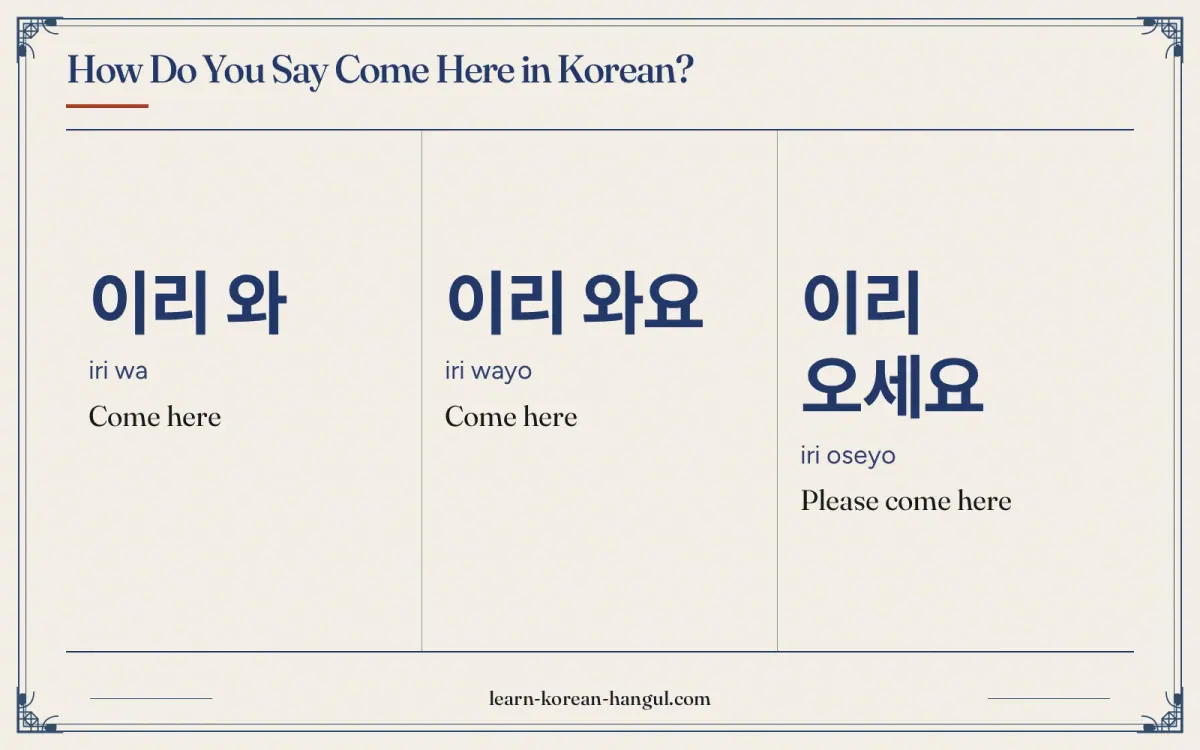
The standard way to say come here in Korean is 이리 와요. The phrase has two parts: 이리 means "this way" or "over here", and 와요 comes from the verb 오다 (to come) in the polite ending.
| Listener | Korean | Romanization | Meaning |
|---|---|---|---|
| Child, friend, pet | 이리 와 | iri wa | Come here |
| Coworker, acquaintance | 이리 와요 | iri wayo | Come here |
| Guest, customer, elder | 이리 오세요 | iri oseyo | Please come here |
| Neutral, about a place | 여기로 와요 | yeogiro wayo | Come to this place |
Revised Romanization (the South Korean government standard of 2000) is only a reading aid here. Learn the Hangul first. The next section explains each form.
What Are the Polite and Casual Ways to Say Come Here?
Come here has four common forms, and the listener decides which one to use. The verb stem 오- stays the same, while the ending and the honorific change.
Polite: 이리 와요 (iri wayo)
Polite · 해요체이리 와요 is the everyday polite form. It sounds friendly with adults you know, and the tone decides whether it is an invitation or an order. Add 좀 (a bit, please) to soften it: 이리 좀 와요.
이리 와요. 같이 사진 찍어요.
iri wayo. gachi sajin jjigeoyo
Come here. Let's take a photo together.
Polite: 이리 오세요 (iri oseyo)
Polite · 해요체이리 오세요 adds the honorific -시-, which respectfully invites the listener. Shop staff, hosts and nurses say it to customers, guests and patients. To elders, a variation is 이쪽으로 오세요 (please come this way).
손님, 이리 오세요.
sonnim, iri oseyo
Customer, please come this way.
Casual: 이리 와 (iri wa)
Casual · 반말이리 와 is the casual form. Parents, teachers, older siblings and friends use it. It is warm with a child, but it sounds commanding with anyone who deserves respect.
이리 와, 간식 줄게.
iri wa, gansik julge
Come here, I'll give you a snack.
Polite: 여기로 와요 (yeogiro wayo)
Polite · 해요체여기로 와요 means "come to this place". 여기 is a location (here), while 이리 is a direction (this way), so 여기로 fits when you point to a spot, such as a free seat. In speech the particle 로 is often dropped: 여기 와요.
여기로 와요. 자리 있어요.
yeogiro wayo. jari isseoyo
Come over here. There's a seat.
Four forms cover most situations. The sound is where learners hesitate, so the next section takes it slowly.
How Do You Pronounce 이리 와요?
이리 와요 is pronounced [이리 와요], i-ri wa-yo, in four syllables with no sound change. The one feature to learn is the syllable 와.
- 이 (i): a clear "ee".
- 리 (ri): a light tap of the tongue, between "r" and "l".
- 와 (wa): a rounded "w" gliding into an open "ah".
- 요 (yo): a short "yo", level or slightly rising.
Sound Changes to Listen For
The main change is in the spelling, not the sound: the verb 오다 plus the ending -아요 contracts.
- Vowel contraction (모음 축약). 오 + 아요 becomes 와요. The two vowels merge into the single syllable 와. Writing 오아요 is a spelling mistake.
- No contraction with -세요. 오세요 keeps 오 and adds 세요, so it stays two syllables, [오세요].
- Linking in 이쪽으로. In 이쪽으로 오세요, the final ㄱ moves forward, so 이쪽으로 sounds like [이쪼그로].
Practise by saying 오다, then 와요, and notice that the "o" glides into "wa". Pronunciation is one half. The other is knowing who you are talking to.
When Should You Use 이리 와요, and When Should You Not?
Use 이리 와요 to invite someone to come closer with a friendly tone. Avoid the casual 이리 와 with seniors and strangers, because it can sound like an order.
Situations Where It Fits
- Inviting a friend to look at something. 이리 와 봐, 이거 봐.
- A host leads guests to a table. 이리 오세요.
- A parent calls a child. 이리 와, 안아 줄게.
- A colleague joins a photo. 이리 와요, 같이 찍어요.
Situations to Avoid
- Elders and strangers. Use 이쪽으로 오세요.
- A sharp or loud tone. Even polite words can sound like an order when shouted.
- Calling an adult by gesture alone. Waving a finger upward can seem rude. Use the palm-down wave and a polite phrase together.
Three short dialogues show these situations in action.
What Does Come Here Sound Like in a Real Conversation?
이리 와요 appears at home, in shops and with friends. Listen for the warm, falling tone in the parent's call and the even, polite tone in the host's invitation.
A Parent and Child
Mother
이리 와, 안아 줄게.
iri wa, ana julge
Come here, I'll give you a hug.
Child
응, 엄마!
eung, eomma
Yes, Mom!
What to notice: 안아 줄게 is a promise of a hug, and the casual 이리 와 shows closeness.
A Restaurant Host
Host
손님, 이리 오세요. 자리 안내해 드릴게요.
sonnim, iri oseyo. jari annaehae deurilgeyo
Customer, please come this way. I'll show you to a table.
Customer
감사합니다.
gamsahamnida
Thank you.
What to notice: the host combines the honorific 오세요 with 드릴게요 (I will do for you), both respectful.
Friends Looking at a Phone
Hyun-Woo
이리 와 봐, 이거 봐.
iri wa bwa, igeo bwa
Come here and look at this.
Da-In
뭔데?
mwonde
What is it?
What to notice: 와 봐 (come and see) is a common pair among friends. The gesture that goes with these phrases is part of the culture.
What Should You Know about the Culture behind Come Here?
Calling someone over in Korea involves words and a gesture, and both carry social meaning.
- Palm-down beckoning. Koreans wave toward themselves with the palm facing down. A palm-up wave or an upturned finger can look like calling a dog or a rude summons.
- Children and pets. 이리 와 is the classic call to a child or a pet, so the casual form can feel patronising with adults.
- Service language. Staff in shops and restaurants prefer 이리 오세요 or 이쪽으로 오세요 because the honorific shows respect for the customer.
- Softeners matter. 좀 and a smile turn an order into a request: 이리 좀 와 주세요 (please come here for a moment).
An expert insight: learners often focus on the verb, but 이리 carries the sense of direction. Pointing with your hand while saying 이리 makes the meaning clear even when the vocabulary is limited. The mistakes below come from ignoring tone and listener.
What Mistakes Do Learners Make with Come Here in Korean?
Most come-here mistakes are about register and spelling.
| Mistake | Why it is a problem | Fix |
|---|---|---|
| 이리 와 to a senior or stranger | Sounds like an order | Say 이쪽으로 오세요 |
| Writing 오아요 | Skips the contraction | Write 와요 |
| Saying 가요 when you mean "come" | 가다 is movement away from the speaker; 오다 is movement toward the speaker | Say 이리 와요 |
| Waving a finger upward | Can look rude | Use the palm-down wave |
| Flat, loud tone | Even polite words sound like an order | Add 좀 and a smile |
Learners often assume the polite -요 form is always safe. Actually, 이리 와요 to an elder is still a little casual, so the honorific 오세요 is the better choice.
Is It the Same as Come over and Come Here Please?
Close, with small differences. "Come over in Korean" and "come here please in Korean" both point to this page, and the short answers below cover each search.
- Come over (to my house): 우리 집에 놀러 와요 (come over and hang out).
- Come here please: 이리 좀 와 주세요 (polite), or 이리 와 줘 (casual).
- Come and see: 와 봐요 (polite), 와 봐 (casual).
- Come in: a different action, covered in come in in Korean.
- Let's go: the invitation to move together is on let's go in Korean.
Now practise the forms with your own voice.
Practice: Say It Aloud
Play the slow clip and repeat 이리 와요 three times, joining 오 and 아 into 와. Then choose the best form for each listener. Answers follow.
- Your toddler is across the room.
- A customer enters a shop you work in.
- A coworker you like is standing outside a photo.
- Write the correct spelling of the contraction of 오 + 아요.
Answers
- 이리 와.
- 이리 오세요.
- 이리 와요.
- 와요.
The phrase flashcards drill these forms with audio.
Related Phrases to Learn Next
Come here belongs to a small group of invitation phrases.
- Let's go in Korean: inviting someone to move with you.
- Come in in Korean: welcoming someone into a room or house.
- Hurry up in Korean: urging someone to move quickly.
This guide belongs to the Korean filler words collection. What this page does not cover: the full conjugation of 오다 and long invitations. Match the ending to the listener, and you can say come here in Korean politely and warmly.
Frequently Asked Questions
How do you say come here in Korean?
Say 이리 와요 (iri wayo) in polite speech. It uses 이리 (this way) and the verb 오다 (to come). Use 이리 와 with children and close friends, and 이리 오세요 with guests and elders. The phrase can sound like an order if the tone is sharp, so soften it with 좀 (please, a bit).
How do you pronounce 이리 와요?
Say i-ri wa-yo in four syllables with no sound change. The 와 is a single syllable made from 오 and 아, pronounced "wah", so the tongue glides from a rounded "w" into an open "ah". Keep the pitch level, and raise it slightly for a friendly request or a question.
What is the difference between 이리 와요 and 이리 오세요?
이리 와요 is polite and neutral. 이리 오세요 adds the honorific -시-, so it respectfully invites the listener to come. Shop staff and hosts use 이리 오세요 with customers and guests. With elders, 이리 와요 can sound slightly casual, so choose 이리 오세요 or 이쪽으로 오세요.
Is 이리 와요 formal or casual?
이리 와요 is polite but not formal, so it suits everyday talk with adults you know. The casual form is 이리 와, and the respectful form is 이리 오세요. For a formal tone, such as an announcement, use 이쪽으로 오십시오. When in doubt with someone senior, use 오세요.
What is the most common mistake with come here in Korean?
Using 이리 와 with a senior or a stranger. It sounds like an order given to a child. To elders, say 이쪽으로 오세요 (please come this way). Another mistake is saying "oayo" instead of 와요, which skips the contraction that Korean speakers always make.