가요
가요
What you'll learn
- Say 가요 and 같이 가요, and pronounce 갑시다 as [갑씨다].
- Choose between 가요, 갑시다, 가자, 가시죠 and 갈까요? for a stranger, a senior and a friend.
- Tell "I go" from "let's go" in everyday speech.
- Avoid the mistake of saying 갑시다 to a boss.
Before you start: you need to read Hangul; romanization is shown as an aid and can be hidden. Time: about 10 minutes.
Key facts
- 가자 (gaja) is the casual "let's go" for friends, and 갑시다 (gapsida) is the formal propositive.
How Do You Say Let's Go in Korean?
The standard way to say let's go in Korean is 같이 가요, because it is polite and says "together" aloud. The plain 가요 also works, but it can mean "I go" or "we go" as well, so the listener relies on context. The table lists the forms side by side.
| Form | Romanization | Meaning | Register |
|---|---|---|---|
| 가요 | gayo | Go, I go, let's go | Polite |
| 같이 가요 | gachi gayo | Let's go together | Polite |
| 갈까요? | galkkayo | Shall we go? | Polite, soft |
| 가시죠 | gasijyo | Shall we go? (to a senior) | Respectful |
| 갑시다 | gapsida | Let's go | Formal, not for elders |
| 가자 | gaja | Let's go | Casual |
| 가보자 | gaboja | Let's go and see, let's try | Casual |
The reason for so many forms is that Korean marks the relationship in the verb ending. A suggestion to a friend, to a coworker and to a company president use different endings of the same verb 가다 (to go). The next section walks through each form.
What Are the Formal, Polite and Casual Ways to Say Let's Go?
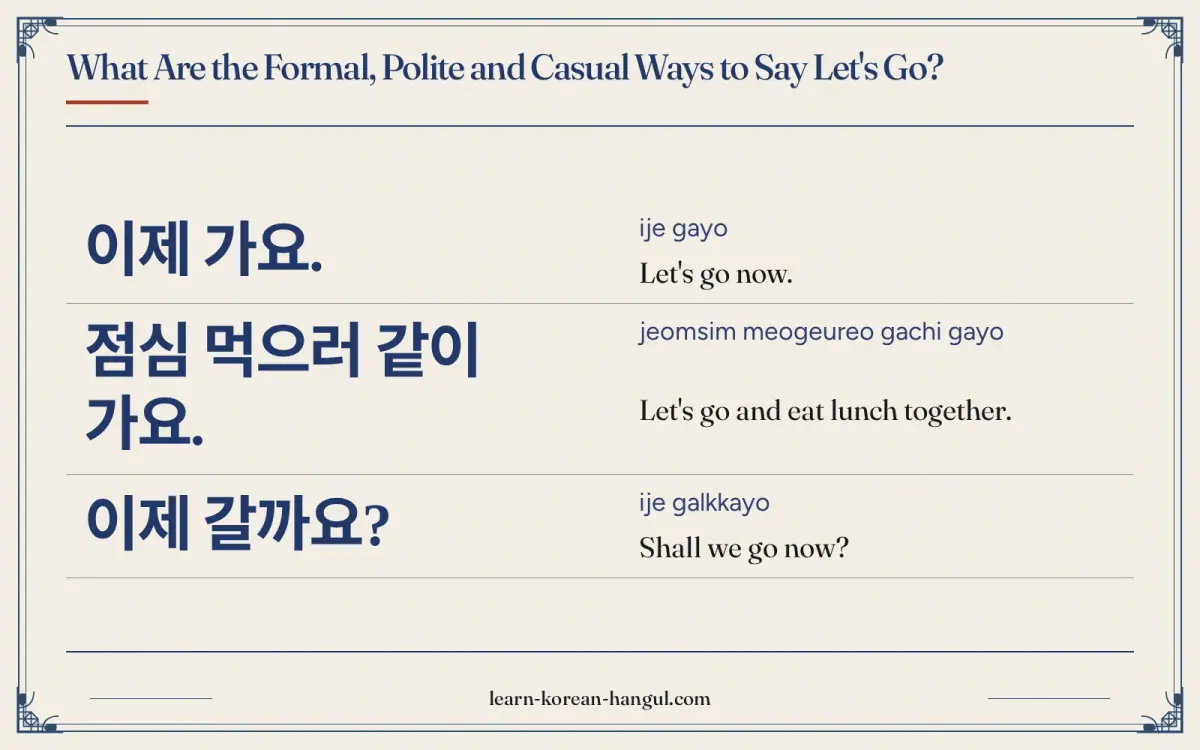
Let's go in Korean follows the Korean speech levels, the endings that change with the listener's age, status and closeness, explained in the guide to Korean speech levels. The verb stem 가- stays the same, and the ending does the social work. The guide to suggestions and requests explains the endings behind these forms.
Polite: 가요 (gayo)
Polite · 해요체가요 is the polite present form of 가다. A polite ending in Korean can mean a statement, a question or a suggestion, so 가요 may mean "I go", "do you go?" or "let's go". A gesture, a pointing hand or the word 우리 (we) makes the meaning clear.
이제 가요.
ije gayo
Let's go now.
Polite: 같이 가요 (gachi gayo)
Polite · 해요체같이 means "together", so 같이 가요 can only mean "let's go together". It is the clearest polite invitation for a coworker, a classmate or a new friend. The first word is pronounced [가치] and not [가티], which is explained in the pronunciation section.
점심 먹으러 같이 가요.
jeomsim meogeureo gachi gayo
Let's go and eat lunch together.
Polite: 갈까요? (galkkayo)
Polite · 해요체갈까요? uses the ending -(으)ㄹ까요?, which means "shall we?". It is the softest way to suggest going, because it asks for agreement instead of declaring a plan. Koreans use it all the time with people they respect.
이제 갈까요?
ije galkkayo
Shall we go now?
Respectful: 가시죠 (gasijyo)
Formal · 합쇼체가시죠 combines the honorific -시- with the suggestion ending -죠, so it means "shall we go, sir or madam". Use it when the person you invite is a boss, a client or a senior. It is the safe upward replacement for 갑시다.
부장님, 이제 가시죠.
bujangnim, ije gasijyo
Director, shall we go now?
Formal: 갑시다 (gapsida)
Formal · 합쇼체갑시다 is the formal propositive, made with the ending -(으)ㅂ시다. It clearly says "let's go", so you hear it in announcements, meetings and from a leader to a group. The catch is that it comes from someone equal to or above the listener. A junior who says 갑시다 to a boss sounds like they are giving an order.
시간이 됐으니 갑시다.
sigani dwaesseuni gapsida
It's time, so let's go.
Casual: 가자 (gaja)
Casual · 반말가자 is the casual suggestion ending -자. Friends, siblings and younger people use it freely, and it carries energy, like "come on, let's go". A related form is 가보자 (gaboja), "let's go and see" or "let's give it a try", used before a challenge.
영화 시작해. 빨리 가자.
yeonghwa sijakae. ppalli gaja
The movie is starting. Let's hurry and go.
Seven forms, one idea. Two of them hide sound changes, so pronunciation comes next.
How Do You Pronounce 가요?
가요 is pronounced [가요], gah-yo, in two short syllables. Follow these steps:
- 가 (ga): a plain "gah". At the start of a sentence the ㄱ sits between English k and g, with little breath; between vowels it sounds like a g.
- 요 (yo): "yo", with rounded lips.
- Keep the pitch level or let it fall at the end, both for a statement and for a suggestion. A sharp rise turns 가요? into the question "Are you going?".
Sound Changes to Listen For
- Palatalization in 같이. When ㅌ at the end of a syllable meets 이, it becomes ㅊ, so 같이 is [가치] and 같이 가요 is [가치가요]. This follows the standard pronunciation rules (표준 발음법), Article 17, and is explained in Korean palatalization.
- Tensification in 갑시다. After the final ㅂ in 갑, the ㅅ of 시 becomes tense, so 갑시다 is [갑씨다]. The rule is explained in Korean tensification.
- Tense ㄲ in 갈까요. The ㄲ is a tense consonant written in the spelling, so 갈까요 is [갈까요], with a tight ㄲ.
Revised Romanization, the official system for writing Korean in Latin letters, writes gayo, gachi gayo and gapsida. It spells 같이 as gachi, which follows the sound, but it does not show the tense [씨] of 갑시다. Romanization is only a guide; the Hangul is the real spelling. Knowing which form to use matters more than a perfect accent.
When Should You Use 가요, and When Should You Not?
Use 같이 가요 when you invite a coworker, classmate or new friend and want a friendly, polite tone. Use 가자 with close friends, and 갈까요? or 가시죠 with people above you.
Situations Where It Fits
- Leaving a restaurant together. 이제 가요 tells the group it is time to leave.
- Inviting a coworker to lunch. 점심 같이 가요 is warm and polite.
- Calling friends to move. 가자 works when the bus is arriving.
- Starting a trip or a game. 가보자 gives the group a push.
Situations to Avoid
- 갑시다 to a boss or elder. It sounds like an order from above. Use 가시죠.
- 가자 to a teacher or older stranger. The casual -자 skips respect.
- A bare 가요 when the meaning might be "I go". Add 같이 or ask 갈까요?
Three short exchanges show these choices in real use.
What Does Let's Go Sound Like in a Real Conversation?
In real talk, "let's go" comes with a reason or a destination. Listen for what follows.
Friends Rush to the Cinema
Minsu
영화 시작해. 빨리 가자.
yeonghwa sijakae. ppalli gaja
The movie is starting. Let's hurry.
Sua
응, 가자.
eung, gaja
Yes, let's go.
What to notice: friends use the casual 가자 and 응 (yes), with no polite ending.
Coworkers Go to Lunch
Coworker
점심 먹으러 갈까요?
jeomsim meogeureo galkkayo?
Shall we go to lunch?
You
네, 같이 가요.
ne, gachi gayo
Yes, let's go together.
What to notice: the question 갈까요? invites, and 같이 가요 accepts clearly.
Inviting a Director to a Meeting
Junior
부장님, 회의실로 가시죠.
bujangnim, hoeuisillo gasijyo
Director, shall we go to the meeting room?
Director
그래요, 갑시다.
geuraeyo, gapsida
All right, let's go.
What to notice: the junior uses the respectful 가시죠, and the director may answer with 갑시다, which sounds natural from a senior. The forms run one way, from senior to junior, for a cultural reason.
What Should You Know about the Culture behind Let's Go?
In Korean, the form of a suggestion shows rank. A senior can say 갑시다 to a group, and the group answers 네, 가시죠, so the same idea has different words for people at different levels.
- Group moves. Korean teams often move together, to lunch or to an after-work meal, and a suggestion from the group leader is usually a plan.
- Rallying calls. At sports matches and concerts, fans may shout 가자 or 가보자 to encourage a team or a singer. The energy matters more than the grammar.
- Questions are polite. 갈까요? turns a plan into a request, which Koreans value when speaking to people they respect.
- Sharing a path. 같이 가요 is also a kind offer, such as walking someone to the station.
An expert insight: learners expect one Korean word for "let's go", then use 가요 and feel misunderstood. The ending carries both politeness and meaning, so the choice is a small social decision. The mistakes below come from this and from rank.
What Mistakes Do Learners Make with Let's Go in Korean?
Most mistakes come from rank, from meaning and from sound.
| Mistake | Why it is a problem | Fix |
|---|---|---|
| Saying 갑시다 to a boss | Sounds like an order from above | Say 가시죠 or 갈까요? |
| Saying 가자 to a teacher | Casual, no respect | Say 같이 가요 |
| Using a bare 가요 for "let's go" | May be heard as "I go" | Add 같이 or 우리 |
| Pronouncing 같이 as [가티] | The ㅌ becomes ㅊ before 이 | Say [가치] |
| Pronouncing 갑시다 as [갑시다] | The ㅅ turns tense | Say [갑씨다] |
Learners often assume that the formal -ㅂ시다 is the most polite way to invite. In fact, it is formal but not humble, which is why a senior may say it and a junior should not.
Other Ways People Search for Let's Go in Korean
People search for let's go in Korean in several forms. The short answers below cover each one.
- Lets go in Korean: the same as let's go. The polite answer is 가요 or 같이 가요.
- Let's go together in Korean: 같이 가요 (polite), 같이 가자 (casual) or 같이 갑시다 (formal).
- Go together in Korean: 같이 가다 is the verb phrase, with 같이 meaning "together" and 가다 meaning "to go".
Knowing the forms is the first step; saying them on cue is the next, so practise now.
Practice: Say It Aloud
Play the slow clip of 가요, repeat it three times, then try 같이 가요 as [가치가요] and 갑시다 as [갑씨다]. Then choose a form for each situation. Answers follow.
- You invite a new coworker to lunch.
- Your best friend is waiting at the door.
- Your director is ready to leave the office.
- You lead a group tour and announce the move.
Answers
- 같이 가요 or 갈까요?
- 가자.
- 가시죠.
- 갑시다, which is formal and clear for a group.
Drill 가요 and the related phrases with the phrase flashcards, which include audio for each form.
Related Phrases to Learn Next
Let's go sits in a group of short action phrases that every beginner needs.
- Hurry up in Korean: 빨리 and other ways to speed things up.
- Come here in Korean: 이리 와요 and its forms.
- Fighting in Korean: 파이팅 and 화이팅, the cheers you hear before a challenge.
- Okay in Korean: 좋아요 and 알겠어요 for agreeing to go.
This guide belongs to the korean filler words collection. What this page does not cover: motion verbs such as 오다 and 가다 in depth, directions and travel phrases. Use 같이 가요 with peers, 가시죠 with seniors and 가자 with friends, and you can say let's go in Korean with the right tone for each listener.
Frequently Asked Questions
How do you say let's go in Korean?
The polite way is 가요 (gayo) or, more clearly, 같이 가요 (gachi gayo), let's go together. With friends, say 가자 (gaja). In formal speech, say 갑시다 (gapsida), and to a boss or senior, say 가시죠 (gasijyo). To suggest going softly, ask 갈까요? (galkkayo), meaning shall we go?
How do you pronounce 가요?
가요 is pronounced [가요], in two light syllables: gah-yo. The ㄱ at the start is plain and soft. Keep the pitch level or falling for a suggestion, because a sharp rise makes it a question. 가요 itself has no sound change, but 갑시다 is [갑씨다], and 같이 가요 is [가치가요], with ㅌ softened to ㅊ.
What is the difference between 가요 and 갑시다?
가요 is polite and flexible: depending on context it means I go, we go or let's go. 갑시다 is a formal propositive that clearly means let's go, but it comes from a speaker who is equal to or above the listener. 갑시다 can sound like an order from above if you say it to a boss or an elder.
Is 가요 formal or casual?
가요 is polite, because the ending -요 is polite. It suits strangers, coworkers and teachers. The casual forms are 가자 for let's go and 가 for go, used with friends and younger people. The formal form is 갑시다 or 가십시오 (please go), used in speeches, announcements and the army. Only the ending changes.
Can I use 가요 with friends, elders and strangers?
Yes with strangers and coworkers, where 같이 가요 is a friendly suggestion. With close friends, 가요 can sound stiff, so they say 가자. With a boss or elder, avoid 갑시다 and say 가시죠 or 가실까요? (shall we go?), which are more respectful. When unsure, 같이 가요 or 갈까요? is safe.
What is the most common mistake with let's go in Korean?
The most common mistake is saying 갑시다 to a boss or elder, which sounds like a directive from above. The second is saying a bare 가요 and being understood as I go, when you meant let's go. Add 같이 (together) or 우리 (we), or ask 갈까요?, so the suggestion is clear.