
좋아해요
좋아해요
What you'll learn
- Say I like you with 좋아해요, 좋아합니다 or 좋아해, depending on the listener.
- Use 을/를 and the short 널 with a person.
- Say I like you a lot and I have a crush on you.
- Pronounce 좋아해요 as [조아해요].
Before you start: you only need to read Hangul. This page prepares you for I love you in Korean, the next step in feelings. Time: about 10 minutes. Audio plays only when you press a button.
How Do You Say I Like You in Korean?
The standard way to say I like you in Korean is 좋아해요, which literally means "I like (you)". Korean often drops the words for "I" and "you", so the short sentence 좋아해요 is complete, but the person is clearer when you add the object.
| Situation | Best form | Romanization | Why |
|---|---|---|---|
| Telling a classmate or colleague politely | 좋아해요 | joahaeyo | Polite, clear |
| A first confession to someone you respect | 지은 씨를 좋아해요 | jieun ssireul joahaeyo | Names the person with 씨 |
| Telling a partner or close friend | 널 좋아해 | neol joahae | Casual, warm |
| A speech or a formal letter | 좋아합니다 | joahamnida | Formal |
| Explaining a crush | 반했어요 | banhaesseoyo | I have fallen for you |
The thing to remember is the object: 좋아해요 needs someone to like. The next section sorts the forms by the listener.
What Are the Formal, Polite and Casual Ways to Say I Like You?
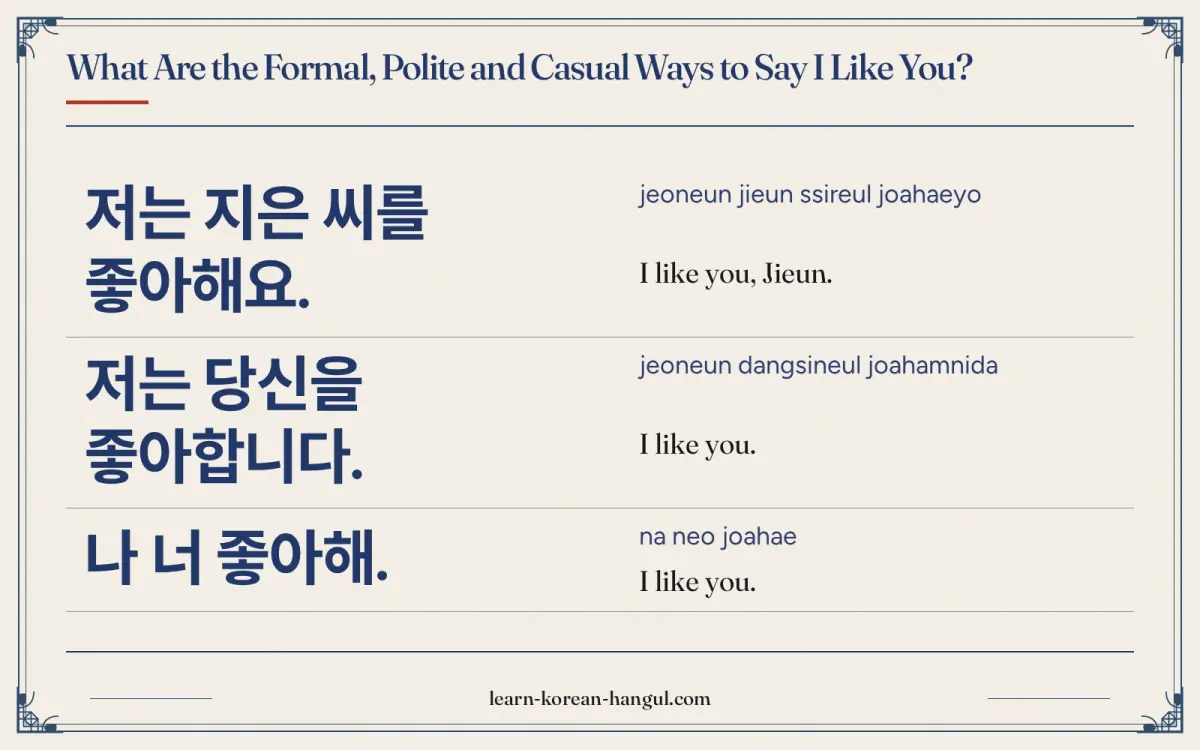
The forms follow the Korean speech levels, the endings that change with the listener. The guide to Korean speech levels explains each level. For this phrase you need one formal, one polite and one casual form.
Polite: 좋아해요 (joahaeyo)
Polite · 해요체좋아해요 is the default. It suits an early confession, a classmate, a colleague or a friend you speak to politely. It is warm without being heavy.
저는 지은 씨를 좋아해요.
jeoneun jieun ssireul joahaeyo
I like you, Jieun.
Using the name plus 씨 (ssi) is the usual polite way to say "you" in Korean. The dictionary word 당신 sounds cold or even confrontational to a stranger in everyday speech; it is mostly heard between spouses, in songs and in writing.
Formal: 좋아합니다 (joahamnida)
Formal · 합쇼체좋아합니다 uses the formal -ㅂ니다 ending. It is rare in a private confession, but you will hear it in a speech, in a letter or in a drama where a character is serious and old-fashioned. It is pronounced [조아함니다]. The example uses 당신 because it imitates written, letter-style Korean; in speech, use the person's name.
저는 당신을 좋아합니다.
jeoneun dangsineul joahamnida
I like you.
Casual: 좋아해 (joahae)
Casual · 반말좋아해 drops the polite ending. It fits close friends, partners and people your own age or younger. The spoken short form 널 좋아해 (neol joahae) joins 너를 (neoreul, "you" plus the object particle) into 널.
나 너 좋아해.
na neo joahae
I like you.
Polite: 반했어요 (banhaesseoyo)
Polite · 해요체반했어요 comes from 반하다, "to be struck by". It says that someone has captured your heart, and it is used for a crush or for love at first sight. It is the past form but points to your present feeling.
처음 봤을 때부터 반했어요.
cheoeum bwasseul ttaebuteo banhaesseoyo
I fell for you from the first time I saw you.
The spelling of these forms hides a few small sound changes.
How Do You Pronounce 좋아해요?
좋아해요 is pronounced [조아해요], jo-a-hae-yo, in four syllables. The ㅎ at the end of 좋 is silent, but the ㅎ at the start of 해 is pronounced.
- 좋 (jo): a soft j and "o". No h sound.
- 아 (a): "ah", joined to the first syllable.
- 해 (hae): a clear h and "eh", as in "hay".
- 요 (yo): "yo".
Sound Changes to Listen For
These changes follow the National Institute of Korean Language standard pronunciation rules (표준 발음법, Articles 12 and 18):
- ㅎ is silent before a vowel. 좋아해요 is [조아해요] and 좋아해 is [조아해].
- ㅂ before ㄴ becomes ㅁ. 좋아합니다 is [조아함니다]. See Korean nasalization for this rule.
- 반했어요 is [반해써요]. The ㅆ moves to the next syllable.
With the sound clear, the next question is which form to use when.
When Should You Use 좋아해요, and When Should You Not?
Use 좋아해요 when your feeling is real and the other person can answer in kind. Do not use it as a casual compliment, because Koreans often hear it as a confession.
Situations Where It Fits
- A first confession. 지은 씨를 좋아해요 is gentle and clear.
- Telling a partner you still care. 아직도 널 좋아해.
- Explaining feelings to a close friend. 나 그 사람 좋아해 (I like that person).
Situations to Avoid
- Saying thanks for help. Say 고마워요, not 좋아해요.
- Praising a colleague's work. Say 일 잘하시네요 (you are good at your work), not 좋아해요.
- Saying a bare 좋아요. On its own it means "good" or "okay", not "I like you".
The conversations below show how a confession and its answer can sound.
What Does I Like You Sound Like in a Real Conversation?

A confession is often short and nervous, and it is usually followed by a pause. Watch the tone.
A Quiet Confession
Minjun
저, 사실 지은 씨를 좋아해요.
jeo, sasil jieun ssireul joahaeyo
Um, actually, I like you, Jieun.
Jieun
정말요? 저도 민준 씨가 좋아요.
jeongmaryo? jeodo minjun ssiga joayo
Really? I like you too, Minjun.
Minjun
다행이에요.
dahaengieyo
What a relief.
What to notice: Jieun answers with 좋아요 and the subject particle 가 (민준 씨가 좋아요). This is also a natural way to say I like someone, literally "Minjun is good (to me)". The particle decides the verb: 을/를 goes with 좋아해요, 이/가 with 좋아요.
Between Old Friends
Doyun
나 사실 너 좋아해.
na sasil neo joahae
I actually like you.
Seoyun
뭐? 진짜?
mwo? jinjja?
What? Really?
Doyun
응, 오래전부터.
eung, oraejeonbuteo
Yes, for a long time.
What to notice: between friends the casual form and the short word 너 are natural.
What Should You Know about the Culture behind I Like You?
In Korea, 좋아해요 is often the first step in a relationship and many people say it before the word 사랑해요. The step after a confession is often a question such as 사귈래요? (will you go out with me?), which is covered in the page for will you be my girlfriend in Korean.
- Gradual feelings. 좋아해요 comes first, 사랑해요 later. Many new couples keep using 좋아해 for weeks or months before 사랑해.
- Indirect hints. People may hint with 같이 밥 먹을래요? (shall we eat together?) before they say it.
- Gifts and messages. A written message is common, because it is easier than saying it aloud.
How Do People Reply?
Replies are short and usually echo the verb. A warm answer is 저도 좋아해요 (I like you too). A hesitant answer is 생각할 시간을 주세요 (please give me time to think). A kind refusal is 좋은 친구로 지내고 싶어요 (I would like to stay good friends). Knowing these replies helps you listen as well as speak, so you can follow a drama scene or a real talk without missing the meaning.
An expert tip: do not translate every "I like you" into 좋아해요. If you only mean friendly appreciation, say 친구로서 좋아해요 (I like you as a friend) so that no confession is heard.
What Mistakes Do Learners Make with I Like You in Korean?
Most mistakes come from missing the object or from choosing a stage that is too high.
| Mistake | Why it is a problem | Fix |
|---|---|---|
| 너를 좋아요, or a bare 좋아요 | 좋다 takes 이/가, not 을/를; alone it means "good" | Say 지은 씨를 좋아해요 or 지은 씨가 좋아요 |
| Dropping the person in a large group | No one knows who you mean | Add 지은 씨를 or 너 |
| Saying 사랑해요 first | Feels too strong | Start with 좋아해요 |
| Saying [조하해요] with an h | Not the standard sound | Say [조아해요] |
| Using 좋아해 with an older person | Too casual | Say 좋아해요 or 좋아합니다 |
Learners often assume 좋아해요 is the same as the English "I like you" in every setting. Actually, to a Korean ear it often means more than friendly feeling, so context and a softener matter.
Is It the Same as a Crush or Like You a Lot?
Not quite: each of these searches has its own best form. The short answers below cover the searches folded into this page.
- I like you formal in Korean: 좋아합니다, or the polite 좋아해요.
- I like you casual in Korean: 좋아해 or 널 좋아해.
- I like u in Korean: the same as I like you; the short form is 널 좋아해.
- I have a crush on you in Korean: 반했어요 or 좋아하고 있어요.
- I like you a lot in Korean: 많이 좋아해요 or 너무 좋아해요.
The word 좋아하다 has one more use. It also works for things and activities, such as 여행을 좋아해요 (I like travelling), so the person is only the object when you name or point at them. Now say them aloud.
Practice: Say It Aloud
Play the slow clip of 좋아해요 three times, then repeat it with the ㅎ in 해 clear. Choose the reply. Answers follow.
- You confess to a colleague you respect.
- You tell your partner you like them, in casual speech.
- You say you fell for someone at first sight.
- You say you like a friend, without romance.
Answers
- 지은 씨를 좋아해요.
- 널 좋아해.
- 처음 보고 반했어요.
- 친구로서 좋아해요.
The phrase flashcards drill these lines with audio.
Related Phrases to Learn Next
Liking someone leads to love and missing them.
- I love you in Korean: 사랑해요 for deeper feelings.
- I miss you in Korean: 보고 싶어요 for when you are apart.
- You're cute in Korean: a lighter, playful compliment.
This guide belongs to the Korean love phrases collection. What this page does not cover: writing a love letter, dating customs and the full conjugation of 좋아하다. Name the person, choose the level and say it clearly, and you can say i like you in Korean with confidence.
Frequently Asked Questions
How do you say I like you in Korean?
Say 좋아해요 (joahaeyo) in a polite situation, or 좋아해 (joahae) to a close friend or partner. Name the person to be clear: 지은 씨를 좋아해요 (I like you, Jieun) or 널 좋아해. In a formal speech or letter, use 좋아합니다. All three come from the verb 좋아하다, which takes the person as its object.
How do you say I like you a lot in Korean?
Add 많이, 너무 or 정말 before the verb: 많이 좋아해요, 너무 좋아해요 or 정말 좋아해요. All three mean I like you a lot. 많이 stresses how much, 너무 is the warm everyday intensifier, and 정말 (really) stresses that you mean it. In casual speech drop the 요: 많이 좋아해.
How do you say I have a crush on you in Korean?
Say 반했어요 (banhaesseoyo, I have fallen for you) or 좋아하고 있어요 (I have been liking you). To talk about a crush in general, say 좋아하는 사람이 있어요 (there is someone I like). The one-sided crush is called 짝사랑 (jjaksarang), and Koreans use it often in songs and dramas.
What is the difference between 좋아해요 and 사랑해요?
좋아해요 means I like you, and 사랑해요 means I love you. Koreans use the first for early feelings or a confession and the second for deeper commitment. Saying 사랑해요 too soon can feel heavy. Read the guide to I love you in Korean when you are ready for the next step.
Is it okay to say 좋아해요 to a friend?
Yes, but it can sound romantic. Said to a friend face to face, 좋아해요 may be heard as a confession. To say you enjoy someone's company without romance, say 같이 있으면 즐거워요 (it is fun being with you), or add 친구로서 (as a friend), as in 친구로서 좋아해요 (I like you as a friend).
What is the most common mistake with I like you in Korean?
Learners mix up 좋아요 (it is good) and 좋아해요 (I like). On its own, 좋아요 just means good or okay, and 너를 좋아요 is ungrammatical. Use 좋아해요 with 을/를, as in 지은 씨를 좋아해요, or 좋아요 with 이/가, as in 지은 씨가 좋아요. Saying 사랑해요 on a first date is a second mistake.