귀여워요
귀여워요
What you'll learn
- Say you're cute with 귀여워요, 귀여워 or 너무 귀여워요, depending on the listener.
- See why 귀엽다 becomes 귀여워요 and not 귀엽어요.
- Spell the ending 워, not 와.
- Know when "cute" can sound patronising.
Before you start: you only need to read Hangul. This page fits with you are beautiful in Korean and you are handsome in Korean. Time: about 10 minutes. Audio plays only when you press a button.
How Do You Say You're Cute in Korean?
The standard answer is 귀여워요. It is the polite present form of 귀엽다, "to be cute". Korean does not need the word for "you", so say 귀여워요 while looking at the person, or add their name: 지은 씨, 귀여워요. The same word works for a child, a pet, a cartoon character or a small gift.
| Situation | Best form | Romanization | Why |
|---|---|---|---|
| Telling a friend or coworker politely | 귀여워요 | gwiyeowoyo | Polite, warm |
| Adding emphasis | 너무 귀여워요 | neomu gwiyeowoyo | "So cute" |
| Telling a close friend or partner | 귀여워 | gwiyeowo | Casual |
| A dictionary or sentence base | 귀엽다 | gwiyeopda | Dictionary form |
| A formal talk or announcement | 귀엽습니다 | gwiyeopseumnida | Formal |
Cute is a gentle word, but the listener still decides the form. The next section sorts them.
What Are the Formal, Polite and Casual Ways to Say You're Cute?
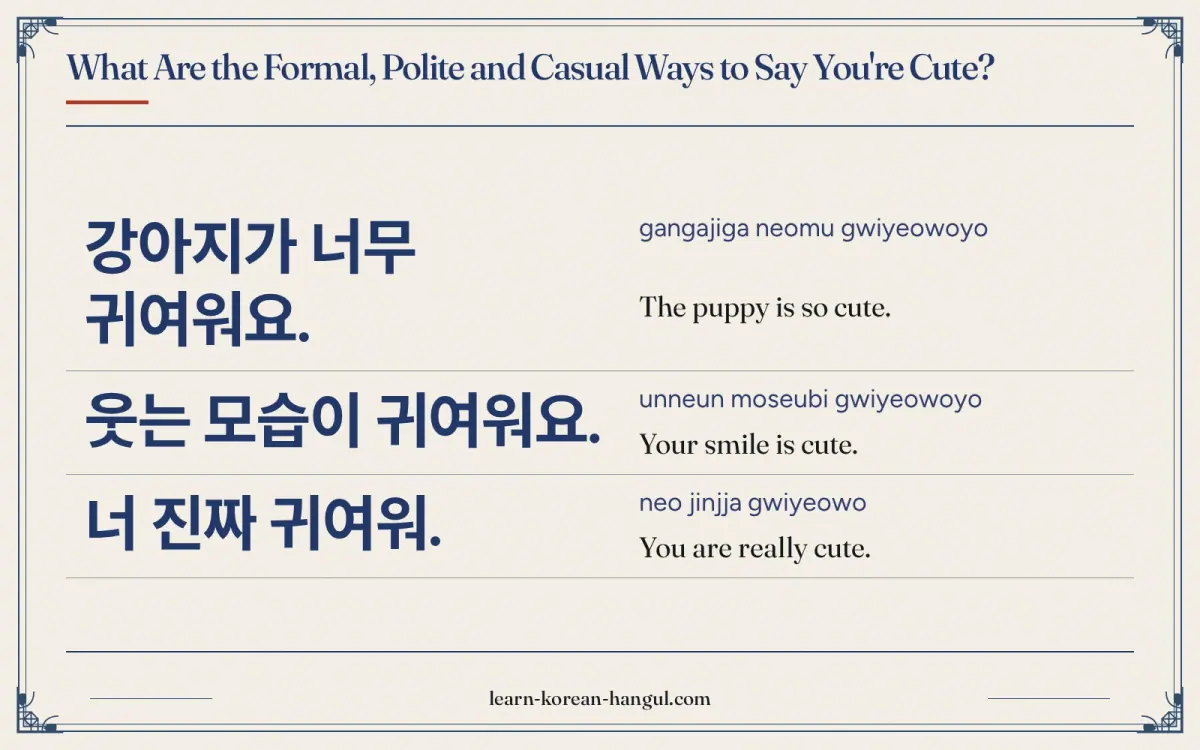
The forms follow the Korean speech levels, the endings that change with the listener. The guide to Korean speech levels explains each level. The stem 귀엽- stays the same, and the ending changes.
Polite: 귀여워요 (gwiyeowoyo)
Polite · 해요체귀여워요 is the form to learn first. It suits friends, coworkers, classmates and acquaintances. It also describes animals and things, so it is easy to use with someone you have just met when the subject is their dog.
강아지가 너무 귀여워요.
gangajiga neomu gwiyeowoyo
The puppy is so cute.
The particle 가 in 강아지가 marks the puppy as the subject of the sentence. 너무 here means "so", as in "so cute".
Polite: a Person's Feature (웃는 모습이 귀여워요)
Polite · 해요체To compliment a person without sounding too forward, point to a feature or an action. 웃는 모습 (unneun moseup) means "the way you look when you smile". This is gentler than a bare 귀여워요 and works well with a colleague you like.
웃는 모습이 귀여워요.
unneun moseubi gwiyeowoyo
Your smile is cute.
Casual: 귀여워 (gwiyeowo)
Casual · 반말귀여워 drops the polite ending. Use it with close friends, siblings, children and a partner. Friends also say it as a teasing compliment, with a smile. The small word 진짜 (jinjja) means "really".
너 진짜 귀여워.
neo jinjja gwiyeowo
You are really cute.
Formal: 귀엽습니다 (gwiyeopseumnida)
Formal · 합쇼체귀엽습니다 is the formal form. You will hear it on a TV show or in a presentation, as in 이 캐릭터는 정말 귀엽습니다 (this character is really cute). It is rare in daily talk about a person. It is pronounced [귀엽씀니다].
The forms look simple, but 귀엽다 hides a small grammar rule.
Why Does 귀엽다 Become 귀여워요?
귀엽다 is a ㅂ-irregular adjective. The stem is 귀엽-. Before an ending that starts with a vowel, the final ㅂ turns into 우, and 우 + 어 joins into 워: 귀엽 + 어요 → 귀여우 + 어요 → 귀여워요. The past tense is 귀여웠어요 (gwiyeowosseoyo), and "because it is cute" is 귀여워서 (gwiyeowoseo).
- 귀엽다 → 귀여워요 (cute)
- 아름답다 → 아름다워요 (beautiful)
- 쉽다 → 쉬워요 (easy)
- 춥다 → 추워요 (cold)
Before a noun the form is 귀여운 (gwiyeoun), as in 귀여운 강아지 (a cute puppy). The ㅂ stays before a consonant, so you get 귀엽지 않아요 (it's not cute) and 귀엽고 (cute and ...). Two ㅂ-irregular verbs, 돕다 (to help) and 곱다 (to be pretty), take 와 instead of 워, which is why some learners write 귀여와요. For 귀엽다, the correct spelling is always 워. Now the sounds.
How Do You Pronounce 귀여워요?
귀여워요 is pronounced [귀여워요], gwi-yeo-wo-yo, in four syllables. The word has no sound change, but three glides in a row make it tricky.
- 귀 (gwi): a quick "gw" into "ee". Start with rounded lips for the glide and finish with a bright "ee".
- 여 (yeo): a y glide into ㅓ. The ㅓ is unrounded: keep your lips relaxed.
- 워 (wo): a w glide into ㅓ. Round the lips only for the glide, then relax.
- 요 (yo): "yo".
Say the three middle sounds smoothly, like a small wave: gwi-yeo-wo. Do not stop between them.
Sound Changes to Listen For
These notes follow the National Institute of Korean Language standard pronunciation rules (표준 발음법):
- No change in 귀여워요. Say it as spelled.
- 귀엽다 is [귀엽따]. The ㄷ after a final ㅂ becomes tense (Article 23). Revised Romanization shows gwiyeopda. See Korean tensification.
- 귀엽습니다 is [귀엽씀니다]. The ㅅ becomes tense, and the ㅂ before ㄴ becomes ㅁ (Article 18).
- 귀여웠어요 is [귀여워써요]. The final ㅆ moves to the next syllable.
With the sounds clear, here is when each form fits.
When Should You Use 귀여워요, and When Should You Not?
Use 귀여워요 when you feel warmth, not when you want to judge. It praises charm and sweetness, not beauty or skill.
Situations Where It Fits
- A friend's pet or baby. 강아지가 너무 귀여워요 is a safe and popular compliment.
- A partner's habits. 자는 모습이 귀여워 (you look cute when you sleep) is tender between a couple.
- A small gift or a character item. 이 인형 정말 귀여워요 (this doll is really cute).
Situations to Avoid
- A boss or an older person. It can sound patronising, as if you are talking down to them. Praise their taste or kindness instead.
- Someone who is upset. Calling an angry person cute may sound like teasing.
- A job or a result. Use 잘했어요 (well done), not 귀여워요.
Two short conversations show how it sounds.
What Does You're Cute Sound Like in a Real Conversation?
Cute compliments are light and often come with a smile, a laugh or a joke.
Showing a Puppy Photo
Jiwon
우리 강아지 사진이에요.
uri gangaji sajinieyo
This is a photo of my puppy.
Hyunwoo
와, 너무 귀여워요! 이름이 뭐예요?
wa, neomu gwiyeowoyo! ireumi mwoyeyo
Wow, so cute! What's its name?
Jiwon
콩이예요.
kongiyeyo
It's Kong-i (Bean).
Hyunwoo
이름도 귀여워요.
ireumdo gwiyeowoyo
The name is cute too.
What to notice: 이름이 뭐예요? is a wh-question, so the pitch does not climb at the end. The particle 도 in 이름도 means "also", which is a natural way to add a second compliment.
Between a Couple
Doyun
오늘 왜 이렇게 귀여워?
oneul wae ireoke gwiyeowo
Why are you so cute today?
Seoyun
뭐야, 놀리지 마.
mwoya, nolliji ma
What? Don't tease me.
Doyun
진짜야. 진짜 귀여워.
jinjjaya. jinjja gwiyeowo
I mean it. You are really cute.
What to notice: both speakers use the casual style. 왜 이렇게 ...? is a wh-question, so the pitch falls. 놀리지 마 is the casual way to say "don't tease".
What Should You Know about the Culture behind You're Cute?
In Korea, being cute is widely valued, and 귀엽다 is a warm compliment that adults hear as well as children. You see cute characters on phones, banks and products, and people often describe a friend, a coworker or a partner as cute with affection. Cute behaviour done on purpose is called 애교 (aegyo); the word guide to cuteness in Korean explains it.
- Warm, not formal. Cute is friendly, and it fits relaxed settings more than formal ones.
- Not always flattering. Between adults at work, being called cute may feel like being treated as small, so listen to the tone.
- Pets and objects. The word is used far more freely about pets, children and items.
A helpful habit is to name the thing you like: 눈이 귀여워요 (your eyes are cute) or 목소리가 귀여워요 (your voice is cute). This sounds more personal than a bare 귀여워요.
What Mistakes Do Learners Make with You're Cute in Korean?
Most mistakes come from the ㅂ-irregular stem or from the wrong listener.
| Mistake | Why it is a problem | Fix |
|---|---|---|
| 귀엽어요 | The ㅂ must change | Say 귀여워요 |
| 귀여와요 | 귀엽다 takes 워, not 와 | Write 귀여워요 |
| 귀여워 to an elder | Too casual | Say 귀여워요, or praise something else |
| 귀여워요 to a boss | May sound patronising | Praise their kindness or taste |
| [귀엽다] without tense ㄸ | Not the standard sound | Say [귀엽따] |
The pair 귀엽다 and 예쁘다 also needs care. 예쁘다 is "pretty" and speaks about appearance; 귀엽다 is "cute" and speaks about charm and sweetness. Someone can be cute without being pretty, and the other way round. Choose by the feeling, and see you are beautiful in Korean for the second word.
Is It the Same as so Cute or Cute Korean?
Mostly. Each of the searches folded into this page has a short answer.
- You are cute in Korean: 귀여워요, or the casual 귀여워.
- So cute in Korean: 너무 귀여워요 or 진짜 귀여워요. Casual: 너무 귀여워.
- You are so cute in Korean: 너 너무 귀여워. Polite: 정말 귀여워요.
- Cute in Korean (before a noun): 귀여운, as in 귀여운 아기 (a cute baby).
- So cute you are in Korean: Korean puts the adjective last, so say 너 너무 귀여워.
- Cute Korean (a cute Korean person): 귀여운 한국 사람.
Now say them aloud.
Practice: Say It Aloud
Play the slow clip of 귀여워요 three times and glide through gwi-yeo-wo. Then choose a phrase. Answers follow.
- You compliment a coworker's puppy.
- You tease your partner, casually.
- You say it with emphasis, politely.
- You write "cute" before the noun "baby".
Answers
- 강아지가 귀여워요.
- 귀여워.
- 너무 귀여워요.
- 귀여운 아기.
The phrase flashcards drill these lines with audio.
Related Phrases to Learn Next
Cute is a step on the way to warmer feelings.
- You are beautiful in Korean: 예뻐요 for a compliment on looks.
- You are handsome in Korean: 잘생겼어요 for men.
- I like you in Korean: 좋아해요 for a confession.
- I love you in Korean: 사랑해요 for deeper feelings.
This guide belongs to the Korean love phrases collection. What this page does not cover: full conjugation of 귀엽다, 애교 routines, and cute nicknames. Use 워, not 와, choose the level for the listener, and you can say you're cute in Korean with confidence.
Frequently Asked Questions
How do you say you're cute in Korean?
Say 귀여워요 (gwiyeowoyo) in polite speech and 귀여워 (gwiyeowo) to a close friend or partner. Korean usually drops 'you', so one word is a complete sentence. Add 너무 (neomu, so) or 진짜 (jinjja, really) to strengthen it: 너무 귀여워요, 진짜 귀여워. The dictionary form is 귀엽다.
How do you pronounce 귀여워요?
It is pronounced [귀여워요], gwi-yeo-wo-yo, in four syllables, with no sound change. Say the first part as a quick 'gwi', then glide through yeo and wo. The ㅓ in each is unrounded, so keep your lips relaxed. The dictionary form 귀엽다 is pronounced [귀엽따], with a tense ㄸ after the ㅂ.
What is the difference between 귀여워요 and 귀여워?
They mean the same thing, but 귀여워요 is polite and 귀여워 is casual. Use 귀여워요 with coworkers, acquaintances and people slightly older than you, and 귀여워 with close friends, siblings and a partner. Dropping the 요 with an older person sounds rude.
Is 귀여워요 formal or casual?
It is polite, between formal and casual. The formal form is 귀엽습니다 (gwiyeopseumnida), pronounced [귀엽씀니다], and the casual form is 귀여워. The same word also describes pets and objects, so the context shows whether it praises a person, an animal or a thing.
Can I use 귀여워요 with friends, elders and strangers?
With friends, yes. With strangers, it is polite but can feel personal, so use it for children, pets or something they own. With an older person or a boss, avoid it, because it can sound patronising, as if you were talking down to them. Praise a quality or a choice instead.
What is the most common mistake with you're cute in Korean?
Learners write 귀엽어요 or 귀여와요. 귀엽다 is a ㅂ-irregular adjective, so the ㅂ turns into 우 and joins the ending to make 워: 귀여워요. The spelling 귀여와요 is wrong, and 귀엽어요 is not used. A second mistake is saying it to a senior as flattery.